Piano Cleveland presents James (Zijian) Wei in Review

Piano Cleveland presents James (Zijian) Wei in Review

James (Zijian) Wei, piano

Zankel Hall at Carnegie Hall, New York, NY

October 26, 2025

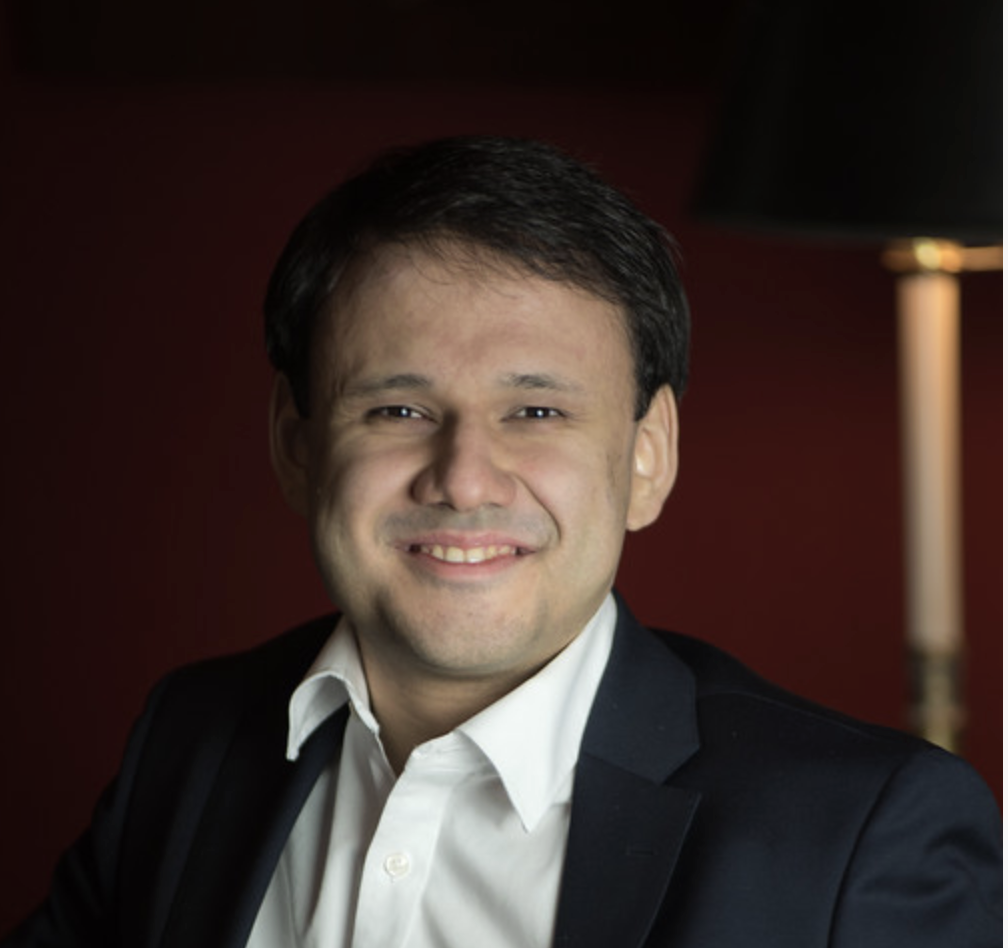
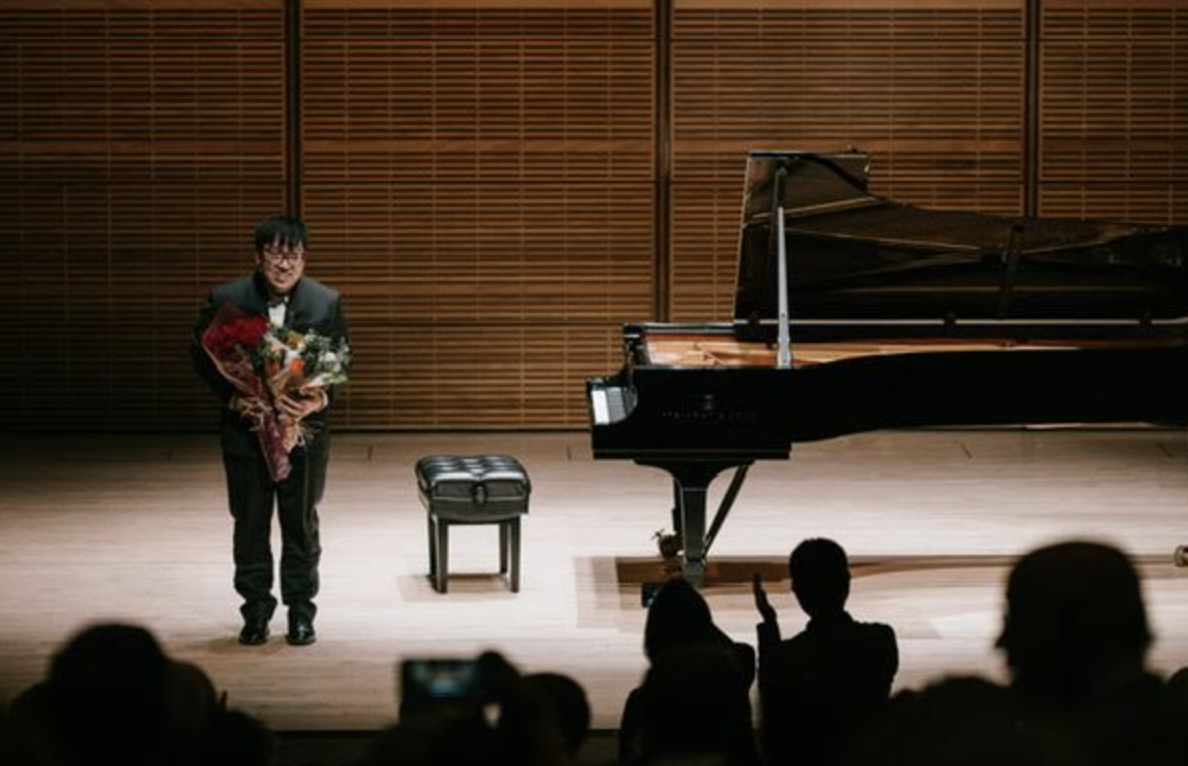
One of the joys of reviewing in New York is seeing a rising talent from another country blow into town with boundless enthusiasm and gifts galore, and such was the case this weekend with the Zankel Hall (Carnegie) recital of Chinese pianist James (Zijian) Wei. Mr. Wei is the 2024 Mixon First Prize winner of the Cleveland International Piano Competition (CIPC), and the presentation of this important concert by Piano Cleveland was among his generous prizes. 

As anyone witnessing the proliferation of competitions can attest, few performers win an award without vying for a dozen, but to succeed in multiple competitions says something about a performer’s drive, broad appeal, and the stamina needed for a career. Mr. Wei’s distinctions have been many, including the First Prize in the 2017 Changjiang Cup National University Piano Competition, the Grand Prize in the Professional Category of the 2018 Huanglong Music Season Piano Competition, First Prize in the 2018 Jianfa Gulangyu International Piano Competition, and Third Prize in the 76th Geneva International Music Competition, as well as the receipt of the Rose-Marie Huguenin Award in 2022. In addition to being the 2024 Mixon First Prize winner in the CIPC, he won CIPC’s Best Chamber Music Performance Award, Henle Verlag Urtext Special Prize, Audience Choice Prize, and Young Judge Prize. Mr. Wei has also played with quite a few orchestras, particularly in China, where his teachers have been Jay Pengjie Sun, Liu Xi, Galina Popova, and, since 2016, Danwen Wei at the Central Conservatory of Music. Based on the snippets of Rachmaninoff’s Piano Concerto No. 3 and others that this reviewer has heard from young Mr. Wei (just 26 years old), he excels as a passionate concerto soloist, which is a good thing, as he is apt to have a full plate of those. Sunday, though, he was a recitalist, and he impressed as a performer with much to say.

Mr. Wei burst onto the stage of Zankel Sunday with enormous energy, and his excitement was infectious. Though his first half was solidly from the classical era –  pairing Mozart’s Piano Sonata in A major, K. 331 (yes, the one with the Rondo alla Turca last movement) with Beethoven’s Sonata Op. 101 (also in A major) – the second half would offer contrast with Scriabin’s Sonata No. 5, Op. 53, Barber’s Excursions, Grainger’s Ramble on the Love Duet from Der Rosenkavalier of Richard Strauss, and Ravel’s La Valse. It was apparent from the start that Mr. Wei is a pianist who enjoys adventures and extremes. 

Mr. Wei took a quiet moment of meditation before his Mozart, as if for something sacred (which, after all, music is), and he began with an ethereal tone one rarely hears in this first movement. He lavished each phrase with affection, flexibility of tempo and the occasional left-preceding-right luxuriance. Some call such a style over-Romanticized, self-indulgent, or precious – and this reviewer too generally prefers a bit more restraint – but it was hard to resist Mr. Wei’s emotional responses. 

Mr. Wei’s Mozart also reflected a sense of liberty that was striking in this oft-played work. Surprises abounded, from the first movement’s elaboration added in the repeat of the fifth variation, taking us at one point up to the modern piano’s highest D (which of course did not exist on Mozart’s instrument) to his quiet end to the movement – the opposite of the robustness one expects. It was clear that Mr. Wei is a performer who goes his own way. The Menuetto was memorable for its spirited operatic contrast, and the Rondo alla Turca enjoyed delightful articulations and nuanced dynamics from one iteration to the next. In fact, one wished he had observed all the repeats later in the movement, but he seemed focused on driving the momentum to the boisterous finish (for which he took the left hand chords an octave down). The audience seemed enthralled. 

There was a slightly more reverent approach to Beethoven’s Op. 101, and it was welcome in this shining masterpiece. Mr. Wei projected all the warmth of its opening movement and all the energy of the subsequent march. Much of the Adagio was simply sublime, and the mastery shown in the last movement’s challenging fugato was admirable. 

The program after intermission was a dream for such an extroverted pianist, starting with Scriabin’s Piano Sonata No. 5. Your reviewer has actually never heard this piece’s opening attacked with more savagery. The ride that followed was wild, with Scriabin’s own eccentricities magnified by the pianist’s own uniqueness. The languido moments were like perfume, and the volando sections seemed to take literal flight. It was brilliant, and all seemed improvised from the pianist’s own spirit and prodigious technique. 

The Barber Excursions that followed were excellent overall, though this reviewer, having some strong attachment to these pieces, found some unsettling surprises, one arising rather conspicuously in the third piece. The lay reader may want to skip to the next paragraph, but suffice it to say that the groups of seven at mm. 49-55 were played with the second quarters of each measure becoming eighths in what then resembled an ordinary 6/8 meter. Unless there is some edition out there unknown to me, that interpretation strays beyond “liberty” into the category of a misreading. It may sound picayune, but much of the heraldic joy of the piece stems from this section’s first two quarters being equal in each measure – which can be achieved simply by counting to seven eighths. The final rustic movement was charming.

Every recital is enhanced by the inclusion of a rare gem, and that gem here was Percy Grainger’s marvelous Ramble On The Last Love-Duet, arranged from Richard Strauss’s Der Rosenkavalier. Its lush harmonic language was magical, and it made a perfect transition to Ravel’s La Valse, which closed the program. In La Valse, as if all were not virtuosic enough already, Mr. Wei added octaves where many pianists struggle for just single notes. Despite the occasional glitch (and for this musician an occasional longing for a bit more waltz continuity), it was a tour de force, greeted with a long and excited standing ovation. 

Two encores followed, first Wencheng’s Autumn Moon on a Calm Lake popularized notably by Lang Lang some years ago) and then the beloved Schumann-Liszt Widmung. Both were lovely additions to an exciting afternoon. Kudos go to Zijian Wei and to Piano Cleveland!

Share

Duo Atlantis in Review

Duo Atlantis in Review

Rachel Youngberg Payne, Mezzo-Soprano, Jack Tyndale-Biscoe, Piano

Weill Hall at Carnegie Hall, New York, NY

October 26, 2025

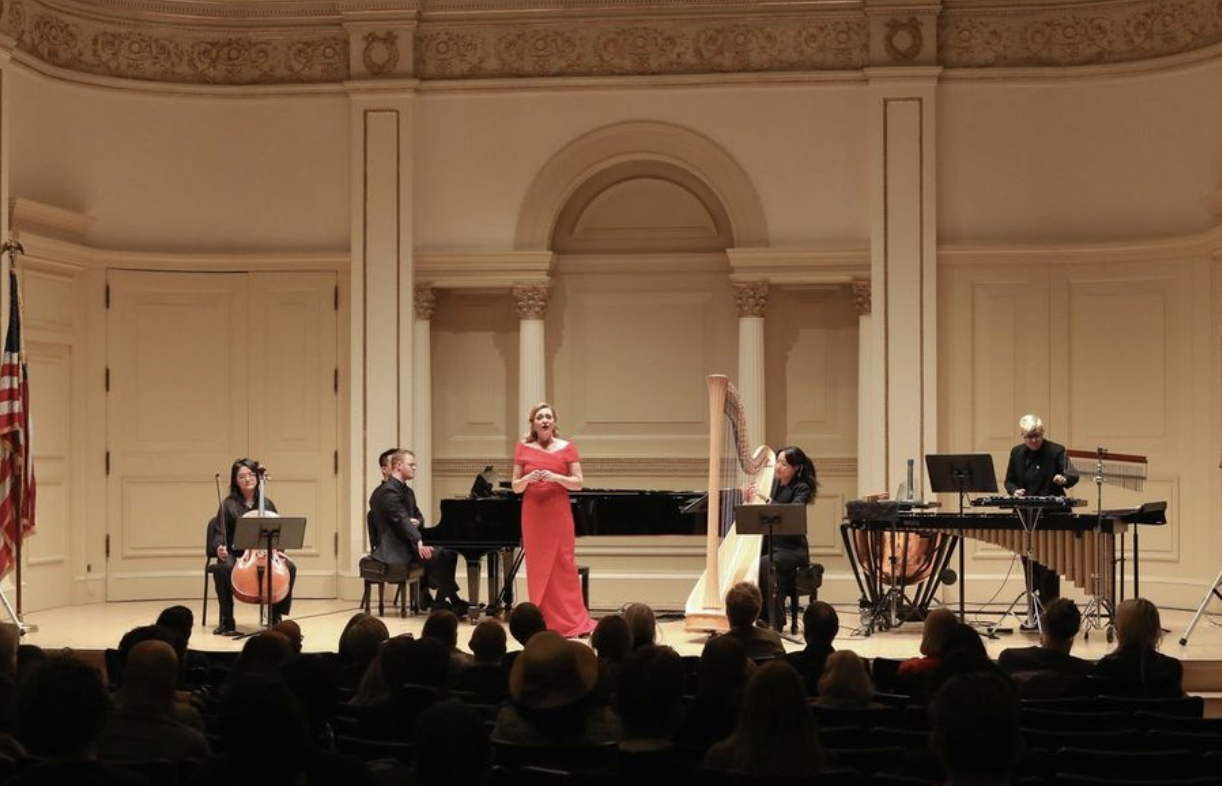
A completely delightful concert took place this Sunday, the New York Debut at Weill Hall of Duo Atlantis, a collaboration between mezzo-soprano Rachel Payne and pianist Jack Tyndale-Biscoe. The program, entitled “Echoes Across the Atlantic” blended British and American art song, including music of Edward Elgar, Ralph Vaughan Williams, Benjamin Britten, Muriel Herbert, and Bear McCreary (b. 1979) from the UK, plus selections by Samuel Barber and Aaron Copland representing the US. This duo connected much more than the two already-related cultures. Drawing inspiration from the ocean between the two, plus the shared human experiences of  “travel, love, memory, and humanitarian stories” (as their Carnegie summary states), they communicated with each note, connecting with their audience and reminding us how deeply we all are connected. It was a thoughtfully conceived program to make us laugh, cry, dream, and wish. All of that would mean little, though, if they had not performed it superbly as musicians – and they did indeed.

Opening with two selections from Elgar’s Sea Pictures, Op. 37, the duo set a haunting tone first in Sea Slumber Song, starting with Mr. Tyndale-Biscoe’s atmospheric piano introduction. It is usually a matter of just a minute or less before this reviewer finds a nit to pick with singers, but Ms. Payne started off beautifully and continued so, with a pure and rich tone, true and focused intonation, and thoughtful and communicative phrasing. Any vocal imperfections were transmuted by the alchemy of her expressiveness. She clearly shared in the intensity of the piano part as well, “living” each entire piece, not just her part – which ought to be the norm, but one sees the opposite all too often! Mr. Tyndale-Biscoe, showing consistent mastery, drew no attention to himself, simply serving the music and realizing it expertly. His piano introduction to the next Elgar selection, Where Corals Lie, picked up the pace and captured just the right restlessness.

The next pieces were a wonderful surprise, which this reviewer can’t recall ever hearing in concert: selections from Children’s Songs by Muriel Herbert (1897-1984). Ms. Payne announced them as “charming and disarming” – and they were just that. Mr. Tyndale-Biscoe didn’t miss a trick in setting the tone for – and punctuating – these miniatures, each one finishing in a wink. We enjoyed the whimsy of Merry-go-Round,the acrobatics in the growing of The Tadpole, the happy affirmation of differences in Jack Spratt and finally The Bunny, which was simply adorable. At one point in the concert Ms. Payne mentioned from the stage that she has children to whom she sings, and it does seem that such basic musical directness is an integral part of her magic onstage.

Mr. Tyndale-Biscoe spoke eloquently to introduce the next works and he more than lived up to his tantalizing descriptions with his playing. The duo gave a dreamy reading of Samuel Barber’s Nocturne from Four Songs for Voice and Piano, Op. 13, and then crossed the musical ocean to perform two selections by Ralph Vaughan Williams, his Let Beauty Awake from Songs of Travel and Silent Noon from The House of Life. The “poetry and philosophy” that Mr. Tyndale-Biscoe had spoken about in these songs were both evident to a poignant degree, with both musicians savoring the warm and wistful creations.

Not a duo to avoid humor, they delighted next in Benjamin Britten’s Calypso from Cabaret Songs, a musical “race” to get to a train station, appropriately here, Grand Central. It was all that Mr. Tyndale-Biscoe had described it to be- “playful, ironic, and theatrical.”  Lest we grow too lighthearted, two of Copland’s Old American Songs followed to bring us to tears, The Little Horses and At the River, closing the first half with further reminders of children and community – both themes at the center of the premiere after intermission.

The second half of the program was devoted to the world premiere of Dragon’s Blood:  A Four-Part Song Cycle for Voice, Piano, Harp, Cello, and Percussion composed by Emmy-winning (and, in the UK, BAFTA-winning) composer Bear McCreary. Set to a heartbreaking text by screenwriter J.D. Payne, the song cycle spotlights the impact on children of cobalt mining in Congo, using a “dragon” in a cave as a metaphor for the harm that can come to children from such work. Incidentally, the concert was co-sponsored by Floodlight, an organization involved in promoting ethical industry practices, and the performance of this song cycle certainly made a powerful statement towards that end.

It was not as radical a shift as one might think from the first half’s music to this troubling story, as thoughts of children were already in the air. In fact, for an audience immersed just moments before in Herbert’s carousels and Copland’s “little horses” lullaby, the descriptions of an innocent young Congolese boy with dreams of sunlight and warm bread were simply devastating. Mr. McCreary’s score, an immediately accessible and colorful one, was conveyed with all the agony of the situation, but also with some hope in the final rallying cry to the community. The Atlantis Duo was as powerfully communicative as ever, responding to the text and music with just the right sensitivity and drama.

Credit to the cellist, harpist, and percussionist should not be omitted. The harpist Karen Tay helped evoke the beauty of childhood, while the cellist Wangshu Xiang created the ferocious growls of the titular dragon. Grace Goss on percussion added intensity throughout. If any of these names are incorrect, that is from a hasty search to find out who they were, as they were not listed on the program (with surely some administrative glitch responsible). Anyway, the overall effect was potent, and undoubtedly the audience was moved to learn more and to do more. An encore of Mahler’s Urlicht capped off the recital, with a panel discussion on the Dragon cycle to follow, to delve into it all further. Sadly this reviewer could not attend, but it did seem that no further words were needed after such a moving afternoon of music.

Share

Mayflower Art Center presents MusicON in Review

Mayflower Art Center presents MusicON in Review

Performers and composers presented by the Mayflower Art Center:

Joanne Kang, Foo Jeng Wong, and Maxwell Lu, piano;

Yeji Pyun and Sara Salomon, violin; Clara Cho, cello; Daniel Lamas, viola;

KaiChen Cheng, flute; David Valbuena, clarinet

Youngwoo Jeon and Yoon Sang Timothy Cho, conductors;

Marc A. Scorca Hall, The National Opera Center, New York, NY

October 25, 2025

An evening of music by twelve promising – and in several cases much-lauded – young composers took place this weekend at the National Opera Center as part of the 2025 MusicON Festival under the auspices of the Mayflower Art Center, an organization offering education and support to young aspiring musicians. As the three-day festival was held from October 24th to October 26th, and this reviewer only attended the October 25th concert, a reader wanting to grasp the full scope of the festival will be able to find more about the other evenings by other reviewers at this site.

Meanwhile, as co-hosts Tianzhe Chen and Emily Bai announced at the concert, MusicON is in its fourth year, having worked with musicians of twenty countries and regions, featuring more than fifty performers and presenting 141 musical works. This year’s offerings featured thirty-eight composers, including six finalists in this year’s MusicON International Composition Competition, eleven works by invited composers, and twenty-one compositions by students of the Mayflower Art Center. Though Saturday’s concert included “only” twelve works, there was a dizzying amount of information to process, including which works were composed by those designated as Guest Composers, Honored Graduates, Emerging Composers, or Finalists of this year’s competition. Sadly there were no biographical notes on anyone, nor any program notes on the music, but more on that later.

Starting with highlights, one work will linger in this reviewer’s mind, and that is a piece called Syriac Fugato 2 by young Lebanese composer Sami Seif (Finalist in this year’s competition), as performed by Yeji Pyun on violin and Daniel Lamas on viola, both of whom performed standing up for the first time in the evening. The piece resembled a vocal improvisation passed between the two instruments, sometimes with strained hoarse sounds suggesting moans or crying out, but conjuring an overall sense of desolation throughout. There was effective use of  a wide range of techniques – from bouncing bows and tremolos to microtones and slides – but it was the focus on a single tone, departure from it, and return (with humming at its close from the violist) that helped give the piece its compelling unity and humanness.

Another piece memorable for its sheer sense of adventure was Jetlag  by Yiming Jia (Honored Graduate), performed by violinist Yeji Pyun, cellist Clara Cho, and pianist Foo Jeng Wong. Synchronized sweeping string slides against the rather jazz-infused piano part – along with several rapid tempo changes – gave the piece a disorienting effect one can only assume was meant to evoke the title condition. The overall impact was dreamy and humorous at once.

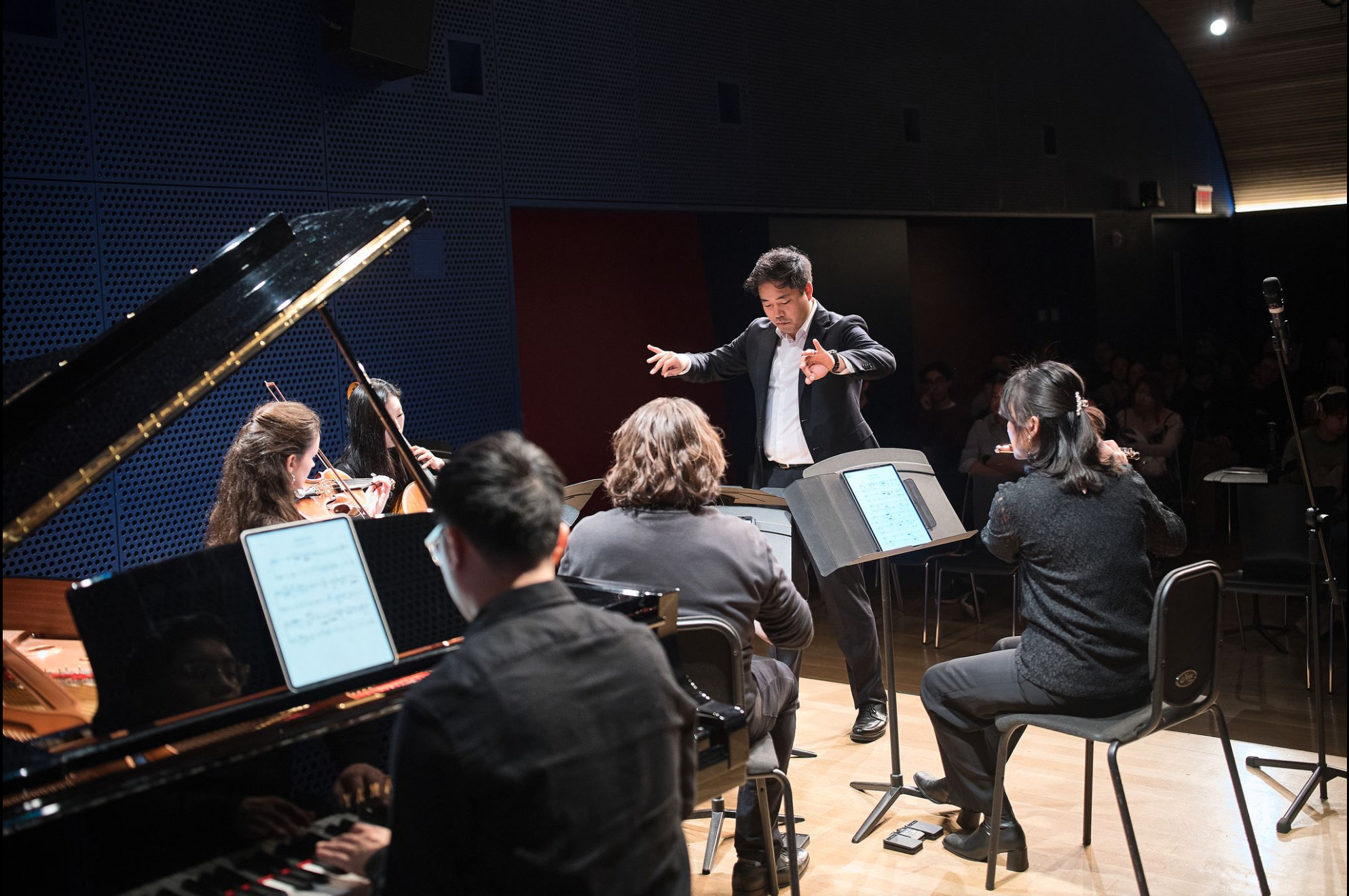
Among pieces one may need to hear twice to fully fathom was the closer of the program, Two Islands, by Fabian Leung (Honored Graduate). It overflowed with lush harmonies, interesting ideas, and contrasting styles, perhaps a few too many for this listener to assimilate in one hearing, but it was certainly brimming with energy and potential. As with all the works on the program, it was given a dedicated performance by skilled musicians – here, pianist Joanne Kang, violinist Yeji Pyun, cellist Clara Cho, flutist KaiChen Cheng, and clarinetist David Valbuena, with Yoon Sang Timothy Cho conducting (yes, due to the rhythmic challenges in much of the music on the program there were conductors listed even for some trios and quartets).

One comment on the overall concert was applicable here, that though it seemed there was much happening in the music, the listeners were left in the dark, figuratively speaking. It would not be too much “spoon-feeding” to illuminate the performances with some ideas of what each composer intended in each work (as audiences still benefit from program notes for music in very well-known styles, after all). Several composers were in attendance, and a few words from them (or printed notes) about their inspiration could have guided the listeners’ ears through some of the unknown territory.

Moving to the many other works on the program, there was as the opener, Silence Of Lost Songs in Extinction by Xinze Shi (Emerging Composer), played by pianist Joanne Kang, violinist Yeji Pyun, and cellist Clara Cho, with conductor Youngwoo Jeon (the latter whom at that point I could not see, before moving from the back of the hall). The performers navigated its mercurial shifts well, from the acerbic opening dissonance to more tonal glimmers from the piano, and on to quasi-Baroque sections, presumably among the “lost songs” to which the title refers.

A Short Conversation Without Words by Winston Schneider (Guest Composer) found pianist Foo Jeng Wong, violinist Yeji Pyun, cellist Clara Cho, and clarinetist David Valbuena wending their way persuasively through the piece as it developed from an expressive opening clarinet solo to more ominous and searching interchange.

Water Makes Many Beds I by Olex Li (Emerging Composer) was also rather cryptic, but the title seemed appropriate for some of the flowing, quasi-impressionistic sections. Pianist Joanne Kang and violist Daniel Lamas captured a floating feeling at times. Showing still more aquatic inspiration was Cerulean Cascade by Albert Lu (Emerging Composer). Though the music did not overtly convey a sense of the work’s title throughout, it explored numerous appealing effects from slides in the strings to flutter-tonguing in the flute part. The players – pianist Foo Jeng Wong, violinist Sara Salomon, cellist Clara Cho, flutist KaiChen Cheng, and clarinetist David Valbuena, seemed to handle their parts well, and conductor Yoon Sang Timothy Cho kept the flow with a solid beat in what seemed to be some metrically nebulous writing.

The Tree Has Seen Nothing by Cyrano Jett Rosentrater (Guest Composer) set up an interesting mystery of pleasant and contrasting sounds, though, as with other selections, one could only guess at the composer’s intent. Flutist KaiChen Cheng, violist Daniel Lamas, and guitarist Luis McDougal built it from its placid opening to a shrieking peak, before it receded into a gentle ambling guitar part and fadeout to the flute’s final quavering.

Fi by Maxwell Lu (Honored Graduate) found the composer serving as pianist himself, along with clarinet Jefferson Sheng. The word “Fi” means quite a few things, so again it would have been great to have some guidance via program notes. The innumerable repeated treble notes in the piano found the able clarinetist adding his lines to the texture and joining in exploration before the return to the high treble repeated notes. Crack by Sofia Jen Ouyang (Guest Composer) possessed yet another title with many meanings. Pianist Foo Jeng Wong joined cellist Clara Cho and David Valbuena on bass clarinet. The piece was filled will interesting effects from its explosive opening through to the end.  More furious repeated notes were heard in Torque by Asher Lurie (Finalist), performed by pianist Foo Jeng Wong, violinist Yeji Pyun, and cellist Clara Cho. The exploration of subtly changing rhythms along with gradually expanding intervals was intriguing. One could almost imagine the rotational tension suggested by the title.

Tangle by Jingya Huang (Finalist) was then performed by a string quartet. Violinist Yeji Pyun, violist Daniel Lamas, cellist Clara Cho were listed – though there was another violinist not listed, who appeared to be Sara Solomon (though it is hard to say based on one’s view of the stage). Conductor Youngwoo Jeon kept the group on course from its measured beginning and ostinato-like sections right up to its dramatic final chords, played with ferocity.

Undoubtedly, we will be hearing more from many of these performers and composers, and one looks forward to following their development.

Share

Mirror Visions Ensemble “Listen!” in Review

Mirror Visions Ensemble “Listen!” in Review

Daniel McGrew, tenor, Scott Murphree, tenor, Jesse Blumberg, baritone

Mischa Bouvier, baritone, Margaret Kampmeier, pianist

Merkin Hall, Kaufman Music Center

October 5, 2025

An extraordinary concert exploring the ties between text and music took place this weekend at Merkin Hall under the auspices of the Mirror Visions Ensemble (MVE). Devotees of new music may know of the organization, as it has been part of New York musical life for over thirty-two years, commissioning over 105 new works by more than 35 composers. For those unfamiliar, though, some of its performers demonstrated on Sunday just what makes it unique. As expressed on the organization’s website (mirrorvisionsensemble.org), “Mirror Visions Ensemble (MVE) was founded from a desire to explore the relationship between music and text, initially through the creation of ‘mirror visions’ — settings of the same text to music by different composers.” Sunday’s concert explored this relationship with four songs set to the same Elizabeth Bishop poem (“I am in Need of Music”) and two songs set to the same poem of Siegfried Sassoon (“Everyone Sang”). This already made for a fascinating concert, but to add to the diversity there were six songs interspersed which did not “mirror” any others. These included the world premiere of a work by Randall Eng entitled Song, set to a text by Brigit Pegeen Kelly and commissioned by the MVE.

Four excellent singers alternated as soloists, joining in one duet and a quartet for the program’s finale.  They were tenors Scott Murphree and Daniel McGrew and bass-baritones Jesse Blumberg and Mischa Bouvier. The superb pianist for the entire evening was Margaret Kampmeier, moving seamlessly from composer to composer, heard in the following order: Kamala Sankaram, Deborah Pritchard, Lori Laitman, David Sisco, Jake Heggie, Ben Moore, Jodi Goble, Chris DeBlasio, Paul Moravec, Tobias Picker, Ricky Ian Gordon, and Randall Eng.

The opening selection “Listen” by Kamala Sankaram (b. 1978) was a gently lyrical welcome to the concert, and it shared its title with the  program. billed as “LISTEN! Reflection, Resonance, and Reverence in Song.” Scott Murphree, the Director of MVE who had just eloquently introduced the program, was the soloist. What one noticed immediately about Ms. Sankaram’s music was that it clearly communicated the text by Mark Campbell. The plea to listen to children took us to an airy register, and words of pain took us through darkness and dissonance. We hardly needed printed lyrics. If this all sounds like Text-setting 101, it is quite common to encounter the opposite – with words about rhythm set to unmetered meandering and text about calm set to shrieking dissonance. It was refreshing to hear Ms. Sankaram’s unity and clarity of message. (This is not, by the way, to say that she succumbs to the old film score ways known as “Mickey Mousing” –  as she is neither obvious nor predictable.)

From this opening call to listen, the concert proceeded with the U.S. premiere of “Everyone Sang” composed by Deborah Pritchard (b. 1978) and sung by Daniel McGrew. Ms. Pritchard’s setting conveys the layers of feeling in Siegfried Sassoon’s text, reflecting shock mixed with ecstasy over the end of World War I (in which Sassoon was a soldier), along with tears, as the horrors of war are recalled. Ms. Pritchard’s music captures these mixed emotions with dizzying color, much of it coming from the piano’s repeated treble patterns and coruscating scales. It was stirring to hear.

Six songs followed before the second setting of the Sassoon text, that of Paul Moravec (b. 1957) sung by Jesse Blumberg; for clearer “mirroring” of  the two settings, though, your reviewer will skip over those six for now. In a most striking difference from Pritchard’s setting, Moravec takes Sassoon’s bird imagery as a springboard – not quite as stylized as Pritchard’s magical treble effects, but rather weaving birdsongs into a pervasive texture starting from the pianist’s introduction. Another striking difference is that when Moravec’s vocal lines do enter, they have a robustness that conveys victory beyond what is sensed in the Pritchard version, piano and voice parts projecting more strength and energy. Where the Pritchard song comes to a distinct break before shifting the focus to words of tears and horror, the Moravec song does not, instead folding those darker words into the flow of overall release. The contrasts are thought-provoking – as with beliefs about Sassoon himself, based on his life and letters. One kept thinking throughout the afternoon that these pairings deserve more than an afternoon, as they would fill a week-long seminar.

If the different takes on Siegfried Sassoon’s poem were remarkable, the settings of Elizabeth Bishop’s sonnet ranged still more widely. “I Am in Need of Music” was heard in settings by Lori Laitman, Ben Moore, Chris DeBlasio, and Tobias Picker, all separated by “non-mirroring” works as before.

The setting by Lori Laitman (b. 1955) stood out first of all for being the only duet, sung here by Jesse Blumberg and Mischa Bouvier. Having two singers allowed for restatements and echoes, underscoring the impassioned effusions. Particularly beautiful were the softer evocations and musical colors in the last six lines, or sestet, of the poem – about the “magic made by melody” and the sinking into sleep. The same poem, set by Ben Moore (b. 1960) and sung by Jesse Blumberg, stood out for its very nostalgic musical language at first, then expanding its range in an urgency that grew and flowed continuously over the ends of lines and into the sestet.

One could marvel at the differences in just the above two settings, but the same Bishop poem was heard again in the setting of Chris DeBlasio (1959-1993), the only composer on the program no longer living. It had a haunting sadness right from its dreamy piano introduction – made sadder with thoughts of how this composer left the world far too soon. This song was the only one to repeat the first eight lines of the poem, giving it an A-B-A form and a feeling of emphasis on the return of “I am in need of music” – sung with great involvement by Scott Murphree. In the last of these eight lines (both times), Mr. Murphree (or Mr. DeBlasio?) replaced the word “quivering” with “trembling” – not of huge consequence and possibly unintentional (but mentioned to show we respect the imperative to “listen!”).

The last of the Bishop settings was that of Tobias Picker (b. 1954), sung by Mischa Bouvier. The heaviest in feeling of the four, helped along by the choice of the bass-baritone register, it seemed to emphasize the feeling of “need” more than the feeling of what was needed – just demonstrating again what contrasting interpretations lie in a poem, a line, and even just a single word.

Interestingly your reviewer stumbled on one more setting of this same Elizabeth Bishop poem – a gem by Alva Henderson (b. 1940). It just goes to show that such obsessions can be contagious! Aside from the joy of such discovery, this listener had a few reservations as well. It seemed, during some of the four performances of this sonnet about music, that so much felt overwrought and angst-ridden. How much was in the compositions, and how much was due to the performances? Certainly some settings stressed the “need” versus “the music” that is needed, explaining a lot, but somewhere along the way it also struck this listener how few moments of softness there had been. All four singers may have been concerned with projecting for the sake of diction and clarity, especially given the central role of text in this concert, but all could be heard more than clearly, and some intimacy was lost in what occasionally resembled operatic auditions. One longed to feel the singers relax and let the music speak, including the music from the piano, which held much of the afternoon together.

Onward to the “non-mirroring” texts, there were six, and they added much color to the program. Scott Murphree brought out the beauty in David Sisco’s Bird Song (to poetry of Dennis Rhodes), an outstanding example of how music can illuminate meaning. Mischa Bouvier gave oceans of energy to Vachel Lindsay’s wash of words in the setting of  In Praise of Songs That Die by Jake Heggie (b. 1961). If songs that die were the focus in Heggie’s piece, the message soon after in Yone Noguchi’s poem My Song Is Sung offered the comforting antithesis, that “the real part of the song, its soul, remains after it is sung.” Noguchi’s poem came to life in the setting by  Jodi Goble (b. 1974), sung soulfully by Daniel McGrew. Mr. McGrew also gave impetus to another call to “listen!” in the song Demand by Ricky Ian Gordon (b. 1956), based on Langston Hughes. Like so much by Mr. Gordon it had a captivating vibrancy. Ms. Kampmeier added an electric energy to the piano part.

The finale of the afternoon, and the longest work at around twenty-five minutes, was the world premiere of Song by Randall Eng (b. 1972) set in six sections to a most disturbing poem of Brigit Pegeen Kelly (1951-2016). In the composer’s words: “Brigit Pegeen Kelly’s heartbreaking poem Song centers around an act of shocking violence, as a group of boys behead a girl’s beloved pet goat. The world of masculine brutality that it conjures is a natural fit for a song cycle for four men, but my setting attempts to equally focus on the responses to that violence. Kelly’s direct, precise language offers a canvas to explore not only the perspective of the knife-wielding boys, but also the girl’s joyful memories of the goat, the community that tries to shield her from seeing its carcass, and eventually the goat’s severed head itself. The head sings its sweet song to haunt the boys, it sings to bear witness to what has been done, it sings as an act of justice.”

It is difficult to say that one “enjoyed” this work, as the gruesome subject matter obliterated any alleged surrounding “sweetness.” In fact, this listener thought at first that the final word “sweetness” was intended to be ironic. Moving on (and because no one wants to hear this reviewer’s songs, “Where Were These Boys’ Parents?” or “Goats Don’t Call That Justice”), one could appreciate the tremendous virtuosity of composer Randall Eng in narrating the tale vividly through the music, artfully punctuating key moments like the word “joke” (the misguided premise for the crime), fleshing out the story with sections of jazzy dancing rhythms (often in sevens), and accentuating the pain at one point by having all four singers join the pianist in brutal, percussive clusters and extended techniques. It was certainly unforgettable, and a thought-provoking close to the concert. As Mr. Eng concluded in his notes, addressing the power of music, “you can behead a goat, but you can’t kill its song.”

Share

SolAria Music Foundation Presents On Wings of Song in Review

SolAria Music Foundation Presents On Wings of Song in Review

Fang Tao Jiang, Soprano; Jonathan C. Kelly, Piano
Special Guest: Le Bu, Bass-Baritone 
Guest Artists:  Reed Gnepper, Yushan Guo, Miaoyan Hou, Tiffany Zhao, Haishan Lai, Ruochen Liu, Lirong Liu, Ruocheng Yang, Jingyi Du, Yuyao Chen, and Zhongjiancheng Deng
The New York Youth Vocal Ensemble

Weill Recital Hall at Carnegie Hall, New York, NY

October 5, 2025

A festive atmosphere filled Weill Recital Hall this weekend, as soprano Fang Tao Jiang and several dozen others performed a variety-filled concert of vocal music entitled “On Wings of Song.” The music ranged from famous operatic selections and lieder to Chinese and American folk songs, plus what was billed as “Musical Theater Medley: Let the World be Filled with Love” (arr. Guo Feng). Though Ms. Jiang sustained the demanding first half as soloist with the sensitive collaboration of pianist Jonathan Cameron Kelly, she was joined after intermission by special guest bass-baritone Le Bu, eleven SolAria Emerging Young Artists, and the twenty-four-member New York Youth Vocal Ensemble (with some overlap of personnel). Ms. Jiang’s excellent credentials may be found at her website (www.fangtaosings.com), but suffice it to say here that she is a force of nature, combining her philanthropic, musical, and personal gifts into one impressive package.

The concert started off with only a hint of the extravaganza that would come, via a steady stream of excited audience members entering between works, some of whom were evidently there to hear “their own” friends and children, including Ms. Fang. After a measured opening performance of Il fervido desiderio by Bellini, Ms. Jiang halted the piano introduction of the next work, Donizetti’s Me voglio fa’ na casa, in orderto graciously welcome more latecomers. After recommencing, Ms. Fang showed more and more comfort with each note. She sang with a playful spirit that found her pianist Mr. Kelly accommodating each whimsical fluctuation with aplomb and a keen sensitivity to her every impulse. She projected a sound of considerable power and range (albeit one with a more widely oscillating vibrato than this listener favors, though that is certainly a matter of personal preference).

After the Donizetti, another stream of latecomers found Ms. Jiang saying sweetly “I’ll wait” before she sang Sposa son disprezzata (Vivaldi/G. Giacomelli). She sang this aria with sincere dedication, navigating its high notes and long melismas with overall success, and projecting a pathos that had the audience settling down a bit. The next stream of latecomers was addressed by her request for “a few words” – and surprisingly these were not words of thanks this time but the words, “Please be on time,” as she exploited the teachable moment. Did we mention that she is an educator?

Next, she launched into Mendelssohn’s famous Auf Flügeln des Gesanges (“On Wings of Song”), and it was fitting that the song for which the program was named showed some of her finest singing, as she soared through its phrases with a clear feeling for its purity. It was followed by Richard Strauss’s Ständchen, given especially pearly piano figuration by Mr. Kelly.

The Liszt song that followed, Oh! Quand je dors, has been one of this listener’s “desert island” favorites for several decades, which makes it hard to hear outside of a few interpretations (with Frederika von Stade’s eliciting the greatest swoons – and this is apart from the fact that Liszt transcribed it for piano solo as well). The song is, in a sense, a musical sigh of resignation to the fact that the object of love in Victor Hugo’s text is found only in sleep and dreams: it is at once heavenly and heartbreaking. Perhaps it was the edgy excitement of Ms. Jiang’s evening (or possibly her occasionally distracting vibrato) that lent the piece a certain frenetic energy, but it felt hard to sink into the dream. Her performance of Debussy’s Apparition, on the other hand, suited Mallarmé’s restlessness wandering to a tee.

Ms. Jiang also seemed to savor the Chinese pieces. First came two folk songs, the evocative Swallow Song and then When Will the Sophora Bloom, the latter illuminated by her rather humorous preface about a girl feigning interest in a Sophora tree while waiting for the object of her love. Ms. Jiang moved and emoted while singing, to convey its humor further, and it was a joy. The very touching I Live by the Yangtze River by Qing Zhu closed the set movingly before ending the first half with Long Time Ago, the Aaron Copland arrangement of an American ballad he discovered in a library. Ms. Jiang listed it as “In memory of my mother and loved ones” in what was a touching tribute.

After intermission, the variety expanded greatly starting with All Dharmas are Equal, from the opera Monkey King by Huang Ruo, a composer whose work Ms. Jiang has performed with critical accolades. As with most other works, she prefaced it with an introduction from the stage and sang it with strong commitment.

The introduction of bass-baritone Le Bu brought a stunningly new sound to add to Ms. Jiang’s in the famous duet, Là ci darem la mano from Mozart’s Don Giovanni. They blended well in it, reminding us why this selection is so popular. Le Bu followed it with the solo aria from Massenet’s Don Quixote, Riez! Allez! Riez du pauvre idéologue and blew the audience away. His is a voice already being welcomed at the Metropolitan Opera and sought after widely (as can be learned from this website: https://minerva-artists.com/roster/le-bu/), but it was a first for this listener. His precision, deep resonance, and natural musicality are bound to keep him front and center on many a world stage.

The average performer’s age seemed to lower a bit, after this point, though the favorites kept coming, starting with the Flower Duet From Delibes’ Lakmé, joiningvoices of Ms. Jiang and Yushan Guo. It was a lovely blend overall, though there seemed occasional intonation glitches. One needn’t dwell on nit-picking, though, as this was in many ways one of those concerts that goes beyond the “norm” to defy description, from the elements of “outreach” (to present and guide those in their early musical lives) to the addition of “extras” such as Ms. Jiang’s wardrobe selections. She wore no fewer than four outfits over the course of the evening, all created by designer Grace Chen (and all eye-catching on the lovely Ms. Jiang, from blue to black to pink and then red).

After one more solo from Ms. Jiang, the iconic O Mio Babbino Caro from Puccini’s Gianni Schicchi, the concert was dominated by guest artists, starting with Tiffany Zhao and Miaoyan Hou who sang Summertime from Gershwin’s Porgy and Bess with young jazz pianist Haishan Lai. They gave it a new spin with their alternating solos and improvisatory accompaniment. It is hard, with such a classic, to fiddle with it in ways that don’t disrupt the piece’s inherent phrase rhythms and breathing (and a few ensemble junctures left one wondering whether all were intentional), but it was certainly novel.

Twelve young singers filed onstage next to sing the American folk song, Shenandoah. It had a stirring sincerity and featured several promising young voices as soloists. They were then joined by rest of the singers, members of New York Youth Vocal Ensemble, to sing what was called “Music Theater Medley: Let the World be Filled with Love” by Guo Feng. The program listed Fang Tao Jiang as choir director and Jonathan C. Kelly as coach, and it was a remarkable experience to travel on this blitz tour of some of film and theater’s most beloved tunes. More compressed than a typical medley here, there were only several seconds of many of the selections in order to showcase tidbits from Annie, The Sound of Music, The Phantom of the Opera, Les Misérables, The Greatest Showman, Moana, Matilda, and even a snippet from the intro of Singin’ in the Rain. It was heartwarming to hear these dear young voices.

Some “heavy hitters” – Reed Gnepper, Ruochen Liu, and Zhongjiancheng Deng – came onstage next to sing the Neapolitan song O Sole Mio (E. di Capua), and it was a tour-de-force of humorous and virtuosic one-upmanship. This trio was then joined by Fang Tao Jiang, Lirong Liu, Yushan Guo, Ruochen Yang, Miaoyan Hou, Jingyi Du, and Yuyao Chen in a rip-roaring closer of Brindisi, the famous drinking song from Verdi’s La Traviata. It was celebratory, to say the least, and was greeted with a large and well-deserved standing ovation.

Share

Ian Hobson: Complete Schumann Piano Works – The Violin Sonatas in Review

Ian Hobson: Complete Schumann Piano Works – The Violin Sonatas in Review

Ian Hobson, pianist; Andrés Cárdenes, violinist,

Tenri Cultural Institute, New York, NY

September 26, 2025

For those who have missed news of one of the epic piano cycles of the past decade, Ian Hobson is nearing the end of his live New York recital traversal of Schumann’s piano works. Having launched the cycle on February 19, 2020 – just before COVID-19 obliterated concert life as we know it – Mr. Hobson resumed the series in March of 2022 and has enriched New York musical life with several Schumann concerts each year since. As New York Concert Review writer Frank Daykin described Mr. Hobson, he is a “heroic completist.” As such, Mr. Hobson has included not just all of Schumann’s solo piano works (large, small, celebrated, and neglected), but all of Schumann’s chamber works that feature piano as well. On September 26, for the penultimate concert of the cycle, we heard all three of Schumann’s sonatas for violin and piano (Op. 105, Op. 121, and WoO 2) with guest violinist Andrés Cárdenes – a program of extraordinary difficulty and one which many music lovers seemed to know in advance would be a special event. Friday’s crowd filled the Tenri hall to capacity, so Schumann lovers who have not obtained tickets for the final concert on November 7 will want to do so posthaste.

Though this Schumann cycle is by nature piano-centric, it should be noted first off what an inspired choice it was to collaborate with violinist Andrés Cárdenes. Well-matched to Mr. Hobson in terms of his decades of international performances, enormous discography, accolades, and versatility as teacher and conductor, he also plays with a full, rich tone, and a resonance that faces little danger of being overwhelmed even by the typically large sound of Mr. Hobson – or the highly resonant piano at the Tenri Institute. Additionally, Mr. Cárdenes possesses that kind of felicitous technique where there is simply nothing too difficult: he makes child’s play of rapid leaps, double-stops, and often unwieldy passagework, with nary a scratch, stumble, or strain. It was one thing to hear Schumann’s bravura fistfuls on the piano in these works – sometimes so awkwardly scored that they sound like, well, fistfuls – but then to hear some of that same material in the violin part played with such consistently surefire intonation was astonishing.

Hearing all three sonatas in an evening was memorable, and as Mr. Hobson commented after intermission: “We don’t get to hear them very often and certainly not in one recital.” He then pointed out that reverse chronological order had been chosen for the program, with Sonatas No. 3 (WoO 2) and No. 2 (Op. 121) coming before intermission and Sonata No. 1 (Op. 105) closing the program. There seemed a slight implication of having saved the best for last as he announced that the Op. 105 (composed in 1851) is “undoubtedly a masterpiece.” To this listener, that hint of a preference for the earliest sonata seemed evident in the duo’s performance itself. In it the duo found warmth, phrases that breathed, and structural cohesion. There was even a sense of spaciousness that afforded the observation of repeats (generally and wisely omitted in the more taxing works preceding intermission). The Sonata No. 1 was worth the trip by itself.

So, what of the first half of the program? The later Sonatas 2 and 3 did constitute a mammoth achievement simply in terms of the duo’s impressive unity as they tackled the challenging writing – not to mention their stamina – but this listener wanted more from the experience. For one thing, there needed to be more dynamic contrast, particularly on the softer end of things, where the score is marked piano or pianissimo. Such dynamics of course indicate more than mere decibel levels, as they evoke echoes, whispers, and entry points to much more, so it is a loss to miss those opportunities. Whether by mutual decision or a desire to be heard over the piano, Mr. Cárdenes had very few moments of piano or pianissimo dynamics himself, though he clearly is capable of the full spectrum, as we later heard.

To compound matters on the first half, the duo seemed bound to each other less by the glue of phrasing than by the rivets of rhythm, with accentuation dominating to excess. Hearing a composer noted for his shifts of mood and color, from his robust alter ego Florestan to that of the vulnerable dreamer Eusebius, one felt hard pressed to find any signs of Eusebius. Was the difference between first and second halves simply a matter of settling into the hall and getting bearings, or was it musical preference? It is hard to say.

For readers new to these works, the Sonata No. 3 in A minor (WoO 2) was considered Schumann’s last complete work (based on the co-composed Brahms-Dietrich-Schumann “F-A-E” Sonata, of which the Brahms and Dietrich portions were later replaced by Schumann to make the resulting work his own). Some feel that the piece’s patchwork history is evident in ways that detract from its unity and potency. Clara Schumann suppressed it on the advice of violinist Joseph Joachim, and it lay dormant until publication a century later in 1956. By contrast, the Sonata No. 2 in D minor, Op. 121) from 1853 is sometimes thought to reflect more of Schumann’s truer self, though the writing is technically ambitious, or to use Mr. Hobson’s word, “impressive.” It was certainly technically impressive in the Cárdenes-Hobson delivery, with only the occasional glitch, but the virtuoso elements felt a bit too dominant, taking on a relentless quality throughout. It is tempting to call a bit of “riding roughshod” one of the hazards of complete cycles – after all, the program was monstrously hard, and it is not easy to “sell” all of a composer’s oeuvre equally.

Fortunately, the Sonata Op. 105 came as a reminder of the reasons we treasure Schumann. It was a beauty in which virtuosity was at the service of musical substance, and both players shone – as did Schumann himself. It was greeted with a long standing ovation.

One eagerly awaits the cycle’s final concert, November 7, featuring an enticing program of the Piano Sonata No. 1 in F-sharp minor, Op. 11, and, as the second half, the Davidsbündlertänze, Op. 6. The concert is entitled “Florestan and Eusebius.”  As they say, “run, don’t walk” to hear it.

Share

Winners of the 8th Rosalyn Tureck International Bach Competition in Review

Winners of the 8th Rosalyn Tureck International Bach Competition in Review

Winners: Pianists Claire Li, Olivia Li, Eunha Basu, Olivia Tianqing Ye, John Samuell, Edward Hikaru Neems, and Antonio Alessandri

Bezanquen Hall at the DiMenna Center for Classical Music, New York, NY

July 27, 2025

As Beethoven famously remarked, Johann Sebastian Bach should be called not “brook” [as Bach’s name means in German], but “sea” to convey his inexhaustible gifts. As most musicians know, a lifetime can be spent studying Bach’s works without even approaching its breadth and depth. It is thus especially heartening that, thanks to the Rosalyn Tureck International Bach Competition (TIBC), there is an increasing incentive for the next generation of talented young pianists to explore the range of Bach’s entire keyboard output. Last week, seven young winners of the 8th TIBC demonstrated just that in their Gala Winners Concert at the DiMenna Center for Classical Music.

Founded and directed superbly by pianist Golda Vainberg-Tatz to honor her mentor, the renowned Bach interpreter Rosalyn Tureck (with Dr. Tureck’s blessing shortly before she passed away in 2003), the TIBC has now taken place in 2008, 2010, 2013, 2015, 2017, 2019, 2022, and 2025 just this July. This reviewer has heard and been assigned to review several of the competition’s recitals, and they all were impressive; the level of this 8th TIBC, however, seemed to reach new heights. The performances of the seven young winners were astonishingly polished and compelling – and thankfully, even with a scheduling conflict, this reviewer could see and hear them all via live video via YouTube (8th TIBC Winners) and on audio recordings.

As there are many details to process and seven pianists to discuss, we’ll dive right into the performances, but to learn more about the history of the TIBC, the reader may visit its website TIBC, and also read the competition booklet available there for information on the participants and jury members.

To start, we heard Claire Li, age 11 playing Bach’s Fantasia in C minor, BWV 906  (Category 1: Short Preludes and Fugues). She showed remarkable poise and focus even before starting, sitting quietly beforehand to gather inspiration. The preparation paid off, as her performance was reliable , rhythmic, and robust. The Fantasia is a complex one for such a young player, but it gave her a chance to exploit her impressive independence of lines between the two hands. Only one very minor distraction during the repeat of the second section threatened to diminish her focus, but she stayed on track like a professional.

The next pianist, Olivia Li, played the Sinfonia No.11 in G minor, BWV 797 (Category 2: Inventions and Sinfonias). The listing of her as “age 8” gave this listener a brief double-take, but then again, the competition’s early categories allow for age 8 (and more advanced categories through age 28); her playing, however, caused another double-take, as she showed the control and expressiveness of a musician far beyond her years. She played with a singing tone, perfectly tapered phrases, and beautifully gauged ritardandi. Ordinarily for such a young player, a teacher might have opted for one of the more accessible Inventions – or even might have stayed within the Category 1 repertoire – but clearly someone sees her as exceptional, and she is. This piece gave her opportunities for marking phrases in an expressive way – and these surely set her apart as a winner.

Olivia Tianquing Ye 

The older participants deserved special kudos for walking onstage to play after such cherubic little wunderkinder who may not even have learned yet what nerves are. In addition, what was already a good half-hour wait through speech-making (before the first notes were played) grew longer with each performance. Especially in view of this format, all of the winners deserved kudos.

The next pianist was Eunha Basu, age 15 (Category 3: Well-Tempered Clavier, Preludes and Fugues), who played the Prelude and Fugue in G minor, BWV 885, from Book II. Seemingly unfazed by the waiting or anything else, she dove into her music with poise and assurance. She played with an authority that was vehement but – refreshingly – never harsh. She simply inhabited the music, with thoughtful control of dynamics and excellent layering of parts. Her four-voice fugue was masterfully projected, reflecting a clear understanding of its structure through skilled voicing and articulations.

Another remarkable 11-year-old pianist came onstage next, Olivia Tianqing Ye (winner in the Category 4/A of Suites and also the Contemporary category). She played the Sarabande and Gigue from the English Suite No.5 in E minor, BWV 810, both revealing astonishing maturity. She showed a genuine sensitivity to the Sarabande‘s long lines, artfully delineating its phrases and ornamenting it judiciously on repeats. The very athletic Gigue of this suite has such leaps and chromaticism that it can be awkward even just for a listener to grasp, but Ms. Ye made short work of that as well. If she were an adult musician, one might say that she turned it into child’s play, but in this case she is, in fact, a child – so how can one describe such utterly natural facility?

Still more astonishing was young Ms. Ye’s rendition of Lowell Liebermann’s Nocturne No. 4, Op. 38,  which she played next. She established its eerie hypnotic feeling from the start with her steady repeated figures in the left hand against a crystalline voice in the right. As it developed, she handled its growing technical challenges with amazing ease for one so young and built to a powerful – and beautifully controlled –  climax. One had to keep reminding oneself that she is just 11.

After the high drama of the preceding Liebermann piece, it could seem anticlimactic to present the rather spare textured and cerebral Duetto BWV 804, but it was performed with such conviction and musical understanding by Edward Hikaru Neems, age 14 (Category 5 – Assorted works) that one almost forgot what preceded it. His clarity of voicing and clear delineation of themes captured the listener, and his movements from the main statements through the lighter episodic sections always conveyed a sense of musical narrative. As excellent as young Mr. Neems was, one would have loved to hear his more extended offerings, including Bach’s Aria variata alla maniera italiana, BWV 989 and some Preludes of Robert Muczynski. Alas, time limits!

Similarly commanding was John Samuell, age 13  (Category 6: Assorted works), playing the Toccata in C minor, BWV 911. He projected a vivid sense of the character of the different sections and allowed each one to unfold with inevitability. The fugal sections thrived on his excellent control and brilliant fingerwork. He is a formidable musician for one so young, and it was thus not a surprise upon reading his biography to learn that he is also a budding composer and highly credentialed organist. One looks forward to hearing more from him. In addition to winning the Rosalyn Tureck Prize in his category he was also awarded the Kern Foundation “Aspiration” Award.

This image has an empty alt attribute; its file name is IMG_2359-1.jpg
John Samuell 

Last but not least we heard Antonio Alessandri, age 19, playing excerpts from the Goldberg Variations (Category 8). He played the Aria, Variations 1, 2, 3, 4, 28, 29, 30, and the return to the Aria (so basically the beginning and end of the piece, as time limits dictated). Well on his way to an active career, young Mr. Alessandri already recorded his debut album of these variations in 2024, and his performance of several excerpts served as a tantalizing invitation to hear them in their entirety. Though it is always frustrating to hear this work in an abbreviated version, one could certainly hear glimpses of every quality it requires, from a sensitivity to the hallowed feeling of the Aria, to the emotional range of the subsequent variations and the control of a wide variety of dynamics, articulations, and fingerwork to project that range. Of course judging the pianist’s conception of the work as a cohesive whole was simply not possible here, but what we heard of Mr. Alessandri’s artistry certainly bodes well. One quality that stood out was his rhythmic expressivity, particularly his use of agogics in poignant moments. He is a very special pianist. Along with winning the Rosalyn Tureck Prize in his category, he won the TIBC’s Dame Myra Hess Recital Award and its Evgeny Kissin Grand Prize/Steinway Award.

This image has an empty alt attribute; its file name is IMG_2381.jpg
Grand  Prize winner Antonio Alessandri, Italy 

Congratulations go out to all the winners and to all those who contributed to this important cultural event. It has been a joy to watch it develop over the years and become more and more refined in each detail. One can hardly imagine it growing still further in its next edition, but it will be worth the wait to see and hear! Bravi tutti!

Share

Distinguished Concerts International New York (DCINY) presents Sanctus X 3 In Review

Distinguished Concerts International New York (DCINY) presents Sanctus X 3 In Review

Distinguished Concerts Singers International; Distinguished Concerts Orchestra
Martín Palmeri and Jean-Sébastien Vallée, conductors
The Community Concert Choir of Baltimore; Marco K. Merrick, conductor
Warwick Valley High School Symphony and Chamber Orchestra; E’lissa Jones Maynard, conductor

W. Patrick Alston and Gabriel Evans, organ; Marcus D. Smith and Violetta Zabbi, piano;

Rodolfo Zanetti, bandoneón; Bobbi Harris, timpani;

Johnetta Jackson and Madeline Apple Healey, sopranos;

Alejandra Malvino, mezzo-soprano; Robert Brown, tenor; Edmund Milly, baritone

Stern Auditorium, Carnegie Hall, New York, NY

June 8, 2025

Distinguished Concerts International New York (DCINY) concluded their season this weekend with a program entitled “Sanctus x 3” – and though the printed program was voluminous, it could be summarized in three separate sections as its title suggests. First, the Community Concert Choir of Baltimore sang a group of short soulful selections including mostly spirituals and hymns and one Beethoven oratorio movement. Next, as the second segment and centerpiece, came two Masses –  Martin Palmeri’s acclaimed Misatango and Fauré’s magnificent Requiem – performed by the DCINY’s Distinguished Concerts Singers International with the Distinguished Concerts Orchestra. Third and last of all, we heard a set of purely orchestral compositions and arrangements, ranging from Joseph Boulogne (18th century) to current composers, played by the Warwick Valley High School Chamber and Symphony Orchestra (NY).

If just the above paragraph seems unwieldy, it is with good reason. As with many of DCINY ‘s concerts, there were hundreds of performers and a wide range of styles; as usual, however, DCINY was overly generous, and the program (including stage transitions) lasted close to three hours even without any intermission. A presenting business which draws ever greater numbers of people into the magic of making music is certainly to be commended for that – and by all appearances the performers and their families and friends were too busy with flowers and bouquets to look at a clock; that said, if drawing “outside” audience members is a goal, then their experience should be considered as well. An all-you-can-eat buffet is lovely as an option, but not as a requirement, and concert audiences (particularly assigned reviewers) generally commit to staying until the end. Too much of a good thing – with all respect to Mae West – is not always wonderful.

On to the music, the Community Concert Choir of Baltimore did a great job opening the program under the inspired leadership of conductor Marco K. Merrick. Though the spiritual I’ve Been ‘Buked (arr. Hall Johnson) started with almost tentative softness, Maestro Merrick proceeded to draw every drop of energy from his choir. Ain’-a That Good News (arr. William Dawson) was simply bursting with joy. The old favorite Rock a My Soul (arr. Nathan Carter) really did rock, and an unannounced singer from the basses stepped forward to add his impressive falsetto improvisation to the mix. It was a hard act to follow, but Beethoven’s Hallelujah, from Christ on the Mount of Olives, was given a noble spirit, starting with a fine introduction by organist W. Patrick Alston. They followed the Beethoven with a grand rendition of The Lord Is My Light by Frances Allitsen. Soprano Johnnetta Jackson’s superb diction and powerful voice communicated the text even through the heightened dynamics of the choir.

A mood of supplication took hold in the traditional hymn Come Here Jesus, If You Please (arr. Roland Carter), with Marcus D. Smith at the piano. Boldness rebounded in William Runyan’s Great Is Thy Faithfulness (arr. Nathan Carter), with excellent tenor solo singing from Robert Brown and added drama from timpanist Bobby Harris. A finale of Richard Smallwood’s I Love the Lord / Total Praise (arr. Peter Lutkin) brought all forces together with unbridled spirit, drawing cheers and a standing ovation.

It was hard to believe that ahead would be not one but two Masses (and then a strictly orchestral segment) – but as the Community Concert Choir of Baltimore exited the stage, in filed an army of DCINY choristers from Illinois, Indiana, New York, Texas, Virginia, France, Germany, Italy, Netherlands, Ontario, Switzerland, and the UK (and, as the program adds, “individual singers from around the globe”).

We were fortunate enough to hear Martin Palmeri’s Misa a Buenos Aires, subtitled Misatango, with the composer himself conducting the combined DCINY chorus and orchestra. Naturally he conducted with unique authority and the choristers gave their all. Several writers at New York Concert Review have expressed their need to overcome initial doubt about this traditional Latin Mass text (Latin, as in Ancient Rome) being set as steamy tangos (a different kind of “Latin”), but the ingenious writing won the day, as it reportedly has since its Buenos Aires premiere in 1996.  To this reviewer, any misgivings had nothing to do with national flavor but with dance associations, which is why one might also balk at Straussian waltz settings for such canonical material. It was a struggle to rethink the Mass, but worth the effort. The six movements (Kyrie, Gloria, Credo, Sanctus, Benedictus, and Agnus Dei) are a far cry from Mozart or Palestrina, but they are captivating in their intense musical language. Misatango is a boldly individual expression of belief requiring an open-minded listener. One is reminded of the story of the child who announces that he is drawing God – and when a teacher chides him, saying, “we don’t know what God looks like” the child replies, “you will now.”

As with most tango-inspired music, the bandoneónist is vital in Misatango, and Rodolfo Zanetti took on this star role with aplomb. The bass lines in tangos are also crucial, and the DCINY’s lower strings came through as ever. Pianist Violetta Zabbi added gusto with her sweeping glissandi and vibrant support. Last, but definitely not least, special praise is in order for mezzo-soprano soloist Alejandra Malvino who not only has a stunning voice but sensitivity to each harmonic inflection of her fellow musicians. She is a treasure. An enormous ovation followed the work.

If any traditionalists were not enthralled with the newer Mass conception, the Fauré Requiem followed in a much more traditional vein. Though this Fauré masterpiece has always been high on my list of favorite pieces, it was hard to appreciate it here, squeezed into what already felt like a surfeit of riches. No amount of wizardry or speedy stage crews (which there certainly were) could restore to the music the breathing room it needed. Even the excellent conductor, Jean-Sébastien Vallée, who tamed the enormous choral forces with a deft hand, seemed somewhat pressed, as if aware of time constraints. One of casualties, sadly, was the ethereal In Paradisum, which simply felt rushed. (One usually hears just slower than a beat per second for this movement, as marked on most scores, but their tempo was markedly faster.)

On more positive notes, there were some standout performances. Edmund Milly’s baritone lines were both suave and penetrating. Soprano Madeline Apple Healey gave the Pie Jesu a silvery purity with her thoughtfully shaped phrases. Organist Gabriel Evans was given well-deserved special mention in the program booklet, but just as worthy of mention was concertmaster Jorge Ávila who – true to form – made the most of the violin lines as soloist.

It was life-affirming, at the end of two substantial Masses, to hear from the relative youngsters of the Warwick Valley High School Chamber and Symphony Orchestra (NY) – extended concert duration aside.  Conductor E’lissa Jones Maynard led the ensembles with energy and decisiveness. With combined forces of about 87 players, the Warwick Valley High School has done something very right.

The chamber orchestra opened with Dmitri Shostakovich’s Waltz No. 2, a piece popularized in film (notably in Stanley Kubrick’s “Eyes Wide Shut”), heard here in an arrangement by Paul Lavender. The players showed strength and verve. Perhaps the percussion section was a bit too dominant, but there was no question of a solid beat! Featured in excellent melodic lines were violist Angelina Nguyen and cellist Jakob Yon, the latter instrument more prominently.

In a stylistic pivot, the program continued with the first movement of Symphony Concertante in G, Op. 13, No. 2 by Joseph Bologne (1745-1799), as arranged by Sandra Dackow. Bologne, also known as Chevalier de Saint-Georges, composed in a style not unlike Mozart’s, and his music still deserves more recognition than it receives. This arrangement was a joy to hear, and the players did quite well with it.

The first movement of Edouard Lalo’s Symphonie Espagnole followed, in a Todd Parrish arrangement, and the young concertmaster Andrew Redling stepped forward for the solo part, doing a commendable job.

The forces were then expanded from chamber to full symphony for the next work, The Dance Of Iscariot, by Kirt N. Mosier. There were a few raggedy edges, as one might expect from such a large and young ensemble, but they did well overall with this dramatic piece. The concert concluded with the work Gravitas (2024-2025) by Soon Hee Newbold, and it lived up to its title. Newbold’s film score background was definitely evident in its overt drama, and the players seemed to relish its spirit of heroism – the audience as well, giving them a huge ovation. Hats off to E’lissa Jones Maynard and the Warwick Valley High School ensembles, as well as to all who performed in this marathon concert.

Share

Inner Fantasies: A Live Concert Recording of Schumann and Brahms in Review

Inner Fantasies: A Live Concert Recording of Schumann and Brahms in Review

Xiyu Deng, piano

Recorded at Williams Hall, New England Conservatory, Boston, MA

Recorded Live May 4, 2017

A recording by pianist Xiyu Deng entitled Inner Fantasies: A Live Concert Recording of Schumann and Brahms came to me this week to review, in advance of a release in late May on streaming platforms including Apple Music and Spotify, and many will be apt to enjoy it. Though there is hardly a shortage of recordings of anything by Brahms or Schumann, Xiyu Deng’s performances come as a breath of fresh air. Part of the performances’ freshness is that they are just that – live performances, recorded at Williams Hall of the New England Conservatory in 2017 at the pianist’s graduation recital. They have – particularly in the Schumann – a spontaneity and urgency that are often missing in studio recordings. No matter how skilled a recording technician is, there is a distinct difference between the feeling of a studio recording and that of a live concert – a difference not just heard, but felt emotionally. Studio recordings proliferate partly due to the fact that one slip can mar an otherwise magnificent experience; in the case of Xiyu Deng, however, she is also exceptionally accurate, and we are informed that “no edits or post-production were applied.” So, the end result is quite live and special.

For those unfamiliar with Xiyu Deng (as this reviewer was until now), she is a New York-based classical pianist  who more recently completed her Doctor of Musical Arts degree at the Manhattan School of Music as student of Dr. Joanne Polk. Her notes do not supply information on her graduate studies (or teacher) leading to this recorded recital, but her performances of Schumann’s Davidsbündlertänze, Op. 6 and the Brahms Fantasien Op. 116 (all seven pieces, including three Capriccios and four Intermezzi) speak for themselves. Some poking around yields the fact that her teachers also have included Dr. Bo Tong at the Central Conservatory of Music in Beijing and Gabriel Chodos at New England Conservatory (student of Aube Tzerko, who studied with Artur Schnabel). She has been awarded prizes at the BNP Paribas ‘Rising Star’ Piano Festival, New England Conservatory Honors Competition, and the Open Class at the 17th Hong Kong-Asia Piano Open Competition, and has played in prominent venues in Europe, Asia, Australia, and the United States.

A youthful spirit is immediately apparent in Dr. Deng’s Davidsbündlertänze – and this rather youthful work (1837) thrives on it. The piece reflects both the brave spirit of Schumann’s music society, the Davidsbündler (League of David) and, as written in Schumann’s own letters, the inspiration of his beloved Clara Wieck, who would become his wife in 1840. Dr. Deng shows an understanding of Schumann’s brave alter-ego Florestan, while also embracing the dreamier Eusebius; what’s more, she is adept at Schumann’s whimsical shifts from one to the other.

In the first dance, Dr. Deng’s phrases simply bubble up, with no hint of the strict or staid. Unlike Cortot and others, she is free with the markings for ever softer dynamics in the second section (after the repeat), but the trajectory still comes across. Diminuendi from some phrase beginnings seem somewhat reversed, but the gestures remain clear. In other words, this performance reflects the spirit of the composer more than merely the letter (though the letter was undoubtedly part of arriving at that spirit). Though her rhythmic freedom occasionally has its costs –  such as some ties feeling rushed and occasional dotted rhythms not emerging quite as marked – Schumann’s impetuous spirit is more alive than usual, rendering such concerns almost moot.

The second piece is especially poignant in this performance, and the third has a refreshing freedom and bumptious quality. The fourth has such speed that for a moment one fears it might race through its beauties, but Dr. Deng still savors its beautiful harmonic sequences – thankfully.

Highlights include the frenetically energetic No. 6, and also No. 8. Marked frisch, No. 8 has, at its best, a kind of mock urgency that brings to mind (pardon the anachronism) a Buster Keaton scene, and Dr. Deng projects just that humorous intensity. In No. 12 there is one of the tiniest of glitches, almost not worth mentioning in such a neat performance, except that it actually adds to the humor. This dance is like “target practice” for many, but Dr. Deng sounds carefree throughout.

Some movements may strike a listener as unusually slow – such as No. 7 which may need, if not a bit more momentum, a bit more of a sense of longer line (and possibly more of a different sound at the key change) but it is remarkable that she sustains such a tempo as well as she does – and in live concert, no less. One quibble in No. 14 is that (possibly in the name of delineating phrases) there is a considerable delay before the second eighth of each measure in the left hand accompaniment. Many players do something similar, to set off the first note as if on a velvet cushion, but it is possible to do without compromise to the meter.

Moving on to more mature works of Brahms, Dr. Deng gives the Fantasien, Op. 116, some impressive performances. The opening Capriccio in D minor has a driving, full sound and a good sense of Brahms’s sweep and scope. This pianist is quite neat but without sounding “careful” in a negative way.

In the Intermezzo in A minor, one is struck first by the hallowed spacious feeling this pianist creates. One is also briefly struck by the fact that not every sound comes out (starting with one in the fourth measure). Such a flaw is not to be held against her, a common enough occurrence while taming a highly resonant instrument in live concert, but it is worth mentioning as testament to the fact that there was no editing. It would have been quite easy to clone the missing sounds from where that exact chord comes in later with perfect voicing; the imperfection, however, was left alone.

This reviewer’s only reservations are really just inevitable differences of opinion. One arises in this Intermezzo‘s A major section, where she plays what are written as right-hand grace notes quickly and before the beat (hence before the left hand, whereas to this listener the music is more poignant if right coincides with the left hand as an expressive appoggiatura (as heard in performances by Gieseking, Gilels, Horszowski, Katchen, Schiff, Grimaud, and Hough, among others). On the other hand, a fair number of famous pianists – Artur Schnabel and Yevgeny Kissin among them – have approached it as Dr. Deng does. In a Solomon-like compromise, Wilhelm Kempff in his 1950’s recording has a hybrid, with the first one coming before the beat and the second one more with the left hand. When this issue resolves, there will be world peace – but Dr. Deng makes a good case for her choice.

The G minor Capriccio is given a brisk ride. The noble central part in E-flat is a bit faster than what I prefer, but I’ll also admit that, as one who adores this piece, my ideal tempo has it lasting a lifetime. In contrast, the performance of the Intermezzo in E Major is glacially slow – which is not a complaint, and many will find it a highlight of the set.

One can split hairs about every aspect of these great pieces, as with any pianist, but the sum total here is potent. Dr. Deng ends the set with ferocity in the final Capriccio in D minor. The last chord, in another mystery of voicing, sounds more like a pure octave than a complete chord, but few will be bothered by such things. One almost finds oneself imagining it, along with what must have been tremendous applause.

All in all, Dr. Deng is to be heartily congratulated. I wondered at first why such a young pianist might release a recording of a performance that is already eight years old, but now I know. This was no ordinary graduation recital!

Share

Bloomingdale School of Music Presents Latin American And Chinese Musical Landscapes in Review

Bloomingdale School of Music Presents Latin American And Chinese Musical Landscapes in Review

José Maldonado, guitar

Weiwei Zhai, piano

David Greer Recital Hall, Bloomingdale School of Music, New York, NY

May 2, 2025

One of the great joys of New York is the abundance of music, often in small, lesser-known venues, and often free. Such was the case this past Friday as pianist Weiwei Zhai and guitarist José Maldonado performed at David Greer Recital Hall in the Bloomingdale School of Music. In tribute to their respective roots in China and Latin America, their unusual program offered around an hour of fairly short, generally accessible solos and duos from China, Puerto Rico, Mexico, and Costa Rica – with a short Bach movement added as an opener. The Latin American composers included Mexican Manuel María Ponce Cuéllar, usually known as Manuel Ponce (1882-1949), Puerto Ricans William Ortiz Alvarado (b. 1947) and Rafael Hernández Marîn (1892-1965), and Costa Rican Alonso Torres Matarrita (b. 1980). The Chinese composers were Shiguang Cui (b. 1948), Jianzhong Wang (1933-2016), and Qing Liu (b. 1956) – all writing in the twentieth century – plus one traditional Chinese folk song arranged by Peter Schindler (b. 1960).

As well as offering colorful music, the duo offered a friendly salon-type feeling. Both artists are also experienced teachers, and sharing their knowledge about the music in a personable way seemed quite natural for them. José Maldonado in fact shared his brief oral “program notes” in both English and Spanish. Dr. Zhai and Dr. Maldonado both have doctorates, and both have amassed credentials that the reader can find online at the following websites:  

Weiwei Zhai and José Maldonado.

I must confess to some sadness learning that we would not hear the program as listed on the website, so would miss the Cinco Preludios of Ernesto Cordero (b. 1946) and the movement from his Concierto Evocativo. These are very special pieces from a much-loved Puerto Rican composer from whom I’d like to hear more in live concert (though recordings abound); there was still, however, plenty of variety in the revised program. Other changes included the addition of pieces by Shiguang Cui, William Ortiz Alvarado, Rafael Hernández Marín, the Schindler arrangement, and, as mentioned, a Bach piece.

One rarely needs to explain to this listener the addition of Bach – especially an arrangement of the uplifting Sonata in C, BWV 529, originally for organ – but here, as Mr. Maldonado explained, it was a nod to the Baroque era to preface Ponce’s “tease of new and old” in his Prélude for guitar and harpsichord. The Bach made for a joyful nod, and the Ponce that followed exuded a similarly ebullient spirit, leading the duo into remarkable exchanges and dovetailing. They played with rhythmic precision, good articulation, and energy. Where the two performers had a massive challenge was in the inevitable dominance of the hall’s bright Steinway piano over a guitar’s more delicate sound. This would, of course, have been less of a problem with harpsichord (as the Bach could have been as well), but one plays on what is available. Short of bringing in a harpsichord or the precarious miking of the guitar, there were few options. The lid of the piano was already down, but perhaps closing the front of the lid under the music rack (even with some heavy cloth) could have helped.

Matching became moot as Weiwei Zhai continued the program with three Chinese solos, first Jasmine Flower, arranged by Peter Schindler. As Dr. Zhai commented, the folk song itself is extremely famous (as this reviewer knew, having reviewed a violin version of it at Carnegie Hall during which the largely Chinese audience sang along to it). In this Schindler transcription, the melody was set amid disparate styles, from a dreamy Broadway-ish introduction to more salonish variation and florid, virtuosic treatment. Octave tremolos that perhaps were meant to evoke Chinese pipa techniques resulted in a Liberace-esque glitz, but Dr. Zhai played with sincere involvement. Ditty from Shandong Folk Suite by Shiguang Cui followed, refreshingly in a style that was free of Western cliché, and Dr. Zhai played it with pure sparkle and spirit. She concluded her solo group with Liuyang River by Jianzhong Wang, whom she described as partly influenced by Ravel and Debussy, with its pentatonic runs suggesting the river’s waters. Indeed, one heard plenty of pentatonic – as one had in the prior two pieces – but she showed a flair for its impressionistic washes of sound.

Dr. Zhai then introduced the Song of the Yue Boatman (Ancient Chinese Song) by Qing Liu, arranged for piano and guitar by the two performers themselves. It worked well – with the guitar feeling naturally suited to its folkish simplicity. It was quite touching, and somehow the balance worked better than it had in prior selections.

The duo then moved on to a more sobering work by William Ortiz Alvarado entitled HY-1-4175 (the phone number of the composer while living in New York as a self-described Nuyorican). Composed in 1987, it was the most ponderous and elusive piece on the program, fraught with the emotions of being both a New Yorker and a Puerto Rican. One could hear the dreaming, the sense of longing, and the fragments like flashes of memory (at one point punctuated by percussive guitar tapping). At times the piece seemed disjunct, but such an impression served to underscore the piece’s theme of displacement.

More immediately moving was the same composer’s solo Pavana played heartbreakingly by Dr. Maldonado. Even in its moments of extreme softness, his sound was always soulfully present. Perfume de gardenias by Rafael Hernández Marín followed as a healing balm, and Recordando un Bolero by Alonso Torres Matarrita brought the duo together for a sentimental finale with seductive Piazzolla-esque tinges, closing the program with a glow. For those who wanted further glow, there was a reception afterwards in the yard. Though this reviewer could not stay, many in the audience were headed there joyfully. What a gift to the community!

Share