Distinguished Concerts International New York (DCINY) Presents Elżbieta Woleńska in Review

Distinguished Concerts International New York (DCINY) Presents Elżbieta Woleńska in Review

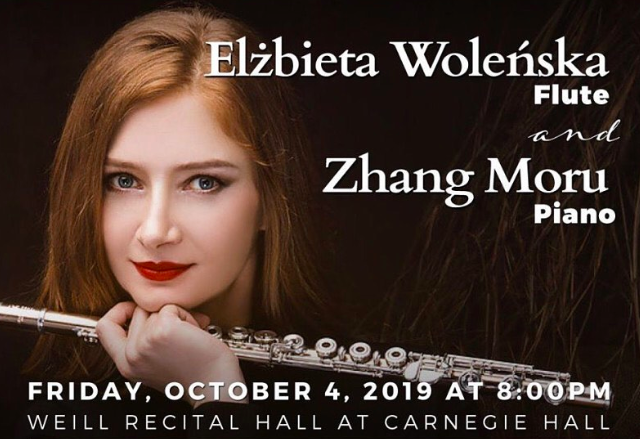
Elżbieta Woleńska, flute; Zhang Moru, piano
Weill Recital Hall, Carnegie Hall, New York, NY
October 4, 2019

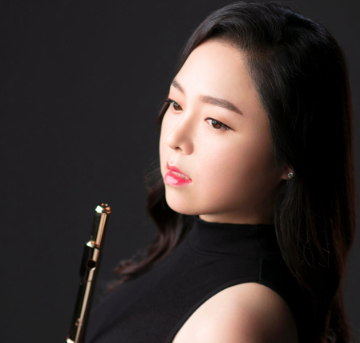
Distinguished Concerts International New York (DCINY) presented an exceptional debut this week for flutist Elżbieta Woleńska and collaborative pianist Zhang Moru, in a program listed at various websites as “Frederic Chopin, Pablo Sarasate, and others.” One had really little idea of what was in store, but if the intention was to maximize the surprise, it worked – Chopin turned out to be the least of the offerings (just an arrangement of the Prelude in D-flat, Op. 28, No 15 – popularly known as the “Raindrop” Prelude). The “Sarasate and others” (namely the Carmen Fantasy, Op. 25 and a half-dozen other gems by a variety of composers) combined to make one of the most impressive flute concerts in memory. Each piece was a discovery in its own way, and it was one of those nights when one forgets to look at one’s watch.

For a bit of background, Ms. Woleńska studied flute in Paris and Poland, earning a doctorate and numerous distinctions and awards. She has taught in Poland, along with performing and recording internationally, and currently teaches at Zhaoqing University in China, as does pianist Zhang Moru, who has also won a long list of awards and prizes.

The first work on the program was one by Johann Sedlatzek, entitled Souvenir à Paganini, Grand Variations on the Carnival of Venice. In what was a clever touch of symmetry, the concert ended with the same theme, via Mike Mower’s Deviations on the Carnival of Venice for flute and piano, given alternately jazz, salsa, rock, and other treatments – but more on that later. Suffice it to say that there was such fascination in the programming itself that one’s interest would have been held even without such a high level of playing – but the playing happened to be astonishingly virtuosic.

Beyond the program’s symmetry and the flutist’s mastery, the opportunity to hear music of Sedlatzek (1789 – 1866) is also rare. A Silesian flutist born in Prussia, referred to as “The Niccolò Paganini of Flute,” Sedlatek concertized throughout Europe, played alongside violin virtuoso Niccolò Paganini, and perhaps most memorably he served as principal flutist in the world premiere of Beethoven’s Symphony No. 9 in 1824 under Beethoven himself. One heard immediately Sedlatzek’s kinship with Paganini, and if readers want to listen to it, along with other works by Sedlatzek, one can obtain Ms. Woleńska’s recording entitled Souvenir at her website (https://www.wolenska.net/music) and other online stores.

Incidentally, after the Sedlatzek, Ms. Woleńska thanked the audience and commented that the “grand, grand, grand, grandson” of Sedlatzek was in the audience, and he stood to acknowledge the applause. Though such connections may not be rare in the classical music world, they are interesting to contemplate.

For a more lyrical spell, Lensky’s Aria from Tchaikovsky’s opera Eugene Onegin followed, and its plaintive poetry came through well, despite the jump from tenor voice to flute. On a perhaps fussy note, no mention was made of the transcriber, though one guesses that it was the Guy Braunstein version played by Emmanuel Pahud and others. One cannot assume these things though (nor memorize each version’s distinctions), and transcriptions ought not to be relegated to a pile of generic products by anonymous workers.  Similarly, the Sarasate Carmen Fantasy, Op. 25, which followed (originally for violin) had no mention of the transcriber – and there are several versions out there – but this one may even have been Ms. Woleska’s own. In any case it fit her like the proverbial glove, its five movements layering brilliance upon brilliance. She sailed through its florid passages with dazzling skill, capturing perfectly the coquetry of the habanera, and fluttering her way through unthinkably fast repeated notes. Just when one imagined that the pyrotechnics could not increase, they did. Only a few excessively shrill moments in the Lento third movement detracted, possibly unavoidable in this arrangement.

The ensemble with Zhang Moru was excellent throughout and riveting at times, such as in the final accelerando of the Sarasate. The pianist kept a firm command of the evening’s wide array of challenges, all with polish and a presence that was unassuming, generally allowing the flutist to shine. One’s only reservations of the evening in terms of the collaboration were a few rough moments in an early triplet section of the Sedlatzek – and where the piano (though only on the half stick) was a bit too dominant – and a few moments in the Sarasate’s first movement where the flute was slightly covered. All in all, though, this duo worked amazingly well together, and one hopes they will continue to do so.

The Chopin arrangement (the “Raindrop” Prelude) followed – and again there was no mention of the arranger, but perhaps in this case it was a merciful omission, as it fell short of the other arrangements. Though Chopin’s lyricism offered a respite from the hyper-virtuosic repertoire preceding it, the arrangement itself was puzzling, with inner voices from the original brought into treble prominence, creating a different effect altogether from the original. It was a bit surprising that a musician from Chopin’s native Poland would endorse these alterations, but presumably the flutist wanted to include something from her homeland, and it seemed to fit the bill. Similarly, there was a doffing of the hat to China, where both musicians teach, in what was listed as Ancient Chinese Folk Song: Singing in a Fishing Boat in the Dusk (again anonymous, though someone had to have arranged it). It closed the first half with a refreshingly different flavor in its pentatonic melodies and shadings.

After intermission came a delightful array of flute-piano duos in somewhat newer styles. First came a piece called Airborne (composed in the early nineties) by Gary Schocker (b. 1959), whom many may know better as a leading flutist than as a composer, but who clearly excels in both roles. Airborne is written in a breezy jazz style that brings to mind the music of Claude Bolling (and at times some hints of Vince Guaraldi), but with his own special voice unifying it all. It was a pure joy in this duo’s rendition, with particularly fine precision from the pianist.

Hypnosis by Ian Clarke (b. 1964) followed, based on improvisations by the composer with his former bandmates Simon Painter and David Hicks (1986-1994). It conveyed a new-age dreaminess that perfectly suits its title and was playing winningly.

Rituals by Slovenian composer Blaž Pucihar (b. 1977) was another joyful discovery for this listener, though Pucihar’s work is clearly not unknown to the flute and wind world. It combines haunting melodies, sensitively set, with wonderfully inventive elaboration and a folk-like quality described as balkanian in the notes (though they reminded this listener of Bartók). It was superbly played by both musicians.

Concluding this enchanting array was Deviations (as mentioned previously, on that Carnival of Venice theme) by Mike Mower (b. 1958). It ran the gamut from waltz, jazz and swing, to salsa and rock styles. A spectacular ending, it was met with a standing ovation and rhythmic clapping, eliciting an encore in the literal sense – a reprise of the final Mower variation. Bravo!

Share

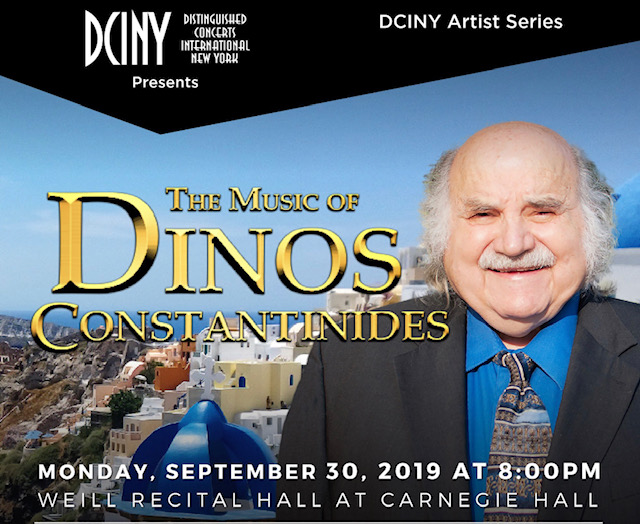
Distinguished Concerts International New York (DCINY) Artist Series presents The Music of Dinos Constantinides in Review

Distinguished Concerts International New York (DCINY) Artist Series presents The Music of Dinos Constantinides in Review

Featured Artists: Maria Asteriadou, piano; Kutztown Chamber Players, Peter Isaacson, conductor; Johanna Cox Pennington, English Horn; Kurt Nikkanen, violin; Esther Waite, flute; Gabriela Werries, harp; Sandra Moon, soprano; Christopher Lowry, viola; Caio Diniz, cello; Perla Fernandez, violin; Mireille Lopez, violin; Luis Casal, violin; Isaac Casal, Cello

Weill Recital Hall at Carnegie Hall, New York, NY

September 30, 2019

Distinguished Concerts International New York (DCINY) presented the music of Greek composer Dinos Constantinides for the twelfth time (in ten years) on September 30th, in a very generous program, which was practically a retrospective of his oeuvre. I have reviewed his concerts previously in these pages, always with pleasure. This occasion was no different. All the performers were great, a few of them even world-class, and they infused the composer’s music with heartfelt expressive energy, without which it wouldn’t succeed (no composer’s would).

One over-arching “theme” of this concert was Mr. Constantinides’ ability not only to invent, but to reinvent his extant works. All the great composers have done so, from Bach to Ravel and beyond. It’s wonderful to have this ability and opportunity to reconsider, taken from such a large body of work. All but one of the works exhibited his great love for his Greek heritage, and many sonorities and rhythms of Grecian folk music.

The first half consisted of three concerto-like creations, one for piano (Grecian Variations, from an early solo work), one for English horn (Threnos of Creon, from an operatic setting of Antigone), and the third for violin (Mountains of Epirus, originally for violin and piano).

Maria Asteriadou was the authoritative pianist in the Grecian Variations, playing with great personality and energy, accompanied (as were the other two concerto-like works) by the beaming young faces of the Kutztown Chamber Players, ably led by Peter Isaacson. Johanna Cox Pennington drew forth gorgeous tones from her English Horn in the Threnos, which was uniformly mournful in tone, appropriate to its subject: the disaster that King Creon’s life had become. Kurt Nikkanen’s virtuosity on the violin, along with wonderful flair and commitment, elevated the materials in the Mountains of Epirus to something epic.

After intermission, a generous helping of chamber-music-scaled works included a former concerto for flute and harp, re-arranged for the two instruments and piano (dedicated to DCINY for their 10th anniversary), played with subtle delicacy by Esther Waite, Gabriela Werries, and Ms. Asteriadou.

The only work that didn’t refer to Hellenistic culture directly was a setting of Elizabeth Barrett Browning’s famous sonnet “How Do I Love Thee” for soprano and viola. There was a great deal of text repetition, with long melismatic settings of certain words, perhaps a bit much for an already lengthy poem. For my taste, despite the excellent involvement of both Sandra Moon and Christopher Lowry, and Ms. Moon’s really good diction, the setting didn’t add much to my understanding of the poem. However, I suppose the heightened expressivity of Mr. Constantinides’ music did, in fact, coordinate with the white-hot tone of High-Romanticism à la Browning.

The Kaleidoscope Fantasy for solo cello (also a reworking of an original for soprano, violin, cello, piano, and two slide projectors), based on a musical response to children’s art works, provided a rare instance of Mr. Constantinides exploring much more dissonant, exploratory sounds, superbly brought to life by Caio Diniz, who did not let a slipped tuning peg faze him at all. A Hellenic Dance for two violins and viola was the briefest work of the evening; Perla Fernandez, Mireille Lopez, and Mr. Lowry made the audience feel the folk sources vividly. The evening concluded with a former concerto for violin, cello, and orchestra, also re-arranged for piano, resulting in a piano trio. The Casal brothers (Luis and Isaac) were joined by Ms. Asteriadou for an exciting close.

Mr. Constantinides, a committed teacher, surely leaves wonderful influences on his lucky students, and the devotion of his performers attests to a lifetime of collegiality and creation.

Share

Six Corner Records presents Irving Artists CD in Review

Six Corner Records presents Irving Artists CD in Review

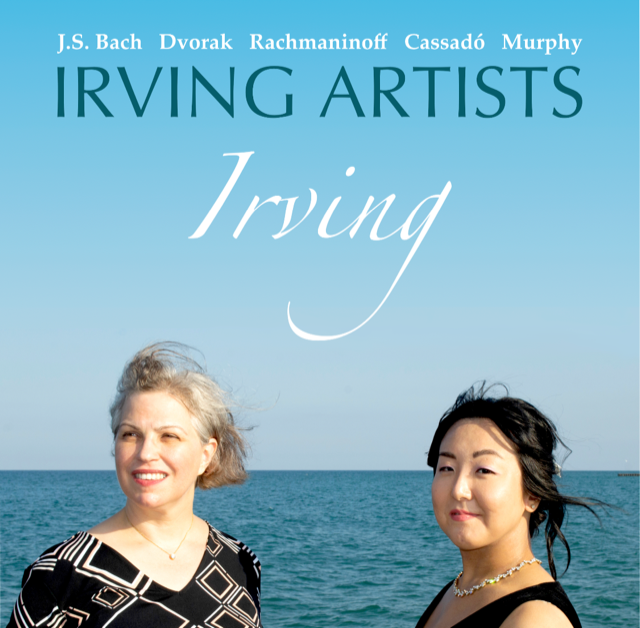
Hiroko Nagahata, piano; Alexa Muhly, cello; Heather Thon Dahl, clarinet
IrvingArtists.com
Recording Engineer: Tyler Rice
Recording Studio: Transient Sound, Chicago
Recorded on: June 17, 18, 2019 (for tracks 1-4, 8-9), September 10-11, 2019 (for tracks 5-7)

A new CD in its pre-release form was sent to me recently for review, and it looks to be one that many will enjoy. Just over forty minutes (on the short side for a CD), it includes, apart from one trio arrangement, all solos and duos by Bach, Dvořák, Rachmaninoff, and Gaspar Cassadó, played by pianist Hiroko Nagahata and cellist Alexa Muhly. Ms. Nagahata and Ms. Muhly comprise the core duo of their Chicago-based ensemble called Irving Artists (alternatively just Irving), which they call a “flexible format” group. Their duo thus becomes a trio with the inclusion of clarinetist Heather Thon Dahl for an arrangement by Keith Murphy (a Chicago-based composer) of the Shaker melody, Simple Gifts, which concludes the CD.

Although no liner notes or tray card information were included in the review copy, some background on the two principal performers was offered. Hiroko Nagahata received a Doctor of Music Degree from Michigan State University, a Master of Music degree from Manhattan School of Music with Dr. Efrem Briskin, and a Bachelor of Music Degree from Kobe College, Japan. She gave her New York solo debut at Weill Hall (at Carnegie Hall) under the auspices of Artists International and has performed in a variety of festivals and series, along with her teaching and work with the Lyric Opera of Chicago and Choirs of America, among other organizations.

Ms. Muhly holds a Bachelor of Music degree from the Cleveland Institute of Music and a Master of Music degree from the Yale School of Music. She has performed widely in the US, Canada, and Europe, especially distinguishing herself in performances of the music of Frederic Rzewski (including with Mr. Rzewski himself) both through the Carnegie Presents series and for Chamber Music America conferences. She has also been principal cellist of the Chicago Chamber Orchestra and Kalamazoo Symphony.

This CD offers a rather unusual assortment of pieces, which the promotional material calls a “carefully curated set.” A listener may be hard-pressed to understand the reasoning behind combining these selections, but they certainly offer a variety of styles and timbres.

Ms. Muhly and Ms. Nagahata combine forces in the CD’s longest work, Bach’s Sonata for Viola da Gamba and Harpsichord in G major, BWV 1027, played here with cello and piano. The work is described in the duo’s promotional material as “rarely performed in modern contexts” – and it is true that, though the piece itself is hardly neglected, the most notable recent recording with piano rather than harpsichord may be that of Angela Hewitt with Daniel Müller-Schott, dating from 2007, and most available recordings involve harpsichord.

The rendering of this piece by the Muhly-Nagahata duo is commendably faithful to the score. The players show good ensemble work overall and seem comfortable with each other in matters of tempi. The second movement stands out for its unhurried tempo, which one could describe as courtly. The two musicians clearly revere this piece and it shows in their intense commitment to each note. Occasionally, the adherence to each eighth note in the piano part seems to go beyond steadiness to verge on a certain sameness that risks becoming tedious. This may be due to an effort to simulate the style of a harpsichord – though one wonders why that would be, after a special reference in the promotional material to the “modern” instrumentation. Though Bach’s greatness always comes through, whether via synthesizer or symphony, a modern pianist can tap his instrument’s dynamic gradations to achieve maximum fluidity of phrase, and not to avail oneself of that strikes this listener as a lost opportunity – but chacun à son goût, as the saying goes.

Meanwhile, on the topic of “commitment to each note” one hears an intensely soloistic sound from the cello that stands apart from the piano a bit too prominently for this listener (though perhaps this is partly due to recording levels). This quality is particularly noticeable in the slower movements, first and third (in this slow-fast-slow-fast format). The listener is at times moved to turn down the volume to avoid hearing stridency in the cello part, but consequently one loses the piano’s interesting lines. These are personal issues, though, in what is overall a praiseworthy addition to this work’s discography.

The musicians then separate for the next two next solo works. First Ms. Muhly plays the opening movement – the Preludio-Fantasia – of the Suite for solo cello by Gaspar Cassadó (1897-1966), Catalan cellist and composer. Ms. Muhly’s playing here is unfettered and self-assured, and she projects the movement’s inherent drama and emotion well. One would like to hear her play the entire piece.

A great sonic leap then takes the listener to a piano solo from Ms. Nagahata, Rachmaninoff’s Prelude in D major, Op. 23, No. 4 (listed as Op. 17 in what is surely just a pre-release typo). It is one of the great gems among the Preludes and is given a devout interpretation here. The restraint that in the Bach verged on regimentation succeeds here in preventing the heart-on-sleeve impatience that can spoil this piece’s beautiful arch. Though there are moments which, for this listener, could still be more fluid (and some melody notes that sound a bit punched out, perhaps due to recording levels), it is overall a beautiful rendition.

Staying with Rachmaninoff, this CD moves on to his much-loved Vocalise, played by both Ms. Muhly and Ms. Nagahata. One hears more of Ms. Muhly’s impassioned phrasing here, and it works well for this piece. She is supported by sensitive playing from Ms. Nagahata. It is one of the highlights of the CD for this listener.

The two then move to somewhat lighter fare with the Dvořák Slavonic Dance in E minor, Op. 46, No. 2 given a charming reading, before their final offering, Simple Gifts, arranged for trio by Keith Murphy, who teaches at Loyola University Chicago.  Clarinetist Heather Thon Dahl joins the duo for this piece, adding an appealing tone to its folk-like opening, as well as later modal touches, polytonal effects, and klezmer-like episodes. As one might guess by now, the arrangement is not quite “Simple” despite its spare opening over a cello drone. On that score, kudos go to Ms. Muhly for achieving the twangy sound that evokes a distant didgeridoo or equally rustic instrument. This arrangement covers a lot of ground and offers a fresh addition to the many settings of this beloved Shaker melody.

The CD, entitled Irving, will be available in October through CDBaby, iTunes, Amazon for digital download and physical CD, and streaming on Apple Music.

Share

Pro Musicis presents Gaspard Dehaene in Review

Pro Musicis presents Gaspard Dehaene in Review

Gaspard Dehaene, piano
Weill Recital Hall at Carnegie Hall, New York, NY
September 25, 2019

French pianist Gaspard Dehaene played a demanding program on Wednesday night with great technical facility, keen intellectual probing, and sensitivity to harmony and color. Winner of the Pro Musicis International award in 2015, he joins a long line of illustrious pianists (and other instrumentalists) chosen for their vision beyond the mere spectacle of the concert stage. In Mr. Dehaene’s case, one can easily see this, given the thoughtful devotion to Schubert on the first half of his program.

He began with the set of twelve Ländler, D. 790. The ländler may be thought of as the country-bumpkin predecessor to the waltz (sometimes including “yodel” themes and the like), and Schubert composed dozens and dozens of them, often linked by key relationship, that could actually be used in a social dance setting—they are not as stylized as later composers’ versions of social dances. But as Schubert’s tragically short life went on, he filled these humble dances with his characteristic harmonic sidesteps and other surprises in a way that elevates them far above their genre.

Only a little earlier this month, the music world lost one of the premiere exponents of the Austro-Hungarian piano tradition, Paul Badura-Skoda. I recall hearing him many times fling a bouquet of these ländler with consummate charm and lilt. Mr. Dehaene’s set involved more intellectual, sober values, at first sounding wooden, but growing into charm. I began to worry, however, about something that clouded his entire recital: his use of a very bright, noisy piano, one whose dampers and pedal made metallic noises and actually raised the pitch of the sustained final chords of each piece, which was most disconcerting. Mr. Dehaene was most sensitive in the 3rd, 5th, 6th, and 11th ländler . Schubert’s dynamics are truly detailed, and I didn’t hear enough true pianissimo to suit me.

He followed the dances with a solid performance of the middle of the “last three” piano sonatas, the great A major, D. 959. This work embodies the “Schubert struggle,” if you will: the forces of light and dark in perpetual conflict. In Schubert’s tragic case, dark eventually overcame him, but in his music the situation is far more ambiguous.

Mr. Dehaene has an obvious clarity of grasp of these large spans that he, as Alfred Brendel says, “proceed(ed) with the assurance of the sleepwalker.” Here I found the instrument partly to blame for the lack of differentiation and, at times, mellow singing tone. At times, Mr. Dehaene intersected with the heartbreaking lyricism perfectly, at other times accents were too sharp. His treatment of the different harmonic content in the recapitulation of the first movement was superb, as was the mysterious coda, with its half-step “window” into the next sonata (the B-flat, D. 960), was particularly well done. For me, though it can be debated, the Andantino was too fast and not desolate enough. Interestingly, after the agitated “portrait of a soul coming apart” middle section, when the theme returns with triplet C-sharps over it, he was at what would have been the correct tempo for the beginning. It was all a bit “severe” for my taste, despite those moments when Mr. Dehaene gave in to a more melting tone. The same goes for the Scherzo, which lacked lightness in the staccato chords and sounded brusque and overly-bright. The songfulness of the rondo finale suited Mr. Dehaene’s organizational strengths quite well, although I wished for more mystery in the key changes and the many “wandering stops” that Schubert places. The fiercely difficult coda posed no difficulties for him. I sincerely hope that he will continue to live with this masterpiece for many decades, returning to it with new experience, and draw from the eternal spring it provides.

After intermission, both pianist and piano seemed changed. His group of the four Chopin Mazurkas, Op. 24 was stylish and offered so many of the color shifts I wished to hear in the first half. Furthermore, the Schubert/Liszt song transcriptions (Auf dem Wasser zu singen, D. 774 and Aufenthalt, from Schwanengesang, D. 957)  and the Liszt Rhapsodie espagnole that followed showed his command of the instrument, which was never superficial, but always included scrupulous voicing no matter how many thousands of other notes had to be dispatched.

Mr. Dehaene favored the enthusiastic audience with sincere comments of gratitude, delivered charmingly, to the Pro Musicis committee. He then played the wistful Schubert solo arrangement known as Mélodie hongroise (adapted from the four-hand Divertissement à la hongroise, D. 818) with disarming simplicity.

Share

Distinguished Concerts International New York (DCINY) presents Jorge Ávila in Review

Distinguished Concerts International New York (DCINY) presents Jorge Ávila in Review

Jorge Ávila, Violin; Adrienne Kim, Piano
Weill Recital Hall at Carnegie Hall, New York, NY
September 23, 2019

A splendid recital took place this Monday featuring violinist Jorge Ávila with pianist Adrienne Kim under the auspices of Distinguished Concerts International New York (DCINY). Anyone who has heard Mr. Ávila in his longtime role as concertmaster of the Distinguished Concerts Orchestra knows that he is a pro in that capacity – neither jangling ringtones nor fainting singers can ruffle him. His steady playing in countless orchestras (including pit orchestras) might almost lead one to expect the offhand, workaday sound that besets giggers, but such was definitely not the case here. Mr. Ávila is quite the soloist (with a healthy list of solo credentials to match  – see http://jorgeavilamusic.com), and his commitment to this program of violin masterworks – Beethoven, Schumann, Chausson, and more – was clear.

Mr. Ávila and Ms. Kim opened with Beethoven’s Sonata for Piano and Violin No. 5 (F major, Op. 24 posthumously nicknamed the “Spring Sonata”). The balmy first movement opened with a particularly sweet violin tone and sensitive piano collaboration. Though there were moments where this listener found the violin sound perhaps a bit too robust, or the piano not enough (m. 11 and similar spots, where the melody switches instruments), such balance quibbles are somewhat subjective. The mutuality of phrase and rhythm throughout was that of a duo with many years of playing together. High points included the Scherzo’s trio section, timed with split-second togetherness and polish, and the fourth movement, Allegro ma non troppo, a final smile from Beethoven.

The premiere of a new work by Nic Scherzinger (b. 1968) followed. Entitled Imprint, it was dedicated to Mr. Ávila and Ms. Kim, and according to the composer is a short “song without words.” As Mr. Scherzinger explains it, “When I began working on this piece pianist Adrienne Kim suggested the title Imprint since Adrienne and Jorge have been performing together for so long. As chamber musicians, there is a certain “imprint” that performers make on each other that can only happen with time and experience, which I try to capture musically in this piece. When the aria begins, the piano and violin start as two completely different individuals, but as the music progresses, they slowly come together, having made imprints on each other.” The title and program notes led this listener somehow to expect more perceptible interchange of roles or musical material than one was able to grasp in a first hearing, but that said, the piece was beautifully atmospheric, combining long-breathed violin lines with an undulating piano bass, both parts gaining intensity throughout the well-paced journey.

Chausson’s expansive Poème for Violin and Piano, Op. 25 (1896) concluded the first half. This quasi-concerto, inspired by a Turgenev love story and the wizardry of the violinist Eugène Ysaÿe, is lush and extravagant. Violin technique is exploited to the hilt, from dazzling double-stops to stratospheric trills, and Mr. Avila seemed to relish it all. He was persuasively expressive, with a flexibility and variety in his vibrato that helped convey the musical message of each distinct phrase. More challenging, of course, is simulating the multitude of colors and timbres of the work’s orchestral origins, and to that end one again wished that the piano would have come a bit more to the fore. Perhaps some excess caution was attributable to the Steinway’s resonance (with lid open on the full stick), but one wanted still more of the orchestral textures to come through the piano part. All quibbles aside, the audience (a full house) seemed visibly to enjoy the performance and applauded resoundingly.

In Schumann’s Sonata No. 1 in A minor, Op. 105 (another work published as Sonata for Piano and Violin) the equal importance of parts was projected, and it was a joy to hear Ms. Kim’s excellent pianism combining with Mr. Ávila’s extroverted style to bring Schumann’s impassioned score to life. Except for some minor rough spots for Mr. Ávila in the third movement, the performance was outstanding, bristling with Schumann’s agitated energy.

Shorter works of Turina and Kreisler followed, closing the program almost as built-in encores. First the duo played Turina’s evocative La oración del torero Op. 34 (The Bullfighter’s Prayer, arranged by Heifetz), and they did it to a tee. The emotions of a matador before his fight were conveyed so dramatically that one could imagine the jitters, the colors, and the intense heat of the day. The music of Turina is one of the specialties of this duo, and they have recorded some of his work on a disc of Spanish sonatas (Centaur label).

The program closed with the much-loved Kreisler bonbon, Tambourin Chinois, Op. 3, played with perfect élan, spirited bowing, and the occasional delicious slide. There was consummate unity here, as befits such a longstanding musical pair. A standing ovation and much gracious bowing led to an encore of more Turina, now the Vivo movement from his Sonata No. 2. Mr. Ávila, not wanting to exhaust attention spans, assured the audience from the stage, “Don’t worry: it’s very short.” Indeed, two minutes more of Spanish fireworks flew by, and it was a joy. Cheers to this duo – and olé!

Share

Ensemble SONE presents Ju Hee Kang in Review

Ensemble SONE presents Ju Hee Kang in Review

Ju Hee Kang, Flute
Heejin Kim, Piano
Yeon Hwa Chung, Harp
Weill Recital Hall at Carnegie Hall
September 18, 2019 at 8:00 pm

Some performers exude an air of professionalism and intelligence before the concert has even begun. Ju Hee Kang is one such musician. Flute recitals can venture quite easily into overly familiar terrain, with the kind of easily digestible material that has made the instrument so popular.  Ms. Kang managed to avoid that, with a program that included some rarities, a world premiere, and a virtuoso showpiece of true musical value.  Her partners in this recital, the pianist Heejin Kim and the harpist Yeon Hwa Chung, provided seamless support as ensemble players and shone beautifully in their many passages of solo playing.

At some point before the evening of the concert, the advertised program was altered slightly to omit a Handel Sonata and to include Emile Noblot’s Andantino for Flute and Harp and Ibert’s Entr’acte. Noblot, a French pianist who studied at the Conservatoire de Paris, became a renowned bandleader, and a staple of French radio broadcasts after World War II. The harmonic language, use of the whole tone scale, and structure of his Andantino reflect the still pervasive influence of Debussy on many mid-century composers. Ms. Kang was wise to choose this as an opener.  Her strengths, a big beautiful tone, smooth legato phrasing, and fine breath control, were immediately apparent. Ms. Chung  played with an acute sensitivity to dynamics.

Jacques Ibert’s Entr’acte, frequently played as an encore, provided  Ms. Kang with an opportunity to feature the more fiery side of her temperament.  Here, the composer, an avid Hispanophile, painted a tonal portrait of a traditional Spanish dance, complete with percussive effects on the flute to replicate the rhythmic stomping of the dancer.  Ms. Kang easily negotiated the rapid  staccato passages and shifted beautifully between contrasting dynamics.  Perhaps the harp lacks some of the bite of the guitar, but I was happy to hear the engaging musicality of Ms. Chung once more.

A more substantive composition, the Bartók Suite Paysanne Hongroise, occupied the largest spot on the program’s first half.  This solo piano work, arranged for flute and piano by Bartok’s student, Paul Arma, is one of the fruits of the composer’s many years of research into the folk music of the Carpathian Basin.  It’s a fascinating arrangement of a rich trove of musical material.  Ms. Kang and her pianist, Heejin Kim, delivered a solid account of a work that poses many technical and stylistic challenges.  I especially enjoyed the improvisatory feel of the first song, the bluesy quality of the second, and the infectious fourth, with its leaps into Alpine territory amidst the driving foundation of the piano part.  The finale of the whole suite, a multi-tiered accelerando into a virtually unplayable tempo, made for great musical theater.  Ms. Kang may have faltered slightly at the climax, but it was still an exciting ride.

A bit of esoterica, the Sonatine by Walter Gieseking, brought us slightly further into the twentieth century chronologically, if not compositionally.  Gieseking, one of the giants of French pianism, who adopted Germany as his home, was also an active composer.  The Sonatine, a very attractive work in three movements, owes a great debt to the influence of Francis Poulenc, an exact contemporary of Gieseking.  The simple walking melodies over unexpected harmonic changes and the Gallic cabaret waltzes are the language of Poulenc, and they are present in the Sonatine also.  Of all the works so far, this one posed the most challenges for Ms. Kang in interpretation and execution.  The moments of rubato in the second movement felt somewhat forced, and in the last movement, a test for anyone’s stamina, she seemed to lose steam on the repeated high notes.  Still, I’m grateful to have heard such a charming piece, written by an artist whom I admire so much.

The world premiere, Beceues, by Vartan Aghababian, was an intelligent piece of programming, offering thematic continuity with both the Bartók (works derived from folk tunes) and the Schubert (theme and variations).  Mr. Aghababian, who has had extensive experience in film scoring and editing, wrote well for Ms. Kang’s talents.  With a leisurely pace, and long, shapely phrases, the flutist played with a dreamlike quality, as if recalling a memory from the distant past.  It was a thoroughly convincing performance.

Only a confident artist like Ms. Kang would leave the meatiest and most technically taxing piece for last, but it was a pleasure to hear her rendition.  Trockne Blumen, one of the last songs in Schubert’s Die schöne Müllerin cycle, is the basis for a set of variations for flute and, just as notably, piano.  Though the Introduction is bleak  (mirrored by the flutist with a colorless, pale tone), the variations, in full blown Romantic style, pull out all the stops.  Ms. Kang and Ms. Kim aced it all – torrents of arpeggios, cascading triplets in both flute and piano, and the final variation ending in a barrage of brilliant sixteenth notes. To their credit, they made affecting music in the process.  This was a satisfying end to a well balanced concert by three promising, gifted musicians.

Share

Orchestra Moderne NYC: Women Warriors: The Voices of Change in Review

Orchestra Moderne NYC: Women Warriors: The Voices of Change in Review

Amy Andersson, Founder and Music Director
Composers: Nathalie Bonin, Miriam Cutler, Anne-Kathrin Dern, Sharon Farber, Mandy Hoffman, Penka Kouneva, Starr Parodi, and Lolita Ritmanis
Guest performers: Sonita Alizadeh, Isolde Fair, Nathalie Bonin, Gillian Hassert, Riga Cathedral Girls’ Choir TIARA, The Visionary Singers
Honorary speaker: Masih Alinejad
Alice Tully Hall, Lincoln Center, New York, NY
September  20, 2019

Lincoln Center’s Alice Tully Hall was the venue for Orchestra Moderne NYC’s Women Warriors: The Voices of Change, a multimedia symphony concert celebrating women activists who are fighting for social justice. I’m certain the hall and the date had to be secured at least a year ago or more, but it seemed eerily apposite that this thrilling, innovative orchestral concert was given on the day that millions of people, many of them schoolchildren, called a “climate strike” in protest of the political inaction on an issue that threatens the very host we all rely on: Earth.

Any fears I had about the event being more “agenda” than “art” were quickly allayed by two things: the quality of the performances, and the sheer emotional power of the coordinating images. How many times do you get to witness an Afghan young girl, exiled to Iran, who has been sold into marriage twice (age 10 and 16), and is now a rapper?

I wish one event like this could move the hearts of those whose hearts need moving, but alas, humans never seem to learn. All the issues on this powerful affirmation of women’s strengths are still, sadly, pertinent and unsolved. Basic freedom, AIDS/HIV, LGBTQ rights, war/peace, religious clothing requirements, climate change, clean water, child brides, police overreach, gun violence, sexual assault, reproductive choice.

This made for an evening that would have been hard to take were it not for the superlative assembly of much-awarded women composers for film, television, and even video games. Add to that a well-curated visual screen behind the performers, with documentary stills and moving footage of historic women’s rights figures and current events.

This concert event should be required viewing at the U.N. general assembly that begins in New York on Monday; and it should be done in every high school and college domestically and worldwide.

The concert was divided into “chapters,” each dealing with a different social issue. I understand that Amy Andersson, the founder and music director of the Orchestra Moderne NYC, worked on realizing the concept for two years. Those are two well-spent years. The number of world premieres in one event was stunning.

For way too long, the female element has been marginalized: composers, conductors, performers (except perhaps in opera) have not been represented with the same privilege as their male counterparts, and it continues. But events like this go a long way toward redressing that. May there be many more.

Share

Distinguished Concerts International New York (DCINY) Artist Series presents Lela Kaplowitz in Review

Distinguished Concerts International New York (DCINY) Artist Series presents Lela Kaplowitz in Review

Lela Kaplowitz, jazz vocalist
Joe Kaplowitz, piano; Lucia Kaplowitz, violin; Mat Muntz, double bass; Gary Fritz, percussion
Weill Recital Hall at Carnegie Hall, New York, NY
September 19, 2019

Croatian-born jazz singer/songwriter Lela Kaplowitz gave a largely entertaining, always sincere, concert on Thursday night. It was essentially a live performance of her latest CD, titled To One. She was backed by a four-piece ensemble that included her husband Joe Kaplowitz (an excellent jazz pianist), daughter  Lucia Kaplowitz(violin, and vocal and beatbox contributions), and two other fine musicians, double bassist Mat Muntz, and percussionist Gary Fritz.

For my taste, in this idiom, the vocals could have used a microphone, for Ms. Kaplowitz threatened to be swallowed up by her small backup team. A CD can be engineered so that these issues go away, but a live performance has its own rules.

That being said, I wish I could convince my classical singers to have the physical freedom Ms. Kaplowitz exhibited, as well as her joyful charisma. This made her message, a sort of “new-age” jazz effusion, much more compelling.

The lyrics were somewhat cliché, although the universality of them could not be gainsaid. Ms. Kaplowitz wishes to create a musical experience that will be elevating for all listeners, with music as a positive, vibrating force. I agree with the thesis, but I did not find the comparisons with the “great singer-songwriter era of the 1970s” as stated in her manifesto. No matter, she absolutely portrayed her own personal vitality with her engaging stage presence.

Seven of the selections were arranged to coordinate with the seven chakras, or spiritual energy centers of the body, according to ancient Hindu texts. They contain healing energy and can be unblocked for greater vitality in life.

Clearly, Ms. Kaplowitz believes in this life force, and her personal radiance went a long way toward redeeming the sameness of some of the material. She also generously gave solos to each member of her ensemble, all of whom were wonderful.

I would like to hear Ms. Kaplowitz again in covers  of more standard jazz perhaps from the American songbook, or Croatian songbook. Now that would be something unusual!

Share

Eun Chong Ju: Camille Saint-Saëns – Introduction and Rondo Capriccioso, Op. 28 in Review

Eun Chong Ju: Camille Saint-Saëns – Introduction and Rondo Capriccioso, Op. 28 in Review

Eun Chong Ju, violin
Min Kyung Kim, piano
Recorded at First Korean United Methodist Church, Main Chapel, Richardson, TX,
Oct 28, 2018

Korean born violinist Eun Chong Ju, with pianist Min Kyung Kim, recently released her recording of the Introduction and Rondo Capriccioso, Op. 28 by Camille Saint-Saëns. There are no physical copies available, but it is digitally available from  iTunes, Spotify, and YouTube Music.

Composed in 1863 for Pablo de Sarasate (1844-1908), this work has been a mainstay of the violin repertoire ever since. It has become almost a mandatory showpiece for violinists to dazzle audiences with their virtuosity. Indeed, one can easily access performances of nearly every big-name (and not- so-big name) violinist. Millions of new listeners were introduced to this work after it was featured in an episode of the anime series Shigastu wa kimi no uso (Your Lie in April). It is thus reasonable for a listener to ask in what way another recording of such a warhorse can be differentiated from the others. In a way, a listener needs to put on “fresh ears” for each performance, and Ms. Ju’s recording is no exception.

This listener has always tried to judge live performances “in the moment” and to resist making too many comparisons to other performances; when the performances have been recorded, however, the listener ‘s expectation level is higher, given the opportunities for multiple takes and editing. Also, comparisons with other recordings are inevitable, though some of those comparisons are unhelpful or even misleading, such as the “Stopwatch” approach (Performance A lasted 1:43, Performance B lasted 1:39, often with the implication that “faster is better” when it may be the exact opposite!).  Technique and tonal quality are fair game for comparison, but often the key differences are stylistic choices, in which the preference of the listener rules the day.

Now, with all that said, it is time to get to it. First, the positives: Ms. Ju is fearless in her approach; there is nothing tentative or lacking in commitment. There is a good amount of “swagger” where appropriate, and the pacing is effective.  She does not try to gloss over difficult passages by increasing the tempo and sliding over the notes.  The articulation is generally clean, and the ensemble is commendable.

Now, on to the negatives. In the effort to make every note heard, there is a certain heaviness that weighs down the rapid passages. One misses the light bounce bow work that one often hears in other performances.  There are also some signs of straining, especially in the extreme upper register, along with some problems in the triple-stop section, with one particularly jarring moment. All this being said, these are issues that can certainly be addressed in future performances/recordings.

Ms. Ju is without a doubt a talented and promising musician.  This recording shows that she is a work in progress, and I wish her the best in developing her talents and career.

Share

The Palisades School of Music Presents William Chen in Review

The Palisades School of Music Presents William Chen in Review

William Chen, piano
Merkin Hall, Kaufman Music Center, New York, NY
September 8, 2019

This past Sunday at Merkin Hall, sixteen-year-old pianist William Chen gave an impressive recital of extremely demanding works by Bach, Beethoven, Schubert, Chopin, Rachmaninoff, and Lowell Liebermann. Though I do not recall ever hearing about this pianist, he is clearly an outstanding young artist to watch.

The program was a large one which many professional pianists would be hard pressed to pull off after many more years of study, degrees, and concertizing than Mr. Chen has had. This is not to suggest that Mr. Chen has any shortage of credentials either, by the way, as his biography already lists numerous concerts throughout the world and a substantial list of awards (from the Bosendorfer and Yamaha USASU Competition, the New York Music Competition for Young Artists, the Kaufman International Piano Youth Competition, AADGT, Young Pianist Competition of NJ, New England Conservatory Preparatory Concerto Competition, and more –  as well as being a Young Scholar of the Lang Lang International Music Foundation); one has to remind oneself, though, that he is still just in high school (at the Special Music School in NY), so to have conquered such a program reflects not only exceptional talent but a level of commitment that is extraordinary for one so young.

To open, Mr. Chen played Bach’s Prelude and Fugue in E-flat minor (WTC I) with solemn composure and attention to phrasing and tone. He allowed himself a prolonged wait before starting (as he did before almost each piece), and it was wise, not only to allow various ringtones and other noises to abate, but to draw listeners into the pianist’s musical realm. He let the somber opening sing and showed consummate tonal control and restraint in its pacing. The Fugue unfolded with clarity in each voice whether direct, inverted, or in one of the ten remarkable stretti. Some players exaggerate the subject’s fifths and fourths to the point of resembling foghorns, but Mr. Chen’s approach was both restrained and lyrical, creating the transparency of texture that is ideal for this piece.

Beethoven’s Sonata Op. 10, No. 3 in D Major followed in a performance that was hard to fault, honoring Beethoven with fidelity to the score and a persuasive projection of its drama and architecture. There was no shortage of pianistic prowess in the outer movements, but it was the slow movement, the tragic Largo e mesto, which impressed most. Here Mr. Chen showed that he can sustain the life of long lines even at a glacial tempo, leaving the audience with bated breath until the very last note.

For those craving fireworks, Mr. Chen gave Lowell Liebermann’s four Gargoyles an exciting ride before intermission. Explosive bursts enlivened the opening Presto, and the third (Allegro moderato) was positively shimmering. The powerhouse finale, Presto feroce, let out all the stops. If one wanted a bit more shape to the phrases in the second, Adagio semplice, ma con molto rubato, it may mean that this listener was getting a bit spoiled. All in all, the set made a fantastic finish to the first half, and one could hardly believe that Rachmaninoff’s expansive Variations on a Theme of Corelli, Op. 42, and Schubert’s notoriously difficult “Wanderer” Fantasy, Op. 15 were yet to come!

Before the two remaining large works, the second half opened with a sensitive rendering of Chopin’s Nocturne in D-flat Major (Op. 27, No. 2), which prospered from Mr. Chen’s keen ear for tonal beauty and mature phrasing, including the seamless blending of one tone into the next. It boded well for the Rachmaninoff Corelli Variations, with its many melodic outpourings.

The Rachmaninoff did not disappoint, and in fact one marveled again at this young player’s composure and mastery through some of its virtuosic passages. My handful of reservations included the need for still more softness where Rachmaninoff marked “pianissimo.” It becomes especially important where it marks a thematic return in Variations II and IV (the latter being admittedly difficult in the low register, but still worthy of care). Elsewhere, various infamous spots were handled with great skill (e.g., the left-hand double notes in Variation X), and even the oft-smudged Variation XX stayed reasonably on target. One may have wanted a bit more savoring of the incredible harmonization of Variation XIV, but again (pinching oneself), this pianist is not even out of high school. There will surely room for more spontaneous reverie in the years to come.

Perhaps adrenaline played a role in what seemed an emphasis on momentum, or perhaps at heart was some awareness that the “Wanderer” Fantasy still lay ahead – this program was, after all, very weighty for an average audience. Rachmaninoff himself was not oblivious to such matters of audience engagement, as he once wrote about his own performance of these same variations, “I was guided by the coughing of the audience. Whenever the coughing would increase, I would skip the next variation. Whenever there was no coughing, I would play them in proper order.” In the case of Mr. Chen’s program, if there had been any such concern, it might have been advisable to omit the Chopin Nocturne and let the two larger pieces breathe more fully (and the Chopin could even have been saved for an encore).

In any case, Schubert’s “Wanderer” Fantasy was excellent, and it showed a strong grasp of its technical challenges, voicing demands, and sprawling structure. Once again, there seemed a need for greater softness where marked pianissimo, and perhaps at heart was a fear of not projecting, but the good news is that all projected quite well, so an exploration of the lower dynamic extremes in a few spots should indeed be possible. There certainly was no lack of stamina, and in what was almost an “embarrassment of riches” Mr. Chen responded to his final ovation with a sizzling account of Liszt’s La Campanella. What, no Islamey?

All kidding aside, such a concert represents an enormous achievement, after which it is hoped that this pianist can enjoy a short breather for some of his other professed interests of “reading, movies, board games, clouds, geography and maps, hiking, scuba diving, and private piloting.” While William Chen deserves huge accolades, congratulations are also in order to those who are raising him and to his teachers, Michael Thomopoulos and Wha Kyung Byun. Bravo! With both talent and such a superb foundation, there should be continued greatness ahead.

Share