Pro Musicis Presents Juliann Ma in Review

Pro Musicis Presents Juliann Ma in Review

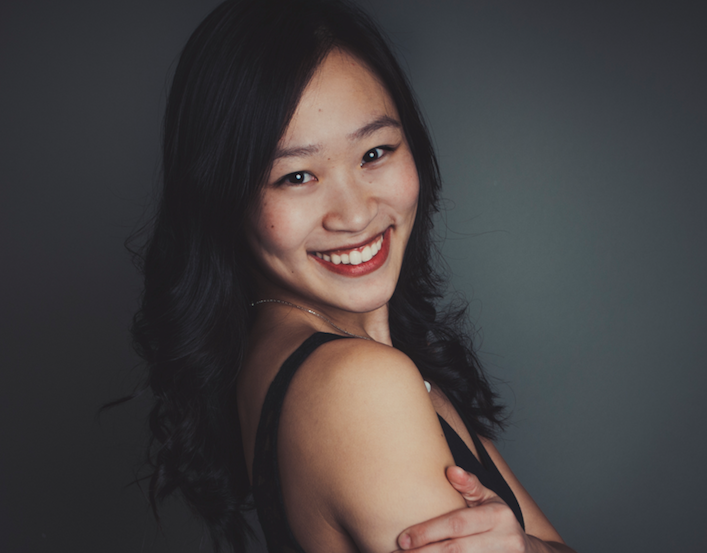
Juliann Ma, pianist
Weill Recital Hall at Carnegie Hall, New York, NY
November 9, 2017


A noteworthy recital debut occurred last Thursday, that of excellent pianist Juliann Ma, under the auspices of the Pro Musicis organization. Pro Musicis, founded in 1965, has for decades had a track record of presenting outstanding and communicative young artists in both conventional venues and community service concerts. Their roster has had such an illustrious array of musicians that it is impossible to select just a few names (but one can visit www.promusicis.org to learn more). Whether the Pro Musicis magic is more in their choosing of exceptional talent or in their nurturing of it through concerts and outreach may be up for debate – surely a mixture of both – but, in any case, they continue to thrive. Juliann Ma, their 2016 addition to the roster, provided ample evidence of that at her recital.


Ms. Ma is much more than an excellent pianist. A graduate of the Juilliard School (MM), she also has a degree in music from Stanford University (BA) with a minor in Creative Writing, plus a Diplôme d’Exécution de Piano from the École Normale Supérieure de Paris Alfred Cortot (on a Fulbright grant) and a Professional Studies certificate from Mannes (The New School for Music). She possesses the communicative gifts, appealing stage presence, and keen instinct for clever, accessible programming that will serve her well in her musical ambassadorship in the coming years.


Ms. Ma has an individual mission as well, which is to spread the message about the beauty and fragility of nature. Her carefully crafted program, entitled “Arise, Awake” was filled with works inspired by nature, including Debussy’s Prélude à L’Aprés-midi d’un faune (“The Afternoon of a Faun”) transcribed by the pianistic wizard, Vyacheslav Gryaznov, and three movements from Stravinsky’s Firebird, in Guido Agosti’s knockout version that has experienced quite a popular resurgence in the past decade.


Ms. Ma’s passion for nature became most overt, though, in her dramatic performance of Ravel’s exquisite Oiseaux Tristes (“Sad Birdsfrom Miroirs), upon which she based a collaborative interdisciplinary project. She preceded her performance with her own environmentalist poem entitled “Arise Awake,” and then incorporated six dancers into her piano interpretation to dramatize the sad birds’ story. Towards the close, the “birds” fell into a despairing cluster around the piano, and Ms. Ma folded her arms over the nearest one, thus in a sense becoming part of the dance. A similar performance (though more elaborate and without the finish around the piano) was just released by her organization, Sustainable Environment through the Arts and Sciences (SEAS): https://juliannma.com/seas/ .


For the visually oriented audiences of today, Ms. Ma’s conception may have a strong impact. There is always something extra-musical to watch or consider, so it may well touch the hearts of audiences not yet enamored of this music; for someone already deeply devoted to this music, however, the composer’s pure creation already represents an artistic pinnacle. Ravel transformed nature’s sounds into something uniquely spiritual, and the question arises as to whether it serves his creation to go the reverse direction and concretize the ethereal. For this listener, the dance ultimately distracted from the music, and increasing the distraction were various extraneous issues – percussive footsteps on Weill Hall’s wooden floor, the hard-to-ignore squeak of a barefoot pirouette, and some unforgiving lighting, all necessitating some suspension of disbelief in order for one’s imagination is to truly take flight. In the polished video, the latter were non-issues, yet this listener’s preference for the unadorned music remains the same. Admittedly, pianist/reviewers are probably not the target demographic.


Just as Oiseaux Tristes needs no enhancement, Ms. Ma as a pianist does not. She possesses the ability to find the essence of each work, and with help from her strong, fluid technique, she projects the musical shape, color, and drama vividly. Her opening Debussy was a joy, and the lush Gryaznov version made up in pianistic shadings whatever was lost in the transcription from the orchestral original. One could hardly imagine it performed better than Ms. Ma did.


Her Scriabin Sonata No. 5 (Op. 53) was also excellent, as brilliant and full of fire and ecstasy as one ever hears, as well as remarkably clean and polished throughout. Additionally, she gave it one of the strongest and most dramatically persuasive endings that I can recall in a lifetime of hearing the piece. Brava!


On the subject of drama, Ms. Ma has a strong bent for theatricality, which may make some curmudgeons spring to the accusation “all flash and no substance”; I am delighted to report, however, that this is definitely not the case. The supreme test was after intermission, with J. S. Bach’s Chromatic Fantasy and Fugue in D minor (BWV 903), and Ms. Ma more than passed with flying colors. Her performance was a model of thoughtful phrasing and voicing – the highlight of the program for this listener.


Following the Bach was Darknesse Visible by Thomas Adés (b. 1971), a musical descent into despair that Ms. Ma performed impressively from memory. The last few measures (after John Dowland) led without pause – a wonderful segue – into the opening octave blast of Danse Infernale, Berceuse, and Finale” from Agosti’s transcription of The Firebird, a musical phoenix rising from the ashes.


It was a marvelous evening, all in all, and the cheering audience was rewarded with an encore of the jazz standard “Body and Soul.” It will be a genuine pleasure to watch Ms. Ma’s career advance from this highly auspicious debut.

Share

Mateusz Borowiak in Review

Mateusz Borowiak in Review

Mateusz Borowiak, piano
Merkin Concert Hall at Kaufman Center, New York, NY
Sunday, November 5, 2017 8PM


A stunning display of profound musicality and musical profundity took place in the first of Mateusz Borowiak’s epic three-recital series at Merkin Concert Hall, the venue of his US debut. When I first saw advance notice of the series, presenting the complete piano sonatas of American composer Louis Pelosi, two per recital, coupled with three of the major etude cycles—all twenty-four Chopin, all twelve Debussy, and Rachmaninoff’s Etudes-Tableaux, Op. 39, I thought “This guy is either a foolhardy daredevil, or one of the great pianists.” After this first recital, I’m inclining to the latter.


Mr. Borowiak calls the presentation of the Pelosi works a “world premiere.” Perhaps it is for all six together, but I recall hearing Donald Isler perform the Sonata No. 1 a few years ago. No matter, it is certainly a noteworthy occasion in anyone’s musical calendar. Pelosi, who makes his living as a piano technician, calls himself a “tonal contrapuntist.” He believes in one “central tone” that dominates the proceedings.


I was going to compare Pelosi to Chopin, if Chopin had died 150 years later, with a dose of Anatoly Alexandrov, but that would be unfair to Pelosi. He is an original. His music is very brooding and gestural, favoring imitative counterpoint, with difficult, intricate piano textures that utilize the whole keyboard. He accomplishes all this without sounding neo-Baroque. Pelosi certainly has an ideal advocate in Mr. Borowiak, a pianist of serious demeanor and great concentration, who wore white tie and tails—one doesn’t often see that these days. The two have collaborated before, on a recording of preludes and fugues by Pelosi.


This recital opened with Pelosi’s Sonata No. 4, and closed with his Sonata No. 6, framing the complete Chopin etude sets of Op. 10 and Op.25. Both sonatas were rendered from score with clarity and expressiveness, even in the thickest murky textures. Pelosi seems to speak of tragic things, immense things, and his use of what I call “seeking and finding” in evaluating various contrapuntal outcomes leads him to his own seeking and finding of interior emotional states, which he generously shares with the listener. The music requires intense concentration, which is the least we can do when someone creates such material. Just when you think it’s perhaps a bit too discursive, it breaks into a sort of consoling song-like episode, then it turns to a jittery fugue. The works hold together because of superb thematic unity, and very often they are cyclic—themes from earlier in the piece return later in the work.


The Chopin Etudes were revelatory. Tempi in the fast ones were very fast, yet one never felt that Mr. Borowiak was at the outer limit of what he was capable technically. His lyrical playing was melting and passionate. He even managed to find flexibility, elasticity, and a certain flirtatiousness amid the welter of notes. Was it my imagination, or did the E-flat minor, Op. 10, No. 6, sound “Pelosi-like” in his hands? Really, all of Op. 10 was great, with perhaps two miscalculations: No. 10 needed more variety in the articulation, however it was completely convincing; and No. 12, the celebrated “Revolutionary,” was exciting but harsh (but certainly passionate!). I wrote “wow” next to No. 8, this was one instance of the flirtatious quality. Remember, Cortot said: “The Chopin Etudes are as inaccessible to the virtuoso without poetry as they are to the poet without virtuosity.” I imagine Cortot would have been pleased, for Mr. Borowiak possesses both.


The Op. 25 set was even more successful overall, if that is possible, a matter of degree. The pieces were stitched together into a sort of compelling narrative by Mr. Borowiak, from the delicacy of No. 1, “Aeolian harp,” to the feather light No. 2, with excellent attention paid to the left hand, the “not obviously difficult” one. His playful leggiero in No. 3 was breathtaking, and his incredible double thirds in No. 6. Again, only in the octave etude, No. 10, did I feel that he miscalculated the sound in the room, but it is a violent piece, and the middle section was gorgeous. I could go on, but this will have to suffice.


I can’t wait for the next installment!


Share

New York Chamber Players Orchestra in Concert presents Zehavi Rodriguez in Review

New York Chamber Players Orchestra in Concert presents Zehavi Rodriguez in Review

Zehavi Rodriguez, cello; New York Chamber Players Orchestra; Giacomo Franci, Artistic Director
Liederkranz Concert Hall, New York, NY
October 13, 2017


Four prizewinning young string soloists had an opportunity last month to be heard with the New York Chamber Players Orchestra as part of their Young Artist Showcase Concert, chosen through NYCP’s Young Artists 7th Annual competition. As stated on the orchestra’s website www.newyorkchamberplayers.org, the competition finals in June were “open to 12 prodigies” with the intent of choosing three winners. Four were ultimately selected to perform October 13th at the lovely Liederkranz Concert Hall off Fifth Avenue.


As I was assigned to review only the cellist among the winners, I will focus on that shortly, but wanted to acknowledge also the other performers, in all cases exceptionally accomplished for their ages. In addition, one should mention that the NYCP Orchestra performed the much-loved Symphony No. 40 in G minor (K. 550) by Mozart as the first part of the program, acquitting themselves well of its challenges, especially for an orchestra that is not a large full-time one. The second part was devoted to soloists with orchestra.


The first soloist was Fourth Prize winner, Chelsea Xia, a violinist, who played Mozart’s Concerto No. 5 in A major (K. 219). She played just the final movement, for which the piece has been nicknamed the “Turkish” on account of its incisive rhythmic section in A minor (resembling the Rondo from the later Piano Sonata in A major K. 331). Ms. Xia played with admirable technical polish for one so young and a good amount of gusto in the jaunty “janissary music” moments. She has a very promising start on what should be a fine career ahead.


Third Prize went to Sara Yamada, violinist, playing Pablo de Sarasate’s Zigeunerweisen, Op. 20 (Gypsy Airs). It is always a striking experience to hear such a youngster (whom one might expect to see playing in the park) performing at such a high level in a Romantic virtuoso style. She played with exceptional technique and assurance. One should be accustomed to such accomplishments by now, with prodigies abounding, but it never fails to jolt one out of one’s seat. Granted, there is room for further growth, but if this is childhood, what amazing things may await!


The First Prize Winner, violinist Joseph Hsia, finished the concert with the Vieuxtemps Concerto No. 5 in A minor, all three movements. The most mature of the players we heard, he appears ready technically to take on any challenges that music offers. He demonstrates the ability to immerse himself fully in a long, involved work and approaches even the perilous spots with the assured kind of bull’s-eye intonation that invites the listener to relax and do the same, without bracing nervously at each Olympic hurdle, as one often does in youth concerts (and even concerts by established professionals). Bravo!


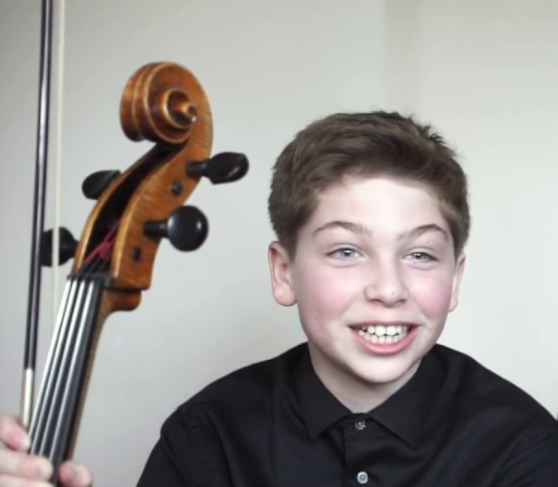
The only cellist of the evening was the winner of Second Prize, Zehavi Rodriguez, also the youngest of the players at just age eleven. He performed the Saint-Saëns Cello Concerto in A minor, Op. 33, with a command and flair belying his youth.


On the subject of age, there was nothing about this cellist’s demeanor that screamed “prodigy” in the stereotypical way – no overdone attire, no precious mannerisms – but rather a no-nonsense attitude about what seemed an earnest pursuit of music. When he walked out to play, there was a mature suavity about him that was matched by some very mature playing. He is a young musician who may well be on his way to some grand achievements.


From his first declamatory phrases to the rapid double-stops, and particularly the more chromatic descending sixths section, he was undaunted. He demonstrated a keen awareness of the shifting drama and lyricism of the piece, and he always reflected a sense of where he fit in with the overall supporting harmony and structure – no small feat for one his age. While one can always find little issues here and there to critique – an isolated intonation glitch, an occasional need for more time or accentuation – there was no question that this young man has the ability to go far in music, should he ultimately desire that.


On a side note about the shortened version chosen, many teachers do have their students make some cuts, though this was perhaps one of the most radically shortened versions heard to date, leaving the piece at just six minutes duration (as opposed to around twenty). It “worked” to put it in practical terms, but one might envision Mr. Saint-Saëns cringing at the radical surgery. This reviewer (in the role of accompanist) recalls flipping through the chaos of omitted pages of a piano reduction of it decades ago in the studio of a famed cello teacher, having learnt the harsh lesson that “that is how everyone does it.” To fit something of the piece into a showcase concert or a competition time limit, yes, one can understand dispensing with the more “meandering” parts – and for an eleven-year old, even six measures of this piece can provide ample challenge! – but down the road one hopes to hear this young man in unaltered repertoire.


In any case, all flowed fairly seamlessly to an exciting conclusion. Mr. Rodriguez handled the final build-up with just the right bit of swagger in the syncopated passages, and there was joyous momentum towards the exciting finish. Even the most jaded reviewer has to admit that there is little that is more exciting than hearing a young musician’s first concerto appearance with orchestra.


All in all, the evening was a resounding success. Hats off to the NYCP Orchestra for pulling off such a worthy endeavor!


Share

Carnegie Hall presents China NCPA Orchestra in Review

Carnegie Hall presents China NCPA Orchestra in Review

Lü Jia, Music Director and Conductor
Haochen Zhang, Piano
Stern Auditorium at Carnegie Hall, New York, NY
October 30, 2017


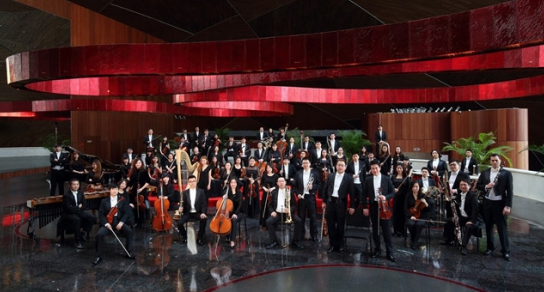
An exciting, successful concert was given on Monday night by the orchestra of China’s National Centre for the Performing Arts. This seems to me to be an unbilled youth orchestra, for the ages of the virtuosic players appear to be late-teens to mid-twenties. Even their excellent conductor is younger than average, as conductors go. I did not hear one single flub of a note, even in the treacherous horn (and other wind) parts. The strings make a luscious warm sound that would be the envy of any orchestra; and these players not only play their instruments beyond reproach, but their interpretations are full of real passion.

The first work, Qigang Chen’s Luan Tan, in its US premiere, was most effective for me in its early minutes, where the persistent click of the temple blocks really seemed authentic and mysterious. (Unfortunately, it was marred by a very noisy group of people who were in the reverberant hall just outside the auditorium.) The title of the work refers to a style of Chinese drama in the 17th century, one that was rowdy and boisterous, rather than based on decorum. Later, the work veered into what I would call “Debussy 2.0” (the late Debussy of Jeux), not surprising in a student of Messiaen. The piece built and built relentlessly, until I began hearing the influence of another French composer, Ravel, in the annihilating crescendo of his Bolero. Luan Tan even ends with a similar closing figure to Bolero. The frenzy was beautifully conveyed by the group.

Haochen Zhang, pianist


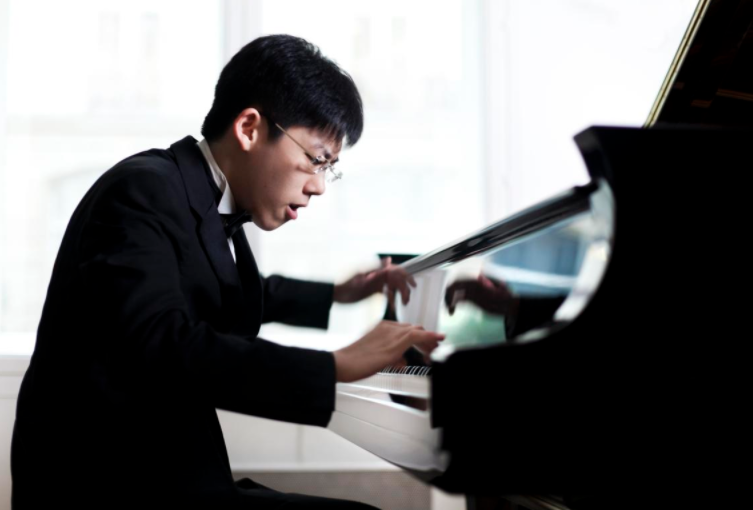
The next work, I will admit, I am not predisposed to like at all, was the totemic Yellow River Concerto. It is a four-movement work adapted from an earlier cantata, and it is so derivative in its bombast that I just can’t take it seriously. The whole thing sounds like bad Tchaikovsky, Rachmaninoff, Dvořák, and even Stephen Foster at times. I don’t see why such an important symbolic work should sound so “Western.” Even the pentatonic folk tunes on which it is based are stereotypical of what’s bad about imperialism, bound to major-minor tonality. I do apologize to any Chinese folk who think I am stupid or narrow-minded; I am not. The Yellow River is a “mother river” symbol, and as such, is very important to the Chinese. I first heard the work played by Lang Lang at the 2008 Olympics in Beijing. Since Lang Lang injured his left arm through over-practicing Ravel’s left-hand concerto, he was replaced here by Haochen Zhang. It is therein that the magic begins- this pianist was simply superb. He was the gold medalist at the 2009 Van Cliburn competition, and has since made a good career for himself.

Mr. Zhang drew me right in, despite my considerable reservations about the piece. I simply cannot recall the last time I heard a pianist of such quality and poetry. Every phrase was effortlessly dispatched, and lyrical passages sang with unbelievable poignancy. Also, on a less profound note, his repeated notes (in imitation of a Chinese wind instrument) were gasp-inducing; and he played this whole thing with sobriety, and with none of the theatrical facial contortions one has come to expect from Lang Lang. After his glorious ovation, he returned for a well-deserved piano solo encore: Chopin’s Lento con gran espressione (Nocturne) in C sharp minor, Op. posth. (1830). It passed by in a ravishing, delicately melancholic dream-state, the effusion of a very “old-soul” pianist.

After intermission, the orchestra gave a fully charged reading of Sibelius’ best-known and loved symphony, the Second, Op. 43 (1901/02). Sibelius’s lonely grandeur and constant questing were given ample space and time to occur. (The only finer performance I’ve ever heard was by Leonard Bernstein.) The deep, full-throated string tone was stunning, with a great sense of pull and elasticity, and the winds were perfect. The pizzicati in the second movement were perfectly together and expressive. The symphony gave rise to many conflicting opinions in the early 20th century, some not-so-favorable—people who were used to clear structural cues were disoriented (though they are present). I always think it’s wiser to feel the climaxes, those typical events in which Sibelius’ cosmos just seems to end, followed either by silence, or a renewed sense of either faith or optimism. These are the events that are his structure, and they were powerfully rendered by this orchestra under their superb conductor.

After the Sibelius, the orchestra performed two encores- Bamboo Flute- Tune, by Yuankai Bao, and Brahms’s Hungarian Dance No. 6.


Share

A Concert Celebrating the Publication of Barrett Cobb’s book, Walk, Shepherdess Walk, in Review

A Concert Celebrating the Publication of Barrett Cobb’s book, Walk, Shepherdess Walk, in Review

Barrett Cobb, flute/mezzo-soprano; Chris Fecteau, piano;

Teresa Diaz, flute; Rae Ramsay and Ruth Ann Cunningham, sopranos;

Elizabeth Thorne, Mezzo-soprano; Kate Goddard, violin; James Diaz, narrator

Special guest: Harry Saltzman

Church of the Good Shepherd, New York, NY

October 29, 2017


In celebration of the recent release of her sing-along book, Walk Shepherdess Walk, the author/illustrator Barrett Cobb, in her other roles as singer, flutist, and composer, gave a delightful program this Sunday based on pastoral themes. The above sentence warrants a long pause: singer, flutist, composer, author, and illustrator/painter! One often calls versatile artists “triple-threats” but Barrett Cobb is really a quintuple threat and more. For full disclosure, I had encountered some of her writing in her work for New York Concert Review, but her other gifts, as well as her winning presence in person, are new to me.


The concert was subtitled “A Program of Mostly Sheepish Music.” Though musical themes of lambs and shepherds might to the untutored seem rather limiting, the program’s reach was actually quite broad, touching on profound and beautiful themes that have recurred in music for centuries. Along with the likeliest choices (naturally several Agnus DeiLamb of God – settings), there was related music of pan pipes, satyrs, and walking woven into the program in organic ways, including Claude Debussy’s exotic Syrinx and the show tune You’ll Never Walk Alone from Carousel (Richard Rodgers), without ever straying too far afield.


The concert opened with Barrett Cobb singing Antonín Dvořák’s Songs My Mother Taught Me, in homage to her own mother, who taught her the book’s title song Walk, Shepherdess, Walk, by Eleanor Farjeon. Ms. Cobb sang the Dvořák with true feeling, sure intonation, and a lovely tone that projected well in the highly reverberant church. It was a deeply touching tribute. Sensitive accompaniment for the entire program (except the unaccompanied Debussy and Scull selections) was provided by pianist Chris Fecteau.


Following the Dvořák came the song Walk, Shepherdess, Walk, for which Ms. Cobb played the flute in her own charming arrangement, along with soprano Ruth Ann Cunningham and Mr. Fecteau. Again, it was beautifully done. It was a novel experience to hear a performer move so fluently from singing to playing the flute on the same recital, both at such a remarkable level. Incidentally, I listened to Ms. Cobb’s recording that accompanies her book (as the title song can be downloaded at www.walkshepherdesswalk.com), and it is winsome, but it actually does not do justice to her voice as we heard it live on Sunday – one usually finds the reverse to be true!


After this introductory set of songs came a grouping entitled “Sheep” containing some of the world’s most famous pastorally inspired music. Naturally a program about lambs and shepherds would be unthinkable without J. S. Bach’s Sheep May Safely Graze (from Cantata BWV 208), and so this aria followed with the three performers we had just heard, joined by Teresa Diaz on second flute. It was a beautifully balanced rendition of a beloved classic. Equally appropriate was He Shall Feed His Flock, from Handel’s Messiah, and Ms. Cobb and Mr. Fecteau handled it well. The spiritual, Listen to de Lambs, closed the set in a soulful way.
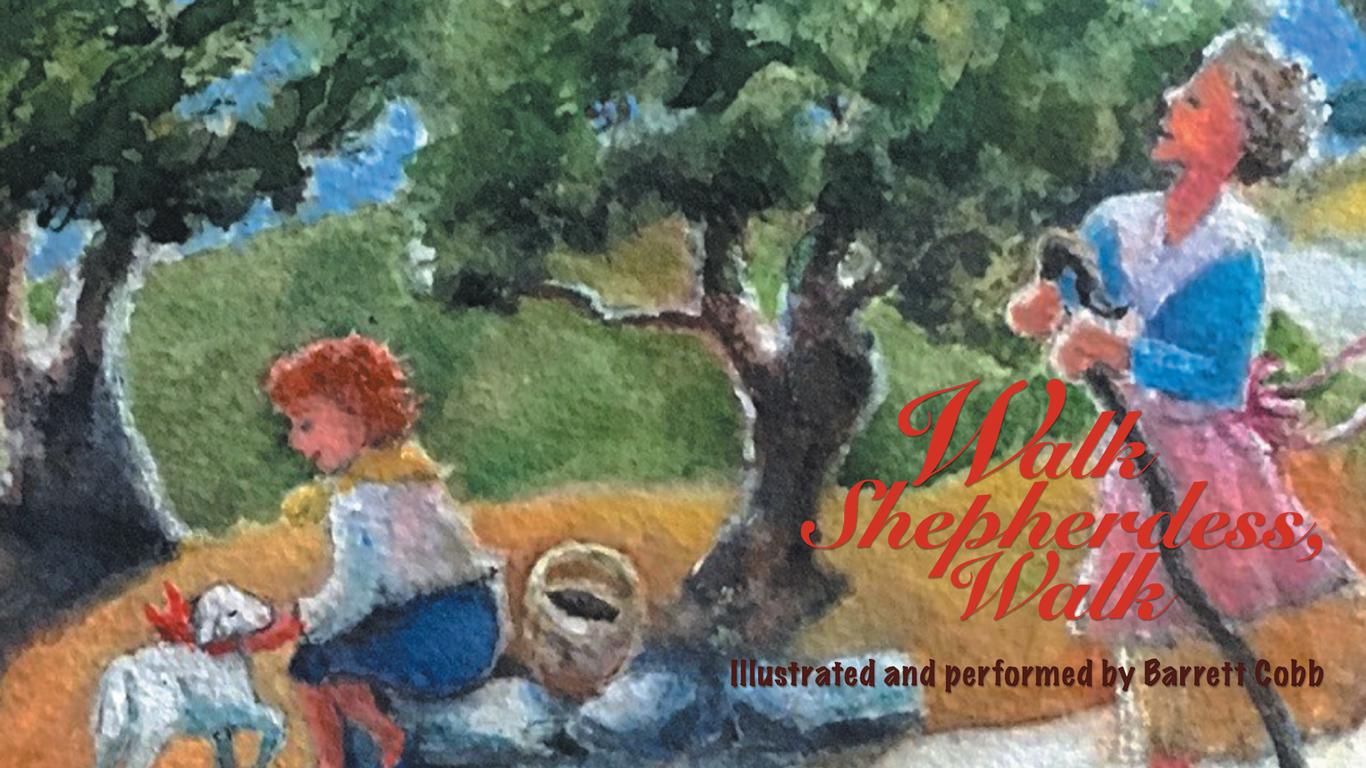
 

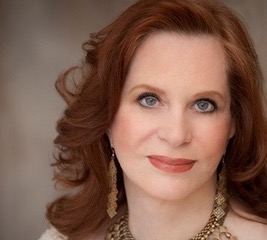
 Walk Shepherdess Walk, the author/illustrator, singer, flutist, and composer

Barrett Cobb


The program’s next section, containing just one piece, was entitled “A Shepherdess” and cast the shepherdess as object of the unrequited love through Mozart’s setting of Goethe’s poem, Das Veilchen (The Violet). Ms. Cobb found just the right balance of mood between the song’s bucolic innocence and the pain of the trampled violet’s story, giving a light touch to the disturbingly facile resolution of Mozart’s final added line.


Moving to music about lambs in a more religious context (a section entitled “Lambs of God”) we heard the Agnus Dei from Bach’s Mass in B minor, followed by Barrett Cobb’s own Agnus Dei, and the Agnus Dei from Petite Messe Solemnelle by Rossini. It was quite interesting to hear three settings of the Agnus Dei in a row. Bach’s is famously heart-rending and was sensitively done by Ms. Cobb with the addition of Kate Goddard on violin. Ms. Cobb’s own composition followed it well stylistically, without any attempt to overturn tradition or to be original for originality’s sake. The Rossini brought the first half to a grand close, followed by a brief intermission.


Along with the text of the song Walk, Shepherdess, Walk, illustrated line by line with enchanting pastoral watercolor images in Ms. Cobb’s book, the book also contains her own brief story entitled “A Lamb’s Tale.” Present to read this tale was narrator James Diaz, a welcome new voice. To set the stage was Schumann’s tender ode to delicate innocence, Du Bist Wie Eine Blume (You are Like a Flower), sung by Ms. Cobb, and the reading was followed by another of Ms. Cobb’s own compositions, The Lamb’s Lament, for alto flute and piano. The piece reminded one faintly of Poulenc or Ibert, though with its own distinctly individual and melancholic voice. It was played hauntingly by Ms. Cobb, with gentle support from Mr. Fecteau, as ever.


The section of the program entitled “Pan’s Lament” featured Debussy’s Syrinx, a musical depiction of the mythological origin of pan pipes. Here, Ms. Cobb as flutist was at her finest, with Debussy’s sinuous lines shaded perfectly.


On a nostalgic note, the program continued under the heading “Lost Lambs” with the Whiffenpoof Song by Guy H. Scull (ending with Baa-ing). It brought a collegial (and collegiate) touch and was given a spirited performance by the quartet of Ms. Cunningham and Ms. Cobb, joined by soprano Rae Ramsey and mezzo-soprano Elizabeth Thorne. The classic Gershwin tune Someone to Watch Over Me, sung by Ms. Cobb, closed the grouping with sentimental grace.


The final selections under the heading “Walking Songs” began with one of my personal favorites, Handel’s Where’er You Walk (from Semele), inadvertently listed as being by Purcell (who was also inadvertently listed as having lived from 1659-75, a mere sixteen years). It is not my intent to (ahem) lambaste anyone or in any way, er, ram these corrections through, but given this program’s potential for future performances, these typos should be fixed. No one wants to “pull the wool over anyone’s eyes” about composers’ lives!


An unexpected delight was the unannounced appearance next by Ms. Cobb’s husband, Harry Saltzman, singing Walkin’ My Baby Back Home, by Fred Ahlert. Complete with baseball cap and vaudevillian gestures, he brought added fun to an already very friendly event, and the audience loved it. Ms. Cobb followed with her finale, a powerful rendition of You’ll Never Walk Alone (from Carousel, by Richard Rodgers). What a pair!


The sizable and enthusiastic audience gave a standing ovation and for an encore was invited to sing along in Walk, Shepherdess, Walk, before a reception that included (you guessed it!) “Goats do Roam” wine. Bravo to the many people involved in this memorable afternoon, at least five of whom were Barrett Cobb!


Share

Mechanistic Music: In Memoriam Paul Zukofsky in Review

Mechanistic Music: In Memoriam Paul Zukofsky in Review

Mechanistic Music: In Memoriam Paul Zukofsky
Aaron Likness and Andrew Zhou, pianists
Elebash Recital Hall, CUNY Graduate Center, New York, NY
October 12, 2017


The Paul Zukofsky Memorial Concert, entitled “Mechanistic Music,” took place at Elebash Recital Hall at CUNY’s Graduate Center in Manhattan, and was pre-arranged between tonight’s artists and the late Paul Zukofsky in the months before his death. The first step for this program transpired when Mr. Zukofsky showed the score for Craig Pepples’ Monkeys at Play to his life-long friend, the pianist Ursula Oppens, who in turn passed the score on to the piano duo of Aaron Likness and Andrew Zhou. As a result, the work was given its world premiere this evening, and with the ‘mechanistic’, yet light-hearted sounds, one could see why Mr. Zukofsky, who was often known for his dry wit, wanted the work performed. There are almost as many pauses as notes—well not quite—and yet these silences felt ironic at a time when Mr. Zukofsky himself was silenced (although certainly not forgotten). Pianists Aaron Likness and Andrew Zhou performed this work with an artistry that kept the audience entertained—during the interplay as well as the moments of quietude. I enjoyed the work, and it stands out as a unique and riveting piece of music that illustrates the range of the piano in addition to utilizing rhythmical intricacies to specifically evoke the sound of monkeys typing on algorithmic keyboards. The concept combines primitive and futuristic elements in a way that’s enlightening. My only criticism is that it felt like the material was overstated by work’s end and that it could use a cut.

Stravinsky’s Sonata for Two Pianos is strikingly one of his more lyrical works—surprising since its keyboard instrumentation might lead one to believe that we would get thornier, more percussive music similar to the Symphony in Three Movements or Petroushka. The playing by Mr. Likness and Mr. Zhou was extraordinarily expressive, conjuring up the lush sounds of harps and strings. Stylistically and harmonically present were the Neo-Classical qualities of Pulcinella. The Ives work on this program, Impression of the St. Gaudens in Boston Common, the piano version of what became the first movement in the orchestral work Three Places in New England, is unique for its polytonality, lush harmonic palette (with an abundance of pedaling creating a wash of sound) and—oddly enough—a blues-like ostinato bass line during its solemn Civil War-march passages. Mr. Likness gave it a hauntingly beautiful solo performance.

During his last months, Paul Zukofsky suggested some other pieces for the program. According to composer Craig Pepples, Mr. Zukofsky hesitated before adding Satie’s “Cinema” from Relache to the program, with its outrageous insertion of Chopin’s funeral march, but after thinking about it, he finally pronounced it “wonderfully cheerful”. The piece (for one piano, four hands and arranged by Milhaud), with its extreme, predictable repetition, was originally a surrealist ballet with a cinematic interlude. The annoyingly repetitious strands, with its banal 8-bar phrases, seems exclusively suited to the cinema or ballet, but it may be this kind of drawn-out, simplistic humor that Mr. Zukofsky wanted to leave us with—a sort of eternal frolic. This Satie is opposite of Mr. Zukofsky’s taste in the complex, irregular modern scores he championed. Maybe he wanted the last laugh.

Share

The New School/Mannes School of Music Presents the Winners of the 2017 Mannes Concerto Competition in Review

The New School/Mannes School of Music Presents the Winners of the 2017 Mannes Concerto Competition in Review

Mannes Orchestra, David Hayes, Music Director
Tishman Auditorium, New York, NY
October 20, 2017


New York City offers incredible cultural riches, as most people know, but what not everyone realizes is that some of the best of it is free, in the form of student concerts given under the auspices of the leading music schools, among them the Mannes School of Music. The performances by such young musicians, who give their all, can be the most exciting and passionate experiences one encounters in live music.


Last Friday night I was assigned to review the Mannes Orchestra concert, in particular the performance of one of two winners of their concerto competition, pianist Ivan Gusev. playing Grieg’s Piano Concerto in A Minor. The other winner of the concerto competition, timpanist Jeffrey Kautz, was to perform Raise the Roof (2003) by Michael Daugherty (b.1954). Though I was not needed to be there, I decided to gain a feel for the orchestra by hearing the first half, including the timpani concerto plus the orchestra’s opening work, Capriccio Espagnole, Op. 34, by Nikolai Rimsky-Korsakov.


As I’m not one who withstands high decibel levels, I sat far enough away to be safe, and was ready to plug my ears discreetly if necessary. Thankfully plugs were not needed, and in fact I wish I had sat closer to the stage for one of the most riveting virtuoso feats I’ve seen in a long while. Mr. Kautz is a timpanist of flabbergasting ability, who made the ingenious Daugherty work do just what its title suggests, that is, to “Raise the Roof.” The opening Capriccio Espagnole also provided showcases for some remarkable individual talents, as the orchestral section leaders took turns in some of Rimsky-Korsakov’s irresistible and idiomatic melodies.


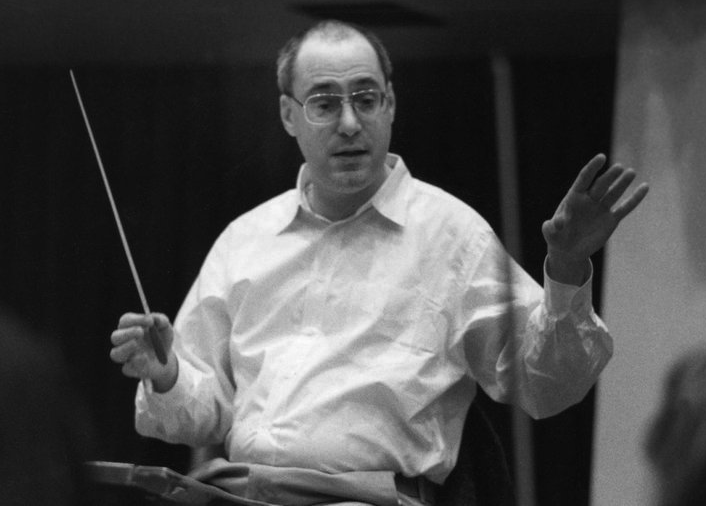
The conductor at the helm of all the excitement was David Hayes, who leads his players with the kind of limitless, infectious energy that is especially remarkable in view of the fact that he is among the busiest conductors around (conducting at Curtis as well as Mannes, to name just two) – yet there is no sign of “phoning it in” or flagging in the slightest!


All of this seemed a tough act to follow after intermission, but the Grieg Piano Concerto proved, with its captivating drama, sumptuous melodies, and folk rhythms, to be as timeless as ever (and fire-resistant against the backdrop of the Daugherty pyrotechnics)! While the pianist, Ivan Gusev, had a formidable task cut out for him, he was more than up to the challenge. He gave a performance that let the gifts of Grieg shine brightly – technically assured without being too flamboyant and sensitive without being too self-indulgent.


Currently pursuing his Master of Music degree as a student of Jerome Rose, he has been a winner of the International Piano Competition in Finland (Jyväskylä, 2006), laureate of the Mauro Monopoli Prize International Piano Competition (Barletta, Italy, 2013), The Benditsky Russian piano competition (Russia, 2015), and the Third International Neuhaus piano competition (Russia, 2015), as well as recipient of other distinctions, including honors from Moscow Conservatory as student of Eliso Virsaladze and Michail Voskresensky. In addition to being a winner of the Mannes 2017 Concerto Competition, he was recently a prizewinner at the 2017 New York Piano Competition.


What immediately struck the listener about Mr. Gusev in the Grieg was his strong sense of the collaborative aspects of the concerto. Conductors in general love it when a pianist can treat a concerto like a piece of chamber music, because it lightens their responsibilities considerably. Mr. Gusev is secure enough with the nuts and bolts of playing to do just that. Through passages where many pianists would be fixated on the accuracy of an arpeggio, for example, Mr. Gusev had his sights never far from the conductor. Not once in all the thrilling runs and technical hurdles did he succumb to the temptation to “go rogue” but was always extremely attentive to the conductor and mindful of cues, entrances, and transitions.


Sometimes, considering such a skilled conductor on the podium, one wondered whether the pianist’s own cues might even have been a bit overstated, such as the highly accented tremolo chords before tuttis (the first of which might have been eased by more bass power). Then again, such junctures tend to invite awkwardness (as one did in the last movement), so it is better to be safe than sorry. All in all, Mr. Gusev’s thoughtful approach achieved admirable results.


The slow movement, containing Grieg’s most heart-rending lyricism, was beautifully projected. Mr. Gusev worked hand in hand with the orchestra to create a hallowed atmosphere, with seamless lines and a warm and balanced sound.


If the opening of the third movement was thrown off a bit, it was perhaps the challenge of breaking such a spell as one moves into the pace of a folk dance; dancing was what it did, however, and it brought the piece to a fine finish. All in all, the performance was a fine success and capped off a powerful concert.


This was an evening not to be forgotten – and first for this reviewer at the Tishman Auditorium, undoubtedly the setting for many future musical adventures. Bravo to the Mannes School of Music, and to the conductor, orchestra, and soloists!

Share

The Center for Contemporary Opera Presents Gordon Getty’s “Scare Pair”: Usher House and The Canterville Ghost in Review

The Center for Contemporary Opera Presents Gordon Getty’s “Scare Pair”: Usher House and The Canterville Ghost in Review

The Center for Contemporary Opera Orchestra, Sara Jobin, conductor
Gordon Getty, composer
The Sylvia and Danny Kaye Playhouse at Hunter College, New York, NY
October 19, 2017 at 7:30pm


It is something of a rarity to have two operas performed in a single evening, but on October 19, 2017, The Center for Contemporary Opera presented what was billed as a “Scare Pair”: Usher House and The Canterville Ghost, by American composer Gordon Getty. Each single-act opera is approximately sixty-minutes in duration. There was a pre-concert interview with Mr. Getty to learn more about these works. The program contained a synopsis of each work, and it was a nice touch to have the names of the orchestra members listed in the program along with the members of the creative and production team.

Gordon Getty is well-known for his patronage of the arts, but he considers composing his true passion. The now 83-year-old composer is the subject of a PBS documentary, Gordon Getty: There Will Be Music. His style is strictly tonal, often to the point of being monochromatic. Quoting Mr. Getty, “My style is undoubtedly tonal, though with hints of atonality, such as any composer would likely use to suggest a degree of disorientation. But I’m strictly tonal in my approach. I represent a viewpoint that stands somewhat apart from the twentieth century, which was in large measure a repudiation of the nineteenth and a sock in the nose to sentimentality. Whatever it was that the great Victorian composers and poets were trying to achieve, that’s what I’m trying to achieve.”

Mr. Getty has the integrity to post on his website all available reviews (www.gordongetty.com), many of which are very harsh. For this decision he has my respect, especially in a world where artists share only praise.

This is not this reviewer’s first experience with the music of Mr. Getty, as he previously reviewed “The White Election,” a song cycle of Emily Dickinson poems (The White Election in Review April 19. 2012). I was especially curious to hear how Mr. Getty handled larger works.

Usher House is based on Edgar Allan Poe’s short story The Fall of the House of Usher. In the words of Mr. Getty on the subject of the libretto he wrote, “I found myself taking liberties.” Poe himself is inserted as the narrator. Roderick and Madeline are re-cast much more sympathetically than in Poe’s actual tale, while introducing/inventing a character named Dr. Primus as the villain. Mr. Getty’s libretto would have benefitted from editing by an experienced librettist, as his version lacks clarity and there is far too much superfluous dialogue. Dr. Primus seems like an evil version of Sarastro, but his motivations other than just being evil were never made clear. In addition, calling Poe “Eddie” was bizarre to my ears.

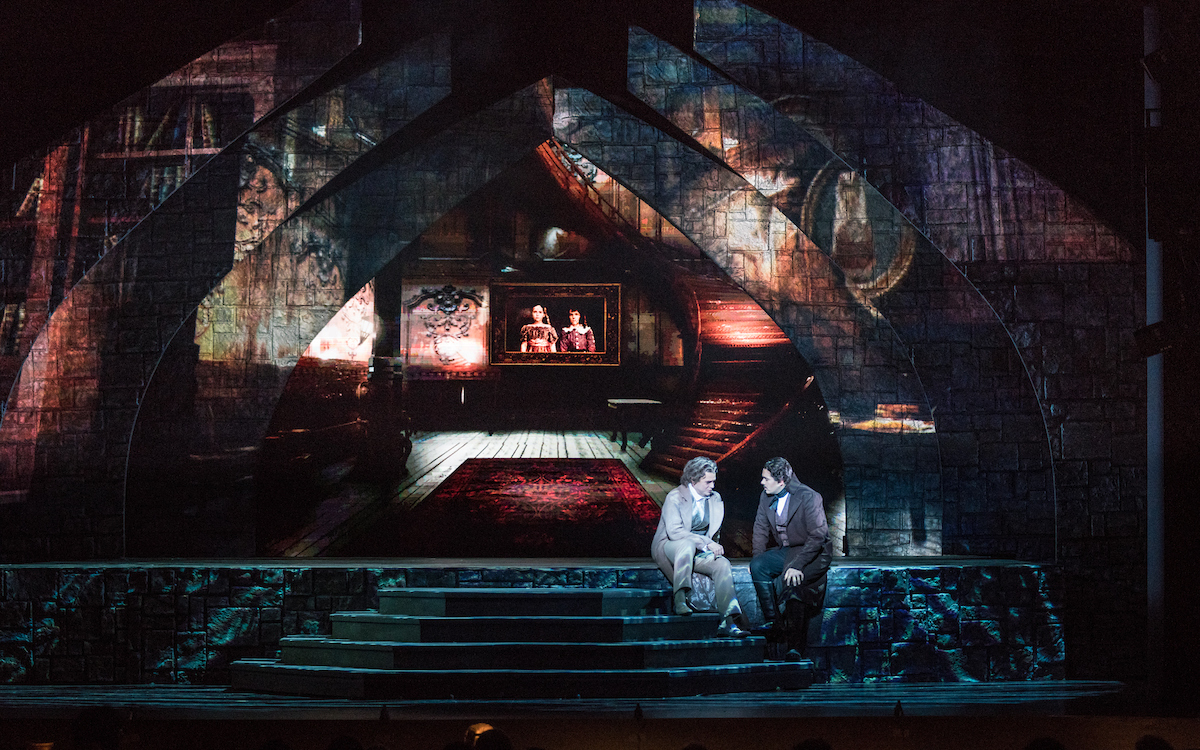
The set was a series of projections on the stage, which was very good in creating the gloomy atmosphere of the Usher House, along with some “guest appearances” of ancestors, who may or may not have been apparitions depending on one’s viewpoint. Perhaps these projections were designed for a larger stage, as they were often out of proportion to the surroundings, especially the ancestors, who dwarfed the “living” persons on stage. There were supertitles projected above stage, which were helpful, without being entirely necessary, given the excellent diction of the performers.

Almost all the vocal writing in Usher House is recitativo, so much so that it wears thin on this listener. One can almost predict how the lines will be sung because of the repetitiveness of style, overly laden with fourths and fifths. The one actual aria, the lovely “Where is My Lady” as sung by Poe is proof that Mr. Getty can write effectively, making it all the more frustrating that there is not more. The orchestrations are sparse and rely heavily on creating effects (some bordering on stereotypical kitsch) instead of propelling the story or providing melodic material. It all meanders about, with the final destruction of Usher House rendered with a whimper instead of a bang.

All praise goes to the cast, who gave this material their full commitment. Dominic Armstrong as Edgar Allan Poe proved his vocal talents despite little material to work with. Keith Phares played Roderick Usher sympathetically, Matthew Burns was appropriately sinister as Dr. Primus, and Jamielyn Duggan’s macabre dance as Madeline might have been the highlight of this performance for the audience, who applauded respectfully.

After intermission, the hardworking cast members were back for American premiere of The Canterville Ghost. Based on Oscar Wilde’s 1887 story of the same name, the tale centers around the ghost Sir Simon de Canterville, and the Otises, an American family who purchased the property known as the Canterville Chase. For hundreds of years, Sir Simon has been terrorizing residents of the Chase, but the Otis family proves less than intimidated by his presence. Sir Simon is continually humiliated by the members of the family, save for daughter Virginia, the one member of the family sympathetic to Sir Simon.

As with Usher House, The Canterville Ghost relies heavily on recitative. There is a need for “smoothing” the libretto, as many scenes end abruptly, with awkward silences filling the air as the next scene is being set. Projections were used as well as fixed sets. There must have been limited rehearsal time, as the performers often were standing in the middle of projected images.

At the risk of repeating myself, the overuse of recitative, the skeletal orchestration, and the hackneyed musical elements are every bit as present in Canterville as in Usher House. Where The Canterville Ghost succeeds is in its fidelity to Oscar Wilde’s brilliant wit – the music is completely incidental. In spite of this, The Canterville Ghost is a delightful romp. Kudos to the cast, with special mentions to soprano Summer Hassan, who as Virginia wowed with her soaring voice in “Stay With Me Beautiful,” and to Matthew Burns as Sir Simon, whose comedic gifts stole the show.

The audience gave the cast a standing ovation, and when the affable Mr. Getty joined all on stage there were shouts of “bravo!” that filled the hall.


Share

Dan Auerbach in Review

Dan Auerbach in Review

Dan Auerbach, solo violin
The West End Presbyterian Church; New York, NY
October 14, 2017


The violinist Dan Auerbach presented an evening of unaccompanied works for the violin in a concert that was unconventional in almost every aspect of programming. In the modest, but acoustically sound main chapel of The West End Presbyterian Church, the tripartite recital was given without an intermission, and with barely a break between a succession of meaty, challenging works, both technically and interpretively.

Mr. Auerbach’s playing shows a abundance of both intellect and facility. It cannot be easy to start any program with the Bach D minor Partita, and even harder to play it as well as he did. Overall, his phrasing was lucid, fluid, his tone solid but never harsh, and his intonation secure, even in the most difficult double and triple stops. The Allemande was propulsive, declamatory, almost conversational, followed by a Courante that was feathery light, accurate but simply rendered. As in the first two movements, the dynamic range of the Sarabande and Gigue tended judiciously toward the soft, a welcome choice that drew the listener in rather than a more presentational approach. Mr. Auerbach ended with a beautiful account of the great Chaconne, especially strong in the outer minor sections. It is difficult to find the right tone after the modulation to D major, and I don’t think Mr. Auerbach ever settled into a convincing interpretation here, but his transition back into minor was finessed elegantly. This was a very satisfying performance.

After the briefest of bows and a bit of drying off with a handkerchief, the violinist launched into the Hudba for Solo Violin, Op. 9b, by the Czech composer Alois Hába. As a preface to this piece, Mr. Auerbach spoke of the composer’s work with microtonal music, and specifically the use of quarter tones in the Hudba. Right away, from the opening Allegro, the violinist made a great case for this overlooked composer. With a more boisterous, aggressive style of playing, he drew long, arching phrases. The Andante movement, alternately lyrical and heated, ended poetically, with a long, sensitively played decrescendo. By now, the ear was accustomed to smaller intervals, and I realized that, as a compositional tool, microtonality can be employed for more nuanced, detailed expression, much the same as our own human voices. Mr. Auerbach layered his playing of the Scherzo and final Moderato movement with a quiet control of murmuring tremolos, lightning fast scales, and difficult passages in the alpine regions of the instrument. Again, this was a completely convincing reading of an impressive composition.

With barely a moment to recover and readjust his ear to Western tonality, the violinist tore into the first of three selected Paganini Caprices, Op.1, No. 14. This Caprice, with its preponderance of multiple stops, is a challenge under any circumstances. After having played the Hába though, it became even more of a hurdle. Mr. Auerbach handled it well, though he did retune immediately after. He should give himself more of a break in the future. Caprice No. 5, however, needed no such disclaimers. It was simply virtuosity of the highest order, with a fluidity and security that is rarely seen. By this time, Mr. Auerbach may have regretted leaving No. 11, the hardest, for his finale. He gave a creditable account, and was rewarded with warm applause from the audience.

It is a pleasure and a relief to encounter artists such as Mr. Auerbach. He is a gifted, serious musician who places the integrity of the music and the composer first. I see from his biography that he is a devoted teacher, and I can only say that it gives me hope for the next generation of violinists.

Share

Ogninana & Michael Masser Family Foundation and Waring International Piano Competition present Yi-Yang Chen in Review

Ogninana & Michael Masser Family Foundation and Waring International Piano Competition present Yi-Yang Chen in Review

Yi-Yang Chen, piano
Weill Hall at Carnegie Hall, New York, NY
October 18, 2017


The winner of the 2017 Virginia Waring International Piano Competition (www.vwipc.org) , twenty-seven-year old Yi-Yang Chen , was presented by the Ogninana & Michael Masser Family Foundation and the VWIPC in a recital at Weill Hall on October 18, 2017. The intermission-free program included works by Beethoven, Debussy, De Falla, Rachmaninoff, and a piece composed by Mr. Chen.

Yi-Yang Chen is currently the assistant professor of piano and music theory at East Tennessee State University. In addition to winning the VWIPC, Mr. Chen’s biography lists many other victories and prizes in a number of equally impressive competitions.

Before anything else, I must revisit one of my pet peeves, the omission of program notes. There seems to be a trend in omitting any program notes. I am not sure if this is a cost issue (saving money on printing fewer pages) or the thought that they are unnecessary and therefore there is no reason to write them. While in some instances this might be the case (as often performers are playing works that are so well-known that the average listener would be familiar with them), this trend is nonetheless disturbing to this reviewer. Even brief notes would enhance the listening experience. I will return to this issue later.

Mr. Chen opened with Beethoven’s Bagatelles, Op. 126. A bagatelle, by conventional definition is a trifle, a thing of little importance. In music, it may be assumed to be a work in a light style, but Beethoven’s Op. 126, among his later works, are no trifles. Intended to be played as a set, these six miniatures contain some of the most revelatory and profound music to be found in such crystalized form. Mr. Chen projected a keen awareness of this truth, but perhaps occasionally his very admiration of the pieces became an impediment, his approach sometimes growing a bit fussy or persnickety. The notes were all there – and Mr. Chen was unfailingly accurate – but the word “overthinking” came to mind. While there may be a discrepancy between the lightness of the term “Bagatelle” and the weighty nature of Beethoven’s distilled musical feeling in his late years, it may be best to let the pieces unfold more freely and spontaneously, letting the listener discover the depths.

The Debussy works that followed, Étude 11 pour les arpèges composés and La Puerta Vino from the Préludes, Book II, were epiphanies. They glimmered with a wondrous radiance in a way that was completely natural. Mr. Chen seems to have an innate understanding for this music. It was some of the finest playing of Debussy this reviewer can recall hearing, either in concert or recordings, and the highlight of the evening for me.

Next was De Falla’s Fantasia Baetica. Written in 1919, it was commissioned by and dedicated to Arthur Rubinstein. It seemed appropriate that Mr. Chen should excel at playing De Falla, considering Debussy’s influence on De Falla, and Mr. Chen’s affinity for the former. He negotiated this difficult work with what appeared to be the greatest of ease. The passagework was sparkling, and the energy never flagging. Mr. Chen held the line and momentum throughout, challenges which many players struggle with in this work. It was an excellent performance.

Mr. Chen followed with his composition In Memoriam: Japan, March 11, 2011. The date refers to the cataclysmic earthquake and tsunami that struck Japan. There is obviously deep meaning in this event for Mr. Chen (as for the rest of the world), but it would have been both helpful and appropriate for some notes of explanation to be included. The titles of the two movements ( I. Twisting Path, II. Oblivion) were inexplicably missing from the program, but were included in some promotional materials. It opens with sledgehammer blows on the lowest A, which one would assume is the earthquake itself, some use of plucking strings inside the piano to create sounds similar to the koto, and other atmospheric effects using the inside of the instrument. There were moments in the second movement that were reminiscent of Janáček’s Sonata 1.X. 1905, “From the Street.” Unfortunately, if one strips away such random hints, there is little to inform the experience. The work is obviously programmatic, but one wanted further insights, lest one’s assumptions do a possible disservice to the composer and the performer.

Ending with Rachmaninoff’s bravura Sonata No. 2 in B-flat minor, Op. 36 (in the revised 1931 version), Mr. Chen’s was a powerhouse performance. This was not the cookie-cutter reading that one often hears from competition contestants. His bold, take-no-holds approach was all that one hopes for in this work. It is a high-risk proposition that demands a large technique, and Mr. Chen delivered. I’ve heard many performances of this sonata, and Mr. Chen’s ranks among the best. The audience rewarded Mr. Chen with a well-served standing ovation.

Yi-Yang Chen has the promise of enjoying a very successful career. I look forward to hearing him again in the future.


Share