Distinguished Concerts International New York (DCINY) presents Between Heaven and Earth in Review

Distinguished Concerts International New York (DCINY) presents Between Heaven and Earth in Review

Distinguished Concerts International New York (DCINY) presents Between Heaven and Earth
Distinguished Concerts Orchestra and Distinguished Concerts Singers International
James M. Meaders, DCINY Associate Artistic Director and Conductor, Tom Shelton, Guest Conductor, Richard Sparks, Guest Conductor
Jolaine Kerley, soprano; Timothy J. Anderson, narrator
Stern Auditorium at Carnegie Hall, New York, NY
March 7, 2016

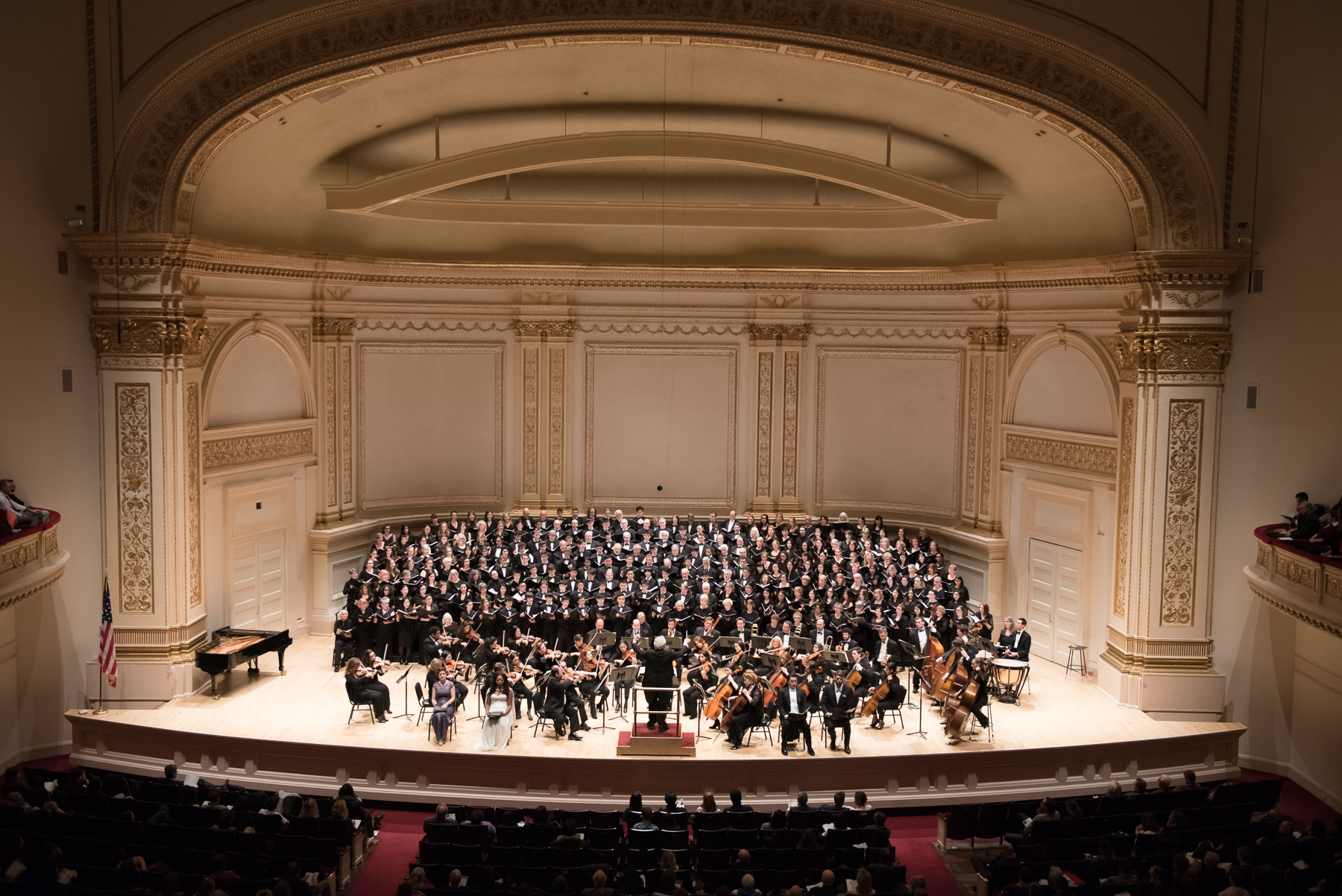
The massed-choir events presented by Distinguished Concerts International New York (DCINY) generally have a very high level of music making and popular success. Monday’s concert was quite a mixed-bag, gathered under the title mentioned above. The singers come from eight states and six foreign countries and are prepared by their individual local conductors before traveling to New York to combine with many other choirs.

The first one-third of the evening was devoted to seven selections for a huge youth choir, containing all age groups from small boys up to high schoolers. They were led efficiently by Tom Shelton, who also made some of the rather slick arrangements. The selections were not performed in the order listed on the program, and one was left out entirely. Perhaps I shouldn’t evaluate this performance with the same rigor I would apply to a professional choir. Surprisingly, the enormous group had trouble actually projecting, except when the vocal writing allowed the voices to soar to higher notes, where one could enjoy the characteristic gleam of such an age-group. The repertoire extended from modern sacred, to Baroque, folk-inspired (Stephen Hatfield’s moving Family Tree), even Italian madrigal. The exciting Ritmo by Dan Davison involved not only singing, but clapping, stomping, finger-snaps, chest thumps, and marching in place—a veritable encyclopedia of eurhythmics, accompanied by piano four-hands (the very capable Matthew Webb, assisted by his page turner).

Several instrumental solos were featured: trumpeters Anna Roman and Jesdelson Vasquez; and flutist Tamar Benami, as well as a fearless (uncredited) choir member for the concluding Go Down Moses. The performance certainly brought pleasure to the many parents and friends of the singers in the audience, and it is good to see young people (a) learning music at all, and (b) working together on something instead of the relentless isolating march of the cell phone.

After the infamous “brief pause” to shift huge choirs (only ten minutes this time), conductor Richard Sparks led a new chorus, narrator, and soprano, with a small ensemble of piano, organ, two oboes, two French horns, and a percussion assemblage, in the New York premiere of Toronto-based composer Allan Bevan’s Nou Goth Sonne Under Wode. The composer also played his own organ part. This work takes many of the sentiments in the traditional crucifixion scene Stabat Mater and ramps up the grief until a sort of transfiguration occurs to Mary, who then sings a concluding Alleluia. The choral writing relies too heavily on musical clichés of mourning, aiming for monumentality, but the whole was very sincere. The O Vos Omnes section was particularly successful. The part for narrator was a bit odd, sometimes too soft despite amplification. There were other moments when the chorus, narrator, and soloist were drowned out, despite the small instrumental ensemble size. The valiant soprano was the very good Jolaine Kerley, whose clarity and expression were top-notch. She wisely chose to just stop singing the climactic loud high D-flat (her last note) before it gave out entirely, just keeping her mouth open and letting the choral resonance fool you into thinking she was still singing it. Smart lady, this trick was sometimes employed by the likes of Elisabeth Schwarzkopf.

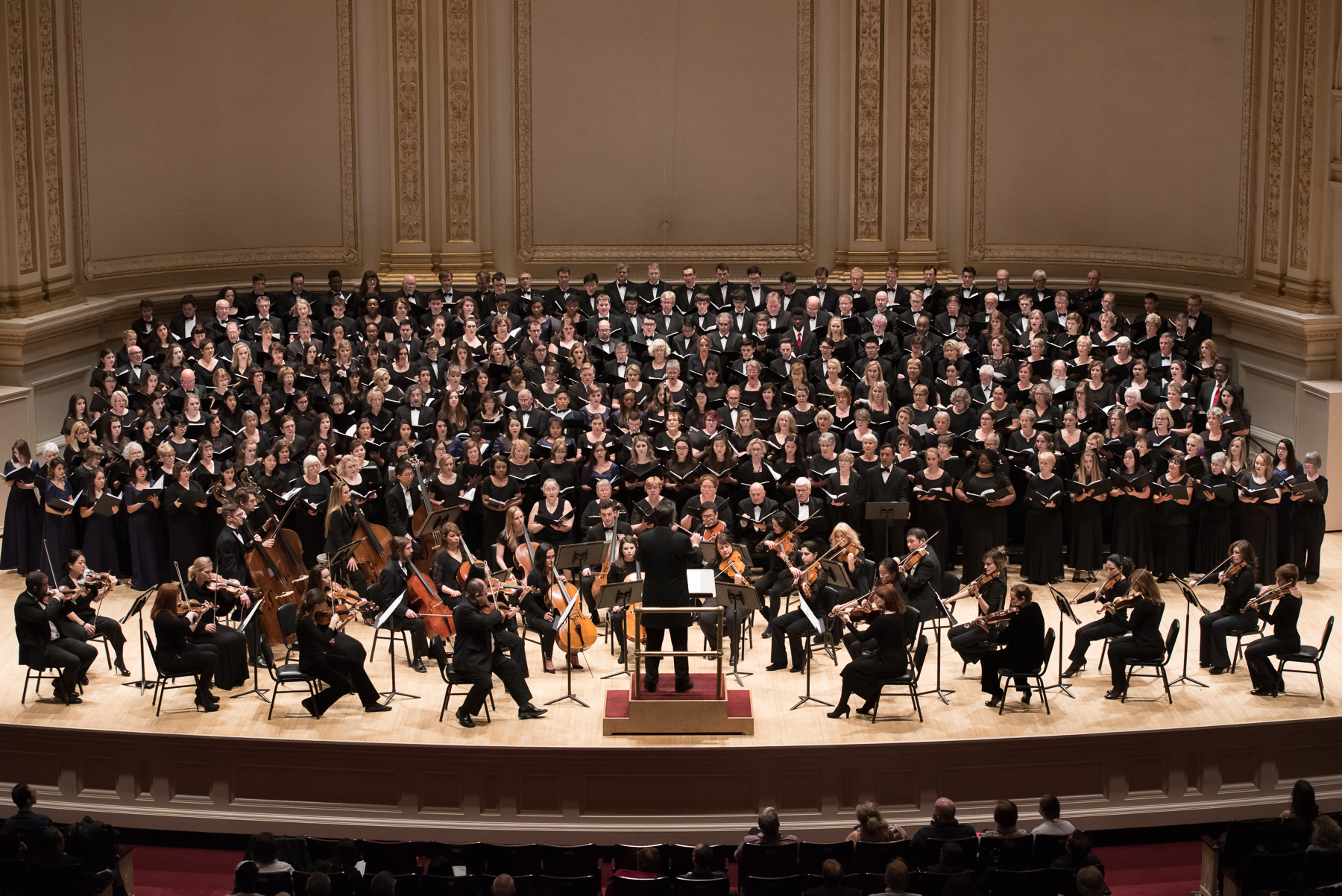
After intermission, James Meaders, one of DCINY’s associate artistic directors, conducted yet another two-hundred-plus singers and large string orchestra in the Sunrise Mass by the young Norwegian composer Ola Gjeilo. This was by far the most beautiful and intriguing work on the program. He set the traditional Latin texts of the Mass, but gave each section a title having to do with the (usually) natural world: The Spheres (Kyrie), Sunrise (Gloria), The City (Credo), Identity (Sanctus) & The Ground (Agnus Dei). His use of tone clusters and overlapping chords makes the musical language seem more modern than it really is, but very beautiful. In The Spheres, motives that are first heard “smudging” into each other are later presented cleanly as a melody by the choir. The work is also cyclic, that is, themes heard are reused elsewhere in the work, a time-honored technique and one that gives unity. There is perhaps a bit of over-reliance on stock “minimalist” gestures in the string parts. The final chord of the piece, on the word Pacem (peace) was stunning in its hushed quality, held for a very, very appropriate long time.

Perhaps music is what’s “between heaven and earth.”

Share

Legato Arts presents Sean Botkin in Review

Legato Arts presents Sean Botkin in Review

Legato Arts Presents Sean Botkin, piano
Weill Recital Hall at Carnegie Hall, New York, NY
February 24, 2016

Beauty and frustration are often lifelong companions of the artist—and also of the reviewer. Thus were my thoughts last evening at the powerful performance given by pianist Sean Botkin. I will confess that when I saw the program, including four mainstream composers, I was afraid it might be unimaginative. However, Mr. Botkin did program two rarities by two of them: Prokofiev’s First Sonata and Rachmaninoff’s First Sonata. The Russians clearly suit his type of pianism, and he has an affinity for them.

Every time I tended to get annoyed by a patch of sound that was too unrelievedly massive or too loud, then something sublime would occur, and I could forgive all. If I had any suggestion to make to this obviously well-equipped pianist, it would be: It is more interesting to “draw the listener in” to your sound world and the music, rather than to “push the music out” to them. This type of over-projection reminds me very much of “old-school” Juilliard thinking.

Mr. Botkin began with the Prokofiev, his Opus 1, written at age sixteen, revised a couple years later, and obviously well-thought of enough that it is included in his complete sonata corpus. Botkin played with controlled passion—there was lovely elasticity in the cadences and where the composer has indicated ritardando. The tone quality was beautiful, never bangy, and his architectural sense made this uncharacteristic work sound better than it actually is, albeit a bit blustery.

Mr. Botkin then followed with one of the great middle-period Beethoven sonatas, the G major, Op. 31 No. 1. It was in the Adagio grazioso middle movement that some of the loveliest playing of the whole evening occurred. He handled the extravagant pre-Rossinian operatic lines and accompaniments with sensitivity and elegance—his trill ability is miraculously even. However, in the first movement, he didn’t seem to emphasize the parodic element: Beethoven was either mocking a string quartet whose first violinist played before everyone else, or a pianist whose hands couldn’t play together, inverting the usual “left-hand before right.” It lacked impish humor. “However” however: he did scrupulously observe every single phrasing and articulation marking, even the ones that are less than convenient for the interpreter. The Rondo finale, was played too fast for a true Allegretto, despite Schindler’s unreliable testimony (as always) that it was to be played Allegro.

The first part of the recital concluded with a headlong performance of Chopin’s Fourth Scherzo, Op. 54 in E major. Here, in the sorrowful middle section, was the other highlight of the evening for me—absolutely gorgeous, intimate, lyrical playing. The outer sections lacked transparency and, for lack of a more politically correct word: “anima.” It was aggressive rather than elegant, and the harmonic shifts were not savored with sufficient sensuality.

After intermission, Mr. Botkin tackled the daunting and huge First Sonata by Rachmaninoff, the one the composer himself said that no one would ever play. Mr. Botkin has recorded it, and his mastery is evident in every passage, as is his clear point of view, again emphasizing power, volume, and big-line architecture over other aspects. Rachmaninoff had originally underscored the music with thoughts of a “program” dealing with the Faust legend: with Faust, Gretchen, and Mephistopheles symbolized in the three movements. It is a sort of concerto or symphony “manqué,” with all the unwieldiness that implies.

Mr. Botkin took a freely improvisatory approach to the beginning, with a sort of giant feeling of “leading-in” instead of a metrical obedience. Certainly this is one viable way to do it, however, one wonders if the basic rhythm of the “Faust motto” would have benefited from more discipline. Also ignored (I’m sure it was intentional, all part of his concept) were numerous dynamics, all on the softer side. Where I was sitting, there wasn’t much played below mezzo-forte, and all the louder passages were “scaled up.” This sort of sound tires the ear after a while, and the piece is long. This is not to say that he didn’t have beautiful lyrical moments, because he did. He was playing so strongly however, that the unisons of the piano’s strings were progressively going out of tune (first noticed in the Chopin, it got a lot worse later). I feared that he wouldn’t have anywhere left to go for the true fff on the final page of the last movement, but by golly he did. The sound impressed a lot of people, but to me it seemed like the distortion when a stereo is turned up too loud.

I predict good things for Mr. Botkin. I certainly don’t wish him to take my detailed listening habits and preferences for anything definitive or negative. But please, do think of varying your sound palate even more. There is incalculable charisma in charming the listener’s ears, and always making people think that you have something in reserve, that you are never at the outer limit of what you can do. And thank you for providing a correct program with program notes. Next time: an encore?


Share

MidAmerica Productions presents Pavel Šporcl with New England Symphonic Ensemble in Review

MidAmerica Productions presents Pavel Šporcl with New England Symphonic Ensemble in Review

MidAmerica Productions presents Pavel Šporcl with New England Symphonic Ensemble
Pavel Šporcl, Violin
New England Symphonic Ensemble; Maple Mountain High School Choirs
Giuseppe Lanzetta, David R. Thye, and Cory Mendenhall, conductors
Stern Auditorium at Carnegie Hall, New York, NY
February 13, 2016

On what was a marathon of a concert sponsored by MidAmerica Productions, the New England Symphonic Ensemble performed a brisk and polished account (aside from a few horn/wind entrances) of Beethoven’s Fidelio Overture and later gave grand presentations of Vivaldi’s choral work Gloria and John Rutter’s Magnificat. One also witnessed the unique violinist Pavel Šporcl performing two different styles of music.

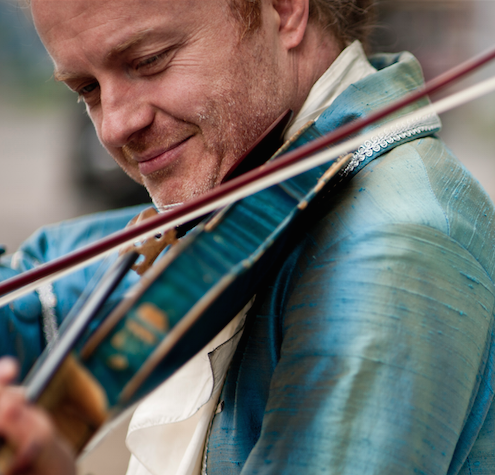
Pavel Šporcl is a virtuoso of the first order. If you want to hear a violinist facing the utmost challenges of Paganini, he is the one. Mr. Šporcl has tremendous flair and an unbelievably impressive technique. These attributes are ideal for late-Romantic and modern works, along with more contemporary popular styles. According to his biography, he likes to go beyond classical music and work with non-classical artists. His gypsy band projects “Gypsy Way” and “Gypsy Fire” have been seen in many countries in nearly 300 concerts. Mr. Šporcl plays on a blue violin built at his request by Jan Spidlen in 2005.

On this particular occasion, Mr. Šporcl’s main presentation was Mendelssohn’s Violin Concerto in E minor, Op 64. Most memorable here was the remarkable technique and brilliance he exhibited in the last movement. It seems to me with an orchestra of this chamber size and the possibly little rehearsal time allotted, the well-known Mendelssohn was the practical choice. However, I very much look forward to hearing Mr. Šporcl play virtuosic, cutting-edge concertos by Prokofiev, Stravinsky, and Shostakovich, and with Mr. Šporcl’s Czech heritage in mind, I’m sure he would give an exquisite interpretation of Dvořák’s melancholy and ethnically zesty concerto. His gypsy and pop selections will interest audiences greatly. Mr. Šporcl’s blue violin is indeed a visceral stand-out. It does not possess the warmth of other violins I’ve heard in this hall–and this is a main reason Mendelssohn wouldn’t be my first choice for this artist. In the first two movements, some of his notes lacked a classically pure expression or vibrato, and had a raw sound one associates with 20th century or pop/rock repertoire. When tempos pushed, conductor Giuseppe Lanzetta didn’t always anticipate Mr. Šporcl’s thinking, and the orchestra was behind at times. In the third movement, however, Maestro Lanzetta was prepared for the rapidity of speed, and both soloist and orchestra were unified. The last movement had as fast a tempo as you’ll ever hear, but it was performed with precision nonetheless.

Mendelssohn’s blazing finale perfectly segued to Mr. Šporcl’s encore, the Paganini Caprice No. 5. In addition to the audience, many orchestra members were studying Mr. Šporcl’s performance with awe. Thanks to a few persistent concert-goers, we actually got to hear this Paganini showpiece, as the bulk of the audience–not knowing the traditions of classical concerts–ceased clapping before Mr. Šporcl’s return to the stage. It was with the Paganini that Mr. Šporcl’s strengths worked the best: excellent intonation, a brilliant technique and bow-arm, a colorful sound with wide-ranging variety, and a flashy, tireless energy. It was already recording-ready (hopefully it was recorded–microphones were present). He is a unique artist that should get a lot more visibility on New York’s contemporary arts scene.


Share

Distinguished Concerts International New York (DCINY) presents Mozart Mealor Martin: Music of Joy and Sadness in Review

Distinguished Concerts International New York (DCINY) presents Mozart Mealor Martin: Music of Joy and Sadness in Review

Distinguished Concerts International New York (DCINY) presents Mozart Mealor Martin: Music of Joy and Sadness
Distinguished Concerts Orchestra and Distinguished Concerts Singers International
Vance Y. George, James Jordan, and Joseph Martin, Conductors
Penelope Shumate, soprano; Krysty Swann, mezzo-soprano; Youngbae Yang, tenor; Jeremy Milner, bass-baritone
Stern Auditorium at Carnegie Hall, New York, NY
February 15, 2016


Distinguished Concerts International New York (DCINY) continued its record of inspirational massed-choral and orchestra concerts, “changing lives through the power of performance,” as their motto states. It is truly a credit to the many individual local choral conductors who prepared these groups that came from all over the US, UK, Austria, and New Zealand, and had but a short time to work out a polished interpretation with all the other choirs, orchestra, and the “real” conductor. It is good to see that these individual conductors are given their own bow(s) after their groups have performed.

The concert was presented in inverse order of its title, hence Martin, Mealor, Mozart. A rather long group of faith- and patriotic-based material, all composed by Joseph Martin (one Irving Berlin arrangement) and conducted by him, opened the program on a suitably upbeat note. If the music wasn’t surprisingly original, it certainly was very pleasing and accessible for community choirs. This particular group of over two hundred had a surprisingly difficult time making itself heard over the full orchestrations, when singing at or below mezzo-forte. When singing by themselves however, the full volume passages were appropriately thrilling, although diction was fuzzy.

Would it be churlish to mention that these mass-choir events require a great deal of stage management, moving one group of two hundred off the risers, moving the next group on, etc. and that this stretches the times of the programs quite a bit? Perhaps this process could be streamlined. And please credit the excellent orchestra by listing its players; they play beautifully. After a very long “brief pause” listed in the program, came the stunning success of the evening: Paul Mealor’s Stabat Mater.

Let me go out on a limb here and state that when I die, if there “is” a heaven, I want it to sound like the music of Paul Mealor. I, like millions across the world, first heard his music in the form of the delicious Ubi caritas that was sung at the 2011 royal wedding of Prince William and Kate Middleton. Mr. Mealor has a way of conveying a divine radiance with his harmonies—although firmly anchored in traditional tonality, his way with a “cluster” creates a sort of spiritual “smudge” (he even mentions incense as an aid to worship, a high Anglican tradition) that is incredibly mysterious and moving.

The Stabat Mater, a portrait of the sorrowful mother of Jesus at the foot of the cross, hits all the satisfying points one could wish, and does not remain mired only in the pain of the scene, but progresses to acceptance, hope, and faith. The work is dedicated to Mr. Mealor’s grandparents. The conductor for this work was James Jordan (disclaimer: an alumnus of one of my alma maters: Westminster Choir College). We also share many of the same mentors in choral conducting. Of course credentials are worthless unless put into practice, and wow, were they ever put into practice. His choir sang with an infinite variety of color and dynamic contrasts, razor sharp diction despite the size of the group, and great emotion. The soprano soloist, the excellent Penelope Shumate (doing double duty in the Mozart Requiem) soared above the choir with her descant, which seemed the embodiment of light. The audience, after a transcendent and respectful silence at the end, erupted into a well-deserved standing ovation. The ensemble remained on stage for the World Premiere of a short, boisterous work Jubilate Deo, also by Mr. Mealor.

After intermission, the Mozart Requiem was conducted by Vance George, with yet another choral assembly of about two hundred. Here, the size of the choir was truly a liability. George took some quite brisk tempi that are utterly justified in light of historically-informed performance practice, but that a large choir would have trouble rendering distinctly. Again, the orchestra seemed louder than the choir, quite an accomplishment. There were numerous discrepancies of ensemble, and one false start, discreetly and rapidly remedied. The four soloists did not benefit from being separated: the two men stage left, the ladies stage right. This creates an automatic deficit in the feeling for cooperation. Ms. Shumate was joined by a fabulous mezzo-soprano, new to me, Krysty Swann, whose plumy tone was natural, never forced, and whose musicality was beautiful. The men fared somewhat less well: tenor Youngbae Yang certainly sang all the notes without strain, but without obvious emotional connection; and the bass-baritone Jeremy Milner made a stereotypically wooly, dark sound, and was out of tune in his “big” moment, the first phrase of the Tuba mirum (miraculous trumpet), which was fully a half-step too high by the end, while the trombone which symbolizes this summoning miracle messed up the arpeggios underneath the singer.

I don’t wish to carp, perhaps it was an off night for Mr. Milner, or for the choir, it is hard to wait backstage through a long concert—it certainly didn’t deter the enthusiasm of the many friends and family members of these dedicated singers who were present in the audience. After all, the motto of one of the Martin pieces “E pluribus unum” (out of many, one) could be taken as the way these singers and choirs come together as well. Truly inspiring.

Share

Composers Now Festival and CUNY Diversity Projects Development Fund present “Eastern Currents” with Ensemble 365 in Review

Composers Now Festival and CUNY Diversity Projects Development Fund present “Eastern Currents” with Ensemble 365 in Review

 Composers Now Festival and CUNY Diversity Projects Development Fund
present “Eastern Currents” with Ensemble 365
Sara Paar, soprano; Karen Rostron, violin; Alice Jones, flute; Marta Bedkowska-Reilly, cello; Mirna Lekić, piano
Tenri Cultural Institute, New York, NY
February 13, 2016

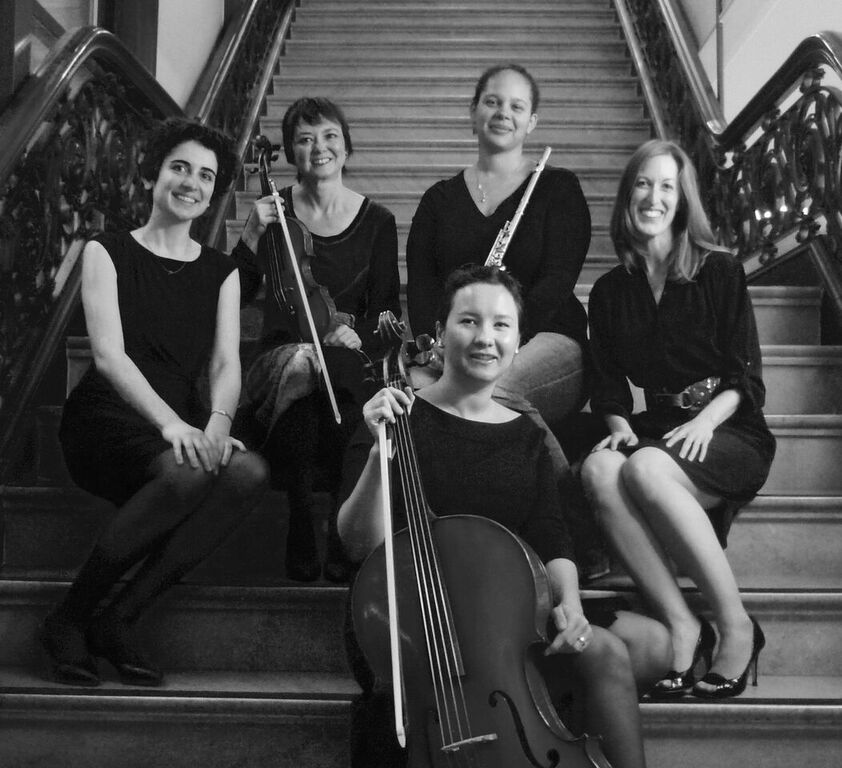
A hardy band of two dozen or so listeners braved the coldest night in one hundred years to attend a well-played program of non-standard music from the “Asian and Arab” worlds. The players in Ensemble 365 met while graduate students at CUNY in 2011, and their unity shows. Each is a very good individual artist, and they combine excellently as well.

Two works by a female composer from Azerbaijan, Franghiz Ali-Zadeh, were presented: Three Watercolors (1987) for voice and ensemble (including prepared piano). Only three of the movements contained the voice, the others were Prelude, Interlude, and Postlude for piano. The excellent soprano Sara Paar was sensitive to every expression in the text, by female Azerbaijani poet Nigyar Rafibeili. Ms. Ali-Zadeh’s second work was heard after intermission: the Music for Piano, with a glass-bead necklace placed over some of the strings, to give the impression of a folk-instrument (mugam). Mirna Lekic’s piano sound was beautiful, even when she played in the register with the necklace, and her rhythmic acuity gave subtle energy to every gesture. I’m sure many members of the audience, sitting in the chilly space of the Tenri Cultural Institute, could identify with the lines: “My soul is like the earth,/Awaiting the radiant springtime . . .”

Duo for flute and cello (2012) by Karim Al-Zand (Tunisian, but raised in Ottawa, Canada) consisted of three short movements, with the cello deliberately “mistuned” (scordatura) in the first section Musette, to mimic a drone instrument. The finale, Snapdragon, had great drive and an exciting conclusion.

In many ways, the conventionality of Arno Babadjanian (Armenian, influenced by Rachmaninoff/Khatchaturian) provided the weakest music of the night. The Larghetto of his Piano Trio in F Sharp Minor (1952) was pretty and lyrical, but it meandered, and did not seem to have the same expressive urgency that the other composers exhibited. Perhaps it would have benefited from being heard in context, between the other two movements of the complete trio.

The evening concluded with two sets of songs, again with the pure-voiced Ms. Paar, accompanied by Ms. Lekić and (in the second set) piano trio, by Ramin Heydarbeygi, who was present, and provided verbal program notes to his own music. The first set Astvihad was commissioned by Ensemble 365 in 2012. The six poems, in modern Persian (Gathic or old Avestan) all deal with death (the demon of death as conceived in the Iranian/Zoroastrian tradition), yet they were not wallowing in somber music, but rather had a sort of contained fury, appropriate to the subject.

The second set of songs Aramesh (2015) dealt with the theme of exile, and the poet of the third song Ruminations of a Tree, Dayani, was also present at the concert. The exile theme remains relevant in an age that sees massive displacement from the Middle East (Syria). How pleased both poet and musician must have been. Ensemble 365 has commissioned over 150 works, and they provide valuable and persuasive advocacy for music which would certainly otherwise languish. Bravi.

Share

DVD in Review: Pianist Gustavo Díaz-Jerez plays Iberia, by Isaac Albéniz

DVD in Review: Pianist Gustavo Díaz-Jerez plays Iberia, by Isaac Albéniz

DVD: Isaac Albéniz Iberia, Pianist: Gustavo Díaz-Jerez
Label: ORPHEUS (2015) Region Code: 0 (Worldwide); TV format: PAL
Running Time: 88 minutes


Attention, those interested in “firsts” in the piano world: for the very first time, a full high definition video of Iberia is now available, and it is quite beautifully played by pianist Gustavo Díaz-Jerez ( www.gustavodiazjerez.com).

For those unfamiliar with Iberia, by Spanish composer Isaac Albéniz (1860-1909), it is one of the masterpieces of the piano literature, a set of twelve pieces devoted to the sounds and impressions of the composer’s native Spain, with the emphasis on Andalusia. Though of strong local flavor, the set was loved and admired by Debussy, Messiaen, Fauré, and countless other great musicians and is now admired worldwide as a creation of universal expressiveness.

Composed from 1905 through 1909, each book was given its separate premiere by French pianist Blanche Selva (1906, 1907, 1908, and 1909) and almost each piece has sunk roots singly into the piano repertoire over time. The set is still seldom heard in live recital in its entirety of twelve movements, possibly due to length (around 90 minutes), difficulty (large orchestral textures with awkward hand distribution), and pacing (a challenge to sustain, with prolonged meditative parts and nuanced pianissimo levels down to ppppp). Many musicians cite the history as reason – that Albéniz did not envision the twelve played at a stretch and that the pieces are not meant as a marathon but better played separately.

From the 1960’s through the 1980’s, pianistic legend, Alicia de Larrocha, gave life to the entire opus in repeated recordings and performances of the set. There followed various other excellent interpretations of the set on compact disc. Videos, though, were a different story. Of de Larrocha, one can find only some of her CBS studio videotapes, and they are of poor sound quality (some even with commentary heard over the playing). Of complete live readings, there have been concerts by outstanding virtuosi such as Marc-André Hamelin, with some selections from these viewable on the Internet, but one needs to flip from link to link to hear several in a row (akin to listening to the old 78-RPM recordings). For the first full video of the complete Iberia, one had to wait for Gustavo Díaz-Jerez, whose performance, recorded in 2015, is now available on DVD (www.iberiadvd.com).

One uses the word “performance” because Mr. Díaz-Jerez does give what appears to be an unbroken recital, despite its having involved four days of recording (July 20-24, 2015). The atmosphere also approaches that of a concert despite the fact that there is no apparent audience in the beautiful hall of Paraninfo de la Universidad de Las Palmas de Gran Canaria (the Canary Islands). The DVD opens with a dignified Mr. Díaz-Jerez, clad in black, walking with resolve towards an imposing Steinway D piano, his footsteps resonating on the large empty stage. It is seemingly a solitary event, but there is such formality and intensity in his demeanor that the occasional shift of camera focus to a hall of empty seats does not detract, but rather seems to suggest listeners past or future. There is a certain poetry in that.

From the first notes of Evocación, a feeling of spaciousness pervades, and it is clear from each expressive inflection that Mr. Díaz-Jerez is a sensitive artist with considerable dedication to this music. He soulfully projects the composer’s most heartrending melodies and lavishes each poignant turn of phrase with affection, somehow without seeming excessively self-indulgent – quite an artful balance! El Puerto follows Evocación with spirit, zest, and a perfect nostalgic lingering towards its close. Mr. Díaz-Jerez has a broad array of articulations at his disposal, and undoubtedly students will enjoy watching close-ups of his hands here and elsewhere – possibly even gaining some insight on distribution of hands in the score’s various tangles. El Corpus Christi En Sevilla brings the opening group to brilliant peaks before its quiet close, rounding out a highly successful Book I.

Book II is equally moving with an intoxicatingly sunny Rondeña and a dreamy Almeria. Mr. Díaz-Jerez has a special knack for transparent voicing in which a melody simply glows from amid other voices without badgering the listener or oversimplifying the texture. The famously challenging Triana ( Click here to view)closes this book well, expansive without being overtly showy. Here is one of the pieces that might benefit most from the synergy of a live audience, but its polish is admirable. The eternal discussion of live versus recorded is not for the current review.

A listener might want to give himself an “Intermission” at this juncture, because a saturation point can be reached. By the end of Book II, one can become so spoiled by the surfeit of sultry harmonies, nostalgic melodies, and florid ornaments, that they lose their distinctiveness. El Albaicín, El Polo, Lavapiés, Málaga, Jerez, and Eritaña all have uniquely beautiful qualities, but they do need some space after the first two books for their uniqueness to emerge. Hopefully, the listeners (viewers) will exercise some judgment in the pacing.

In summary, all the performances are excellent. Though one may have one’s favorite performances by other artists for isolated pieces, this full set makes for a fine reference collection and should be of interest for pianists negotiating the hand-overlappings and leaps for the first time. There are many close-ups. The technique in every piece is solid, there is nothing offensive, and there is much that is exemplary.

While one feels a bit incomplete not hearing the rush of applause upon the last notes of Eritaña, the silence underscores the dream element so present throughout the video. In fact, that aspect is so pervasive that one might simply decide to ignore each shot of hands and face and keyboard, and drift away. This would bring one full circle to the respective raisons d’être of DVD versus CD, visual versus aural, or in combination. As Debussy wrote of this set: “One closes one’s eyes and is bedazzled by the sheer wealth of invention in this music!” What Debussy said is true. Here, though, the listener has a choice.


Share

Violinist Daniel Röhn in Review

Violinist Daniel Röhn in Review

Daniel Röhn in Recital: The Kreisler Story
Weill Recital Hall at Carnegie Hall, New York, N.Y.
February 2, 2016


It is a rare recital that leaves one wanting to hear it all again the next day, but it is not an exaggeration to say that I wanted exactly that after hearing the recent New York recital of German violinist Daniel Röhn. In collaboration with pianist Rohan de Silva and in birthday tribute to the great Austrian composer-violinist Fritz Kreisler, Mr. Röhn combined technical wizardry, melting musicality, old-world style and panache, and a fair amount of historic edification in his comments, all woven seamlessly together into an utterly perfect evening.

Lest it appear that I have some bias towards this frothy fare, that is not the case, for many of these works I’ve heard quite often (or played as collaborator) without their holding nearly so much attraction; what was so captivating was Daniel Röhn’s easy and elegant mastery, always with beauty of sound, purity of intonation, and elasticity of phrase. It was a wonder to behold and reaffirmed the grandeur of the “Golden Age of the Violin” of the 1920’s and 1930’s.

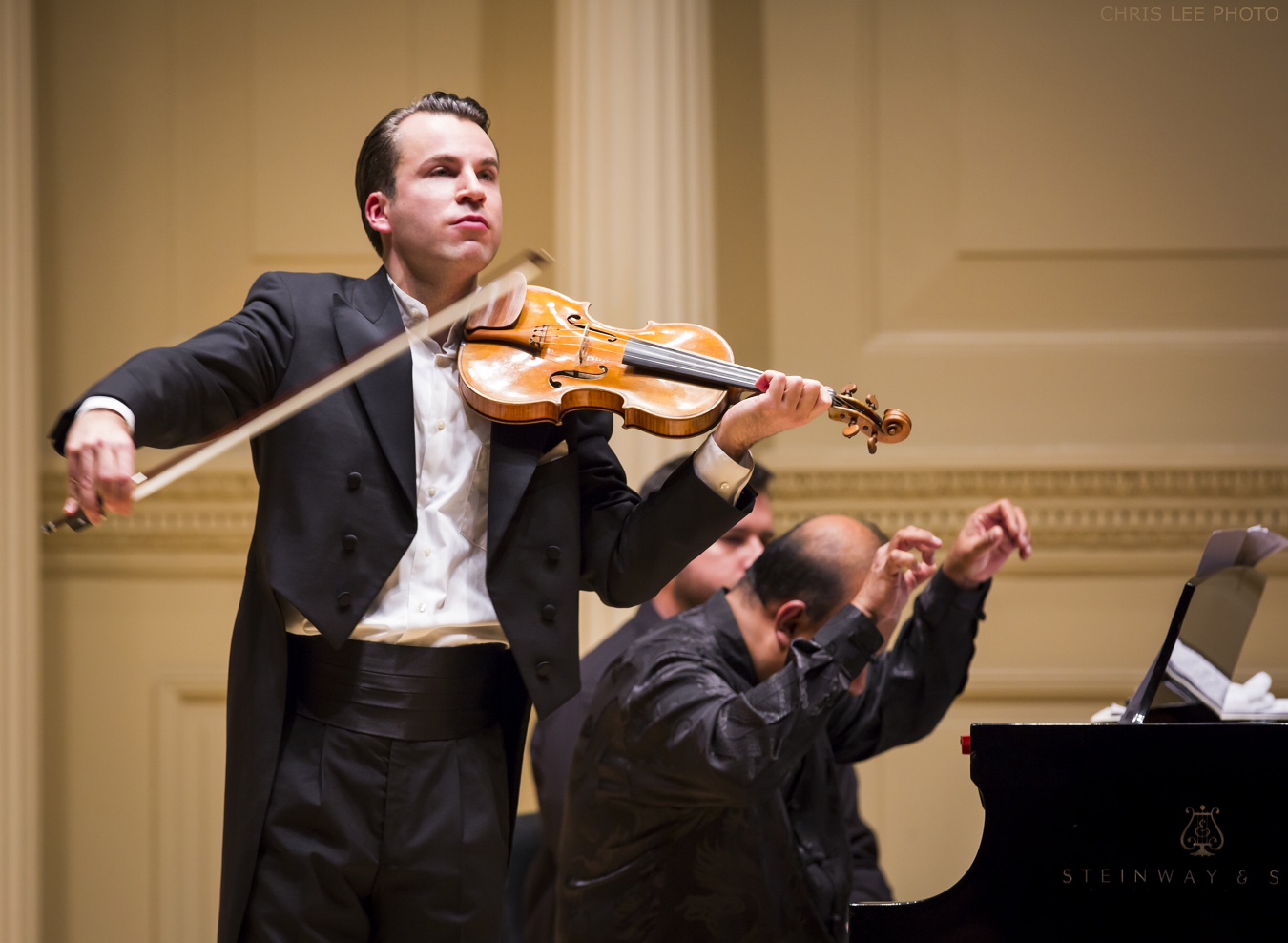
Daniel Röhnm accompanied by pianist Rohan De Silva at Weill Recital Hall, 2/2/16. Photo by Chris Lee

Daniel Röhnm accompanied by pianist Rohan De Silva at Weill Recital Hall, 2/2/16. Photo by Chris Lee


Boldly and with a regal pacing Mr. Röhn opened with Kreisler’s oft-played Praeludium and Allegro, an assertive beginning. He followed it with the equally beloved Bach-Kreisler Gavotte from the E Major Partita BWV 1006, played with polish and sensitivity. Some offhand remarks put an awestruck audience at ease to enjoy the lyrical Paganini-Kreisler Caprice No. 20.

Many performers conquer these tricky works, but the labor announces itself – not so with Mr. Röhn, whose technical ease affords him a graciousness and charm so vital to this repertoire. His fluency suggest that music is his first language, and that may have been the case, for as his biographical notes tell us, he is son and grandson to two noted concertmasters. One finds, with a bit of poking around, that his grandfather, Erich Röhn, played with the Berlin Philharmonic under Fürtwangler, and his father, Andreas Röhn, with the Bavarian Radio Symphony Orchestra. One also learns that his musical pedigree is distinguished on his pianist mother’s side, but perhaps that didn’t make as marketable a tale as the lineage of three dashing dons of the violin – and dashing this grandson is, with the tie, tails, and stage presence of a matinee idol. One expected him to dance off the stage like Astaire, which he pretty nearly did at the end of the first half, while concluding Sarasate’s Zapateado Op. 23, No. 2 (which he had likened to a Spanish relative of Riverdance – so make that Flatley, rather than Astaire).

Before this exuberant first finale came several other works. Claude Debussy’s Sonata for Violin and Piano added some heft to the program (despite its brevity). Mr. Röhn spoke eloquently about its wartime history and also the imagery one can sense in the work, though leaving such reactions open to the listeners’ imaginations. He shared as examples that “in rehearsal today we found hobbling dwarfs” and at another point vampires – inviting the uninitiated listener to dream through the piece’s darker moments. His playing matched his words in color and drama. If every performer communicated as well, as part virtuoso and part inspired educator, more concert halls would be packed – and his certainly was.

Following Debussy was the Prokofiev-Heifetz March from The Love of Three Oranges – a glimpse into the world of another titan of the violin, Jascha Heifetz. Incidentally, Heifetz’s birthday was also February 2 along with Kreisler’s, something parents of children born on this day might contemplate when choosing an instrument! The playing was once again riveting.

William Kroll’s popular Banjo and Fiddle and Josef Suk’s sentimental Song of Love Op. 7, No. 1, rounded out the smorgasbord before the show-stopping Zapateado. Throughout the program Rohan de Silva was a superb collaborator. Understandably sought after by many of the greatest violinists in the world today, Mr. de Silva plays with the kind of flexible support and hair-trigger responsiveness that it seems no cues are needed beyond sheer musical telepathy.

More works associated with Kreisler followed in the second half, including Jean-Marie Leclair’s Sonata No. 3 in D Major. Here was the only work that seemed to show a bit of flagging in energy, but the impression was short-lived. The ridiculously demanding Wieniawski-Kreisler Caprices in A Minor and E-flat Major followed with perfect brilliance. Equally engaging was the commentary describing the overtaxed students of Wieniawski, the great Polish violin master, as he piled challenge on top of challenge.

The Hungarian Dance No. 7 by Johannes Brahms added further to the playfulness, setting the scene for some humorous introductory remarks about Kreisler’s own mischievous streak. He had for several decades passed his own compositions off as penned by other composers (often 17th or 18th century ones), as it was not seemly for a performer to play an entire evening of his own works. Kreisler was in fact quite creative about it and his harmless trickery makes for fun retelling. Two of such falsely attributed works, the Tempo di Minuetto and Grave in the style of W. F. Bach, were played next, but emerged as such gems that one could almost approve of the hoax that enabled the composer to share them.

To cap off the evening was another rousing dance from Spain, Kreisler’s version of Manuel De Falla’s Danza espagnola from La vida breve. It was a dazzling finale, sending audience members to their feet. They were treated, after several curtain calls, to an encore of the very delicate “Zephyr” Op. 30, No. 5, by Jenő Hubay. Just as I was wondering how one follows an evening of so many “encores” with an encore, Mr. Röhn expressed basically the same sentiment from the stage. Meanwhile my wish for an encore of the whole evening promises to be fulfilled, as a recording of it all will be released in the summer of 2016 (unsure as to whether that is CD or DVD – hopefully the latter). Hopes are high!

Share

Yale School of Music presents Chang Pan, cello and Ronaldo Rolim, piano, in Review

Yale School of Music presents Chang Pan, cello and Ronaldo Rolim, piano, in Review

Yale School of Music presents Chang Pan, cello and Ronaldo Rolim, piano
Weill Recital Hall at Carnegie Hall; New York, NY
February 3, 2016

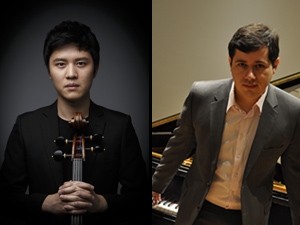
A day of soaking rain in New York could not dampen the ardor of either performers or audience at this very fine recital by an extraordinary artist of the cello and his excellent collaborative pianist. The program consisted of de Falla’s Suite popular Española, the Franck Violin Sonata in A major, and two works by Grieg, the Intermezzo for Cello and Piano in A minor, and the Cello Sonata in A minor, Op. 36.

The principal virtue of Chang Pan’s playing is his extreme absorption in the music; he has a rapt, intense look, as one who is communing directly with the mysterious source “out there” that sustains and inspires true artists—and he possesses the technical ease to bring that inspiration into his instrument and project it to the listener. His bow arm, intonation, and the variety of colors he obtains from the cello are all sublime. He was beautifully partnered by Ronaldo Rolim, who managed every texture, no matter how thick or difficult, with consummate elegance.

The program itself, however, was uneven, with the first half devoted to transcriptions. Yes, I consider the Franck Sonata a transcription, even though the composer himself did somewhat grudgingly accept the transformation for cello which was made in his lifetime, saying it “does not kill the piece.” With so much original cello/piano repertoire, why not program something less often heard? I was very much looking forward to the “Festival Tianshan” which was originally billed, but that was substituted by a Grieg Intermezzo.

Three of the four pieces were in either A major or A minor, and I think artists should carefully consider the way pieces lead into and away from each other, and not fatigue the ear with too much of the same key. Okay, most of the “grumpy old man” portion of the review is out of the way.

The program began well, with six of the seven Canciones populares Españolas of Manuel de Falla, originally for voice and piano. Chang Pan immediately erased any concern about the missing words by playing each with vivid coloration and great spirit. He really made you hear the little allusion to female virginity in the first canción: “the fine cloth in the window won’t sell for much if it gets a spot on it.” Then followed the Franck Sonata, with all its overheated, incense-laden rhetoric and exaltation. I’ve often found in the past that with the necessary octave transpositions in the cello part compared to the violin original that the music doesn’t “speak” where it is intended to, and that with those same transpositions the cello line is buried more in the middle of the piano textures instead of floating over them. I had no reason for concern however, since this duo solved each and every issue forcefully. The daunting piano part was utterly transparent, not a balance problem in sight. The slow movements were notable for their elasticity and aura of spiritual communion. Each phrase and each harmonic contortion was planned meticulously and felt deeply, transitions were also excellent. I did feel that the second movement was too fast, losing some distinction in the rush. But after all, if you can’t be youthfully impetuous when you’re a youth, then when can you be?

After intermission, the pair played an unusual Intermezzo by Grieg, melancholy and lyrical, using it as a sort of slow introduction to the sonata that followed. This sonata should really be given a nickname: “Grieg’s Grab Bag,” for it plunders from his other output shamelessly, with gestures adopted wholesale from the Norwegian folksongs and dances, the lyric pieces, and “that” concerto, coincidentally also in A minor. Even the fantastic skills of these two artists could not disguise what a meretricious assemblage this “sonata” is. It grew tiresome. (Sorry, gentlemen.)

After enthusiastic, well-deserved applause, the duo played a sweet “Chinese Melody” as an encore.

Share

Distinguished Concerts International New York (DCINY) presents Mortals & Angels: A Bluegrass Te Deum in Review

Distinguished Concerts International New York (DCINY) presents Mortals & Angels: A Bluegrass Te Deum in Review

Distinguished Concerts International New York (DCINY) presents Mortals & Angels: A Bluegrass Te Deum
Jonathan Griffith, DCINY Artistic Director and Principal conductor
Distinguished Concerts Singers International
Dailey & Vincent, special guests
Jay Disney and Linda Powell, narrators
Luigi Salerni, director
Carol Barnett, DCINY composer-in-residence; Marisha Chamberlain, librettist
Stern Auditorium at Carnegie Hall, New York, NY
January 25, 2016


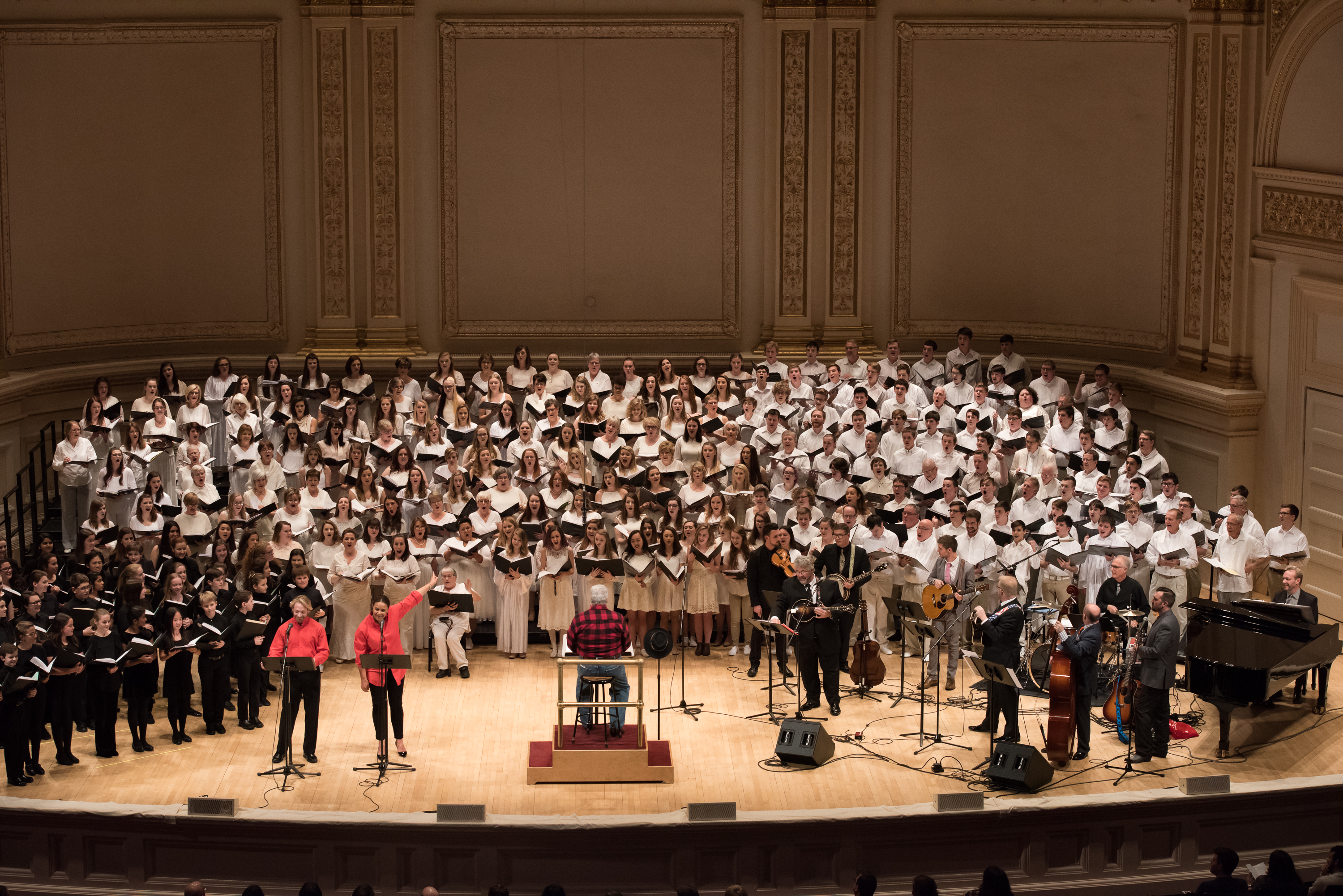
How do you get to Carnegie Hall? Practice, practice, practice? Not this week! “Shovel, shovel, shovel!” quipped Jamie Dailey of Dailey & Vincent, the world-renowned bluegrass group, to the delight of all those in attendance. In the aftermath of what some were calling “Snowmageddon” (or “Snowpocalypse”, if you prefer), Distinguished Concerts International New York (DCINY) presented a concert entitled Mortals and Angels: A Bluegrass Te Deum. The first half was selections from Dailey & Vincent, and the second half was the world premiere of the work for which the concert was named, Mortals and Angels; A Bluegrass Te Deum, a “follow-up” of sorts to composer Carol Barnett and librettist Marisha Chamberlain’s earlier collaboration The World Beloved: A Bluegrass Mass.

As I entered the hall, I noticed that hundreds of white handkerchiefs (with the name of the concert and date printed on them) draped over the seats. I pocketed this concert swag and was sure it was going to be of some use later.

I will admit that I had my doubts about this program beforehand. On a previous program, with the same composer and librettist, I was not entirely convinced that either musical style of the combination, bluegrass or classical, was well served, and I had some reservations about the libretto. Interested readers can follow to link to read more- Bluegrass 57@7 review. In fairness, it should be mentioned that my colleague David LaMarche did not have any such issues when he reviewed the same work in 2014 – Sounds of Americana review. Would I have the same opinion with this new work?

Dailey & Vincent took the stage to open the night. The nine members are Jamie Dailey (vocals/guitar), Darrin Vincent (bass/vocals), Aaron McCune (guitar/vocals), BJ Cherryholmes (fiddle), Bob Mummert (drums), Buddy Hyatt(piano), Jeff Parker( mandolin/vocals), Jessie Baker (banjo), and Shaun Robertson(guitar).”How many of you have heard bluegrass?” asked Jamie Dailey. “Well, you’re gonna hear some now!” he said as the group launched its six-song set. This listener is no bluegrass expert, but he is more than capable of recognizing expert playing and singing. The six selections alternated between fast and slow works, but all offered ample opportunities for these fine musicians to showcase both their individual talents in solo passages and very tight ensemble play.

Jamie Dailey bantered with the audience between numbers, introducing his band mates and telling stories about each. Darrin Vincent introduced Mr. Dailey. Just one fun fact – Shaun Robertson was appearing with the group for the first time, after being discovered on Instagram and being invited to audition for the group! We live in interesting times!

A cover of “Elizabeth”, the Statler Brothers’ hit (for which Dailey & Vincent received a Grammy nomination in 2011) was lovely, and “American Pride”, a patriotic song written by Jamie Dailey, brought the house down. A visibly moved Mr. Dailey humbly accepted the standing ovation. He has a voice that can soar with the best of them!

There was no intermission, but as Dailey & Vincent played on, the stage began to fill with singers dressed entirely in white, soon to be joined on the side of the stage by a much smaller number of very young singers dressed in all black. Conductor Jonathan Griffith took to stage dressed in blue jeans, flannel shirt with bandana, and hat, and took out his hankie and waved it to the audience, signaling the start of Mortals and Angels. Commissioned by the DCINY Premiere Project, Mortals and Angels is a thirteen-movement work that is close to an hour in length. Jay Disney was the spokesperson for the Mortals, who were represented by the children’s choir dressed in black, Dailey & Vincent, and the audience members on the parquet level. Linda Powell was the spokesperson for the Angels- the choir members dressed in all white and the audience members in the upper levels. Mr. Disney gave the “back story” for what was to happen; in short, the “Mortals” were on a fishing vacation and happened to encounter a group of Angels at the same spot (just go with it…). Mr. Disney and Ms. Powell were both “personality plus”, and their playful banter with each other and the audience as they “defended” their sides’ interests was good, clean fun, and added to the theatric quality of the work, though I’m not sure if it was really necessary. Perhaps I’ll leave it at that and let others argue for each side.

The “Mortals” sans Dailey & Vincent were overwhelmingly outnumbered by the “Angels”. I’m still wondering if it was intended for a child’s choir to be “battling” forces seven times their numbers (Mr. Disney made a remark about the 222 singers behind him, as he pointed to the “Angels”). These youngsters gave it all they had, but they were almost completely covered. This is perhaps something that should be considered in future performances.

The text of the work flows with a natural ease, without any agendas (hidden or unhidden), and the music is sincere and without any pretense. This is a winning combination, and with the unique talents of Dailey & Vincent, it was a winning performance. The audience got into the act with the waving of those white handkerchiefs. It was definitely not your typical concert experience, but it was full of raucous joy, something our world today is often lacking.

“We Don’t Stay Afraid for Long” was a favorite, both for the music, and the verse, especially the lines, “Oh, some of us believe in zombies/Some in fairies and elves/Some of believe in angels/And some of us just believe in ourselves.” There’s a lot of wisdom in those words.

So one might ask who won, the Mortals or the Angels? Let’s call it a draw, or better yet, let’s say everyone won, with special credit to Dailey & Vincent, who were the stars not just of this work, but of the entire concert.


Share

Pianist Ian Hobson in Review

Pianist Ian Hobson in Review

Downtown/Uptown Series: Preludes –Etudes –Variations, Ian Hobson in Recital
With spoken introduction by Paul Griffiths
Merkin Concert Hall, Kaufmann Arts Center; New York, NY
January 19, 2016


A good musician tries not to be too dazzled by encyclopedic repertoires – after all, it is how music is played that matters – but this listener has to confess to being dumbstruck by the sheer quantity of challenges in Ian Hobson’s latest 6-recital series in New York. From last October through this coming April, within a mere six months, he will have performed both books of Debussy’s Preludes plus complete Etudes, both books of Chopin Etudes plus complete Preludes, Rachmaninoff’s complete Preludes and complete Etudes (are you dizzy yet?), plus major sets of variations by Chopin, Rachmaninoff, Schumann, Szymanowski and Fauré, and three world premieres by contemporary composers (Stephen Taylor, Robert Chumbley, and Yehudi Wyner). I’m sure I’m omitting something. What is more, the concerts all come on the heels of an enormous 2013-14 series, a 14-recital traversal of the complete solo and chamber music of Brahms. To have prepared such a large quantity of difficult repertoire in one’s career may not be unusual today, but to have it all performable on a high level in such short succession boggles the mind – and all is somehow managed on top of Mr. Hobson’s professorships and conducting appearances. One wonders what vitamins Mr. Hobson might be taking, and how one can get some immediately!

Of course, those who have followed Mr. Hobson’s career may already be aware of his penchant for pianistic feats. Since winning the First Prize at the Leeds International Piano Competition in 1981, plus several important silver medals, Mr. Hobson has amassed a discography of over 60 releases, including the complete piano sonatas of Beethoven and Schumann, plus a complete edition of Brahms variations for piano. He is currently recording a complete edition of Chopin, of which Volume 9 has already received critical praise for “noble artistry” (Gramophone, July 2012).

Having been somewhat familiar with Mr. Hobson’s playing since my student days (when his recordings were some of the “reference” releases available in libraries), I can say that his playing has always struck me as technically strong, musically sound, reasonably grounded in scholarly study, and without any distracting eccentricities. It was therefore good to learn all these years later that he is still going strong, extremely strong!

His program selection was beautiful for this recital, pairing, as its pillars, Chopin’s Twenty-four Preludes, Op. 28, with the Rachmaninoff Variations on a Theme of Chopin, Op. 22. It is a natural pairing (in fact so natural that, for the sake of full disclosure, this reviewer performed and recorded that very pairing some nine years ago). Mr. Hobson additionally included Chopin’s Prelude in A-flat and Prelude in C-sharp minor Op. 45 (two welcome rarities in concert), plus a premiere of “Three Etudes (by any other name…)” by Robert Chumbley (b. 1954). The cohesiveness of the program was ideal, and the Chumbley work added an interesting modern-day perspective on the genre (if one can call it that) of the concert etude. Incidentally, the introductory speaker, Paul Griffiths, was eloquent and informative describing the history and characteristics of Etudes, Preludes and Variations, and it was the kind of evening perfectly designed to welcome the layperson into the realm of some of the greatest piano music ever composed.

Mr. Hobson’s performances themselves were taut and muscular, seemingly geared towards sustaining momentum and projecting with a very full sound, more often than drawing the listener in with intimacy or nuance. There was not a trace of self-indulgence to the performances – some would say a good thing – but I actually tend to like it when a performer “loses himself” in these miniatures. Though the momentum was an asset in the D-flat Prelude, which drags with many pianists, I longed for more poignant dreaming in the F-sharp major one, and perhaps more subtle piano shadings (as one also wanted in the G major). Some more details could have emerged in the storms of the F-sharp minor and B-flat minor ones as well.

It is possible that concert cycles may put pressure on a performer to keep things moving for the sake of uninitiated listeners. My neighbor in the audience began the evening by saying, “I hope these Chopin Preludes are short, because there sure are a lot of them.” One hopes that a performer will rarely need to think this way, but, as Mr. Griffiths mentioned, even Rachmaninoff had a penchant for omitting variations when the audience coughed too restlessly. I still maintain that when a performer surrenders to his artistic imagination, a listener generally can be trusted to follow suit, flu season notwithstanding. Much of Mr. Hobson’s playing was superb, as expected, but one hopes that his profusion of offerings this season will not diminish his savoring of each one.

There were high points, of course. Mr. Hobson seemed especially to relish the grace of the A major Prelude and the delicate (though treacherous) E-flat one. He sank deeply into the A-flat basses towards the end of the 17th Prelude, partly helped by the hall piano’s exceptional resonance, felt down to one’s toes. He engaged intensely in the drama of the Preludes in E-flat minor, F minor, and G minor, and the final Prelude in D minor was a wonderfully brilliant finale. The coruscating scales and thirds proved that Mr. Hobson is still very much a powerhouse.

The Rachmaninoff fared similarly well overall, but again flew by to the point where one missed some of its characteristic poetry and dreaming. Some opportunities for gentle lyricism were missed (and some messiness arose intermittently), though ultimately the work’s majesty did prevail. A large, appreciative audience was treated to an absolutely beautiful encore of the Kreisler-Rachmaninoff Liebesleid, played with winning charm and rubato worthy of the pianistic Golden Age. One eagerly awaits the next concert!


Share