Javor Bračić, Pianist in Review

New York Concert Artists and Associates presents: Javor Bračić, piano
Weill Recital Hall at Carnegie Hall, New York, NY
October 22, 2013

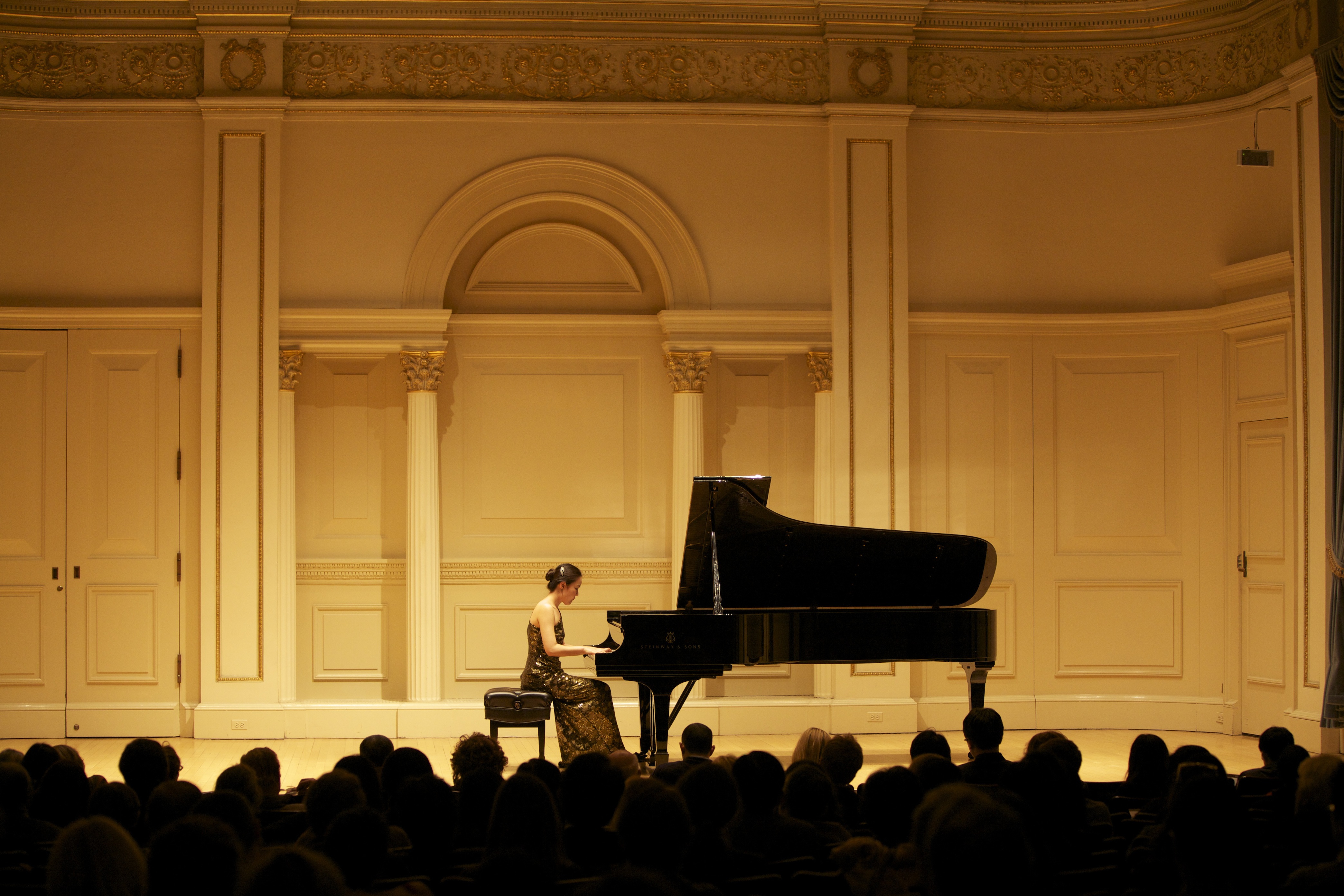
Recital debuts can be a dicey proposition in New York, depending on what other concerts and events are scheduled. Learning that a young Croatian pianist would be giving his New York debut in Weill Hall the same night as the much-heralded and fashionable Yuja Wang would play next door at Stern Auditorium, I imagined that a half-empty hall might await him. How wrong I was! Mr. Bračić’s sold-out house left a virtual mob swarming around the box office, hoping for tickets from last-minute cancellations. As the evening progressed, it became clear why: Javor Bračić is a pianist who possesses a deep, genuine musicianship and an outstanding technique that serves the great music he chooses. He honors both listener and composer with his intelligent, committed interpretations, and he offers a thoughtfully constructed program with elegance and humility. It was heartening to be reminded that such an artist is still a draw and that the “competition” for listeners is not always a zero-sum game.

Mr. Bračić began with Bach’s Prelude and Fugue in C Major, WTC II (BWV 870), which was at once noble and sensitive, with not a note out of place. Moving on to Haydn’s Sonata in D Major, Hob. XVI: 42, he sustained musical tension and interest through its rather long Andante con espressione, right through to the last note of the Vivace assai. Occasionally I wanted ornaments to be more singing in the first movement, and less subservient to the meter, but that was about the only quibble one could have – and a very personal one at that. The delicacy and precision were outstanding.

Moving to later style periods, Mr. Bračić tied his first half together to the Bach and Haydn by performing Debussy’s underplayed Hommage à Haydn (1909) and the even less well known Hommage à Bach (2001) by Croatian composer Davorin Kempf (b. 1947). In between old masters and homages came a World premiere of a work entitled Entwined, Disquiet  (2013) by Rosalie Burrell (b. 1988). At times searching and at others explosive, the two movements explored a tonal world that verged on orchestral, bearing hints of Messiaen and even Scriabin, though without being derivative. Ms. Burrell is still quite young, but already emerging as quite a colorist. I would have enjoyed some information on the piece, but Mr. Bračić, playing from score, appeared to meet this new work’s challenges beautifully, with considerable expressiveness.

As far as the homages go, I’ve never completely grasped the Haydn connection in the ever so brief Debussy work, apart from some tenuous structural likenesses and passing elements of humor and surprise, but it is immediately appealing and was played convincingly by Mr. Bračić. The Bach tribute by Mr. Kempf is far less elusive. Crisp mordents, preceding impassioned scalar writing, hearkened back to Bach’s Toccatas (notable the BWV 565 Organ Toccata in D minor), while quieter counterpoint and sequential episodes were set ingeniously amid some highly adventurous, clearly twentieth-and-twenty-first-century composition. Virtuosity abounded, and Mr. Bračić was on top of it all with dash and drama. Hints of the B -A-C-H theme by Bach himself (based on the tones B-flat, A, C, and B-natural) emerged amid dissonant writing that at times resembled a Bach festival recalled through a dream, all brought to an end with a nod to Bach’s characteristic Picardy close. It is a work I’d like to hear again, especially thanks to Mr. Bračić’s superb performance.

The program’s second half consisted of the Brahms Piano Sonata No. 3 in F Minor, Op. 5, a feast of some of the noblest, warmest, richest piano writing in history, and Mr. Bračić was well suited to it all. Some minor glitches arose – as happen to almost all pianists – but most seemed here to stem from over-straining for power against the piano’s somewhat resistant treble register at climaxes. If those moments can be conquered with the majesty shown elsewhere, Mr. Bračić will have one of the best Brahms F Minor Sonata performances around. As it is, I would hear him again in a heartbeat. His audience seemed to agree, earning an encore of a small Ravel work – you guessed it!- Hommage à Haydn.

Share

Distinguished Concerts International New York (DCINY) presents: The Beauty of Korean Song in Review

Distinguished Concerts International New York (DCINY) presents: The Beauty of Korean Song in Review

Distinguished Concerts International New York (DCINY) presents: The Beauty of Korean Song
Suwon Civic Chorale
Dr. In-Gi Min, conductor, Ami Woo, Eun-Jung Yoo, accompanists
Alice Tully Hall, Lincoln Center, New York, NY 
October 19, 2013


Now in its 30th year, The Suwon Civic Chorale from South Korea was invited by Distinguished Concerts International New York (DCINY) to perform at Alice Tully Hall. In a program featuring traditional Korean music, modern Korean music (including two commissioned works written especially for this occasion and given their World Premieres), and American favorites, it had all the makings of an interesting and educational evening.

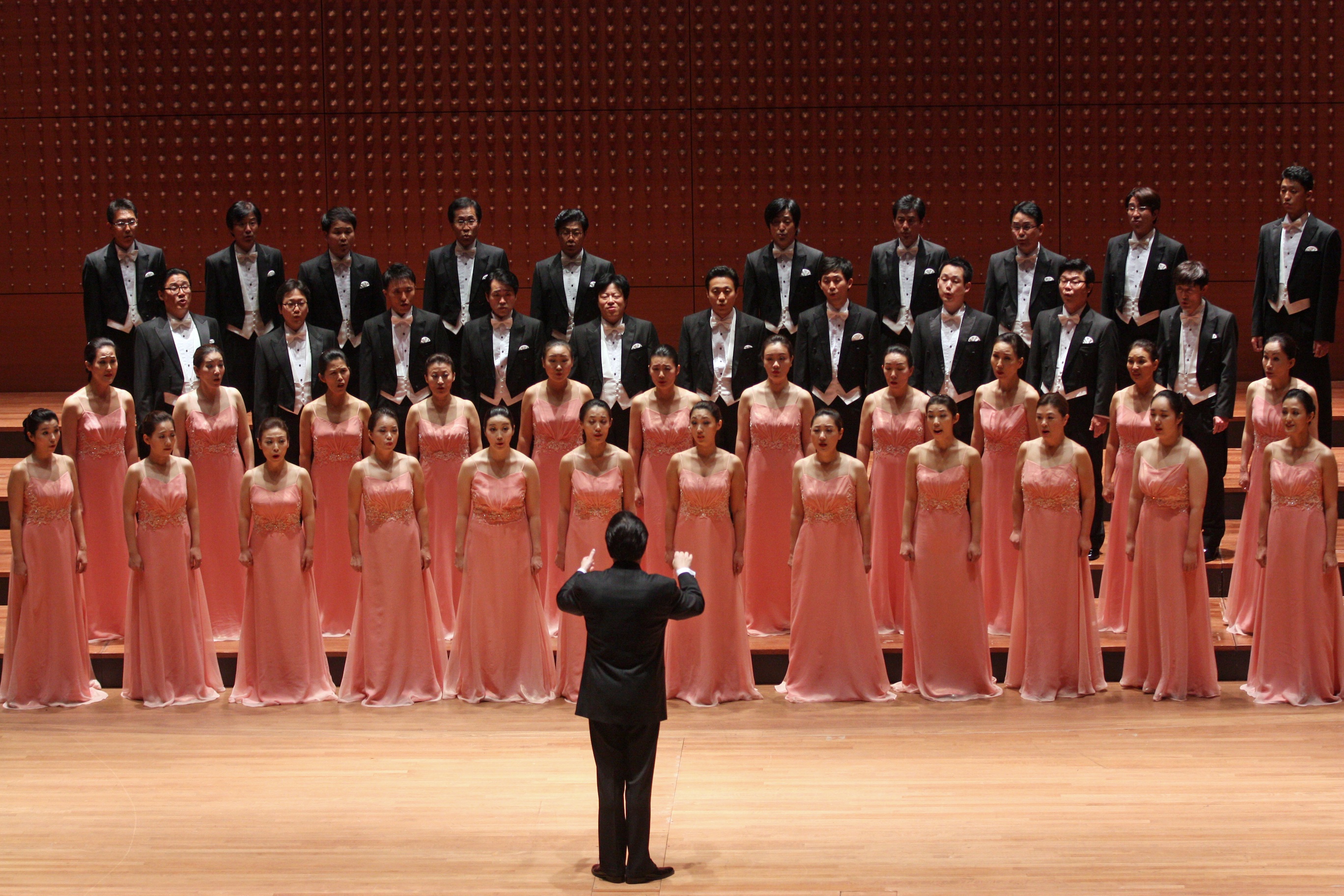
The Suwon Civic Chorale filed on stage in traditional Korean dress. Before starting the concert proper, conductor Dr. In-Gi Min requested that the audience stand as the Chorale sang the national anthems of South Korea and the United States – a thoughtful and respectful gesture that I very much appreciated.

The first half was dedicated to the music of Korea. Arirang is to Koreans what Finlandia is to the Finnish, a much-loved, unofficial national anthem.  Composer Sung-Hyun Yoon used the traditional theme with modern Western compositional technique, a musical East meets West that was given a heartfelt performance and approval from the appreciative audience. Following this setting, Jung-Sun Park’s Kyrie from the Arirang Mass was expertly performed, reflecting traditional Korean harmony and an ornamented singing technique that would be difficult for those without training in Korean singing tradition. As throughout the entire concert, Dr. Min led in an attentive and restrained manner with no showboating – the music was always first and foremost. When a work was finished, Dr. Min would retire stage left and gesture to the Chorale before taking any bows of his own, demonstrating a humility I would like to see more conductors emulate.

Four traditional songs, the Stephen Foster-like Gagopa (Wishing to Return), the three-note based Saeya, Saeya (Blue Bird), the charming Sae Taryung (The Bird Song), with the four soloists singing bird calls in antiphonal style, and the work song Mokdosori (A Song of Pole Carrying), which was sung with gusto, all served as a introduction to the folk music of Korea. The joy of the Chorale members sharing their traditional melodies was apparent, both from the visual and aural aspects of the performances.

The two commissioned works were by highly accomplished Korean composers. The Dona nobis pacem by Keeyoung Kim (b. 1963) is complex, with extensive chromaticism, Korean pentatonic modes, and using a circle of thirds, instead of the traditional western circle of fifths. The Chorale gave this demanding and intricate work a praiseworthy performance. Miserere by Jeeyoung Kim (b. 1968) is a powerful work, from the quiet opening with Tibetan bowls to create what is considered the sound of Heaven in Korea, to the two solos sung in a traditional style called Jeong-Ga, to the bold middle and ending sections. The Chorale realized all of Ms. Kim’s musical ideas in what must be called a simply dazzling performance. Both composers were in attendance, and took richly deserved bows.

The Chorale returned to the stage after intermission with the women dressed in evening gowns and the men in tuxedos with tails. The second half opened with two works by the highly popular American composer Eric Whitacre, Lux Aurumque and Little Birds.

Lux Aurumque is one of Whitacre’s best-known and most frequently performed works. Anyone who is familiar with the YouTube sensation Whitacre’s Virtual Choir has seen and heard this work.  The Chorale mastered the tight harmonies with precision, often with the SATB parts dividing into two, and the sopranos even into three. The balance, as the title suggests, was “golden”. Little Birds uses verses written by the Mexican poet Octavio Paz. The composer suggested in his performance instructions that the singers research real bird calls and whistles, and  it seemed from the sensitive performance that his instructions were heeded. There was a feel that the sounds of the birds flowed organically and did not ever overshadow the vocals.  The effect was enchanting in a nuanced way.

After the Whitacre works, it was time for something completely different, and that was the entertaining Kecak Attack. This work is based on the Indonesian monkey dance of the same name. The chorus separated into smaller sub-sections and used the sound cak-ka-cak in rhythms of various complexities, with snapping fingers and choreographed gestures in an attack-counterattack manner between the divided forces. The sense of play brought much laughter; even Dr. Min got into the act by an exaggerated “push back” of the ever-bolder faction of tenors moving forward in a mock menacing fashion. The incongruity of this spectacle and the elegantly attired performers added to the hilarity.

After this “play”, it was time to get back to serious work with Samuel Barber’s Agnus Dei, an a cappella arrangement of his masterpiece, the Adagio for Strings. The arrangement retains all the beauty of the original as well as the challenges of voicing and intonation.  Both must be precise throughout, or else the entire effect is destroyed – there simply is no margin for error. Using an interesting repositioning of the singers (male-female alternating in all rows), the Chorale met the challenges and delivered a very moving performance. If I had one reservation, it was that the tempo was a bit too fast for my taste, but this was a personal preference.  To end, two traditional Americana songs, Shenandoah and The Battle of Jericho were given solid readings. The full house responded with a prolonged ovation and was rewarded with three encores, the highlight of which was a nod to the Big Apple by way of the highly stylish New York, New York, complete with ballroom dancing and Rockette-style kicks. It was a huge hit.

Share

Sarah Chan, Pianist in Review

Sarah Chan, piano
Merkin Concert Hall at the Kaufman Music Center, New York, NY
October 17, 2013

Having reviewed pianist Sarah Chan in Schumann’s A Minor Concerto just this May (hers being just one of several concerti in a packed program), I wondered how the same pianist would fare in a calmer setting; five months later, Ms. Chan’s own intimate solo recital this week gave this listener (and the pianist herself) just that opportunity. Holding the reins firmly, she emerged as a confident young soloist, with solidity, strong projection, and a winning stage presence.

In a program of essentially Spanish and French music (if France is allowed to claim the Polish-born Chopin for the occasion), Ms. Chan chose mostly short works, the longest lasting from seven to nine minutes. It was an appealing array seemingly designed not to tax the layperson’s attention, so to this veteran listener it seemed to be over in a flash. I liked, though, that Ms. Chan resisted the gargantuan programming that so many young pianists’ recitals display. I also liked that Chan followed her preferences and did not feel compelled to offer a survey course on each style of the piano literature from Bach onward. There was still plenty of contrast.

Enjoying the sheer variety among works, one almost missed the fact that there was sometimes not quite as much variety within a work as one might want. The opening work, Claude Debussy’s “Bruyères” (Prélude No. 5 from Book II), was louder throughout than what I’ve usually heard, and I missed the nuance that makes small dynamic ranges colorful (the composer’s own markings for this piece ranging only from pianissimo up to mezzo-forte, aside from effects of timbre, register, and pedaling).

In Debussy’s “La Soirée dans Grenade” from Estampes, the range was greater, but I still wanted more nuance in the melodic inflection, without which the singing Spanish lines sound stiff. More rhythmic bending could also have helped to convey the feeling marked as nonchalamment gracieux. While Debussy was known as a pianist who avoided histrionics, he would still enjoy pushing and pulling a phrase, as demonstrated in his 1913 piano roll recording of this very work.

Maurice Ravel’s “Alborada del Gracioso” from Miroirs, made a great pairing with the Debussy, and served as a virtuosic backdrop for the Spanish music to come. Ms. Chan expertly handled Ravel’s many challenges, among them her admirably rapid repeated notes. More of a final burst would have capped the piece off perfectly (and perhaps planning the earlier dynamic pacing accordingly), but maximizing each thrill seemed a lower priority than momentum throughout the evening.

Closing the first half were Joaquín Turina’s “Seguiriya” from Danzas Gitanas, Op. 84, Isaac Albéniz’s “Asturias” (“Leyenda”) from Suite Española, Op. 47, and Albeniz’s “El Albaicin” from Iberia, Book III. All three showed Ms. Chan to be a pianist of ample technique and solid command. She also has the resources to achieve a large palette of colors, which I hope she will exploit more and more. Her Iberia selection has markings ranging from ppppp through fff, so moderation can be checked at the door. For some reason the middle register of the concert grand seemed unusually heavy, eclipsing important chords in the outer registers, but Ms. Chan was unruffled.

The entire second half of the concert consisted of the music of Frédéric Chopin.  Opening with his Barcarolle, Op. 60, the pianist seemed much more comfortable than in the first half. Clearly this pianist knew the repertoire inside and out.  There was also more of the savoring of harmonic resolutions that I had been craving earlier.  A string of six Études (from both the twelve op. 25 and the twelve Op. 10) followed. The Étude in A-flat major, Op. 25 No. 1 (“Harp”) opened the group, a gentle choice, though still too fast for my taste and again at the mercy of a dominant middle register. The best was yet to come in the Étude in G-sharp minor, Op. 25, No. 6 (“Thirds”): it sparkled brilliantly as one of the gems of the recital. There ought to be a special award for a performer who can make this devilishly difficult Étude a highlight, as it is the nemesis of so many pianists! Also quite well executed was the Étude in C-sharp minor, Op. 25, No. 7 (sometimes called the “Cello” Étude). Though it is a slower, more melodic Étude, it should not be considered any sort of “breather” – it is tremendously difficult to pull off the pacing and balance, and Ms. Chan did extremely well. In the Étude in B minor, Op. 25, No. 10 (“Octaves”), the pianist surprised us with a ferocity that had been largely hidden up to this point. At moments where many pianists grab a chance to relax, she stormed ahead, and her fearless finale was refreshing. She should keep playing these pieces to the hilt.

The Étude in C minor Op. 10, No. 12 (“Revolutionary” – mistakenly listed on the program as C-sharp minor), came off as a bit glib for this listener. Heroic gesture became efficiency and dispatch, as if the end of the recital loomed too closely to resist racing. Also, by following it (without pause) with the buoyant Étude in G-flat major, Op. 10, No. 5 (“Black Keys”), its dramatic impact was further undercut. These pieces cease being mere “Études” the minute they are played in concert, so they need to be treated as any delicate works of art.

All ended with the much-loved Ballade No. 3 in A-flat major, Op. 47. Despite a not-quite-ready left hand at the start, it closed the program overall with warmth and triumph, boding very well for things to come for Ms. Chan. She already holds an impressive list of accomplishments, academically and musically, and one expects similar achievements in her continued career. A good-sized audience gave warm ovations and received Debussy’s Doctor Gradus ad Parnassum as a parting lagniappe.

Share

Scott Cuellar, Pianist in Review

 Scott Cuellar, pianist
Weill Recital Hall at Carnegie Hall, New York, NY
October 9, 2013
Scott Cuellar, pianist

Scott Cuellar, pianist

The pianist Scott Cuellar’s recent recital at Weill Recital Hall was a model of excellent programming and execution.  His manner at the piano is clean, direct and confident.  To these admirable qualities, he adds the ability to illuminate both the external structure and the emotional core of the works he plays.

The two sisters, Katharina and Marianna von Auenbrugger, to whom Haydn dedicated his Sonata in C Minor, Hob. XVI: 20, were held in high regard by the composer, and as a result, this significant work exploits all the tools of both artist and technician.  The overtly dramatic outer movements frame an elegant, almost Handelian Andante.  Mr. Cuellar treated the sonata as a mini-opera, with long, arching lines and a narrative thrust.  All the elegant and expressive trills and scale passages of the central movement were interpreted in this framework, as a soprano would spin an aria.

Nearly the entire recital was presented without a break, allowing the audience to make connections and see patterns in Mr. Cuellar’s deft programming.  Fauré’s Nocturne in F-sharp Minor, op. 104, No.1, one of the last by this composer, is a thoroughly modern work, particularly in its harmonic language.  Like the Haydn, however, it too is laced with anguish and intensity of emotion.  The pianist used a big-boned sound that was orchestral in its depth and coloration.  Then with the briefest of pauses, Scriabin’s 9th Sonata began, linking that composer to Fauré both chronologically and developmentally.  Although Scriabin did not choose this sonata’s subtitle (Black Mass), the music is surely a supreme evocation of darkness and turmoil, as if inspired by Macbeth’s three witches.  Mr. Cuellar amplified his dynamic range further, employing a rich, powerful bass register, with flashes of treble brilliance His pacing and clarity throughout made the wrenching climax even more effective.

It is fitting that the recital should have ended with Schumann’s great programmatic work, Kreisleriana.  In its eight movements, it explores a range of emotional states and musical styles.  In this finale to the evening, Mr. Cuellar was at his best, virtuosic in scope and expression, like a great man of the theater.  His very specific dynamic palette, combined with sensitive tonal shading and a talent for musical mimicry, brought all of Schumann’s characterizations to vivid realization.

Mr. Cuellar has a sharp intellect and the skills to flesh out his ideas.  This was a terrific recital, thoroughly enjoyable on a visceral level, and a very impressive introduction to this young pianist.

Share

MARA Society of New York presents Fall Concerto

MARA Society of New York presents Fall Concerto
Alexandru Tomescu, violin, Matei Varga, piano, Jesus Rodolfo Rodriguez, viola
Merkin Concert Hall, New York, NY
October 9, 2013

The MARA Society of New York is dedicated to supporting and advancing Romanian music, arts, and culture. They have joined forces with Hospices of Hope to raise funds for the completion of Bucharest’s first hospice care facility. This season they presented a benefit concert entitled “Fall Concerto” along with a silent auction – I had my eye on the private tour of Dracula’s castle in Romania! One hundred percent of the proceeds from the performance and auction were to be donated to their hospice cause.  (To learn more, visit www.marasociety.com and http://www.hospicesofhope.co.uk/ .) Romanians Alexandru Tomescu, violin, Matei Varga, piano, and “honorary Romanian”, violist Jesus Rodolfo Rodriguez, lent their support by donating their time and talents in performance of works by Bartók, Brahms, Schumann, Bach, Enescu, Chopin, and Saint-Saëns.

Bartók’s Romanian Dances, six short pieces originally written for solo piano, opened the concert. Zoltán Székely’s virtuosic arrangement for violin and piano was used by Alan Arnold in his own arrangement for Viola and Piano. Mr. Rodriguez captured the essence of these dances; the sorrowful longing and the wild jubilation. The final dance’s virtuosic passages were tossed off by Mr. Rodriguez with a laser-like clarity. His playing is fearless, but never reckless.  Mr. Varga provided restrained support, allowing Mr. Rodriguez the starring role, as is proper for this work.

Next, Mr. Tomescu joined Mr. Varga in Brahms’s Scherzo for Violin and Piano. The Scherzo is the third movement of the so-called F-A-E Sonata, a collaborative work of three composers: Schumann, Brahms, and Albert Dietrich, as a gift to legendary violinist Joseph Joachim in 1853. The initials F-A-E stand for Frei aber einsam (Free, but lonely), which Joachim had adopted as his motto.  The young Brahms was already a master of this form, with opportunities for both violinist and pianist to assume leading roles, but also as a collaboration of equals. Mr. Tomescu and Mr. Varga realized these ideals in a sprightly and polished performance.

Playing the Stradivarius Elder-Voicu violin he received in 2007, Mr. Tomescu produces a tone that is bold and full-bodied, but never strident. He projects well at all dynamic levels and plays with a quiet, regal demeanor. This does not mean his is not a passionate performer, but rather one who invests his energy in the music and not empty histrionics.  He has the poetry as well as the pyrotechnics, but I am getting ahead of myself – more about that later.

Schumann’s Fantasy for Violin and Piano, Op. 131, followed the Brahms.  This work is one with fluctuating moods, from joyous to reflective and back – much like Schumann himself.  It was fascinating to watch how the performers projected the identities of Schumann’s famous alter egos. The extroverted Mr. Varga matched the character of Florestan, while Mr. Tomescu represented the more introverted qualities of Eusebius.  Both players shone in a spirited performance. One must say that this pairing of Mr. Tomescu and Mr. Varga is fortuitous, as their complementary personalities make for thought-provoking performances.

After a break for a presentation by Princess Marina Sturdza, the patron of Hospices of Hope, Mr. Tomescu returned to the stage for a solo performance of J.S. Bach’s well-known Chaconne from the 2nd Partita in D minor, BWV 1004. He delivered a majestic and dramatic performance sustaining the intensity from start to finish.

The first half closed with Mr. Rodriguez’s performance of Konzertstück for Viola and Piano by George Enescu. He played with great elan, and Mr. Varga was there every step of the way. This was a pairing of simpatico personalities. The work was brought to a close with bravura playing from Mr. Rodriguez- all that was missing were sparks flying from his bow!

After a long intermission, another Enescu work, the Impromptu Concertante for Violin and Piano opened the second half.  This lush, romantic work, allowed Mr. Tomescu to highlight the singing qualities of his tone, while the ever attentive Mr. Varga continued his excellent playing.

Mr. Varga then offered Chopin’s Polonaise in A-flat Major, Op. 53, the Heroic. True to his personality, Mr. Varga gave it a passionate and exciting reading.  One could never accuse Mr. Varga of lacking exuberance in his playing! His infectious smiles, intense involvement with each and every note (including inaudibly singing along), and his sensitivity to the needs and wants of his collaborators, combined with his technical gifts, make him a joy to watch and hear.

Mr. Tomescu rejoined Mr. Varga to close the concert with Saint-Saëns’s Introduction and Rondo Capriccioso.  This showstopper calls for the violinist to reach deep into his bag of tricks to meet the technical and musical demands.  Mr. Tomescu is a master magician indeed – with the able support of Mr. Varga he fashioned a performance of wit and brilliance. The dazzling finale brought the full house to its feet in a long and well-deserved ovation – a great finish to a great evening.

Share

Enrique Velez-Bidot and Hermelindo Ruiz, guitarists in Review

Enrique Velez-Bidot and Hermelindo Ruiz, guitarists
The American Bible Society; New York, NY
October 4, 2013

At concerts presented by Musica da Camara, the sponsors of this event, this reviewer has grown to expect performances characterized by a close connection between the performers and their audience. These events are almost like family gatherings. And this was palpably present in this Emerging Artist Concert, a recital by the young Puerto Rican guitarists Enrique Velez-Bidot and Hermelindo Ruiz, which took place in the Conference Center of The American Bible Society’s New York headquarters. The audience kvelled at every sound, at every word. (To kvell – Yiddish: to take pleasure in the achievement of family members and others close to you.)

The large and enthusiastic audience loved the concert, and their pleasure did not seem to be diminished by the things I will discuss in this paragraph. Firstly, the printed program bore little connection to what we heard. I find this unacceptable, as the printed program is both a guide for the audience and an historical documentation of the event. It seems that Mr. Ruiz, after deciding to change the works he would be performing, failed to inform Musica da Camara in time. He therefore had to verbally explain the changes to the audience, thus confusing the audience and lengthening the spoken part of the recital.  I know that many of today’s audiences find that spoken comments from the performers are both enjoyable and informative. But to this listener it seemed that there were almost as many words coming from the stage as there were musical sounds. A little spontaneity is a good thing. To be effective, however, performer-to-audience interaction must be very well planned and timed. Tonight, five pieces which appeared on the printed program had to be omitted because too much time was spent talking. I would have loved to have heard them, especially “El coqui” by Jose Ignacio Quinton and the two Bach Inventions arranged for two guitars.

The concert’s first half belonged to Hermelindo Ruiz. He began with three of his own works, “Espacio”, “Recordando a Margot” and “Three Sketches.” On all three he exhibited a fine technique and drew many lovely colors from the instrument. The first two were written in a quite accessible style and allowed Mr. Ruiz to spin out some lovely well shaped phrases with clear articulation. The third, equally well played, was much more complex and dissonant. This was followed by the Gavotte en Rondeau from J.S. Bach’s Suite for Lute in E Major, BWV 1006a. This very popular work is part of an arrangement by the composer of movements from his Third Partita for Violin Solo, BWV 1006. Perhaps Mr. Ruiz was being too “respectful” of this work by the great master, but I felt that the performance didn’t quite dance. I would also suggest that the first dissonant note of an appoggiatura should be a bit louder than its consonant resolution.

The first half concluded with the World Premiere of a piece Mr. Ruiz commissioned for this concert, “Variaciones sobre un tema Paraguayo” (“Variations on a Paraguayan Theme”) by the  Paraguayan composer Diego Sanchez Haase. Although very well performed, this work’s basic problem was that, at least on first listening, the theme (the melody, the harmony, the structure et. al.) was so complicated that during the variations one could not tell what was being varied. If the theme (everything about the original material) isn’t clear, then one cannot take joy in perceiving what the composer does with “the original stuff.” The work made great technical demands on Mr. Ruiz, but he was up to all of them.

The second half began with a performance by Enrique Velez of Andrés Segovia’s arrangement for guitar of one of the monuments of Western Classical music, the Chaconne from the Second Partita for Violin, BWV 1004 by J.S. Bach. It was, unfortunately, not a successful performance of this most difficult work. As he had to stop and retune twice in the middle of this long work, my thought was that there must have been something wrong with Mr. Velez’s instrument. And since I know that this would have unnerved any performer, I don’t think it necessary to describe the performance in any detail. But I am happy to mention that there were moments during the Bach (and in the following duet with Mr. Ruiz) that I heard examples of the quality of playing one expects from a player with Mr. Velez’s training and experience. For the concert’s last work, Messers Ruiz and Velez got together in a jaunty performance of Juan Francisco Acosta’s “Bajo la sombra de un pino”.

Share

Jeff Lankov, piano, in “Music of Robert Xavier Rodríguez” in Review

Jeff Lankov, piano, in “Music of Robert Xavier Rodríguez”
Presented by The University of Texas at Dallas
Weill Recital Hall at Carnegie Hall, New York, N.Y.
October 6, 2013
 
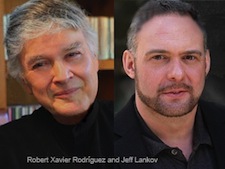
Robert Xavier Rodríguez and Jeff Lankov

Robert Xavier Rodríguez and Jeff Lankov

The name Robert Xavier Rodriguez (b. 1946) is hardly unknown in the music world, with an imposing list of worldwide commissions, performances, and other successes filling his biography, but a recent recital of his piano works had this listener convinced that his musical reach is destined to grow far greater still. Currently Professor at The University of Texas at Dallas (among other career demands), he has amassed commissions and residencies with many of the world’s most renowned symphonies and opera organizations, awards galore (Guggenheim, ASCAP, NEA, American Academy and Institute of Arts and Letters, etc.), a long string of record labels and artists presenting his music, and exclusive publication by G. Schirmer. Such biographical information generally serves to “sell” an artist, but in Mr. Rodriguez’s case his music speaks for itself; moreover, the organizations mentioned among his credits may be the ones basking in reflected glory. Listening to this gifted composer, who has been outstanding in his field for decades now, one even begins wondering why certain accolades are missing – Pulitzer committee, where are you?

Part of what sets Mr. Rodriguez’s musical voice apart from others is its directness of expression, vibrant, unpretentious, lyrical, and often humorous, without sacrificing substance or craft. Though there was a liberal sprinkling of modern ragtime throughout the recital, that style predilection did not limit the emotional range (any more than with William Bolcom and others drawn to the genre) – and certainly all was not based on rags. The balance between accessibility and exploration was just right. In darker inspirations, such as the closing work “Caprichos” (2012), based on some rather unsettling Goya artworks, the tonal language was uniquely chilling and nightmarish, yet always with a life-affirming joy in the storytelling itself. Given its World Premiere here, it is a fascinating, thorny, and demanding work, which I look forward to hearing again. Drawing from a variety of musical resources (including fitting references to Scarlatti and Mozart), it is unquestionably fresh and new, a valuable addition to the piano literature (and for pianists, a natural to pair with “Goyescas” of Granados as a bonus).

Bringing the musical storytelling and imagery to life was pianist Jeff Lankov, who sustained musical interest from the recital’s first notes to its last in performances of brilliance and dedication. To open, he teamed up with the composer in Semi-Suite (1980) for piano, four-hands, an appealing work as full of fun as its punning title. Its four movements (the first one repeated as a fifth) include “The All-Purpose Rag” and “Limerick” (ingenious pieces after which the audience had to laugh out loud), plus a delightful Jig and Tango.  The players projected the tongue-in-cheek references and musical “punch lines” with wonderful deadpan delivery, as Lankov continued to do in “Estampie” (1981), which also contained several ragtime-inspired movements. Lest one underestimate the substance of the latter (with titles including “The Slow Sleazy Rag”, “The Couple Action Rag”, and “Reversible Rag”), the seven-movement work is actually a wide ranging set of variations with considerable lyrical beauty as well as stimulating formal challenges. As the Program Notes for one movement state: “In a complex Scherzo, the regular rhythm of the estampie is sharply juxtaposed with disjunct atonal writing. Ragtime rhythms appear, treated with Ars Nova discant and isorhythm techniques in a synthesis of widely disparate styles, after which the estampie reappears.” All of this intricacy made for challenging listening as well as playing, and Mr. Lankov was the man for the job. A veteran of new music performance whose repertoire includes the complete works of John Adams, plus Michael Finnissy, Messiaen, Piazzolla, Radiohead, and more, he embraces it all. There seems to be nothing that eludes his grasp.  His performance of Rodriguez’s tour de force “Fantasia Lussuriosa” (1989) was particularly compelling, with its seductive lines, decadent melodic embroidery, and all-encompassing virtuosity. It is hard to believe there are not more young pianists pouncing on this piece as a “vehicle.” Mr. Lankov played it to the hilt, yet there seems to be enough flexibility in it to elicit many additional interpretations.

In another note of levity, the second half opened with a selection entitled “Hot Buttered Rumba” from Aspen Sketches (1992).  The title as well as the infectious rhythms had many smiling. Despite prodigious skill, Mr. Rodriguez’s sense of humility and humor are never far. We may credit some of Rodriguez’s humor to the encouragement of his great teachers, Nadia Boulanger. In his words, “Boulanger told me that I would only be half a composer until I also learned to express in my music the same love of laughter that she knew I enjoyed as a person.” She would be proud.

In a possible nod to another of Rodriguez’s teachers, Jacob Druckman, the recital also included Rodriguez’s “Seven Deadly Sequences” (1990), an imaginative and highly pianistic set, which should keep pianists enthralled for years to come. Though not mentioned in the program notes on the piece, Druckman’s own piano set entitled “The Seven Deadly Sins” is similarly vivid and evocative. They would make an interesting pairing, perhaps on disc.

On the subject of discs, one reads in Jeff Lankov’s biographical notes that a recording of this recital’s music is in the works. One can only rejoice. Look out for it.

Share

Pianist Liam Kaplan in Review

Liam Kaplan, piano
Mannes College, The New School for Music, New York
September 28, 2013
Liam Kaplan

Liam Kaplan

Bach-on-the-piano activism is not the eyebrow raiser it once was. The tenet that J. S. Bach’s lifetime of keyboard works dealt only marginally with a plinky-hammered, Lilliputian forebear of a concert grand has been superseded, even among retro-fashionable harpsichordists and clavichordists, by the iconic status of the music and the deferential acknowledgment of equal access, if not equal temperament, to all performers who wish to claim it as their own. Now that the activists are at peace, the spotlight has shifted back to its original point, a discussion of the tuning systems which unlocked music forever when Bach composed his eloquent and sprawling “Well-Tempered Clavier.”

Temperament is a deliberate sweetening or souring of ordinarily pure consonances by a keyboard tuner, who distorts certain intervals slightly in order to retain the usable intonation of all twelve different notes in the octave. The choices of notes to mistune would determine the most aesthetically permissible keys through the centuries, but pieces had to stay near the keys related to the sweet notes or the instruments would have to be retuned around new keys. The search for a single operating system which could service all keys at once was so hotly argued that eventually the whole case was settled by the discovery of the twelfth root of the number two, an all-purpose multiplier for each note’s pitch in order to reach that of its northern neighbor, and no one has ever looked back. Meanwhile, on the sly, Bach safeguarded the family heirloom temperament and displayed the sacred formula not as a Wall Street pie chart but as a doodle on the title page of his book, according to the musical cryptographer Bradley Lehman and his supporters. Simple and harmonious, tuned in fifteen minutes, centered around B major, Bach’s Good Temperament distributed the tartness little by little en route to the brighter keys, stressing the recognized Affekt or emotion inherent to each of the twelve major and twelve minor tonalities. (Modern expense prohibits the use of Bach’s temperament in a usual recital setting.) The live demonstration in 1722, a prelude and fugue played in every one of twenty-four keys, landed Bach a teaching job in Leipzig and a demand for a spin-off collection of twenty-four even more complicated preludes and fugues. Chopin liked to warm up with them.

Fifteen-year-old Liam Kaplan is the latest candidate to have traversed Book One of “Das Wohltemperierte Klavier” in a single concert, at the Mannes College on Saturday evening. An unavoidable intermission bisected the majesty of the marathon but refueled the artist’s prodigious memory. Young Mr. Kaplan, a composition and bass student as well as a pianist at Mannes Prep, is finding his adult voice in a milieu rich with possibility. His inborn gifts of Swiss-watch rhythmic pulse, polyphonic lightness, and formal proportion were obvious from the start. Mr. Kaplan hears like a composer, albeit a rare composer who tells time and who communicates motives as well as harmony. He relishes excursions and surprises, layered balances, extended sequences and coda sections. Many of his performances could be lifted directly into a music history survey with complete satisfaction. Mr. Kaplan draws the listener into his world, a place of discipline and dignity, of sunny and attainable ideals. Although he seems as yet untouched by sorrow or even the theatrical portrayal of darkness, suspended in his refined atmosphere of feathery pointillism and trotting tempos, Mr. Kaplan is eminently likable. Some questions ensue if we fall captive to the cerebral perfection of his fugues in C-sharp minor or A major, or the expertly tailored articulation of his whirlwind preludes in G major and frothy B-flat: at the end of the day, Mr. Kaplan prefers to coax only a mezzo-piano out of a nine-foot Steinway. He seems not to need power or tragedy, to distinguish a poignant tonality from a soothing one, or to play a piano like an organ. He spreads chords ahead of their beats and crushes his leaning grace notes without spice. He is humble and happy not to show off.

Time will tell, of course. To evince such an abundance of fundamental musicianship at fifteen is no small feat. The self-control in Mr. Kaplan’s work is a proven predictor of success and a quality that few performing artists can hang on a shingle. In comparison with the rowdy boys in Bach’s charge at the St. Thomas School in Leipzig (some of whom burned mice over a candle and left them as trophies for the professor), Liam Kaplan might have made Bach a very proud mentor.

Share

I-Bei Lin CD in review

I-Bei Lin, cello; Jonathan Korth, piano
Mae Zenke Orvis Auditorium, University of Hawai’i at Mānoa, Honolulu, HI
April 18, 2011
 
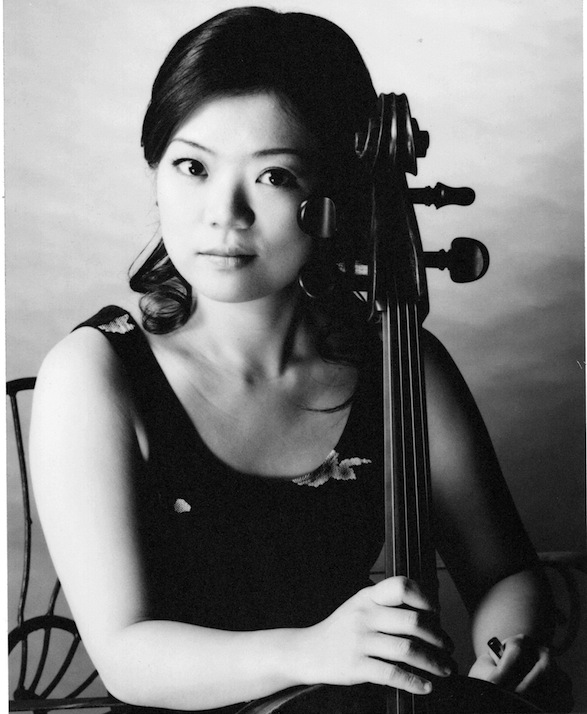
I-Bei Lin Cellist

I-Bei Lin Cellist

Cellist I-Bei Lin has an impressive performance history, having given recitals throughout the world, including New Zealand, Thailand, Taiwan, much of Europe, and the United States. She received her bachelor’s degree from the Eastman School of Music and master’s and doctoral degrees from Northwestern University. She is currently an Associate Professor of Cello and Chair of Strings at the University of Hawai’i at Mānoa.

This review is of an unedited, live recording of a recital from April 18, 2011, featuring works by Beethoven, Donald Reid Womack, Debussy, and Gregor Piatigorsky.  In the spirit of the “live” performance, I made the decision not to listen to the recording numerous times, but to imagine I was in attendance. I believe that this is the most objective approach.

The recital opened with the Sonata for Pianoforte and Cello, Op. 102, No.1, of Ludwig van Beethoven. This work belongs to the beginning of Beethoven’s late period. It is complex and unconventional in form.  Dr. Lin played with confidence, indicating her mature grasp of Beethoven’s visionary ideas. The Adagio was especially praiseworthy in its pacing and sustained intensity. It was an auspicious beginning.

fff, composed in 2011 especially for Dr. Lin and pianist Jonathan Korth by Donald Reid Womack (b. 1966), followed the Beethoven. One might be excused for expecting that the title referred to the dynamic marking fortississimo and that a very loud piece was to ensue; the title, however, refers to its three pieces (falling, floating, flying) played without pause. Womack writes, “they are bound by a common theme of groundlessness, of having air between oneself and the earth”.  These pieces conveyed their respective titles in a highly effective way that capitalized on Dr. Lin’s considerable talents, including a fluid technique and wide range of expressive timbres (Womack had previously written a solo piece for Dr. Lin in 2005 titled Scherzophrenic). The end result was a mesmerizing performance from both Dr. Lin and Mr. Korth.

The Cello Sonata of Claude Debussy closed the first half. This work, written in 1915, is one of the staples of the cello repertoire and deservedly so.  French cellist Louis Rosoor (incorrectly cited as Louis Rosser in the program notes) claimed Debussy told him that thematic material from the sonata was related to dramatic characters, but Debussy denied this.  Rosoor’s version is plausible, as this work is extremely mercurial, with sudden outbursts and mood changes throughout. Not only must the performer deal with the stylistic difficulties, but also overcome the myriad technical demands as well. To use a popular expression, Dr. Lin “nailed it!” in a highly nuanced performance.

The second half opened with a set of Taiwanese Folk Songs, which served a dual purpose. The most obvious was that Dr. Lin was honoring the music of her native Taiwan, but the second was the idea of bringing the audience back down to earth after the atmospheric fff and the emotional roller coaster of the Debussy.  These pieces were played by Dr. Lin in a sincere and unpretentious manner.

Paganini’s 24th caprice for violin has been the basis for brilliant variations by many great composers. Piano works by Liszt, Brahms, and Rachmaninoff readily come to mind, but why should pianists have all the fun? The legendary cellist Gregor Piatigorsky (1903-1976) decided to write a set of variations on this caprice that allowed him to showcase his justly renowned technical prowess to the hilt. Dr. Lin took up the challenge of Piatigorsky’s Variations on a Theme of Paganini to end the recital.  Taking a page from Edward Elgar, Piatigorsky wrote fourteen variations as musical portraits of famous friends. They are, in order, Pablo Casals, Paul Hindemith, Raya Garbousova, Erica Morini, Felix Salmond, Joseph Szigeti, Yehudi Menuhin, Nathan Milstein, Fritz Kreisler, Gregor Piatigorsky, Gaspar Cassado, Mischa Elman, Ennio Bolognini, Jascha Heifetz, and Vladimir Horowitz. The variations are often witty, but many take the form of inside jokes, as it is not always readily apparent how each variation connects to its named inspirations (for example, the Hindemith variation sounds nothing like Hindemith the composer). This is a virtuoso work that projects much better live than in recordings, as the visual aspect is an integral part of the experience. In any case, it is a highly pleasurable tour-de-force for the cellist. Dr. Lin tossed off the challenges with ease in a confident performance. The rousing finish ended the concert in style and the audience reacted with loud applause.

I must commend excellent pianist Jonathan Korth as an outstanding collaborator to Dr. Lin, ever sensitive to balance issues and flexible to the cellist’s every impulse.

In 2005, the late Edith Eisler wrote in the pages of this journal that Dr. Lin “is a very fine cellist.” In 2013, I must tip my hat to her and wholeheartedly agree with her assessment. Dr. Lin is a fine cellist,  equally at home in wide-ranging styles and possessing the technique to make it all seem so easy.

Share

Hyojung Huh CD in Review

Hyojung Huh, piano
Weill Recital Hall at Carnegie Hall, New York, N.Y.
March 13, 2013
 
Hyojung Huh ,Pianist

Hyojung Huh ,Pianist


Korean pianist Hyojung Huh gave a debut in New York this Spring that introduced not only herself as a performer, but also, in the second half, the ten-movement, forty-five-minute Chorale Fantasy of contemporary Korean composer, Shinuh Lee, entitled “Comfort, comfort my people.”  While I missed the concert itself, I was assigned to review an unedited CD of it and found much to admire. While CD recordings almost inevitably miss the energy of a live performance itself, they do enable the multiple hearings one usually needs with new works. Ms. Huh holds an impressive array of degrees as a pianist, including B.M. and M.M. from Seoul National University, M.M. from Westminster Choir College, and P.D. (Performer Diploma) from Indiana University-Bloomington, in addition to an imminent D.M.A. from the University of Wisconsin where she is a doctoral candidate; in addition, though, Ms. Huh has earned degrees in aesthetics, sacred music, and choral conducting, all of which seem to make her a natural fit for the New York Premiere of Ms. Lee’s imposing,  Biblically-inspired Chorale Fantasy.  Drawn by musical and theological interests (having already done Masters studies on Messiaen in relation to Catholic ontology, liturgy and Biblical language), Ms. Huh is currently working on a dissertation offering a metaphysical and theological perspective on the Shinuh Lee composition performed in this recital, a work which does bear some kinship with works of Messiaen himself.  So, rarely will one see a confluence of such well-matched forces – the pianist, the composer, and the central inspiration of the work all in perfect synch.

Hyojung Huh ,Pianist

Hyojung Huh ,Pianist

In laic terms, the work is an intensely dramatic one, alternating evocations of fire and brimstone with those of ethereal peace, created brilliantly by Ms. Lee and conveyed sympathetically and passionately by Ms. Huh. The first movement is entitled “A brimful living chalice of despair and horror and astonishment.” The movement lived up to its title. Vivid in its thunderous and dissonant virtuoso writing, it alternated bass chants against smoldering trills and tremolos with nightmarishly unrelenting rhythms that were sometimes reminiscent of Ligeti’s “L’escalier du diable” to this listener. Comparisons are for expedience – not to suggest that the work is derivative – so I’ll also be forgiven for comparing some of Ms. Lee’s stomping martial accompaniments to Prokofiev’s “Montagues and Capulets” in their savagery. The overall effect was harrowing. Sheer terror yielded wonderfully in the second movement to a feeling of post-apocalyptic quiet. Entitled “Lord Have Mercy”, this prayerfully simple A-flat major Chorale (towards the end reappearing in A major) developed over a pulsating pedal point into a Brahmsian meditation that might make a jaded listener flinch at such sweetness, were it not in juxtaposition to the ferocious first movement.  Ms. Huh also gave it a pacing which prevented any feeling of glibness. Limitless emotional range, here and in the rest of the work, was matched by an arsenal of several centuries of musical techniques and styles, from early chant, to Bach, through the moderns (even hints of Einojuhani Rautavaara), all integrated organically. The work is quite a journey, and Ms. Huh was up to the task of guiding us through it – performing from memory, no less! Undoubtedly she will bring this work to many venues. Some choices in text will be challenging and controversial to many – and they frankly could prevent widespread acceptance of it – but the music itself could be imagined to depict numerous stirring but more widely applicable Bible verses, should changes be made at some point. Universal acceptance, however, does not appear to be the goal here. Remaining open-minded about new music can be one of the big challenges in reviewing, but the same applies to new interpretations of “old” music, which one also encountered in this recital. Ms. Huh’s first half, consisting of the oft-heard “Jeux D’eau” of Ravel and ubiquitous Symphonic Etudes of Schumann, was unconventionally played. Jeux d’eau (translated sometimes as “Fountains” or “Playings of Water”) was not the sort of sweeping, watery interpretation to which I’m accustomed.  My first reaction was that it needed more flow, flexibility, and the qualities that one associates with water; instead, this performance struck one as a bit stolid, on the slow side, and rather careful; on rethinking it, however, Ms. Huh’s was an interpretation that may have simply been focused more on the individual droplets, each in imagined crystalline perfection. Having not heard the concert live, but catching the tonal beauty of individual notes nonetheless, I’m inclined to give the performer the benefit of the doubt! Schumann’s Symphonic Etudes similarly seemed overly cautious.  In this case, due to some weak spots where tempi fluctuated and some messiness ensued, one imagines that there is simply a need to live with the piece longer. The additional Posthumous Etudes (Nos. II and V) were much appreciated, as they are often omitted, but suffice it to say that the Shinuh Lee work will be what is best remembered of this recital.  That is no small achievement.

Share