MidAmerica Productions presents Irrera Brothers in Review

MidAmerica Productions presents Irrera Brothers
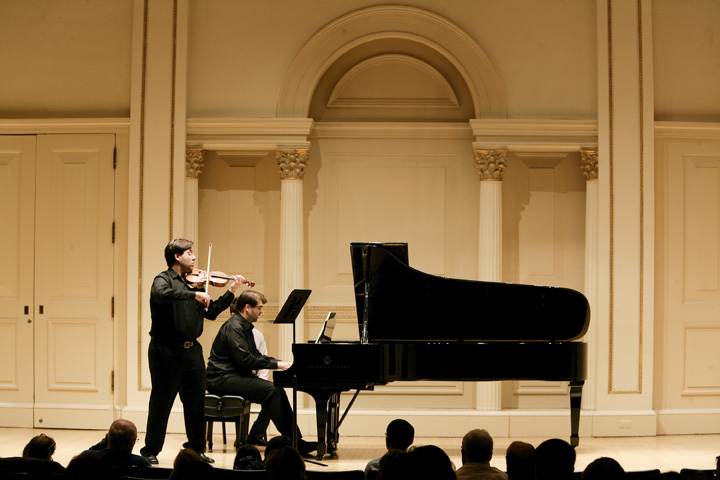
John Irrera, violin; Joseph Irrera, piano
Weill Recital Hall at Carnegie Hall; New York, NY
February 22, 2013
 
Irrera Brothers- Carnegie Hall

Irrera Brothers at Carnegie Hall


The Irrera Brothers, violinist John, and pianist Joseph, list many credentials separately as soloists, but in Weill Hall this February they joined together in a performance as a duo. It is always interesting when talented soloists play together, but when they are siblings, there is an additional layer of interest. One would expect a connection between the players that would be hard to match. By and large, I found this to be the case.

Beethoven’s Sonata for Violin and Piano in G major, Op. 96 opened the program. There were balance issues at the very beginning, with the piano covering the violin, and the playing was somewhat tentative. The notes were all there, and there were moments of beauty, but I was hoping for more. Perhaps there was some nervousness at first. The Chaconne in G minor from Italian composer Tomaso Antonio Vitali (1663-1745) followed the Beethoven and whatever nerves might have present prior had happily abated. The balance was excellent, the shaping of the dramatic lines was strongly realized, and the brothers were right with each other as they built the tension into a fever pitch.

The second half opened with the World Premiere of “Bow Shock” by Russell Scarbrough (b. 1972). Written for the Irrera Brothers in 2012, this is a work that showcases their individual and duo talents to the hilt. The composer in his program notes stated, “the term ‘Bow Shock’ comes from the field of aerodynamics and refers to a curved shock wave that proceeds a solid body moving through the atmosphere at supersonic speeds. It’s a great image for this music…and I couldn’t resist the double-entendre with the word ‘bow’.” It is a jazz-tinged, driving, hyper-energetic work that invites the listener to fasten his seatbelt for the ride. It was a win-win-win: the Irreras can be well pleased that this work shows them to such great advantage. Scarbrough should be delighted with such accomplished musicians giving his music such a dynamic performance. Finally, the listener gets the best of both worlds! After this wild ride, it was time to come back to earth with Three Romances for Violin and Piano, Op. 22 from Clara Schumann (1819-1896). These works were composed as a gift for the legendary violinist Joseph Joachim. These pieces might at first glance seem light works for the salon, but they require subtlety from the violinist and pianist alike. The Irreras clearly grasped this concept and delivered a performance full of grace, wit, and charm. Ending the program was the Sonata for Violin and Piano in D major, Op. 94a by Sergei Prokofiev (1891-1953). Originally scored for flute and piano, it was modified for violin by the composer at the request of his close friend, the great violinist David Oistrakh. This work, although “classical” in form, is unmistakably Prokofiev with its humor, lyricism, and driving energy. The Irreras evidently have a special affinity for this work, as it was a riveting performance. It was the highlight of a very successful concert.

The brothers offered two encores, The first was an arrangement of Chopin’s Nocturne in E-flat major, Op. 9, No. 2 (“for Chopin’s birthday,” stated Joseph Irrera, although Chopin himself always stated his birth date as March 1). The second was “Danse espagnole” from Manuel de Falla’s La Vida Breve,  as arranged by Fritz Kreisler in 1926.

Share

Na Young Kim in Review

New York Concert Artists and Associates presents
Na Young Kim, piano
Merkin Hall, Kaufman Music Center; New York, NY
February 21, 2013
 
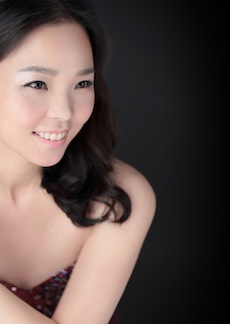
Na Young Kim

Na Young Kim


Winner of numerous competitions, appearances throughout the world, and the full complement of degrees and diplomas from Seoul National University, New England Conservatory, Cleveland Institute of Music, and The Ohio State University, pianist Na Young Kim gave her New York debut on February 21, 2013 at Merkin Hall.

The first half of the program was all Beethoven, the Andante favori, WoO 57, and the Sonata No. 32 in C minor, Op. 111. The Andante Favori was originally intended as the middle movement of the “Waldstein” Sonata, but Beethoven replaced it with a shorter movement after being criticized for the length of the sonata.  As it stands on its own, the decision was well considered and served to improve the dramatic effect of the “Waldstein”.  As for the name Andante Favori, Beethoven’s famous pupil Czerny stated, “because of its popularity (for Beethoven played it frequently in society) he gave it the title Andante favori (“favored Andante”).  Ms. Kim gave a controlled and confident performance, bringing out the singing tone without allowing its charms to degenerate into something cloying.  It was a good start to the evening.  The Sonata No. 32 in C minor, Op. 111, Beethoven’s final piano sonata, is a work overflowing with stormy drama and transcendent beauty. With a rich performance history, including many of the legends (e.g. Richter, Kempff, Arrau),  its programming begs the question of what a new performer is going to “bring to the table”.  Happily, Ms. Kim showed herself to be up to the challenge.  The opening movement, Maestoso – Allegro con brio ed appassionato, was rendered by Ms. Kim with driving energy, clarity of lines and balance, and excellent pacing throughout.  The second movement, Arietta: Adagio molto, semplice e cantabile, was played with steady restraint. Ms Kim showed herself to be a player who patiently brings out Beethoven’s transcendent writing with understanding of the architectural and dramatic demands of this movement.  Her pianissimos were amazingly clear, even capturing a music-box sound near the end of the work.  It was an inspired performance of one the greatest works of the piano repertoire.

The second half consisted solely of Rachmaninoff’s popular Sonata No. 2 in B-flat minor, Op. 36. Originally composed in 1913, it was revised by the composer in 1931. It is the version that is most often performed today (in addition to that of Vladimir Horowitz, who with Rachmaninoff’s consent made a hybrid version of the 1913 and 1931 versions in 1940). It is a work requiring power, passion, and tremendous technique, which Rachmaninoff had in abundance. Was Ms. Kim up to the demands? From the ferocious way she attacked the opening bars, it was obvious that she was. Sterling technique throughout, power without pounding, and strong dramatic sense abounded in Ms Kim’s reading, making it all seem so easy, perhaps too much so.  It was an “A” performance that could have been “A+” with a touch more fire, but a performance of which Ms Kim can well be proud.

Ms. Kim projects an image of calm inner confidence. Everything seems to have been well thought out, planned carefully, and executed with the utmost precision. Not for a moment did she ever appear to be anything but completely in control, which may have led a visually oriented audience to fail to give her the proper respect for her technical prowess. There is little doubt that Ms. Kim has the technique and the intellect to tackle all challenges, but if I had any suggestion, it would be that she could take a few more risks and savor the adventure of her already excellent playing.

For encores, Ms. Kim played the Chopin’s “Minute” Waltz with sparkle and Robert Schumann’s Träumerei from Kinderszenen with tenderness. It was a gentle end to a memorable concert. Na Young Kim is a musician to watch.

Share

Bluegrass 57@7: The Music of Pepper Choplin, Joseph M. Martin, and Carol Barnett (DCINY) in Review

Distinguished Concerts International New York (DCINY)
Bluegrass 57@7: The Music of Pepper Choplin, Joseph M. Martin, and Carol Barnett
Distinguished Concerts Singers International, Monroe Crossing, Guest Artists
Stern Auditorium, Carnegie Hall; New York, NY
February 18, 2013
 
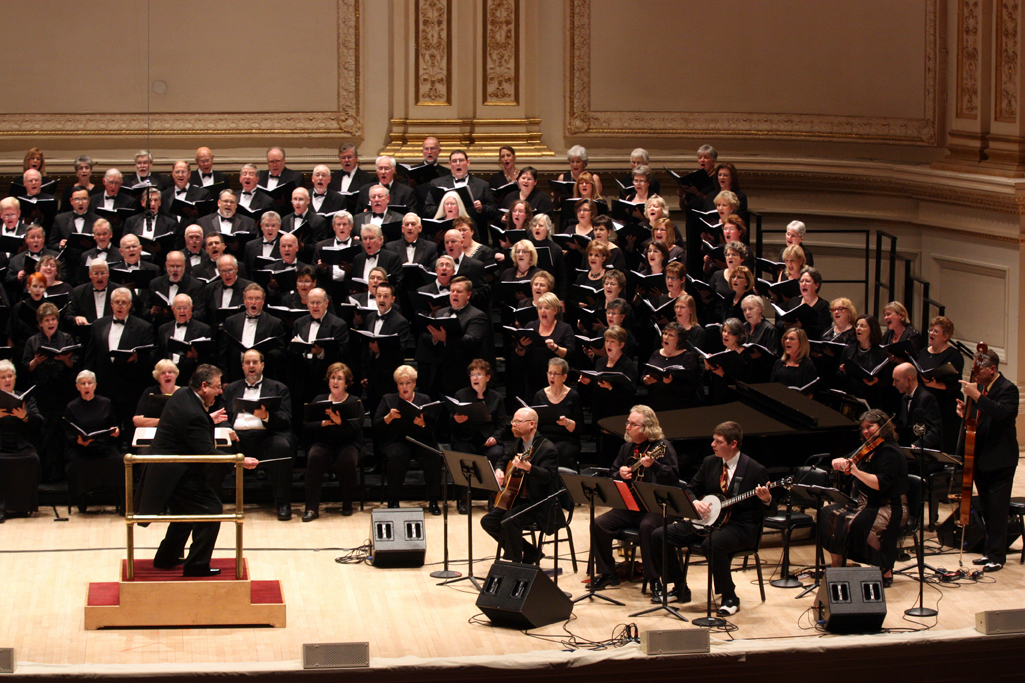
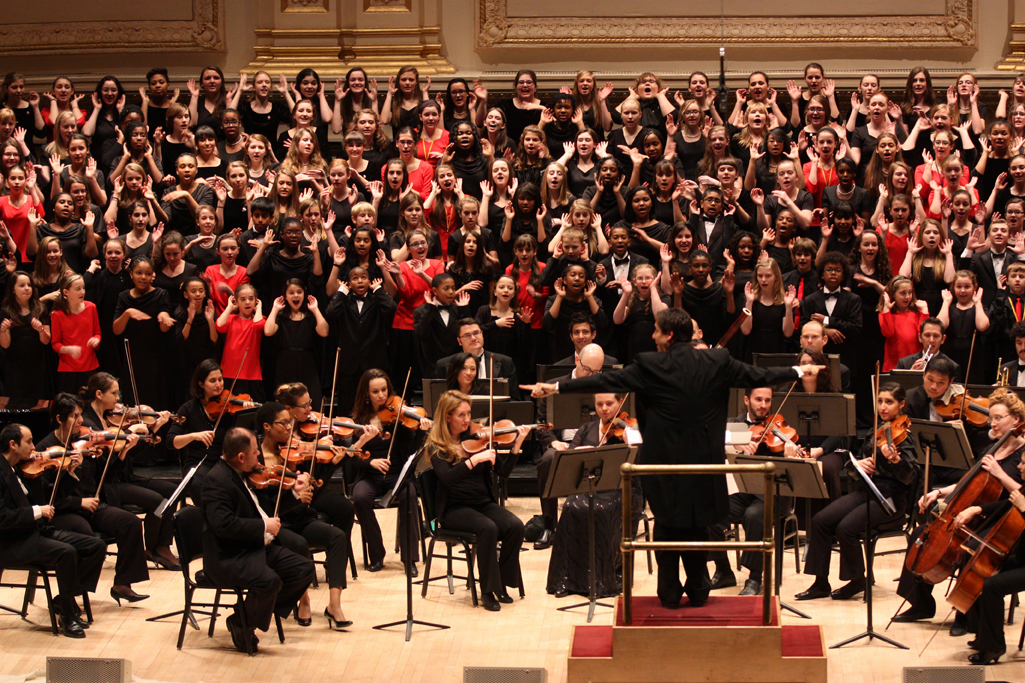
Distinguished Concerts International New York (DCINY): Photo credit: DCINY Production/Hiroyuki Ito

Distinguished Concerts International New York (DCINY) : Photo credit: DCINY Production/Hiroyuki Ito


In a concert with the title “Bluegrass 57@7” (the 57 referring to 57th Street, the location of Carnegie Hall, and the 7 referring to the 7:00PM start time), Distinguished Concerts International New York (DCINY) presented a program dedicated to the Bluegrass genre and its various sub-genres.  Featuring Bluegrass quintet Monroe Crossing, it had the makings of an interesting and educational evening.

The first half featured the vocal music of composers Pepper Choplin and Joseph M. Martin, with the able support of Monroe Crossing. I do believe the most accurate description of the selections presented would be Bluegrass Gospel. The music was mostly joyful and almost always tonally consonant. Indeed, no dodecaphonists were harmed in the making of this music.  Each composer conducted his own works. Highlights of Mr. Choplin’s pieces were the anthem-like “Circle of Love”, featuring the talented vocalist Emily Drennan, and the electrically-charged energy of “Joy on the Mountain”.  Mr. Martin’s “Coming Home” with soloist Sue Martin’s emotional vocals was touching. Then the ebullient Martin waved Choplin back to the stage, handing him the conductor’s baton as he took to the piano for his own “Great, Great Morning.” It had the feeling of a revival meeting. It brought the first half to an exuberant close.

The second half opened with selections from Monroe Crossing.  Monroe Crossing takes its name as homage to the “father of Bluegrass” Bill Monroe and the fact that his music was the common thread that brought the group together (“we crossed paths through the music of Bill Monroe”). Mandolin player Matt Thompson regaled the audience with stories about the group and its members with both humor and humility. in what was probably a well-rehearsed part of Monroe Crossing’s regular performances.  All showmanship and shtick aside, when this ensemble got down to the business of playing, they showed themselves to be not only committed to the art of Bluegrass, but also possessing some serious “chops” as well. The energy was infectious as they played four signature works.  All four pieces were crowd pleasers, but the last called “Bullet Train” was just pure fun from start to finish, and the audience roared its approval.

The final work on the program, Carol Barnett’s The World Beloved: A Bluegrass Mass, was composed with the talents of Monroe Crossing in mind. Matt Thompson told the audience about the challenges Monroe Crossing faced when first receiving their parts.  Not all Bluegrass musicians read notated music, as the art of Bluegrass is largely improvisatory, so this “jumble of dots” was a challenge that was overcome by having each player learn his part by listening to a recorded version. After much hard work, the parts were mastered, and Monroe Crossing has performed this work about “40 times”, according to Thompson. Composer Carol Barnett stated, “My highest hope is that listeners coming from one tradition, classical or bluegrass (and perhaps dubious about the other), might discover something new and wonderful in the combination”. It was an interesting thought and a worthy goal, but one also might feel that neither classical nor bluegrass enthusiasts would be fully satisfied by the end result.  The work is quite moving in sections, and the addition of Monroe Crossing added color, but it is open to debate how much “Bluegrass” was present amid some of the more sophisticated rhythms. Marisha Chamberlain’s libretto is quite provocative in sections, including an unconventional Credo, the thinly veiled 9/11/01 reference in the third verse of the ballad, and the feminization of God in the Conclusion. Conductor Nancy Menk was charged with the challenge of bringing this interesting concept to life, which she did with marked ability. Any reservations I might have had were of no concern to the audience, who responded with a prolonged standing ovation. The Gloria was repeated as an encore to the delight of the audience.  Ms. Barnett and Ms. Chamberlain joined the conductor on stage for bows.

Share

James Jeonghwan Kim in Review

James Jeonghwan Kim, cello
Larry Wang, piano
Weill Recital Hall at Carnegie Hall; New York, NY
February 3, 2013
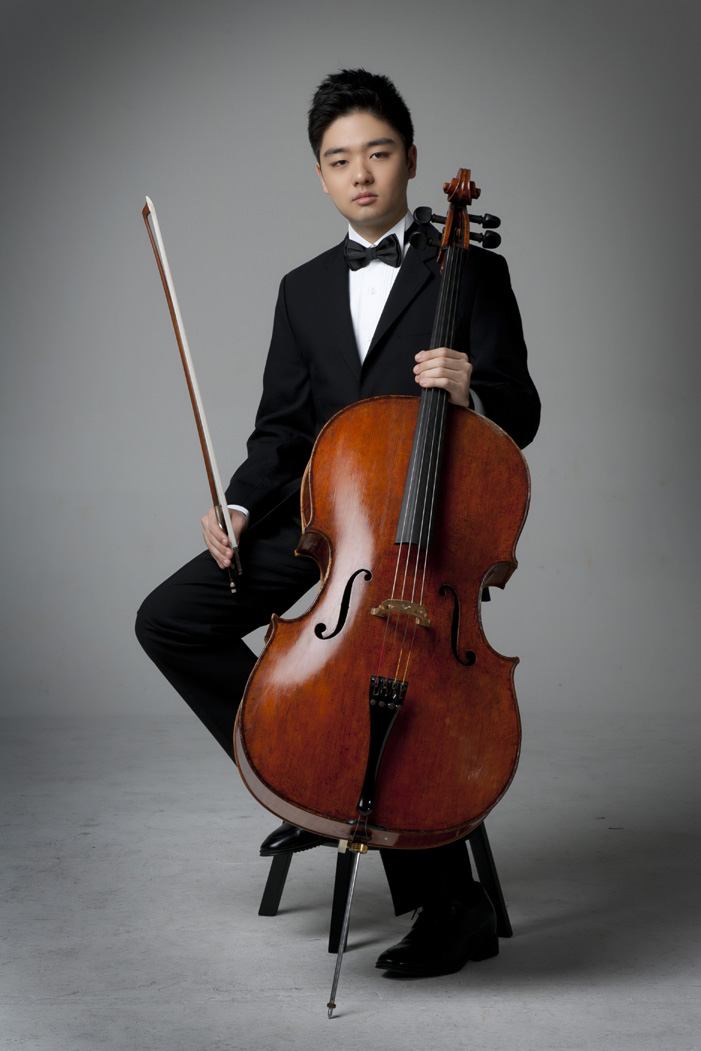
James Kim

James Kim: Photo credit: Ryan Moon

There are debuts and debuts:  the blood bank of human endeavor is forever bringing new musical talent to the fore. But I daresay, the recital of a 19-year-old cellist at Weill Hall on February 3rd was more than merely excellent, it was an historical coming of a fully honed master virtuoso; one is compelled to formulate new standards for the golden instrument!

Young Mr. Kim came to us with formidable credentials. The young artist was born in Seoul, Korea in 1993 and began his studies with Susan Moses, with whom he worked for five years at the University of Indiana in Bloomington. During this time he also received tutelage from Janos Starker, and later from Laurence Lesser at the New England Conservatory. He also enrolled at the Walnut Hill School for the Arts, and is currently studying at Yale with Aldo Parisot. It goes without saying that during his apprenticeship to some of the most illustrious and revered pedagogues of his instrument, Mr. Kim has garnered competition prizes and performance laurels (e.g. The Boston Symphony Orchestra at Symphony Hall; the NEC Youth Orchestra at Jordan Hall; the Korean Broadcasting Symphony Orchestra in his native South Korea– just to cite a few of his accomplishments–before making his official debut at Weill Hall).

But all of this foregoing is commonplace: after a few astonishing and beautifully tapered, long spun phrases of Schubert’s “Arpeggione” Sonata, D.821, this astonished and experienced connoisseur realized that James Kim is a miracle. Never mind my hyperbole; the absolute perfection of his playing, technically, musically and communicatively, had me recalling Casals, Fournier, Rostropovich and Tortelier (of a very different school) but likewise, Feuermann, Yo-Yo-Ma, Miklós Perényi, Heifetz (of a closely analogous virtuoso persuasion), and of course Kim’s mentors, Starker and Parisot. Never before, have I encountered such winged ease, such airborne joy, such silken smooth bowing and tone production. All of these facets were present at the service of stylistic knowledge, bracing rhythmic thrust and most importantly, an inviting warmth and modest honesty.

The Schubert Sonata was played with the first movement repeat, forward momentum and necessary flexibility. Kim’s assisting pianist, Larry Weng, a pupil of Boris Berman at Yale, supplied spot-on ensemble and concentration. He also won a “Brownie Point” by using the Barenreiter Edition, with its corrected harmonies in the central Adagio.

The Debussy D Minor Sonata that followed also had the requisite impetuosity and unpredictability. Altogether, a volatile, wonderfully shaded and exquisitely timed rendition from both protagonists.

Isang Yun’s short unaccompanied piece, “Glissees pour violoncello seul”, especially written for a competition in 1970, makes, as intended, fiendishly difficult demands on the player, but Kim mastered these hurdles as if they were child’s play.

The Mendelssohn D Major Sonata, Op. 58 (more frequently played than its predecessor, No. 1 in B-Flat) took off in a shower of gravel, a galloping interpretation (with pianist Weng as an ideal co-jockey).

There was an encore, too: Rostropovich’s Humoreske, which resembled David Popper’s “Elfentanz”, albeit with an unfamiliar, sinister spice.

Share

Fourth Olympic Challenge Competition in Review

Fourth Olympic Challenge Competition
Weill Recital Hall at Carnegie Hall, New York, N.Y.
February 10, 2013
 

The title “Olympic Challenge Competition” may seem to suggest athletics rather than the more subjective field of music, but the name does suit the heroic efforts showcased recently in a concert of its young winners, ages 5-18, presented by the “You Need Music” Educational and Performing Enterprise. Offering a great incentive to practice and a much-needed chance to perform, “You Need Music” has been growing, according to the director, to draw students from all over the country. As the presenter’s website itself states, ”’You Need Music’ offers the unique opportunity to play at Carnegie Hall for children who put their effort in learning music without a goal to become professionals, but for the sheer love of performing.” Whether or not on a professional track, the twenty-five soloists on violin, cello, and piano (selected from DVD screening and live audition) had clearly invested tremendous energy and discipline to reach levels that were in some instances of a professional quality. Several players, as one would expect for the age range, experienced struggles with technique, focus, intonation, and other matters, but the level was generally high and in all cases was promising. Their concert at Weill Hall, as well as being a “victory lap” of sorts, was to further select three top winners to continue to a February 24th recital at Merkin Hall, with monetary prizes. As it turned out there were two Special Mentions (without monetary prizes) as well. I would have added several more, or exchanged one or two, but such is the nature of competitions. Having adjudicated for four hours for a different organization on the same day, I came to this event with many contest-related issues already in mind.

First of all, this audience at Weill Hall was not told the individual ages of performers, though one could hazard some guesses (and there were no college students allowed). It was also not clear whether the three judges were privy to age information, and one was uncertain whether awards were being made based on current development or potential for later success. Knowing numeric ages can be prejudicial – as in the psychologically misleading single-digit 9 versus double-digit 10 (with perhaps a birthdate difference of only a few months), making one child seem comparatively precocious; there can be equal misjudgments, though, on a visual premise, for instance assumptions based on height. The ideal solution may be a single artistic standard, but how is that really possible within a 13-year age range? One hopes for true discernment, but the cited Olympian “criteria” from the contest’s website, comparing musical qualities to attributes of Zeus, Poseidon, and Athena, seemed not to be terribly relevant or helpful in this case. It may add to the administrative work, but I would recommend a few separate age categories. It would also make possible eliminations more palatable for the older players.

Among these more mature players, William Hume, pianist, would have been one of my choices as a winner. He delivered Kapustin’s very difficult Concert Etude Op. 40, No. 1, with the fluency and ease of a veteran performer. He could certainly have a musical profession in his future, so I was disappointed that he was not chosen for something. Also among the teenagers, Mika Lin, violinist, gave an account of Bach’s Sonata No. 1 (Adagio and Presto) that was commendable for a pre-college-aged student. Pianist Orcin Akman handled the challenges of Liszt’s “Gnomenreigen” with such spirit and clarity that I had her in mind for the top winner, while pianist Deniz Akman savored and explored every ounce of drama in his rendition of Rachmaninoff’s Prelude in C# minor.

Several players were outstanding among the (seemingly) much younger set, including pianist William Chen, performing Liszt’s La Leggierezza, and violinist Matthew Ho, taking on the challenging Praeludium and Allegro of Kreisler. Also impressive were very young pianists Joy Xu (the first I’ve ever beheld playing Debussy’s Dr. Gradus ad Parnassum with the aid of a pedal extender meant for the tiniest players), Annie Gu, who opened fearlessly with Chopin’s Polonaise in G minor, and Dylan Wang, highly self-assured for one so young in Bach’s Concerto in A Major, BWV 1055. Amid the concert’s torrent of notes, young pianist Darina Korneeva played a relatively simple Sarabande (by a composer listed as “Lak”) with genuine tenderness of feeling. One has years to learn octaves and scales, but this little one saw that no note was wasted.

In the end, the First Prize went to William Chen and the Second to Orcin Akman, both mentioned above. Third Prize went to Eugenia Zhang, a violinist who had bravely tackled Lalo’s Symphonie Espagnole (first movement). Special mention went to Deniz Akman and Joseph Maldjian, the latter who had played Shostakovich’s “Hurdy-Gurdy” from “Dances of the Dolls.”

Judges were Ilya Kazanstev (piano), Aisha Dossumova (violin), and Slava Znatchenii (oboe). It was a refreshing touch to have them precede the children’s recital with performances of their own, setting a high bar. Opening was the Solo de Concert for oboe of Émile Paladilhe, followed by Kupkovic’s Souvenir for violin (think Vaudeville meets Paganini). Both works were admirably accompanied by Dmitri Korneev at the piano. Closing the jurors’ performances was Mr. Kazantsev (whom I reviewed favorably about five years ago), tossing off the Kreisler-Rachmaninoff Liebesfreud beautifully.

Share

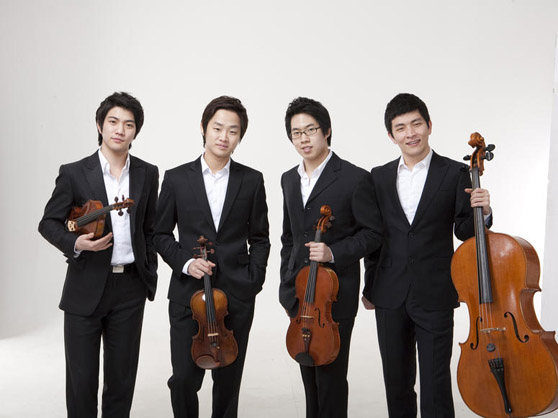
Novus String Quartet in Review

Novus String Quartet
Jae-Young Kim, Violin
Young-Uk Kim, Violin
Seung-Won Lee, Viola
Woong-Whee Moon, Cello
Weill Recital Hall at Carnegie Hall
January 24, 2013
Novus String Quartet

Novus String Quartet

In a Carnegie concert sponsored by Sejong Soloists, the Novus String Quartet did an excellent job of presenting stylistically authentic performances of varied music by Mozart, Ligeti, and Dvorak. The Mozart was particularly impressive, as its exposed, transparent strands were beautifully shaped with clean textures and impeccable intonation. The violinists Jae-Young Kim and Young-Uk Kim, the violist Seung-Won Lee, and the cellist Woong-Whee Moon were all rhythmically in sync too. The challenging Ligeti String Quartet No. 1, “Metamorphoses Nocturnes”, poses its share of complexities, and Novus handled obstacles with ease. They were well-prepared.

Their preparation was also in evidence with Dvorak’s String Quartet No. 13 in G Major, a late opus composed near the time of the cello concerto. The work has both the transparencies of the Mozart and the dense counterpoint of the Ligeti, and Novus solved difficulties with aplomb, presenting a fluid, confident performance of the first order. On top of that, they homogeneously sang out Dvorak’s expressive folk-like music with charm and eloquence.

This ensemble will go far. They clearly have an affinity for the classical style, but also modern works and romantic staples. In an effort to broaden their repertoire, they are currently taking the Konzertexamen degree course under the guidance of Christoph Poppen and Hariolf Schlichtig at the Hochschule fur Musik und Theater Munchen (Academy of Music and performing Arts Munich) . Over the last five years, (the group was founded in 2007 by violinist Jae-Young Kim), Novus has been the recipient of many prizes and awards, such as at the Lyon International, the Osaka, the Haydn, and the ARD in Germany. Most recently, Novus has appeared at the Seoul Spring Chamber Festival, and the highlight of the season was marked by their performance tour through Costa Rica, El Salvador and Panama, sponsored by the Korea Foundation. The tour not only attracted wide media attention and great audience response, but it helped bring together the music and talented artists of Korea and Latin American countries. This is commendable work. They seem interested in bringing their collective talent to places and people that are under-nourished in classical music. They are the right group to do this, as they are building a broad repertoire and presenting it with charisma and skill.

Share

The Sounds of War and Peace (DCINY): Chapter 2- The Music of Karl Jenkins

Distinguished Concerts International New York (DCINY)
The Sounds of War and Peace: Chapter 2- The Music of Karl Jenkins
Distinguished Concerts Orchestra, Distinguished Concerts Singers International
Jonathan Griffith, Music Director; Karl Jenkins, Composer-in-Residence.
Stern Auditorium, Carnegie Hall; New York, NY
January 21, 2013
 
"The Sounds of War and Peace: Chapter 2"

“The Sounds of War and Peace: Chapter 2”

“The Sounds of War and Peace,” a two-evening event begun January 20th, continued on January 21st with Chapter 2 – The music of Karl Jenkins. The United States premiere (and second performance worldwide) of Songs of the Earth was programmed with The Armed Man: A Mass for Peace and its accompanying film (also entitled The Armed Man), and it had the promise of being a fascinating evening.

The Armed Man: A Mass for Peace is probably the most frequently performed work by Karl Jenkins; in fact, it might be one of the most frequently performed works of any contemporary classical composer. Since its premiere in April 2000, The Armed Man has been performed worldwide well over 1000 times – an average of twice a week.  Although I have heard this work on recording countless times and know it well, a live performance of The Armed Man is an experience that never ceases to move me.

The Armed Man is a thirteen-movement work for orchestra, chorus and vocal soloists. Using the 15th century French song L’homme Armé as a starting point, the theme is that the armed man must be feared – an idea that is still with us in the 21st century. Using sections of the Latin Mass, the Bible, The Mahabharata, and words from Kipling, Dryden, Tennyson, Mallory, Swift, Togi Sankichi, and Guy Wilson, this hour-long work is a journey through the preparations for battle, prayers for deliverance, the call to arms, the horrors of the battle, and its aftermath, with the final declaration that “peace is better than always war”.

The accompanying film I have always had mixed feelings about. It was premiered in its current form in Johannesburg, South Africa in September 2007. The images are powerful and often disturbing, as I am sure was the intent, to highlight the horrors of war.  Quoting Jenkins, the film “greatly enhances the musical performances and inevitably leaves the audience emotionally drained, often in tears.”  I understand Jenkins’ viewpoint, but I also believe the music is powerful enough to stand on its own without any imagery.

Conductor Jonathan Griffith knows this work well and his mastery was immediately obvious.  His steady leadership kept everything under control, even deftly tackling a small ensemble problem in the “Better is Peace” movement that could have turned into a disaster. He brought it back on-track almost instantly. The Distinguished Concerts Orchestra played, especially the percussion section, with the fire this work demands. The chorus was well-prepared and a worthy collaborator to the orchestra. It was notable that the sopranos did not crash on the jagged rocks of “Charge!” in which the high A’s have claimed countless victims. Highlights included the cello solo in the Benedictus, and Iman Shamsi Ali in his off-stage Adhaan. The four vocal soloists were all impressive in their roles, limited though they were. My one disappointment was the surprisingly timid brass in the “Charge!” This was a time for them to really come to the fore and it just did not happen. All-in-all, it was a inspired performance that was held the listener from the opening snare drum marching cadence, to the chorus singing the healing words of Revelation 21:4, to end the work.

The Vocal Ensemble Brevis, an all-female choir from Croatia took to the stage to open the second half. Led by Antoaneta Radocaj-Jakovic, they presented works from the Croatian composers Josip Hatze (1879-1959) and Slavko Zlatić (1910-1961).  Hatze’s  Ljuven Sanak  (Sweet Dreams) was especially soothing after the emotionally demanding first half of the concert. Zlatić’s Varijacije na nardonu temu (Variations on a Folk Theme) was an interesting work that deserves to better known.  It was disappointing that the program notes omitted any information about the composers, the pieces, or the ensemble. This excellent assemblage deserved its proper recognition.  As a way to bridge the two large Jenkins works, the ensemble ended with his Adiemus, which they performed with great energy and polish.

While the orchestra and chorus members returned to the stage, Griffith invited Karl Jenkins to the stage to have an impromptu discussion about his new work, Songs of the Earth. Jenkins told the audience that the work came from a commission from the Cultural Olympics. He decided to use the idea of Greek mythology as the basis for the work. Jenkins’ “invented language”, first used in the Adiemus project, was the text for Songs of the Earth. Jenkins explained this gives the composer great flexibility in tone and rhythm in the vocal writing. The six movements were selected because Jenkins found them “musically stimulating” as opposed to following any defined story lines.

Songs of the Earth is an interesting combination of the early Jenkins (Adiemus and the jazz influences from his Soft Machine days) with the larger works, such as The Armed Man, Stabat Mater, and The Peacemakers. The opening movement,” Khaos”, is aptly titled. An improvised saxophone solo plays over the pulsating rhythms of the orchestra and the chorus. It has a primordial quality suggesting the birth of the unformed universe. The second movement, “Gaia: Mother Earth” has the chorus chanting her name over and over in a worshipful manner or ritualistic adoration. “Ouranos and the Heavens”, the third movement, has an ethereal quality, with a singing violin solo and another improvised saxophone solo. The fourth movement, “Dance of the Titans”, with its ever changing meter (one bar 7/8, the next bar 3/4, then the pattern repeats), has a quirky feeling that at times boarders on the grotesque. “Tethys, Goddess of Fountains and Stream”, the fifth movement, has a flowing, water-like feel that the title suggests and features another extended saxophone solo. The final movement, “The Pit of Tartarus” has a relentless driving energy that is strongly akin to the Paradisi Gloria from Jenkins’ own Stabat Mater.

Mr. Jenkins should be pleased at the fine performance of his new work which made it a great success. Congratulations are in order for the chorus from Pennsburry, Pennsylvania (consisting of the High School Concert and Women’s Concert choirs with the Community Chorus), the Distinguished Concerts Orchestra, and conductor Griffith, who combined their considerable talents to make it all come together. Songs of the Earth should take its place with other of Mr. Jenkins’ popular works, and I’m sure his many fans will be looking forward to future performances.

Share

Oberlin Orchestra in Review

Oberlin Orchestra
Raphael Jimenez, conductor
Jeremy Denk, piano
Carnegie Hall
January 19, 2013
Oberlin College

Oberlin Orchestra; Photo Credit: Chris Lee

The Oberlin Orchestra sounded polished and impressive in their Carnegie Hall Concert on January 19th. The music was challenging, including Ravel’s “La Valse” and Stravinsky’s “Firebird” (1919), and the young players rose to the occasion, sounding highly professional–especially in the execution of complex rhythms. The percussion nailed those complexities with ease and solidity of sound, the brass and winds were expressive and noble–even during tricky sections, and the strings were clear and energetic at all times. In Ravel’s “La Valse”, for example, the violins employed every bow stroke, vibrato and portamento with precision and unity.

One could quibble with the lack of sheer tonal strength in the strings, but this may have been due to the brass and percussion overpowering them at times. Or it may have been due to the inferior quality of some of the string instruments (after all, not every student can afford something top-notch yet). Here is something a little esoteric: the influence of the major orchestra in town could enter the attitudes of the major conservatory in town. In other words, it may be that the sound of the pristine, elegant Cleveland Orchestra is in the air.The Oberlin Orchestra in many ways sounded like a young Cleveland Orchestra: polished and elegant, but not necessarily powerfully robust–and that is not a negative, but simply a tradmark characteristic. Conductor Raphael Jimenez did a wonderful job of balancing the sections of the Ravel and Stravinsky, and bringing out the various colors in Christopher Rouse’s “Iscariot”, a dissonant work reminiscent of Ives, from 1989. All these works require an excellent navigator for the heavy orchestration, and Jimenez made these textures transparent. He also deserves credit for preparing the ensemble so well. Most of these young musicians have never played in Carnegie Hall, and any nerves were tempered by Jimenez’s controlled, collected podium style. That said, Jimenez might have allowed for more abandonment and chaos in certain sections of the Ravel. This is a not an effervescent, ebullient Johann Strauss Jr. Waltz, but rather a parody of it–music that gets more and more out of control.

Rouse, an outstanding composer who is Composer-in-Residence of the New York Philharmonic and an Oberlin alumnus (graduating class of 1971), made a welcome onstage appearance.  A younger alumnus, the accomplished Jeremy Denk (a 1990 graduate), performed Mozart’s Piano Concerto No. 21 in C Major, K. 467. Denk gave an impressively speedy and facile performance, but one that still found time to be sensitive to all the music’s phrasing and harmonic shifts. The ensemble between orchestra and soloist was superbly homogenius. The quality of the strings and winds was very high, imbued with clarity of rhythm and excellent intonation.

This evening at Carnegie Hall was a wonderful celebration of Oberlin’s depth of talent and the school’s and students’ accomplishments. Oberlin is no doubt a great place to be if you want to make a deep impact as a musician.

Share

The Sounds of War and Peace (DCINY): Chapter 1 in Review

Distinguished Concerts International New York (DCINY)
The Sounds of War and Peace: Chapter 1
Distinguished Concerts Orchestra, Distinguished Concerts Singers International
Francisco J. Núñez, composer/conductor; Jonathan Willcocks, composer/conductor
Stern Auditorium, Carnegie Hall; New York, NY
January 20, 2013
 
DCINY

The Sounds of War and Peace: Chapter 1


Distinguished Concerts International New York (DCINY), well-known for themed programs, created a concert series called “The Sounds of War and Peace”.  Over two nights, each “chapter” focuses on music that expresses not only the horrors of war and its aftermath, but also the idea of peace through the idea of multi-cultural understanding and cooperation.  On January 20, 2013, Chapter 1 was performed- the first half “peace”, and after intermission, “war”.

The first half, featuring elementary and middle school-aged performers from Georgia, Connecticut, Texas, Pennsylvania, and Maryland was conducted by the multi-talented Francisco J. Núñez.  Billed in the program as “Music for Future Peacemakers”, it was a selection of works that could be best described as having the qualities of child-like innocence, rather than having any more overt “peace “message. It was more William Blake than Mohandas Gandhi.  Opening with Kayama from Adiemus: Songs of Sanctuary by Karl Jenkins, the night got off to a good start. One of Jenkins’ earlier works, it already incorporates many elements of what could be called his signature sound – an easily sung melody combined with the flavor of diverse multi-cultural influences, especially in percussion and rhythm. The “words” of this piece are invented and are not part of any recognizable language, lending it what the program notes described as a  “tribal” sound.  It was given a joyful performance.  Dôme épais, better known as the “Flower duet”, from Leo Delibes’ Lakmé followed. The soprano and mezzo-soprano soloists (whose names were not mentioned) sang this favorite with polish in an arrangement by Núñez. The chorus was challenged by the some of the upper register sections, not at all surprising considering the age of the performers.  It did seem to be a curious selection that did not really fit in with the other works or the theme of the concert itself. Three Dominican Folk Songs, as arranged by Núñez, captured the essence of nursery songs. From the playful, to the poignant, and even to the mocking, the young performers brought it all to life.  After this whimsy, a more serious selection was in order, and selections from Misa Pequeña Para Niños (A Children’s Mass) fulfilled this. Composed by Núñez in memory of his father, it is a fitting tribute written by a composer who has a great understanding of the limitations and possibilities of the child’s voice.  The three selected movements were rendered with great feeling and in conjunction with the “big sound” of the orchestra elicited from the young performers a collective sound beyond their years.  The remaining selections brought back the spirit of joy and hope. The polyrhythmic clapping in Aaron Siegel’s The Light Come Down was a highlight of the evening and brought the crowd’s roaring approval. Sesere Eeye, complete with hands waving, jumps, and leaning forward, was the signal that the fun was back, which continued in Oye by Jim Papoulis.  Even Núñez got into the act, dancing at the podium while the singers spun around in their own dance, reminiscent of Gustavo Dudamel with the Simón Bolívar Youth Orchestra.  Ending with the anthem-like Give Us Hope from Papoulis, the hearts of the audience were won over completely. It was truly touching to see the smiles and excitement on the faces of the young performers – a memory that will be with them always.

The adults took to the stage for the “war” second half- the Carnegie Hall premier of A Great and Glorious Victory, conducted by the work’s composer Jonathan Willcocks.  This work was commissioned to mark the bicentenary of the Battle of Trafalgar. Scored for tenor soloist, chorus and orchestra mirroring Haydn in his Nelson Mass, the four movements use words from the Latin Requiem Mass, the Book of Common Prayer, and contemporary accounts of the events, including Nelson’s.

This four- movement work not only commemorates the well-known battle and it’s most famous personality, Admiral Nelson, but a much lesser-known event that occurred after the battle. A terrible storm after the battle had finished threatened all the combatants and in the spirit of cooperation and brotherhood, they put their differences aside and aided the others regardless of nationality.

The first movement, Preparation, is a solemn prelude to the coming battle. One can feel the rising tensions as there are prayers for strength and hope of victory. The second, Conflict, has the chorus singing the Dies Irae while the tenor soloist is singing the words of Nelson at the same time.  It was an inspired idea that highlighted the idea of battle.  Eventually, the battle slows and the Lacrymosa quietly ends the movement. Storm, the third movement, featured the tenor soloist singing off-stage (in this case, in the balcony) from the Book of Common Prayer asking for deliverance from the terrible storm. Finally, the last movement, Reconciliation, highlights the ideal of a new peace, where the former enemies cast aside their differences. It ends with the tenor soloist singing off-stage while his voice fades to silence. The composer refers to this movement as the heart of the work.

Willcocks proved to be an effective and engaging conductor, while tenor soloist Daniel Shirley’s voice soared over the large forces with strength and clarity. The DCINY orchestra played with intensity and brought out both the savage and the sublime. The large chorus was well prepared and sang with great fervor and passion.  A Great and Glorious Victory wasn’t composed with DCINY in mind, but it is a work they could make their own.  It was a memorable performance. 

Share

Jean Muller in Review

Jean Muller, piano
Weill Recital Hall at Carnegie Hall, New York, N.Y.
January 18, 2013
 
Jean Muller, pianist

Jean Muller

Following the 2012 release of a well-received all-Chopin recording on the Fondamenta label, Luxembourgian pianist Jean Muller kicked off a world tour with largely the same repertoire in a fine recital at New York’s Weill Hall. It is not easy to offer fresh perspectives on the pillars of the Chopin piano literature, particularly after the composer’s bicentennial blitz of 2010, but Mr. Muller appears oblivious to any need to be different (or the same, for that matter); it is enough to be oneself, as Mr. Muller appears to know. These days, the slow burn of being a sincere, dedicated musician is almost revolutionary in its own right.

His program’s first half was made up of the complete Ballades. His were nuanced, at times understated, renditions of these musical treasures. With so many cranked up performances going around of what one could almost call “McBallades” at this point, this listener was relieved to discover that there was nothing formulaic or facile about Muller’s interpretations. Starting the G Minor Ballade (Op. 23) with a more pensive, deliberate first theme than one usually hears, Muller brought it a searching quality, as if encountering its mysteries for the first time. It was highly individual, without being distorted or eccentric. He played with a fluent, natural sense of rubato. Occasionally there were tonal balance issues exacerbated by a somewhat thin treble sound, but in each case one sensed that decisions had been made to favor overall dynamic pacing over individual cantabile lines. Indeed, the pacing toward climaxes was achieved skillfully, with refreshing attention to the work’s inherent logic and integrity. Technical hurdles were handled neatly without virtuoso excess – though perhaps with a bit too much caution for this listener.

The second Ballade (Op. 38) was similar in its strengths. Thoughtfully paced and with no exaggeration or bombast, it reflected the refined poetry of the work. Because the piece alternates quiet lyricism with tempests, this listener wished in turbulent sections for greater unleashing of this pianist’s full resources (as heard later on the program), but it seemed that Muller was holding his energies in reserve. Perhaps when performing all four Ballades, this is inevitable. The brilliant and dramatic coda was negotiated neatly, but with a bit more abandon it could have truly caught fire.

The third Ballade (Op. 47) was a highlight, not surprisingly, as it benefited from this pianist’s thoughtful, civilized approach. The famous rocking theme (or some say “cantering”) was especially winsome, and Muller built the ensuing drama well. Similarly the final Ballade (Op. 52), arguably the most challenging of the group to hold together, was unified with mastery. The chorale-like lull just before the ferocious coda was done perhaps more beautifully than I’ve ever heard – it’s prayerfulness stemming not merely from the perils ahead, as with some performances!

The second half included shorter works, framed by two Polonaises, the F-sharp minor, Op. 44 and the A-flat, Op. 53. Highlights were the poignant Mazurka in A minor Op. 17, No. 4 and the Waltz in A-flat Major, Op. 69, No. 1, both expertly phrased, the latter with especially golden-toned melodic beauty. The old chestnut Waltz in D-flat (Op. 64, No. 1, the “Minute Waltz”) had just the right élan, and the Posthumous Largo in E-flat Major added novelty to the otherwise widely known offerings. Also heard were the Mazurkas in A minor, op. 67, No. 4, and in C Major, Op. 68, No. 1, both handled with polish and sensitivity. Happily the final “Heroic” Polonaise found the pianist letting go more, though still with expert control as he released torrents of left-hand octaves with riveting evenness. It was worth the wait.  Rousing ovations elicited encores of Chopin’s B-flat minor Nocturne and Fantaisie-Impromptu.

Share