Creative Classical Concert Management presents Yi-Chih Lu in Review

Creative Classical Concert Management presents Yi-Chih Lu in Review

Yi-Chih Lu, piano

Weill Recital Hall at Carnegie Hall, New York, NY

July 6, 2022

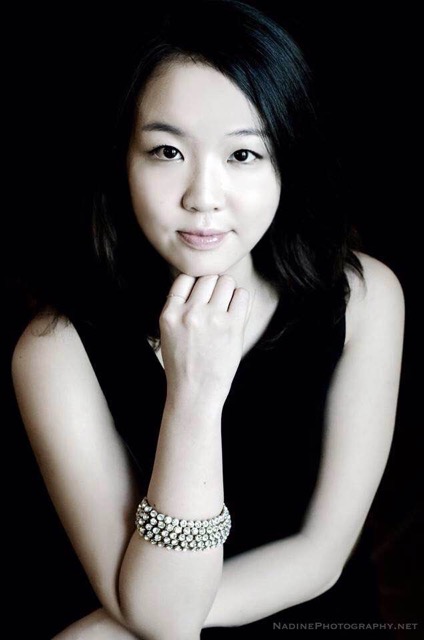
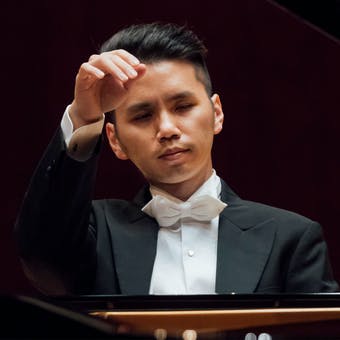
A nearly full hall greeted the New York recital debut of Taipei-born pianist Li-Chih Lu. Mr. Lu plays with magisterial fluency of technique, beautiful tone at all times, and most importantly a deep passionate emotional involvement, which was visible even though the artist played the entire recital masked. His elasticity of phrasing and natural sense of color, based on a deep understanding of harmonic tension and release, was often breathtaking, more often than not in fact, though it could also become a liability, as I shall try to describe.

Scant information was provided on the flyer that served as a program: Artists please make (or have your managers make) a proper program with program notes. Mr. Lu appears to be a young man in his mid-twenties, and to fill a recital hall at this time of year (season over, etc.) is no small accomplishment. After hearing him, I can understand how he would generate such enthusiastic devotion. After Taiwan, Mr. Lu completed training in Berlin and Vienna, though no teachers were mentioned. He won Taiwan’s Golden Melody Award (equivalent of our Grammy), though it didn’t state for which of his recordings.

The entire first half of the recital was devoted to all four of Chopin’s Scherzi. Spaced through the composer’s rather short career at regular intervals, these constitute just one of the many “diaries in music” that Chopin left us. Though Chopin never played all four of them at one sitting, nor intended that they be experienced thus, it has become accepted to engage in the omnibus approach. Certainly, there is more than enough variety to sustain such a hearing, and Mr. Lu provided it. Amid a stunning rendition of all four, I would have to rank them from “most fabulous” to “less” fabulous as Nos. 3, 4, 1, 2. I shall discuss them in that order.

The third scherzo, in C-sharp minor, is dedicated to one of Chopin’s favorite students, Adolphe Gutmann, who began lessons with him at age fifteen, and whose octave technique was said to be legendary. Mr. Lu could be said to be the reincarnation of Gutmann on this one point alone, though there was so much more to his interpretation. The sweeping sense of lyricism that was enabled by the sureness of his technique moved this reviewer to tears, and miracle of miracles, it was never bangy. The tiny notes (“waterfall” passage) that accompany the contrasting second hymn-like theme were spectacular. Believe me, I have heard everyone- Richter, Gilels, Ashkenazy, Perlemuter, Arrau, Ax. This traversal of the scherzo can take its place next to theirs.

Perhaps the most “playful” of the four, the fourth scherzo, in E major, has a bouncy up and down chord riff that is very awkward to play, but which sounded effortless in the hands of Mr. Lu. However, he rightly saved the golden treasure for the theme of the sorrowful middle section, nocturne-like, which was varied on each return. One of the characteristics of the grand Romantic style of playing, in fact, is finding new colors in repetitive material, a major strength of Mr. Lu, and a must in the scherzi, which contains many repeats.

The first scherzo, in B minor, for the first time in my concert-going life, actually seemed humorous in its outer sections, which are usually rendered as something more sinister. Mr. Lu’s incredible keyboard facility is what clarified this thick, difficult music, and he actually enabled us to hear, on a monstrous 9-foot modern Steinway, some of the gossamer, proto-Impressionist delicate haze that Chopin was said to create on his lighter Pleyel instruments. The middle section’s lullaby (Rock-a-bye, little Jesus, my little pearl…) was gorgeously played, and in context, one could speculate that the “joke” in this scherzo was how could Mary ever get him to sleep with all the commotion of the outer sections.

Mr. Lu’s presentation of the second scherzo, in B-flat minor, was the most “conventional” though still astonishing in its sense of discovery, that “seeking and finding” that make a performance memorable. I suspect Chopin would have wanted to work with Mr. Lu for many, many hours on the famous triplets of the first theme: the composer wanted them to sound questioning, and would not yield until the student achieved that quality. Here, Mr. Lu was somewhat dry rather than questioning.

After intermission, there was a potpourri of repertoire that showed off Mr. Lu’s above stated strengths, primarily a technical brilliance that gave him the freedom to indulge in his passionate sense of lyrical rubato.

I am a Czerny fan, not for the hundreds of etudes that have terrorized nearly two hundred years’ worth of piano students, but for his serious piano sonatas and chamber music, which can be quite innovative. Unfortunately, the Fantasie brillante on themes from Le Nozze di Figaro is not one of those innovative pieces. It is in fact rather “stupid,” serving only as a show-off piece, and even Mr. Lu’s enormous gifts couldn’t rescue it from triteness. I apologize for seeming harsh, but an artist needs to learn repertoire selection too. It was a shame for Mr. Lu to squander his enormous talent on this work. He ought rather explore the rich territory, for example, of Liszt’s many operatic paraphrases.

Lu then continued with three arrangements of traditional Taiwanese folksongs. I may arouse the wrath of some vintage piano recital goers, but here Mr. Lu’s ear and technique reminded me of the legendary Earl Wild, perhaps not so wildly complex. These were lavish adornments of picturesque scenes: a maiden rejects the advances of a much older suitor; a poor old man selling rice-buns late at night; and another maiden bargaining for a trip across a river by ferry. All three were beautifully played, preceded by Mr. Lu’s charming verbal program notes.

Mr. Lu closed the recital with the solo version of Gershwin’s Rhapsody in Blue. Here, I had to take issue with Mr. Lu’s approach and say that he speaks Gershwin with a fussy accent that has little to do with jazz. The “rhapsody” is already written into the music by quick alternation of themes, tempi, mood, etc. You don’t have to show how “musical” you are by bending every single phrase until it sounds like not-so-good Rachmaninoff. I’d recommend that Mr. Lu listens to Gershwin’s own piano roll of the Rhapsody, as well as many vintage recordings of early jazz players to get a better sense of the style.

The Rhapsody in Blue is always enjoyed, but I caution that it has become so iconic that it actually gives listeners an easy satisfaction, the opportunity to “tune out”: you are no longer listening to what is actually being performed. You go into a “zone” in which you hear a pre-fabricated tune that you “already know.” But none of my reservations about the Rhapsody curbed one iota of enthusiasm by Mr. Lu’s ardent fans, and I’m glad for it.

I would need (and doubtless enjoy) to hear Mr. Lu in a much wider set of repertoire (Bach, Beethoven, Schubert, French, contemporary) to be able to assess whether he has versatility, but what an amazing “starting point.”

Mr. Lu preceded his encore with very charming, though heavily accented, verbal program notes. I wasn’t able to catch the title or plot of his arrangement (by advance request from an audience member) of a Chinese folk song, but I ascertained that it was a love song. A fitting way to close an auspicious debut.

Share

International Violin Competition of Indianapolis presents Richard Lin, Violin and Thomas Hoppe, Piano in Review

International Violin Competition of Indianapolis presents Richard Lin, Violin and Thomas Hoppe, Piano in Review

Stern Auditorium at Carnegie Hall, New York, NY

June 24, 2022

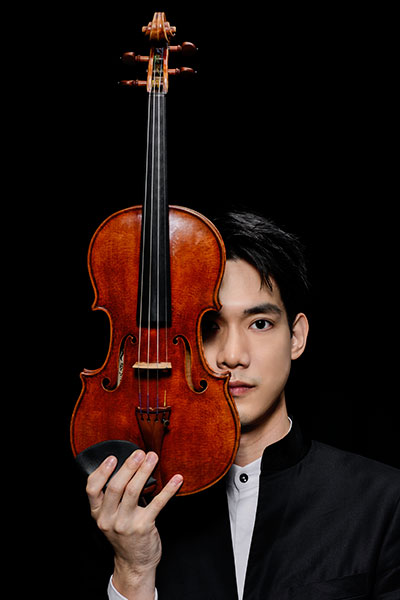
Richard Lin.  Remember the name.  For he has everything required to take the world by storm.

It was one of those magical evenings music lovers live for.  A new artist, supremely talented, fully formed, takes the stage.  For a couple of hours the healing elixir of beautiful sound comforts and invigorates, and all is well with the world.  When it is over, those who were lucky enough to have borne witness feel compelled to talk about it.  How fortunate I am to have this platform!

Richard Lin is the Gold Medalist of the 10th Quadrennial International Violin Competition of Indianapolis, which took place in September of 2018.  This Carnegie Hall debut was part of the prize, along with $75,000 and a recording contract.  Mr. Lin’s accompanist was Thomas Hoppe, who was described in the program as “one of the finest piano partners and chamber musicians of his generation.”  I agree: he is a masterful pianist and a sensitive musical partner.  He is a Professor of Piano Chamber Music at the Folkwang University in Essen, Germany.

Before a note of music was played, Mr. Lin charmed the audience as, with a look of joy in his eyes, he perused the hall from his position center stage.  He gazed first at the balcony, moved down to the dress circle, the second and first tiers and the parquet.  Soft laughter showed the audience’s understanding of Mr. Lin’s appreciation for this revered space.  We were all happy to be there together.

The program began with the Chaconne inG minor of Tomaso Antonio Vitali (1663- 1745).  This piece has a rather unusual lineage.  Its original manuscript was found in Dresden in 1800. It consisted of a violin part and continuo line.  In 1867, Ferdinand David, a violinist and composer, wrote a piano accompaniment and embellished the violin part.  In 1911, David’s version was rearranged by Léopold Charlier, who added virtuoso passages to the violin part.  This is the version which we heard.  The piece began with the pianist’s left hand playing the chaconne’s familiar pattern of descending fourths. The noble melody soon entered, played with simplicity and grace by the violin.  As the piece progressed, we were mesmerized by Mr. Lin’s tonal beautyrapid finger-work and compelling phrasing.  When listening to the ease with which Mr. Lin flew through the fast passages, one felt that he had thoroughly displayed his technique.  This was wrong: there was much more!

There followed the Sonata in E-flat major, Op. 18 by Richard Strauss. This sonata was started in 1887 and finished in  1888, as Strauss began to expand his harmonic vocabulary to incorporate that of Richard Wagner.  It contains more than a whiff of the exuberant tone poem Don Juan, Op. 20 of 1888.  This piece allowed Mr. Lin’s many and varied tone colors to shine and his technical mastery to be exhibited even more fully than before.  Especially memorable were the second movement’s very long lyric lines where bow changes were completely imperceptible.  After intermission, the Sonata for Violin and Pianoby John Corigliano (b. 1938) was performed.  This piece consists of four short movements, each with a unique mood.  Originally titled Duo, the violin and piano work more in dialog than as soloist and accompanist.  Mr. Lin and Mr. Hoppe obviously enjoyed playing with, and off each other. In turn tender and virtuosic, this primarily tonal piece is both accessible and entertaining. 

The last piece on the program was Igor Frolov’s Concert Fantasy on Themes from Gershwin’s Porgy and Bess.  Music indeed seemed to be a “universal language,” as we heard a Taiwanese-American violinist and a German pianist performing an arrangement by a Russian composer of music written by an American Jew based on the rhythms and tonalities of African-American jazz and spirituals!  Frolov made no effort to transform the familiar songs harmonically or rhythmically, as one would do in a theme and variations.  Rather the tunes were strung together with minimal connective material.  It was a delightful romp, with moments of both intimate tenderness and great bravura.

The audience wasted no time in leaping to its feet with tumultuous applause and shouts of bravo.  This somewhat jaded critic was among them.  We were rewarded with two contrasting encores: an arrangement of the gentle Debussy song Beau Soir and Kreisler’s wild Tambourin Chinois. Before he left the stage, the lithe and graceful Mr. Lin bent down and kissed the floor of the beloved Stern Auditorium,-Carnegie Hall’s main stage.

Share

MidAmerica Productions presents New England Symphonic Ensemble in Review

MidAmerica Productions presents New England Symphonic Ensemble in Review

Preston Hawes, Artistic Director

Michael J. Glasgow, composer/conductor
Haley Sicking, mezzo-soprano; Erik Earl Larson, baritone
Chorus composed of “friends of the composer from throughout the USA”

Carnegie Hall, Stern Auditorium, New York, NY

June 20, 2022

Mid-America Productions returned to Carnegie Hall’s main stage with another of its dynamic choral extravaganzas on June 20. After somewhat anodyne performances of the Brahms Requiem, and music by Alexis Renee Ward and Ola Gjeilo, came the work I was assigned to review: the world premiere of Gloria by Michael J. Glasgow.

Poulenc, Pärt, Muhly: make way for Glasgow. Isn’t it about time for another stand-alone Gloria to take its place in the liturgical music world? Though the genesis of Glasgow’s work goes back to a “despairing day” in the composer’s life pre-pandemic, the rest was the result of an invitation to perform a completed work, which was then subsequently delayed, due to said pandemic. Mr. Glasgow states that he concentrated the feelings of lament, which after all do not constitute the primary message of the hymn of praise but rather provide contrast, to the middle of his three sections.

The outer two sections, Gloria in excelsis Deo, and Quoniam tu solus sanctus, are cyclic in nature, in a grand tradition stretching back to Franck and Poulenc. Themes used in the first section recur in the final one. These provide important ear and memory markers for the listener, and they are skillfully handled by Mr. Glasgow. I do take issue with the composer’s statement that “many” composers set the text in three movements—the Poulenc, for example, has six.

Gloria, the hymn first sung by the angels at the birth of Jesus, gradually worked its way into the liturgy as the second part of the ordinary of the Catholic mass. Mr. Glasgow has responded to the tone of celebratory announcement by utilizing fanfares and strongly defined rhythmic profiles. The music overall, for me, had a “cinematic” quality, in keeping with the composer’s mission to have the character of the music convey as closely as possible the meaning of the words. Sometimes it tipped over into easier listening clichés, but its convincing quality never faltered.

I thought that the “despairing” middle section could have been more sharply characterized, delving deeper into lament—however, it was beautiful, as was the entire work.

I must praise the two excellent soloists, mezzo-soprano Haley Sicking and baritone Erik Earl Larson, whose beautifully detailed solos soared over the full orchestrations, and who each sounded like they had been performing this work for years, not for the first time.

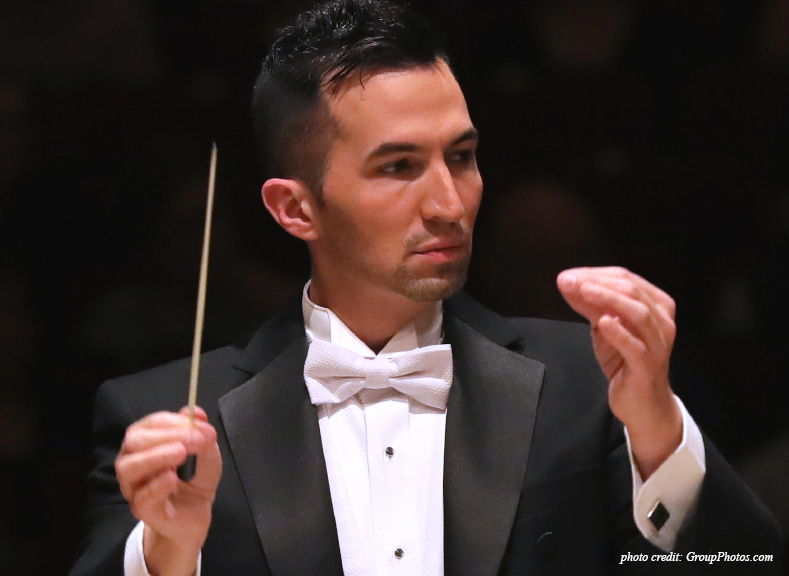
The concluding Amens, described as an invitation to “an amazing party that you don’t want to leave” were indeed thrilling. Mr. Glasgow, a rather showy, unrestrained (physically) conductor, was dancing to the angels’ song.

Here we have a work that may be very practical to adopt into worship services—to that end, I hope there is an arrangement for organ and chorus soon, if there isn’t one already.

At the risk of blasphemy, Gloria in excelsis Glasgow!

Share

Distinguished Concerts International New York (DCINY) presents Vocal Colors and Leading With Love, Standing For Justice in Review

Distinguished Concerts International New York (DCINY) presents Vocal Colors and Leading With Love, Standing For Justice in Review

Vocal Colors

Grove City High School Chorale & Harmonia (OH)

Ann Johnson, Director

Brennan Harris, Piano; Hannah Grosse, Violin I; Jimmy Xiao, Violin II; Madison Estep, Viola; Owen Miller, Cello; Ciera Feucht, French Horn

Leading With Love, Standing For Justice

The Kindness Revolution Singers (MN)

Darcy Reese, Director

Aaron Fagerstrom, Piano and Drums; Will Maclean, Drums

Carnegie Hall, Stern Auditorium, New York, NY

June 21, 2022,

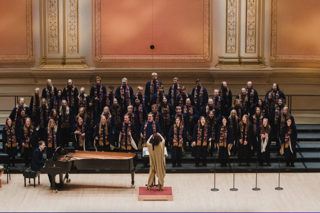
Anyone who laments the dearth of music in America’s High Schools would be heartened by Tuesday night’s concert in Carnegie Hall in which Distinguished Concerts International New York (SCINY) presented two fine choruses from the Midwest. The combined Grove City (Ohio) High School Chorale, a mixed chorus, and Harmonia, a women’s chorus performed the first half, which was titled Vocal Colors. They were under the able direction of Ann Johnson who conducted with a clear and concise beat. I would, however suggest she avoid “mirror conducting” – i.e. doing the same thing with both the right and left arms. Other than two works, one by Mozart and the other by Duruflé, the music was of a genre beloved of high School choirs. This music is both tonal and tuneful, often with a nod towards Pop and Broadway, and with a debt to the African-America Spiritual.

The copious program notes told us that the first work, Da Pacem (The Stars Sang to the Sea) by Paul Caldwell and Sean Ivory, draws on “inspiration and hope inspired by our children.” The chorus and pianist Brennan Harris, who played skillfully throughout the first half, were joined by French Hornist Ciera Feucht, who handled her most difficult instrument well. Miss Feucht was also a member of the chorus.

Next was a spirited performance of Mozart’s Veni Sancte Spiritus, K. 47 during which the chorus was joined by a wonderful string quartet (Hannah Grosse, Violin 1; Jimmy Xiao, Violin 2; Madison Estep, Viola and Owen Miller, Cello,) who also performed in many other works. A well-balanced solo quartet drawn from the chorus (Kat Lutz, soprano; Allison Remick, alto; Andrew Vo, tenor and Ian Loomis, bass) rounded out the forces. The chorus displayed fine intonation and a lovely fresh sound fitting for this work by the twelve-year-old Mozart.

The music of three contemporary composers followed.  The first was Ola Gjeilo’s Across the Vast Eternal Sky. After a short introduction in duple meter, the piano played a lilting waltz melody which the chorus then sang. The rest of the work alternated between the waltz and the material of the introduction. This and the next two works, Jacob Narverud’s You Are the Song and Stephen Paulus’ Sing Creations Music On, written for woman’s chorus, were performed by the women of Harmonia alone, a fact not mentioned in the program. By the way, the program was also cavalier about mentioning the dates of the composers. The dates of the three of the four deceased composers were mentioned in the program notes, with the dates of Duruflé being omitted. In addition, the birth years of the all the living composers were omitted, information which a program should contain.

Then came what was for me the high point of the evening, a performance of Ubi Caritas from Maurice Duruflé’s Quatre Motets sur des themes grègorienes, Op. 10. It was sheer sustained beauty and I can’t think of any way in which it could have been improved. The spell cast by the Duruflé was then excitingly broken by the driving propulsive rhythms of Jake Runestad’s Wild Forces. The Grove City High School’s portion tonight’s concert concluded with a rousing rendition of Music Down in My Soul, a gospel arrangement by Moses Horgan of the African-American spiritual Over My Head.

Throughout their performance the singers performed from memory and with total commitment and concentration. They sang the music by heart with perfect intonation, rhythmic precision, and fine balance among the sections. The following is a personal comment: I don’t know if the repertoire on tonight’s concert was a reflection of what they sing at their home base. But I do hope that when in Grove City, they also have a chance to perform and enjoy some of the great choral music from the renaissance, baroque and romantic eras. I also hope they sing some a cappella music and that the strong singing young men of the Chorale get the opportunity to sing music for male chorus.

The concert continued without intermission and, after a long pause, The Kindness Revolution Singers from Lincoln High School in Thief River, Minnesota took the spotlight. Their half of the program was titled “Leading with Love, Standing for Justice.” But before they took the stage, Aaron Fagerstrom, the group’s fine pianist, beautifully played an excerpt from De Profundis by the Ukrainian composer, Mikhail Shukh. It was an admirable salute, as the program said, “For the Brave People of Ukraine.” The singers, all accessorized by long multicolored scarfs, then entered, followed by their director, Darcy Reese, who gave an impassioned anti-gun speech titled “Enough is enough… Our Tribute to Robb Elementary.” All but one of the following eight works on their program were preceded by such sermon-like exhortations. As the program notes (by Ms. Reese) and the title above the name of the composer made clear what the singers wanted to express, I felt that these speeches were “gilding the lily.” My notes said, “I don’t expect to be lectured to at a concert.” However, the sentiments were sincere and heartfelt.

Now on to the vocal performance itself. The singing of the chorus was constantly exemplary. They clearly showed that they strongly believed in the message they wished to convey to the audience. They made a beautiful sound and had perfect intonation and sense of ensemble. Ms. Reese, who has taught at Lincoln High School for thirty- five years, has obviously taught them well. In a telephone conversation with Ms. Reese, I found that tonight’s chorus goes by different names, depending on the repertoire they are singing and the nature of the concert they are presenting. As I mentioned in the first half of this review, I do hope that, in its other guises, the chorus has the opportunity to explore the great choral literature of the renaissance, baroque, classical and romantic eras.

The second half’s music was, like that of most of the first half, “both tonal and tuneful, often with a nod towards Pop and Broadway, and with a debt to the African-America Spiritual.” The Pop aspect was often heightened by the use of percussion in many of the works. During a cappella compositions, pianist Aaron Fagerstrom often played the bongos while drummer Will Maclean played in both a cappella and accompanied works. Not in the order of performance, we heard the Pop-like If We Stand as One by Jim Papoulis, Lead With Love by Melanie Demore and The Power of Kindness by Mark Hayes; also the spiritual-influenced Ain’t Judgin’ No Man by Greg Gilpin and In Meeting We Are Blessed by Troy Roberson. This last work was followed by Andre A. Thomas’ arrangement of a real spiritual, My Good Lord’s Done Been Here. Next was the jazzy and full of scat-singing I am Alive by Greg Jasperse. The concert ended with It’s Time by Kim André Arnesen. The text of this work’s simple, lyric, and folk-like melody beautifully summed up the message of The Kindness Revolution Singers. The very active drum part and the above the head rhythmic clapping by the chorus brought the concert to a rousing conclusion. As the singers exited the stage, Ms. Reese exhorted the audience to join in the rhythmic clapping. They did!

Harry Saltzman for New York Concert Review; New York, NY

Share

Returning Home in Review

Returning Home in Review

Joanna Hyunji Kim, Soprano and E-Na Song, Piano

Weill Recital Hall at Carnegie Hall, New York, NY

June 16, 2022

The young Korean /American soprano Joanna Hyunji Kim presented an impressive recital at Weill Recital Hall on June 16, 2022. Dr. Kim studied at Ewha Woman’s University in South Korea and the Eastman School of Music. She called her recital “Returning Home,” in response to her belief that, in her words, “there is always an ultimate home for us all to find true peace.” This recital was postponed two years because of the pandemic.

Lovely and graceful in ivory satin, Dr. Kim radiated inner as well as outer beauty. Her voice is rich and powerful, her interpretation sensitive and intense, and her musicianship impeccable.

The evening began with Schubert’s charming song, Seligkeit. The piano dynamic at the beginning of the second verse of this strophic song was particularly effective. Although the texts of all the songs were translated, this title, which means “Happiness” was not- a small oversight. Further along in the program this happened again with Vilse, by Sibelius.

Next we heard a heartfelt rendition of Schumann’s of Heiss mich nicht reden, from Goethe’s Mignon. It was a pleasure to hear Schumann’s setting of this famous poem, which is more dramatic than Schubert’s more frequently performed version of the same text. Another Mignon song, Kennst du das Land, this time in Hugo Wolf’s setting, concluded the set. The bravura piano part gave the excellent pianist, E-Na Song, an opportunity to shine

We moved from Lieder to Chanson for a set of Baudelaire poems set by Debussy. There was another glitch in the program, which I feel obliged to point out. The set was titled Cinq Poèmes de Baudelaire, although actually only four songs were performed. Dr. Kim’s sensitive musicianship and convincing acting were displayed in these atmospheric compositions.

The first half concluded with four Sibelius songs, sung in Swedish. Their tunefulness was a pleasant contrast to the ethereal harmonic vocabulary of the French set.

 After the intermission came a group of three songs by Tom Cipullo (b. 1956) on poems by Lisel Mueller (1924-2020) from a set of six songs titled Of a Certain Age. In these poems, a woman of mature years looks back on a life richly lived. The texts range from the bittersweet and nostalgic to the humorous and tragic. The well-wrought music is compelling, at times moving, and at other times witty. The middle song, Fugitive, was one of the high points of the evening, employing the extremes of a soprano’s vocal and dynamic range (including whispering) and operatic dramatic intensity. Unlike many singers of foreign birth, Dr. Kim’s English diction was flawless and could be understood even without the aid of the text provided in the program.

After this impressive English set Dr. Kim left the stage and returned with violinist Soo Yeon Kim and cellist Heewon Lee. The four women performed an enjoyable set of contemporary songs listed in the program as Korean Art Song, which were sung in the original language. The program tells us that Dr. Kim’s doctoral lecture-recital was on Korean diction and art song. This lecture-recital was presented in 2020 at the Harvard Graduate Music Forum Conference. The first two songs were by Wonji Lee (b. 1979) and the third by Kyu-Yung Chin (b. 1948). Destined, by Lee, which began the set was particularly gripping. The ninety minute recital ended with Un- Young La’s setting of the The Lord is My Shepherd (Psalm 23). So effective was this composition that even without any knowledge of Korean, this listener knew where she was in the familiar text. Ms. Kim’s adoring audience gave her and her colleagues a well-deserved standing ovation.

Share

Douglas Knehans – Cloud Ossuary in Review

Douglas Knehans – Cloud Ossuary in Review

Douglas Knehans, composer; Brno Philharmonic Orchestra, Mikel Toms, conductor;

Pavel Wallinger, violin; Judith Weusten, soprano; Katarina Knehans, text

Ablaze Records AR-00062

A stunning new recording of orchestral music by Douglas Knehans (b. 1957) found its way to me this weekend, and one can safely say that I will be rehearing it (and other works) by this extraordinary composer. Quite a lot of music finds its way to my desk (frankly, much of it not so memorable), so perhaps amid the clutter and noise one may be forgiven for never having heard anything by Mr. Knehans until now, despite his formidable credentials. Those credentials include flurries of performances by prominent ensembles and artists (Opera Australia, Melbourne Symphony, Susan Narucki, James Tocco, Awadaggin Pratt, and Gareth Davies, to name a few) and extravagant praise from the press (Audiophile, BBC Magazine, and The New Yorker), plus a profusion of awards and academic distinctions too many to name here. His educational credentials (Australian National University, Queens College – CUNY, and Yale University), have included scholarship studies with noted composer/teachers Thea Musgrave, Lukas Foss, and Jacob Druckman. To learn more about Mr. Knehans, one can visit his website www.douglasknehans.com. Meanwhile, a fitting introduction exists right on his home page, on which he states: “I just want to write music that touches people, that is immediate, that is powerful, colorful and dramatic.” Mr. Knehans, you are succeeding at precisely that.

On to the recording at hand, the word “powerful” is apt. Both of the two works included, Mist Waves (2019) and Cloud Ossuary: Symphony No. 4 (2019 – with Donemus publishing site saying 2018), are steeped in the human experience of searching and sorrow, and yet both, through the inspired writing itself, are deeply consolatory. Comparisons in music tend to do a disservice to all, but, for the sake of readers wanting a quick characterization, the noting of kinships can be helpful. Sections of both works remind one of Górecki’s Symphony No. 3 in their sheer spaciousness of harmonic unfolding and the deft handling of dissonance and bleak subject matter. There are hints at times of what resemble postminimalism in the harmonic pacing, but at other times the music seems to hearken back flickeringly to Stravinsky and Bartok (as in the more driven percussiveness in the first movement of Cloud Ossuary). The bottom line, though, is that Mr. Knehans seems to follows his own star and cannot be lumped in with any particular school or movement. What makes his music compelling is the thoroughness and sensitivity with which he develops ideas and emotions of importance to him – and to us all, one imagines.

The opening of this CD, Mist Waves, is a piece for solo violin and strings, with the solo part here played superbly by violinist Pavel Wallinger. Slightly under eight minutes in length, it is arguably the most immediately appealing piece of the release, transporting the listener miraculously to another world through its soaring melodic material over haunting repeated patterns. The composer himself describes it as a “kind of loose chaconne” and continues as follows:

Mist Waves is really about land-based cloud and how this forms in waves, sometimes thick and predictable and at other times lightening up and revealing more to us. This serves as a metaphor for me of a type of human consciousness and how things are known and unknown to us in mixtures of known and ungraspable.”

It is surprising on first hearing to read that Mist Waves was originally conceived as a piano-violin work, because its pacing seems to cry out for instruments of a more sustained nature, such as the strings heard here; clearly much is owed, though, to the violinist of its original piano-violin version, Madeleine Mitchell, who was also the dedicatee. In this orchestrated version, it is hard to imagine it played more exquisitely than Mr. Wallinger does in collaboration with Maestro Mikel Toms and the Brno Philharmonic Orchestra. The balance of timbres is masterful, and the sound places the listener somewhere between the heart of the ensemble and the heavens, undoubtedly thanks in part to the engineering of Jaroslav Zouhar and mixing and mastering of multi-Grammy Award-winning Silas Brown.

The second work (and title work for the CD), is Cloud Ossuary: Symphony No. 4, and it is as harrowing as the title suggests in its three movements of increasing depth, darkness and duration (with the third movement lasting twenty-six minutes). The final movement, entitled Bones and All, is, as the composer states, the “center of gravity” of the work. He writes that he composed it first, having been seized with inspiration after reading the poem of the same name  by his daughter, writer Katarina Knehans.

The poem, sung from the viewpoint of one tending to a land of death and grief, is harrowing in its explicit imagery of bones and destruction (“blood-soaked fingers” and “rotting carcass, burned and branded by the world”), but after reaching a cataclysmic frenzy a transformation begins, which – despite the devastation – eventually arrives at the closing line, “We are loved by the sun, bones and all.” It is not exactly a “feel good” ending (as, after around twenty minutes of agony, we hardly trust happiness), but it is, nonetheless, a post-cathartic relief of sorts as the protagonist chooses not to leave this wasteland but to find what the composer describes in his liner notes as “a place of light and love, nurturement and peace.” This work seems especially timely right now, despite the fact that death and tragedy are not a recent invention – it is music of healing.

The singing, by Dutch soprano Judith Weusten, is nothing short of mind-boggling. Each time this reviewer asked herself, “is such writing truly idiomatic for the human voice?” the answer would come, “but Ms. Weusten did it – ask no more.” In stratospheric leaps, piercing wails, and tremulous swooning descents, she showed that she can nail any pitch while traveling to Hades and back emotionally. Her range dynamically is staggering and in need of no manipulation; the one place, in fact, in which a decrescendo seems simply too extreme to be natural (end of the first verse on the word “you”) one wonders whether there wasn’t perhaps some audio manipulation that could have been subtler. Ms. Weusten’s diction is excellent throughout as well, though in the few places where the music is simply too high or melismatic to make out the words exactly, that fact may be merciful. One can always read the text separately and grasp the meaning filtered through the music. Just as the music embodies the pain of a painful text, it also transforms it, just as the protagonist in the poem transforms death and grief.

The rest of the Symphony No. 4 truly seems to exist to serve the above-described final movement, though the first movement, The Ossein Cage is spectacular in its own right. Intended to suggest efforts to escape “an imagined cage of dead bone” as described in the composer’s notes, it employs claves and other percussion to evoke the rattling of the cage, building to a fever pitch. To describe the second movement, Breathe Clouded,  Mr. Knehans suggests “a dream in the clouds – the dark clouds of something coming.” He also states that he did not want to overshadow the last movement but to create a “foggy antecedent” – which is just what it does, and quite atmospherically. All in all, for music lovers who are not “faint of heart” but seeking an experience as cathartic as a powerful play or film, this recording is highly recommended.  

Kudos to all involved in this exciting release.

Share

Paul Jacobs: César Franck Bicentennial Organ Series in Review

Paul Jacobs: César Franck Bicentennial Organ Series in Review

Paul Jacobs, organist

The Church of Saint Mary the Virgin, New York, NY

 June 7, 2022

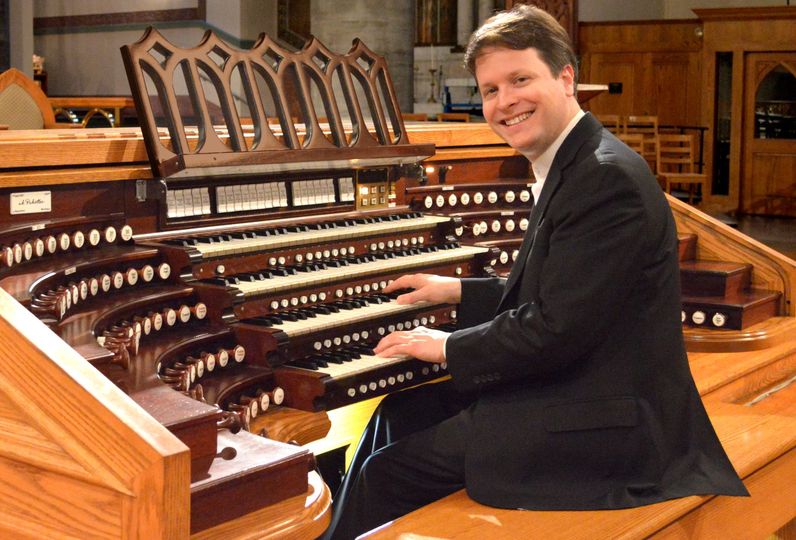
Any opportunity to hear the internationally renowned organist Paul Jacobs in concert is a golden one, so I was delighted to be assigned to this, the second half of his traversal of César Franck’s complete organ works.

Once upon a time, Franck’s D minor Symphony was a staple of orchestra programs everywhere, but lately it seems to have fallen out of fashion. I would wager that aside from the ubiquitous A major Violin Sonata, the music-going public has not heard a note of Franck’s music. However, to church musicians (organists and choir directors) his works are touchstones. For concert organists, they are a rite of passage on the road to mastery of the instrument, as well as a distinct style of playing: Grand French Romanticism.

The issue with touchstones is to reveal what made them new and radical at the time of their creation, rather than add to their smooth, worn quality. In Mr. Jacobs’ hands and feet, we need not worry—he is known for his uncanny ability to clarify the thousands of sonorities (and thousands of notes!) in the most knotty textures, as his complete Bach and Messiaen series have shown (now there’s a contrast!).

The six pieces heard on this occasion are less well known than the products of Franck’s old age (Trois Chorales), with the possible exception of the Prélude, Fugue et Variation. The program notes, which were written for the series as a whole rather than piece by piece, indicate 1868 for the six pieces, the date of publication. These works germinated over a ten-year period, principally from 1859 to 1862, undergoing numerous revisions. Hardly prodigious, you might say, but remember Franck the child had been groomed for a career as a piano virtuoso by his domineering father, and success came slowly with many setbacks until he settled into his true calling as the organist at Paris’ famed Sainte-Clotilde and as a composer.

What a change in the aesthetic was wrought by the advent of Franck! Organists of the Paris society churches in the mid-nineteenth century were content to pander to their congregations with junky “tempest” pieces, and cheap medleys cobbled together from the fashionable operas of Rossini, et al. By comparison, Franck, even at his most extroverted, seems practically austere.

Mr. Jacobs, who spoke from the front of the sanctuary but played the concert “invisibly,” from the gallery, announced that he would change the order of the six pieces. There is documentary evidence that Franck himself did perform them together as a suite at least once. I will gratuitously read Mr. Jacobs’ mind here, and assume that the sixth piece (Final), which is musically the weakest (weak at a very high level) with its bombastic fanfare theme, despite a lovely middle section, he wished to bury in the middle of the concert. He played the pieces in the order 4,5,6,1,3,2. There was no applause invited until the end, adding to the strangeness, for the modern music lover, of an organ recital, though the large church was very full of devotees.

These six works are wildly well-constructed, with interpenetrating themes, foreshadowing Franck’s obsession with cyclic composition. Many of the motives are fully realized later in his life in the D minor Symphony, Also beautifully legible in Mr. Jacobs’ crystalline performance was the obsession with canons and other polyphonic development.

For me, the best performances were the opening two pieces Pastorale and Prière, where the meditative quality was strongest, combined with the beautiful registrations this historic organ provides. The instrument, originally installed by Aeolian-Skinner in 1933 and revised many times, the latest being in 1988, offers many of the features of the grand French organs that Franck would have been used to. The reverb in the church, however, is fairly brief, so some of the halo of sound doesn’t happen at the end of phrases, thus influencing phrasing, timing, rubato, and registration (My, my! Don’t organists have a lot of things to think about?).

The Fantaisie and the Prélude, Fugue et Variation were a bit on the fast side, though Mr. Jacobs’ fastidious logic prevailed and was always convincing. He was supple, but contained, very “French” indeed. The Prélude, Fugue et Variation was robbed of an extra measure of sadness that I feel is essential to the work, however, I may be projecting!

The Grande Pièce Symphonique closed the concert, with its massive deployment of two things: all of Franck’s compositional ingenuity, and all of the organ’s potential. The introduction of the term symphonique led to an entire wave of French symphonies for organ (Vierne, Widor, Duruflé). The slight agogic pause before the last chord was breathtaking.

For a French organ music lover, I would kindly suggest that Mr. Jacobs take a diction lesson when pronouncing the words Grande and Symphonique in French. Side note: It reminds me of one of my former professors, who shall remain nameless, who took umbrage whenever a student would correct her pronunciation of this composer: “I got my doctorate from Indiana University, and I’ll say Caesar Frank if I damn well please!”

You’re in good company Paul. And Franck is in good hands with Paul Jacobs. We organ aficionados look forward to your next series.

Share

Distinguished Concerts International New York (DCINY) presents Carmina Burana in Review

Distinguished Concerts International New York (DCINY) presents Carmina Burana in Review

Jonathan Griffith, DCINY Artistic director/principal conductor

Penelope Shumate, soprano; William Ferguson, tenor; Rob McGinness, baritone

Tzu-Yi Chen, Jeremy Filsell, pianists

Greg Gilpin, composer/conductor

Kelly Yu-Chien Lin, piano

Distinguished Concerts Singers International

Stern Auditorium at Carnegie Hall, New York, NY

June 6, 2022

Distinguished Concerts International New York (DCINY) continued the return towards “normalcy” in the concert world of New York with the June 6th presentation of Carmina Burana, paired with an opening act filled by works written for and performed by middle school (ages 11-13) singers.  The Distinguished Concerts Singers International came from Maine, Georgia, Oregon, Pennsylvania, Kentucky, New Jersey, New York, Mexico, France, and Hong Kong. I was delighted about the international contingent, another step towards the pre-pandemic days.

Gilpin: Music for Middle School Voices was the opening portion of the program. Fifty-three youngsters took the stage to offer six selections written with the abilities of the middle school singer in mind (the title is somewhat a misnomer, as only two of the works were by Mr. Gilpin) As is common for this age group, the young ladies outnumbered the young men in a ratio of approximately 4:1. Pianist Kelly Yu-Chien Lin was the accompanist.

Greg Gilpin, in his 6th appearance with DCINY, conducted/coached the young singers. He projects an avuncular air, which is ideal for performers of this level and age. The energy he radiated was returned in abundance that must have filled him with pride.  For the sake of completeness, the works performed were Festival Sanctus, Come to Me, O My Love, Shenandoah, Dry Bones, and the two Gilpin works: For the Beauty of the Earth, and Why We Sing.

Groups of this type present an interesting challenge for the reviewer. It would be inappropriate (and mean-spirited) to judge them with the standards one would use for older/more experienced ensembles. I suspect that Mr. Gilpin might have been reading my mind – “We are not aiming for perfection, but rather sharing joy,” was the gist of his spoken comments from the stage.  Was it perfect? Of course not. Was it joyful? Absolutely! Who knows what future stars of the singing world were on that stage tonight, but one does know that this was the experience of a lifetime that will be with these youngsters forever. That idea is one that I never tire of, and the families and friends can be justly proud of their stars. Kudos to the “home” directors for prepping their singers and for the dedication they show each day in teaching these youngsters. They are unsung heroes.

Carl Orff’s Carmina Burana occupied the entire second part of the program.  It’s one of those works (specifically O Fortuna) that everyone “knows” without knowing the title or composer. It’s been used so many times in popular culture as to almost become cliché.

Orff wrote in a 1937 letter to his publisher, “Everything I have written to date, and which you have, unfortunately, printed, can be destroyed. With Carmina Burana, my collected works begin.” One could add and here they end, as nothing that Orff wrote after it remotely approached the popularity of Carmina Burana. Despite the obvious erotic source material, the dreaded designation Entartete Musik (degenerate music) bypassed Carmina Burana, no doubt due to the composer’s political and racial acceptability to the regime. The program notes suggest that Orff would be a finalist in a contest for a composer with the most despicable character; fair enough, but some scholars have suggested things are not as black-and-white as they seem.

It was not stated explicitly in the program, but this performance used the 1956 reduced version (authorized by Orff) for soloists, SATB mixed choir, children’s choir, two pianos and six percussionists by Orff’s disciple Wilhelm Killmayer. This allows smaller ensembles to stage the work. It’s an effective arrangement, but it obviously cannot match the grandeur of the sound of the huge orchestra in the original (especially the opening O Fortuna).

Enough of the history, let’s get to the performance.  This is far from this listener’s first Carmina Burana, so how did it compare? Despite my initial skepticism about this version, I was quickly won over by the tautness of conception and the unflagging energy.  Whatever was lost in power from the small forces was more than compensated in the high-octane enthusiasm of the outstanding pianists Tzu-Yi Chen and Jeremy Filsell and six young (unnamed) percussionists. The three vocal soloists all brought their A-game to the stage, with voices that could fill any hall without any strain or stridency. There is much to praise, but I will limit myself to highlights for each. The radiant voice of soprano Penelope Shumate (a DCINY favorite) was always at the forefront, but her foray into the stratosphere in the Dulcissime (Sweetest Boy) was breathtaking. Tenor William Ferguson’s sad lament of the doomed swan in Olim lacus colueram (Once I Swan in Lakes) projected a subtle comic irony that others have “forced” on the listener with some histrionics and facial mugging.  Finally, baritone Rob McGinness delivered the self-important bluster of Ego sum abbas (“I am the abbot” – of Cockaigne) with gusto that had the audience laughing as he wandered the stage. Let’s not forget the large chorus, who were well-prepared and ready to shine, which they most certainly did.

Maestro Jonathan Griffith led with his customary sure hand. It may have been two years away, but he has lost none of his mastery, and it was a treat to enjoy his work once again. The audience gave all the performers a well-deserved loud, extended standing ovation at the end.

Share

MSR Classics presents Song of the Redwood-Tree: The Music of Sunny Knable in Review

MSR Classics presents Song of the Redwood-Tree: The Music of Sunny Knable in Review

Elizabeth Pitcairn, violin; Barbara Podgurski, piano
Trio Cabrini: Nuno Antunes, clarinet and bass clarinet; Gina Cuffari, bassoon and voice; Vlada Yaneva, piano and accordion

Stefanie Izzo, soprano; Scott Pool, bassoon; Natsuki Fukasawa, piano
Parhelion Trio: Sarah Carrier, flute; Ashleé Miller, clarinet; Andrea Christie, piano

Weill Recital Hall at Carnegie Hall, New York, NY

May 31, 2022

This concert, rescheduled from March 2020 due to that virus, is a celebration of Sunny Knable’s second album. The audience in Weill Recital Hall was the largest I have seen since the resumption of nearly-normal concert life last year. Mr. Knable, the music director of Forest Hills’ (NY) The Church in the Gardens, clearly inspires devotion and friendship in his congregation. An affable fellow, he personally greeted nearly everyone before the concert, making his way through the hall; and his verbal commentary was engaging.

I can report that Mr. Knable is a creator of accessible, attractive, well-crafted works—at their best when they explore rapid, rhythmic textures, with exciting interchange among the parts. A few minor quibbles will be mentioned below, but nothing too worrisome. I can also state that the caliber of all the performers was excellent, fiercely enthusiastic at all times, and in total command of their many and varied responsibilities.

The concert opened with The Green Violin, a pun on the “red” violin, a seventeenth century Stradivarius instrument that inspired a 1998 movie. (Was the violin really varnished with the maker’s dead wife’s blood?) The “Red Mendelssohn” that inspired the screenplay was made in the eighteenth century, and while not the actual mysterious violin, is currently owned by Elizabeth Pitcairn, the excellent soloist here, partnered by Barbara Podgurski on piano, in a brief but effective Irish melodic fantasy. Also, I was pleased to note that the piano was on “full stick” for the entire concert, though that led to a few balance problems later in the evening.

Next came a New York premiere titled …the Place of Longing, inspired by Richard Elliott’s 2010 book: Fado and the Place of Longing: Loss, Memory and the City, describing the Portuguese music of absence and longing. The innovative Trio Cabrini includes a singing bassoonist (Gina Cuffari), and an accordion playing pianist (Vlada Yaneva), as well as Nuno Antunes on clarinet/bass clarinet. Ms. Cuffari and  Ms. Yaneva clapped energetically as well, and Ms. Cuffari engaged in some wordless sighing that seemed slightly extraneous to me, the music was strong enough without it. Mr. Knable combines Portuguese song and Bulgarian rhythms skillfully.

To round out the first half, Song of the Redwood-Tree, a 2012 work on poetry by Walt Whitman, featured Stefanie Izzo, soprano; Scott Pool, bassoon; and the excellent pianist Natsuki Fukasawa (Mr. Pool’s regular partner in duo). As this concert was postponed from 2020, they couldn’t possibly have known how fortuitous it was that Whitman was born on May 31 (1819), but it added a layer of resonance. Mr. Knable’s work, in three sections based on portions of the first and second divisions of Whitman’s long cycle, seeks to express musically some of the references in the poem. Ms. Izzo, possessing a full lyric soprano, handled the demands of the voice part (originally written for someone else) with confidence and feeling, though her consonants were not vivid enough to project in the hall. Part of the blame for this must be laid with Mr. Knable, whose use of extremely high registers makes it that much more difficult to understand this poetic masterpiece; we are not in the world of opera, after all (though even there I’d prefer to understand the words), but vocal chamber music. The setting of the tree’s ‘death-chant’ was histrionic. Mr. Knable also repeated (even sometimes changed) text wantonly (a pet peeve of mine though all the great composers did it at one time or another)—Whitman’s text is already so rich musically that it scarcely needs that type of amplification. In addition, the intrepid Mr. Pool and Ms. Fukasawa had to stamp their feet loudly and engage in Mr. Knable’s signature wordless vocalises. The depiction of the horns of ships leaving San Francisco harbor with the plundered riches of California was breathtaking.

After intermission came the world premiere of Tenacity, in which the composer encapsulates his experience of the pandemic in New York. Seven brief sections, whose titles all begin with the letter s, span from the 24/7 sound of sirens in the streets of New York, all the way to the recent (though tenuous) rebound of hope. However, I must chide Mr. Knable for the title “Six O’clock Clapping,” for every New Yorker knows that this happened at 7:00 pm. every night for many months. The excellent Parhelion Trio (flute, clarinet, piano) played it as though it was many years’ versed in it (Sarah Carrier, flute; Ashleé Miller, clarinet; and pianist Andrea Christie).

The concert concluded with The Busking Bassonist, co-commissioned by tonight’s wonderful Scott Pool, partnered again by Natsuki Fukasawa. Depicting some stages in the life of an itinerant musician in New York, it began with the pianist on stage, nervously looking at her watch because her partner was late. Mr. Pool entered humorously through the audience, and the duo began their set in a subway station. The depiction of the approaching train, on whose passengers their livelihood depends, was spot on. In Park-Bench Ballad, Mr. Pool not only had to play his instrument but embody a random park bench sitter, reading a newspaper aloud (which contained, for me, some very unfortunate references to the recent mass shootings in the US, and an editorial from the New York Times), then the pianist also had her share of reading, this time from a book. Her voice was mostly covered by the bassoon line. This segued into the final section Street Changes, a wild, energetic romp of New York energy, playing into Mr. Knable’s strength with fast rhythmic interest. May I also mention that pianist Ms. Fukasawa had to play a melodica mouth-keyboard, which she did with great poise (and breath).

After a warm ovation, Mr. Knable took the stage to perform one of his delicate piano solos (with vocalise), dedicated to his wife: Chanson de la lumière (from Cartes postales de suisse).

Mr. Knable’s “sunny” disposition will always allow him to find friends, especially among talented performers, and those whose lives he touches as a musical leader and teacher. As Whitman said, “Do anything, but let it produce joy.”

Frank Daykin for New York Concert Review; New York, NY

Share

Distinguished Concerts International New York (DCINY) presents Glimpses of the Sacred Veil: The Music of Eric Whitacre in Review

Distinguished Concerts International New York (DCINY) presents Glimpses of the Sacred Veil: The Music of Eric Whitacre in Review

Eric Whitacre, composer/conductor

Distinguished Concerts Singers International

Kelly Yu-Chieh Lin, piano; Jake Charkey, cello

Stern Auditorium, Carnegie Hall, New York, NY

May 31,2022

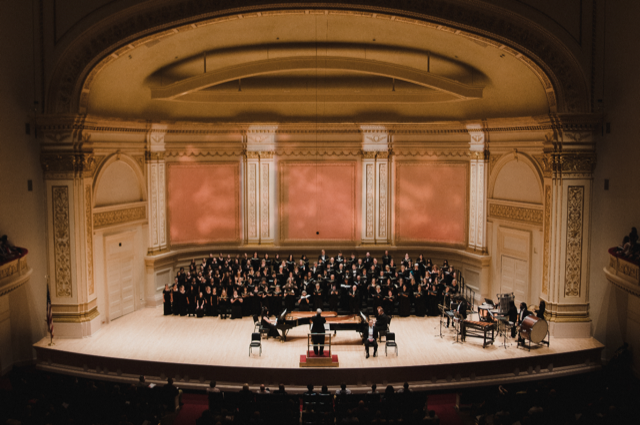
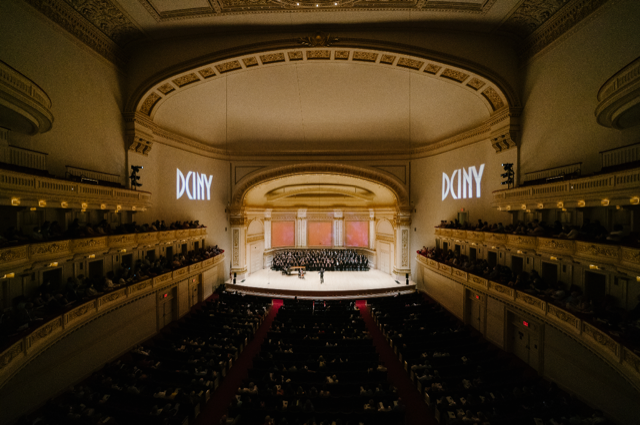
“It’s been two long years.” So said Eric Whitacre, in his remarks to the Carnegie Hall audience on May 31, 2002. Yes, it’s been over two years since his last appearance with  Distinguished Concerts International New York (DCINY), so this was something of both a homecoming and a sign that DCINY is back.  It’s not the first concert DCINY has presented, but it is the first truly marquee event – Eric Whitacre is a bona fide superstar. This reviewer was thrilled to be there to see the excitement that took me back to the pre-pandemic days , when family and friends filled the hall and cheered their hearts out for their stars.

This is Eric Whitacre’s 19th appearance with DCINY, and the program was dedicated to his works, some old favorites, and selections from The Sacred Veil (completed in 2019).  Mr. Whitacre’s trademark charisma is still intact- even when telling stories that he’s told countless times (and I have heard at least four or five times).  He did seem to strike the right balance of fun and gratitude as he spoke, as opposed to just playing the audience for laughs (he got them anyway!).  He introduced each work, which was a plus, as the printed program did not follow the order, and one work was even missing (but the lyrics for that missing work appeared in the program notes).

The Distinguished Concerts Singers came from South Carolina, Tennessee, Colorado, Texas, Illinois, North Carolina, New Jersey, and Minnesota. They were well-prepared by their respective directors , but the magic that is Whitacre is what took these singers to greater heights than they probably imagined possible.  Pianist Kelly Yu-Chieh Lin is a star in her own right.

About the music – the six selections from The Sacred Veil were split equally between the halves, but I am going to speak of them together. About the others works, I have written extensively about them in past reviews, so I’ll limit myself to brief comments. Lux Aurumque, probably the “Signature” work by Whitacre (and seemingly “done to death”), still has the power to enchant. The two volumes of Animal Crackers, set to text by Ogden Nash are pure side-splitting fun, which had the audience roaring in laughter. The City and the Sea, employing texts by E.E. Cummings, had the pianist using the “oven mitt” technique (clusters on the white keys) and was done to the hilt. The last of this set, the bustling little man in a hurry is an old favorite of this listener and did not disappoint. A Boy and a Girl (text by Octavio Paz) and The Seal Lullaby (text by Rudyard Kipling) were both done with a sensitivity that was touching.

Mr. Whitacre spoke briefly about The Sacred Veil, and his friendship with Tony and Julie Silvestri. I’d like to actually quote his written words about this work: “The Sacred Veil is a 12-movement work and the most recent collaboration between Eric Whitacre and poet/lyricist Charles Anthony Silvestri telling a story of life, love and loss. Silvestri’s wife, Julie, died of ovarian cancer at age 36 in 2005, leaving two young children. Including texts from Silvestri, Whitacre and Julie herself, the intimate, compelling score tells a story of courtship, love, loss and the search for solace. Although inspired by this extraordinary and moving friendship, the piece does not mention Julie by name and shares a very human journey –one that so many of us can relate to.”  The Sacred Veil is scored for chorus, piano, and cello. On this occasion, six movements were presented.

I suspect that the movements featured were carefully chosen to give the listener an “overview” of the entire work. It is also possible that the difficulty of certain movements (some are filled with medical jargon) was also a consideration.  This listener has heard the entire work several times and was deeply moved by the journey,  but was also emotionally devastated as well, in particular by You Rise, I Fall (which was not one of the six selected movements).

The three movements  A Dark and Distant Year, Home, and Magnetic Poetry  tell the story of a man despairing of ever finding love, meeting a wonderful woman, falling in love, and settling into a happy life. Four little words “You feel like home” give rise to some poignantly beautiful music, with cellist Jake Charkey projecting that poignancy with simple sincerity.  Magnetic Poetry takes its name from those little magnetized word kits with which  one can make word jumbles on their refrigerator. The text was Julie’s arrangement of these little word magnets that she wrote down on paper. That paper was not found until after her passing. The text-setting was done with reverential power – this was not silly randomness, but the words of a woman who was obviously a force.

The movements Delicious TimesDear Friends, and Child of Wonder are the journey through illness and into final release. Delicious Times is a remembrance of Julie’s children’s reaction to her losing her hair, not one of fright, but laughter and joyful times (“The kids have been amazing, and we’ve had some really delicious times.”). Dear Friends is the request for prayer when the end is near, not prayers for a peaceful death, but a miraculous recovery – the spirit of one who is not giving up and who will fight for life until the very last breath. One can feel that spirit in the music and hopes against hope that somehow that miracle will occur. Child of Wonder (words by the composer ) are what Whitacre calls a Benediction, which is apt, both in the religious sense (a welcome to Heaven) and a release from life into the next.

The audience gave Mr. Whitacre and the singers (in both halves) a standing ovation. I think most were incredibly moved by what they heard and experienced.  As a send-off, Sing Gently, finished the evening.  Congratulations to all!

Share