Bradshaw & Buono International Piano Competition Winners’ Recital in Review

Bradshaw & Buono International Piano Competition Winners’ Recital in Review

Pianists Nana Miyoshi, Maxine Park, Crystal Chen, Andy Liao, and Rixiang Huang
Weill Hall at Carnegie Hall, New York, NY
May 19, 2019


Two large Weill Hall recitals were presented this Sunday to feature winners of the 2019 Alexander and Buono Competitions (alexanderbuono.com), the first featuring winners of the Barry Alexander International Vocal Competition (covered in a separate review) and the second, covered here, featuring the winners of the Bradshaw and Buono International Piano Competition (named for the two-piano team of Cosmo Buono and the late David Bradshaw). Messrs. Buono and Alexander were present to get the evening started with a few words, after which five excellent prizewinners took turns onstage, three before intermission and two after. Their prize categories were Elementary School (ages 4-11), Middle School (12-14), High School (15-18), Amateur Adults, and College/Adults.

The youngest category’s winner, Nana Miyoshi, opened the program with Mozart’s Sonata in F Major, K. 332. While one regularly hears very young pianists play selected movements of Mozart Sonatas, it is less common to hear one in its entirety, due to the required concentration and tonal control, especially for an inner slow movement. Ms. Miyoshi played the entire work with a poise and polish that belied her young years – and it was no small feat just to walk onto the stage of this storied hall and be the first performer of five. (For an excellent description of the rigors of such group recitals, one recommends once again the following review by Alexandra Eames: (Rutgers Pianists in Review)

As one expects of a prizewinner, Ms. Miyoshi was technically reliable in realizing Mozart’s score, but she also showed the beginnings of deeper interpretation of it, particularly in her first movement. The first dramatic C-sharp heralding the move to D minor was full of the operatic intensity one often wishes that more adult performers would project. Moments in the second movement were a bit romanticized for this listener (including generously rolled chords and instances of the left hand preceding right), but all in all the lyricism was quite appealing. With time, this young pianist will gain the ability to gauge the tone of longer note values so that they can last and connect ever more smoothly to subsequent tones, but again the phrasing was generally quite graceful for one so young. The last movement showcased Ms. Miyoshi’s impressively sparkling passagework, with only some telltale rushing reflecting her youth and the excitement of the day.

The second performer was Maxine Park, age fourteen, who played Bach and Chopin. First came five movements from Bach’s Partita No. 2 in C minor (sadly omitting just the Courante). Ms. Park showed outstanding decisiveness from the first notes of the Sinfonia, delivering the double-dotted rhythms with crispness and confidence. Though this reviewer felt there could be more nuance even within the French Overture spirit, such preferences are personal – and again one reminds oneself that this performer is younger than the coats in this reviewer’s closet! Ms. Park sailed through this work’s brisk dance movements with assuredness, and slower sections were thoughtfully rendered. All movements were played with no repeats, except in the Sarabande, which enjoyed some tasteful elaborations on the second iteration. The final Capriccio was wonderfully precise in its leaping tenths, showing excellent pianism, rhythm, and ebullience.

Moving on to Chopin’s Sonata No. 3 in B minor, Op. 58 (just the first movement), Ms. Park showed her interpretive potential in a more Romantic vein, making good sense of a movement many consider unwieldy. It is a bit surprising to hear such a young player take on such a mature work even in these days of prodigies abounding, but Ms. Park did so with admirable projection of the varying moods and skillful transitions throughout. Despite a small misfire in the early measures – something one has heard from numerous seasoned professionals – it was clear that Ms. Park has the technique and temperament to be a strong interpreter one day, if she chooses to be. One can expect great achievements from her as she continues to develop.

Still within the category of pre-college years (now high school) was Crystal Chen, age sixteen, playing selections by Beethoven, Liszt, and Bartok. She started with the first movement of Beethoven’s Sonata in C major, Op. 2, No. 3, in which she made short work of the challenges, from its tricky opening thirds to heraldic broken octaves, all with hearty Beethovenian spirit. As with Ms. Park’s single movement of the Chopin, one was reminded that we were in effect hearing an encore of a typical prize-winning audition, rather than a preview of the concerts these young pianists may give one day as full-fledged soloists, but audience members who liked what they heard will simply have to stay tuned for what is to come.

Ms. Chen followed her Beethoven with a fierce performance of Liszt’s La Campanella from the Grandes Études de Paganini. La Campanella can fall somewhere between target practice and a kamikaze mission, so those who choose to perform it live – and at such an important occasion, with little warming up and much unpredictability – deserve kudos for bravery alone. Ms. Chen was more than up to the task, though, and if it was not exactly a model of neatness, it certainly whipped up a huge lather towards the end, lifting her practically off the bench in the pursuit of a big sound – which she did indeed achieve. The audience was thrilled. She closed the first half with a bristling account of the first movement of Bartók’s Piano Sonata, another bold choice showing her power and potential.

Interestingly enough, some of the most satisfying music-making of the evening came through the hands of Andy Liao, from the so-called “Amateur” category, though if he is called amateur, then heaven help the professionals! Mr. Liao offered just one complete piece, Ginastera’s demanding Piano Sonata No. 1, Op. 22. He gave it a great ride, with a wide dynamic and emotional range and plenty of technique for its tremendous pianistic demands. From the declamatory opening through the smoldering presto misterioso and ensuing Adagio, one felt that there was no note without intent. The Ruvido final movement had just the right driving energy, stirring the audience to a rousing ovation. This piece has had many passionate champions – the name Terrence Judd springs to mind as a favorite – but Mr. Liao now holds a place among them. Bravo!

The final performer, Rixiang Huang, faced quite a difficult task in following so much extraordinary piano music – and in a recital starting at 6:30pm his own offerings finished close to 9pm. As Mr. Huang won in the College/Adult category, it was natural that the presenters wanted to feature him as the concert’s grand finale – and in a wide spectrum of repertoire – but somewhere along the way, the notion of strain on the audience was lost. Though there were some audience members who came and left, present especially to hear their friend or relative, the listener who is present from start to finish ought to be considered as well. Even the hardiest music-lovers reach a point of aural saturation. By the time Mr. Huang walked onto the stage, this listener was ready to hear perhaps one more small piece but probably not another miniature recital. Such matters should be considered, lest the presenters do their winners a disservice.

Despite the above mentioned issues, Mr. Huang appeared unfazed as he calmly wiped the piano keys before his own long segment of the program. His confidence, as one discovered, was well justified, as this young man knows how to play! Currently a Master of Music degree candidate at Juilliard studying with Matti Raekallio and Jerome Lowenthal, Mr. Huang offered a mini-recital made up of Haydn’s Sonata in E minor Hob XVI.34, Beethoven’s Sonata in F-sharp major, Op. 78, Los Requiebros from Goyescas by Granados, and, to cap the evening off, Liszt’s Dante Sonata.

The Haydn could have easily been omitted, as it did not seem to show qualities unique to Mr. Huang and was challenging to listen to with fresh ears after the Ginastera; that said, Mr. Huang gave it good attention to detail, in particular the slow movement which reflected well the improvisatory style associated with C. P. E. Bach whom Haydn highly respected. Repeats were omitted, except in the last movement.

The Beethoven that followed, the two-movement Op. 78, was a refreshing choice, as it is often bypassed in favor of the more dramatic Sonatas Opp. 53, 57, 110, and others, though it is a beautiful and ingenious work. Mr. Huang played it commendably, with sensitivity in its lyrical opening and great care in the details of articulation and dynamics in its later flights.

Still more lyrical was Los Requiebros, and there was a suavity about this performance that was just right. Mr. Huang seemed to feel quite at home with this Spanish style of musical dreaming, and it was a good bridge into the Romanticism that followed in the form of Liszt’s Dante Sonata, properly named Après une lecture du Dante: Fantasia quasi Sonata from the Années de Pèlerinage, V. II. Here, in the Liszt, came the style of virtuosity for which Mr. Huang stood out the most. The Dante Sonata is notorious for its ferocious octave demands. In this reviewer’s conservatory years, a dear class clown when offended would issue mock threats to play “Dante Sonata on your head” – and in all seriousness, it is that fiendish; in Mr. Huang’s hands, however, it was child’s play. Moreover, the music always came across, never devolving into mere noise. Mr. Huang moved easily from the softest tremolos to superb arpeggiated elaborations and, yes, torrents of octaves (and he may have broken speed records in some of those torrents!). He was, in a word, superb.

All in all, it was an auspicious evening for five highly promising pianists. One hopes to hear more from all of them in the future. Congratulations to all.

Share

Alexander & Buono International presents Winners of the Barry Alexander International Vocal Competition in Review

Alexander & Buono International presents Winners of the Barry Alexander International Vocal Competition in Review

Oksana Lepska, Kara Mulder, Yunji Shim, sopranos : 1st prize winners
Anna Shelest, Piano
Weill Hall at Carnegie Hall, New York, NY
May 19, 2019


On May 19, 2019, the Alexander & Buono International organization (alexanderbuono.com) presented two concerts for the winners of two different competitions (one for voice and the second for piano) at Weill Hall at Carnegie Hall. The first was the Barry Alexander Vocal Competition Winners Concert, featuring the first-prize winners, sopranos Oksana Lepska, Kara Mulder, and Yunji Shim, and will be the focus of this review (with the piano winners concert to be covered separately). Chairmen Barry Alexander and Cosmo Buono started the afternoon by greeting the audience, thanking them for attending, and speaking briefly about today’s performance and upcoming concerts.

Before all else, I must commend Alexander & Buono for the exceptional concert program booklet, which had all the qualities of a keepsake item. In a day when one finds oneself exasperated that often not even a cheaply produced single-sheet photocopied program is provided, it was a much-appreciated show of commitment to excellence that speaks volumes to this reviewer.

Oksana Lepska was the first to perform. Ms. Lepska has already enjoyed considerable successes, including being a finalist on Russia’s Got Talent. Her stage presence exudes confidence, and justifiably so. With a voice that filled the hall without a hint of stridency, coupled with technique to burn, Ms. Lepska is a force. The vocal gymnastics of Fiordiligi ‘s aria “Come scoglio,” from Cosi Fan Tutte were tossed off with what seemed to be an off-handed ease, and “Si, mu chiamano Mimi,” from La Bohème had a plaintive, child-like innocence that was charming; it was, however, in three Rachmaninoff songs, The dream, Do Not Sing, my beauty, and Spring Waters, that Ms. Lepska showed her true artistry. I know the expression is trite, but it does seem as if she was born to sing these songs.

Kara Mulder (www.karamuldersings.com) offered a program that was nearly all Dvořák (“Song to the Moon” from Rusalka, and all eight Love Songs, Op. 83). Ms. Mulder projects her voice with strength, but also with a warmth that is distinctly her own. She has an excellent dramatic sense, using the entire stage as she engages the audience. The gestures are natural and organic, without any “mugging” or other histrionics. The audience was moved by her artistry, with several “delays” for applause between several of the Love Songs. This listener, while holding to the convention of not clapping between parts of a musical set, was in complete agreement. I can’t pick one of the eight as a favorite, so I will happily take the whole! Ms. Mulder offered ” Leise, Leise,” from Weber’s Der Freischütz, which gave further proof to her versatility. It was a fine close to her portion of the program.

After intermission, Yunji Shim took the stage as the final performer of the afternoon. Her program focused primarily on art songs by Reynaldo Hahn and selections by the American composer Ernest Charles (1895-1984). While the uninitiated might think that “art songs” means salon trifles for smallish voices, this is far from the case, especially with Ms. Shim. She is a dynamo, with enough power and passion for several people. She used her power artistically and not as a weapon to bludgeon listeners. Ms. Shim seeks and brings forth the subtle nuances of the songs in such a way as to pull the listener completely in. As much as this listener enjoyed the Hahn and Charles songs, it was “Piangi…Un bel di vedremo,” from Madame Butterfly that won me completely over. Ms. Shim projected Butterfly’s hope of Pinkerton’s return with such absolute certainty that it was heartbreaking poignant.

The unsung hero of the afternoon was pianist Anna Shelest, who was a star in her own right. I am sure that Ms. Lepska. Ms. Mulder, and Ms. Shim were all delighted and grateful to have such an accomplished collaborator as Ms. Shelest.

Ms. Lepska, Ms. Mulder, and Ms. Shim returned to the stage for a final bow to the appreciative audience.


Share

Distinguished Concerts International New York (DCINY) presents Fresh Sounds: The Music of Russell Robinson in Review

Distinguished Concerts International New York (DCINY) presents Fresh Sounds: The Music of Russell Robinson in Review

Russell L. Robinson, composer/conductor
Distinguished Concerts Singers International
Stern Auditorium at Carnegie Hall, New York, NY
May 5, 2019


The DCINY presentations continued with a concert of middle-school-aged children, almost 400 of them, about half utilized on each half of a fine program conducted by the prolific and venerated Russell L. Robinson. This must be a very difficult age to teach, what with raging hormones and all manner of other distractions. Yet, I found the dedication, singularly and collectively, of these fine youths very inspiring, and their sounds indeed “fresh.” They came mainly from the South, with a few other states (Oregon, Washington, and Indiana).

Russell Robinson has created over 500 choral compositions, including arrangements, published by all the major outlets in this country; he is constantly sought after to lead seminars and the like, and one can see why when presented with the finely detailed evening he gave us.

Each half of the program was structured very similarly, so it was almost like hearing the same concert twice, with different performers: a couple of “light” classical pieces, a traditional spiritual, a folk song, some more indigenous African music, a jazzy improvisatory song, and finally a rousing anthem to the power of music, all arranged or composed by Robinson.


Distinguished Concerts International New York (DCINY) presents Fresh Sounds: The Music of Russell Robinson


I found the sounds made by the choir to be mellow and unforced at all times, girls outnumber boys by about two to one, and the arrangements are generally SAB (soprano, alto, baritone). Their diction was clear, and their attention to stressed and unstressed syllables was truly refreshing, surely due to the detailed attentions not only of Robinson, but also of their individual home conductors. Their rhythmic sense was very good, and many of the numbers had clapping, a foot stomp or two, and easy motion swaying from side to side, sometimes with hand and arm gestures, principally in the African traditional styles. And I must mention that ALL selections were sung from memory, which is no mean feat.

Two different groups of soloists, a quartet and a sextet, on each half of the program, stepped forward and gave call-and-response jazzy riffs with superb poise, lapped up by the enthusiastic audience of family and friends.

The repertoire ranged from Thomas Morley and Baldassare Donato to Handel and Franck, and a healthy dose of the spirituals and folk songs Robinson is committed to introducing into the kids’ musical knowledge bank.

A very fine uncredited pianist and an African drummer added their colors to this inspiring evening.

I was led to ruminate on how much better off the world would be if everyone had a pursuit as valuable as participation in a choral endeavor; how perhaps we wouldn’t have either so much time for, or the desire for, unpleasant political maneuvers. As DCINY always says: “Changing lives through the power of performance.”


Share

Distinguished Concerts International New York (DCINY) presents The Music of Eric Whitacre in Review

Distinguished Concerts International New York (DCINY) presents The Music of Eric Whitacre in Review

Distinguished Concerts Singers International
Eric Whitacre, composer/conductor
Kelly Yu-Chieh Lin, piano
Stern Auditorium at Carnegie Hall. New York, NY
April 28, 2019


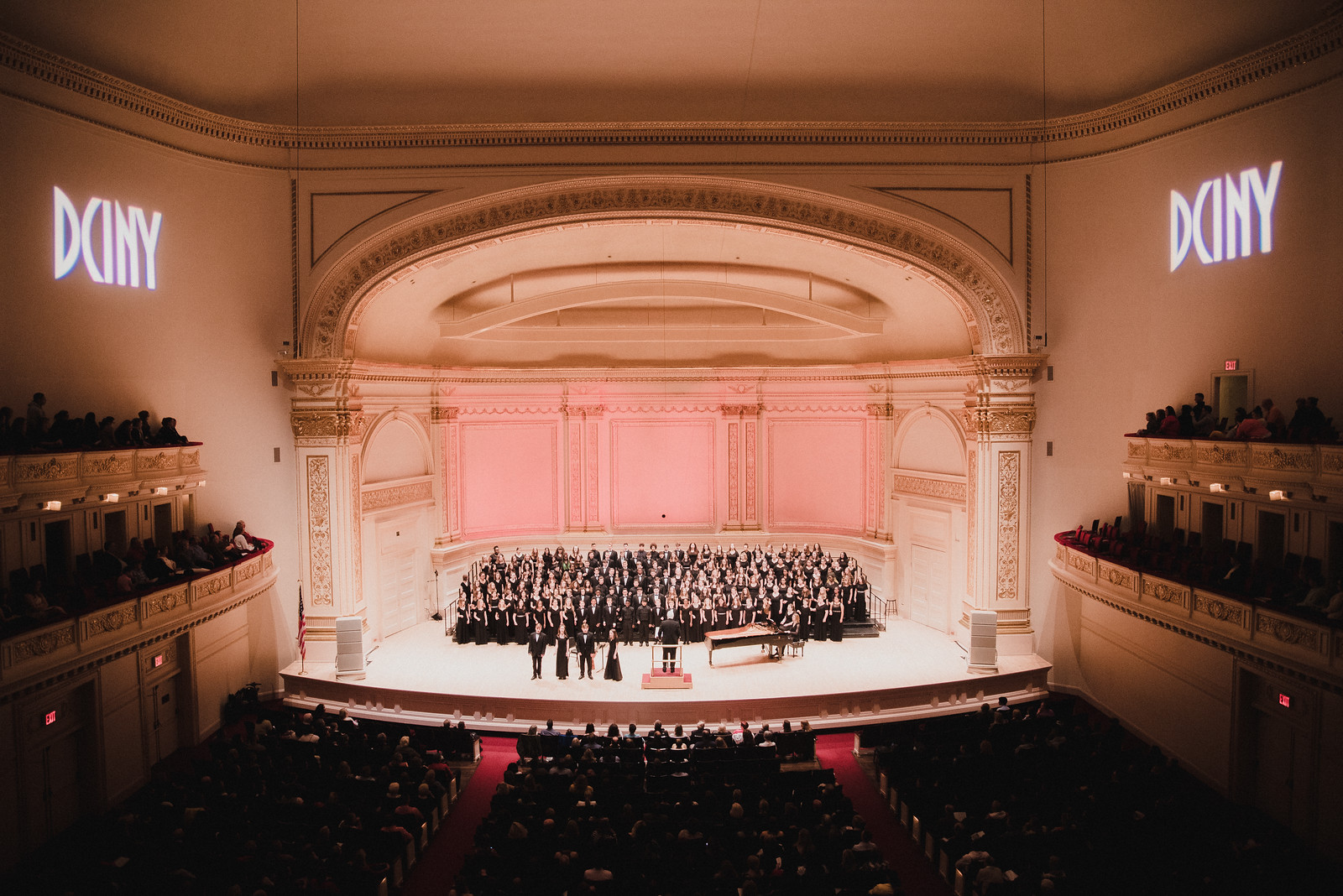
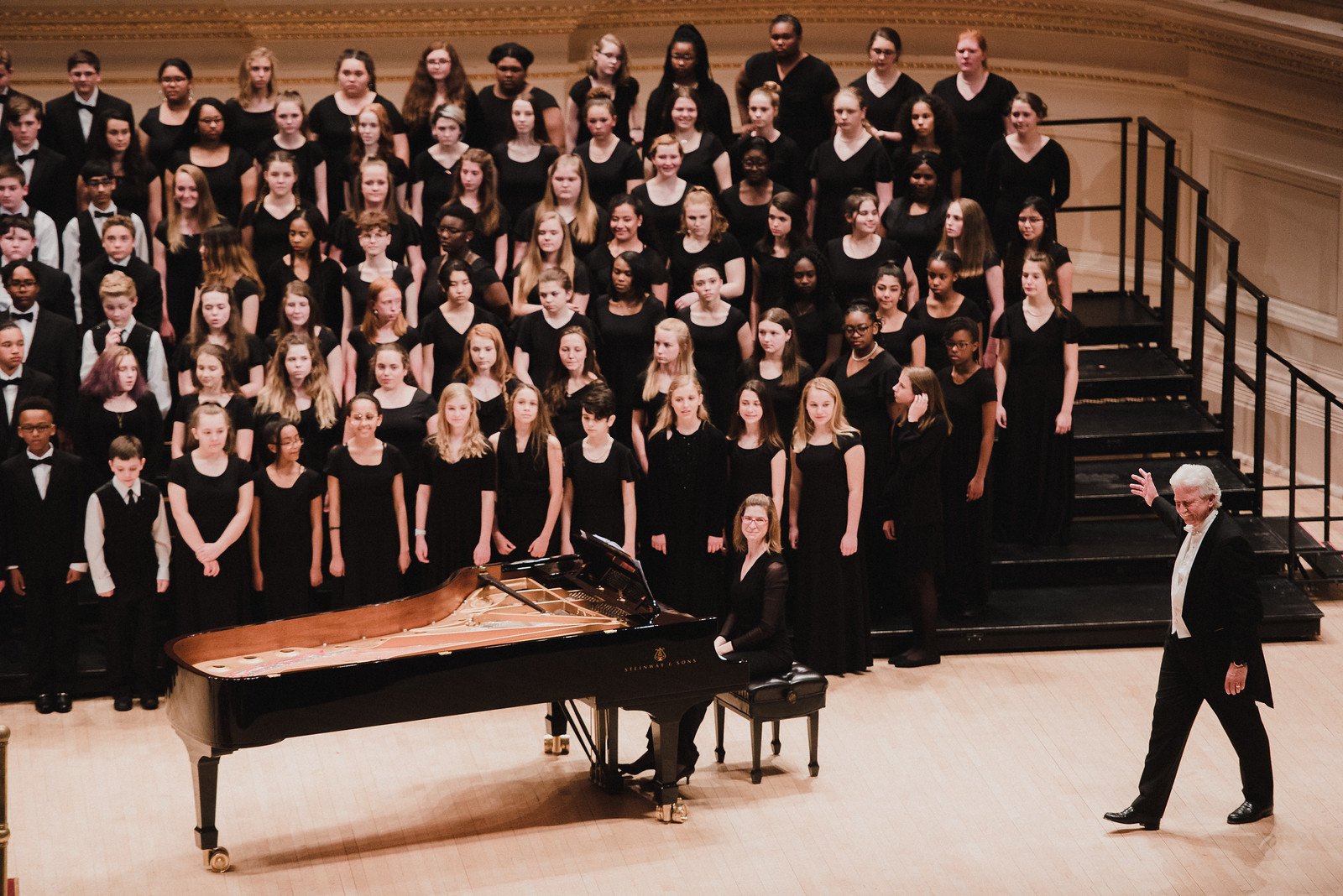
I haven’t attended one of DCINY’s reliably excellent massed-choir events in some time, so I’m happy to report that they took their already high standard to a new level with Sunday’s presentation of the music of one of the great choral leaders in America today, Eric Whitacre. The choirs are meticulously prepared by their individual directors prior to coming to New York for what must be an intense, perhaps even frantic, couple of days’ worth of rehearsal with the main conductor, in this case, Mr. Whitacre. He has the magic that imparts unanimity to diverse forces, for this was one of the most nuanced choral evenings I’ve ever heard, everything from thunder to whisper and every shade between. Kelly Yu-Chieh Lin, his collaborative pianist, was also superb.


More than 450 singers gathered (about half employed on each half of the program), mostly from high schools and academies in the US and Canada, with a few other international outliers. Everything was introduced charmingly and concisely by Mr. Whitacre.


The lion’s share of the program was devoted either to compositions or arrangements by the Grammy award-winning Mr. Whitacre, with two spirituals filling in nicely. He seems to know everyone in the business, not just musicians, but also poets, so everything on the program was related.


Mr. Whitacre’s strength lies in his ability to write luscious, flowing, lyrical (for the most part) choral textures that are enriched by the “cluster” technique (think Ola Gjeilo, Paul Mealor), which gives an emotional “cloud” or aura to the traditional tonal underpinnings of the pieces. He music is challenging enough for high-school age performers without being impossible, and full of gratifying substance for the listener.


The program opened with Mr. Whitacre’s arrangement of The Star-Spangled Banner, a touch that lent a certain sincere, old-fashioned quality to the whole. I recall when many events began with it, after all, the three stages in Carnegie Hall each display an American flag onstage to the audience’s left. Now, I like my anthems, well, “anthem-y,” that is, not too artsy, but when it is as high-quality as it was here, I can’t really object. Only the chord cluster under the final word “brave,” seductive as it was, seemed to me to impart a moment of doubt rather than fervor (perhaps I watch too much cable news!).


Then came one of Mr. Whitacre’s greatest hits: Lux Aurumque (also the title of an album), translated as “Light and Gold,” though I prefer “Golden Light.” The Latin is a translation by Mr. Whitacre’s friend, poet Charles Anthony Silvestri (more on him below) from an English original poem by Edward Esch (rare, one usually translates from Latin). The expression of awe at the birth of the Christ child was rapturous, the control exhibited by the choir breathtaking. The work was created in 2000, but really took off as part of Mr. Whitacre’s “Virtual Choir” project in 2009, involving amateur and professional choirs from 120 countries.


The City and the Sea comprised five poems of E.E. Cummings. Here, the sophisticated poetry made perfect word understanding difficult, always a hazard for larger choirs. Only Robert Shaw seems to have been able to solve this problem definitively. The texts to all the works were printed in the program however, so one could relax and take in the choral subtext added by the music. In fact, here’s a topic for another time: At what point does the choral sound “itself” become the message, even more important than whatever words are being rendered?


The Seal Lullaby (text by Rudyard Kipling) is the remnant of a film project that never materialized (instead, the studio made Kung Fu Panda!). Thank goodness Mr. Whitacre didn’t destroy it, for it forms a very touching and effective piece for choir—the mother seal singing to her baby.


Another Cummings setting, i carry your heart, was prompted by a friend’s seventh wedding anniversary. This was another stunner along the lines of Lux Aurumque. The radiance created by the clusters was the perfect metaphor for human love.


Cloudburst (text by Octavio Paz), is an almost literal depiction of the quiet of nature preceding a thunderstorm, and the rain itself, involving handbells, light percussion, and the snapping of hundreds of fingers that resulted in an uncanny sonic rainstorm (at one point even the audience was invited to contribute).


After intermission and choir-switch, Five Hebrew Love Songs were accompanied by a string quartet and tambourine. They were sentimental, as one would expect in a love song, of course, and very well-sung.


Then came the two zany volumes of Animal Crackers, to the silly, fun miniatures of Ogden Nash: Panther, Cow, Firefly; Canary, Eel, Kangaroo. Here one glimpsed a less lyrical side of Whitacre, with sharp bursts of humor in the brief lines, just cute enough in their delivery. I did feel that it was almost an embarrassment of riches for these texts, and that they might come off better by a smaller chamber choir (just me, the audience ate it up!)


Home, a movement from a larger work titled The Sacred Veil, is another work set to Mr. Whitacre’s friend Charles Anthony Silvestri’s poetry. We learned that the poet’s wife died of cancer way too young, and in coping with his grief, he was led to theorize about a realm perhaps mysteriously connecting the living and the dead. The section titled “Home” is about the moment when the poet realized that he was in love with the woman who would become his wife; who gave him the sense of “home.” What a lovely tribute from one friend to another, and to the departed.


Two traditional spirituals followed: Elijah Rock, and The Battle of Jericho, both arranged by Moses Hogan, another friend of Mr. Whitacre (hence the connection) who also died too young (age 47). The energy was high in these, and the choral sound that resulted was quite different from Mr. Whitacre’s spun lines. That he was able to reveal it so well attests to his quality as an interpreter.


The evening ended with Sleep, and Mr. Whitacre told an anecdote about having originally set Robert Frost’s Stopping by Woods on a Snowy Evening, but then being prevented from performing it or publishing it by the estate of the poet. Enter Silvestri. Mr. Whitacre had him fashion a poem with the same metric structure, to fit the existing music, and the result is this beautiful evocation. The choral diminuendo on the final word “sleep” (coincidentally, also the last word of Frost’s poem) went on repeating, each time softer, until one thought it couldn’t get any softer, and then it did. Amazing. I lost count of how many “sleeps” there were, a very good sign, since it means that I had surrendered my critical faculties to the music. Bliss.


The audience, formed primarily of friends and family, roared, and that moment at the end of each half when the “home” choral conductors are recognized always produces the biggest applause, so proud each of them must be.


Share

Long Island Concert Orchestra with Julia Zilberquit in Review

Long Island Concert Orchestra with Julia Zilberquit in Review

Long Island Concert Orchstra
Jason Tramm, conductor; Julia Zilberquit, piano;
Good Shepherd Church, Lincoln Center, New York, NY
April 27, 2019


The Long Island Concert Orchestra (LICO) under Principal Guest Conductor Jason Tramm brought an all-Mozart program to the Good Shepherd Church near Lincoln Center this past weekend, playing three iconic works including the Piano Concerto in A major, K. 488 with pianist Julia Zilberquit. Though still a young group (founded in 2016), the orchestra is already faring well under the energizing baton of Mr. Tramm and the guidance of Executive Director, composer David Winkler.


The evening opened with a vibrant account of the ever-popular Overture to The Marriage of Figaro, a perfect choice to precede the A Major Concerto, which was composed the same year as that opera (and completed just weeks before the premiere of it). The rousing style of Mr. Tramm set a tone of excitement, and though the LICO ensemble is not large, their sound was robust. They transmitted its driving energy and established its sense of imminent drama. The harmonic foundations were well grounded by a superb double bassist who sounded like a full section by himself – perhaps with some help from the church’s live acoustics. The sizable audience applauded warmly.


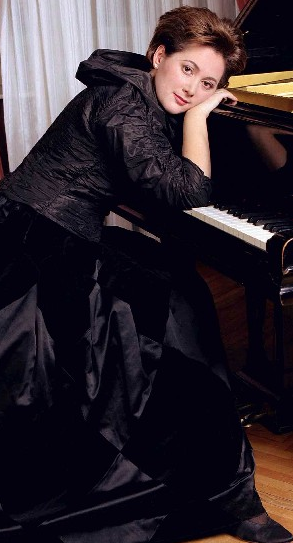
Enter soloist Julia Zilberquit, with regal deportment and clad in brilliant sparkling silver. Hailing from Russia, she has established her credentials well, including solo performances with orchestra (American Symphony Orchestra and the Moscow Virtuosi, among others) and recordings on the Harmonia Mundi, Warner Classics, and Naxos labels. As Ms. Zilberquit has recorded the complete Bach Solo Keyboard Concertos, it did not seem like a stretch to expect from her the precision and detail required in a Mozart Concerto – and in general she did not disappoint.

Julia Zilberquit, Pianist


The opening Allegro movement seemed off to a good orchestral start but there were some signs at the first solo entrance that there was not a true meeting of the minds, tempo-wise. Early on, some piano sixteenth notes seemed to run away, not quite dovetailing with the orchestra, and though this can often be the case near the opening of a concerto, the issue recurred. One is inclined to blame this (and some sketchy attacks and cutoffs) on acoustical issues. Synchronization can hard to achieve when articulations are obscured, and when rapid passagework tends to feature outlines and underpinnings; as a result, the need for more metric projection became clear, which tended to shackle even some solo passages (notably the imitative piano theme in the recapitulation). In any event, the musicians pulled it off, and the mastery in this magnificent piece shone through. Thankfully, Ms. Zilberquit chose to play Mozart’s own cadenza, bringing the movement to a fine closing tutti.


The profound Adagio movement (in the singular key of F-sharp minor) revealed much more about the pianist and her expressive style, and keen listeners were rewarded. Though the opening theme offers numerous expressive possibilities which were bypassed, Ms. Zilberquit turned out to be saving her expressive emphasis for the theme’s final measure, emerging as a player of long lines. It is always interesting, when reviewing, to need to revise one’s immediate reaction, and some of the most thought-provoking interpreters invite this retrospection. Ms. Zilberquit interpreted this movement with unique thoughtfulness. Her final Allegro was brimming with Mozart’s inimitable spirit, including very playful articulations towards the end. It was a delight!


Much to one’s surprise Ms. Zilberquit responded to the hearty ovation with not one but two encores. First, she played an arrangement announced as Bach Siciliano (the Largo from the Vivaldi-Bach Concerto in D minor, BWV 596). It was a stately offering, not unrelated to the siciliano elements of the Mozart slow movement. One was mystified, though, by her next selection, announced as a Shostakovich Waltz (the Lyrical Waltz from Shostakovich’s Dances of the Dolls), which had been given a “beefed-up” treatment complete with glissandi. It didn’t seem in keeping with what one had admired about her style in the Mozart.


The evening concluded after intermission with Symphony No. 40 in G Minor, K. 550. Accurately described by Charles Rosen as “a work of passion, violence, and grief,” this masterpiece is one of Mozart’s most loved and most frequently performed works. Mr. Tramm’s interpretation was simple, to let the music speak without resorting to any “novel “approaches, which was an intelligent choice. While one might have wished for more pathos in the opening movement, the net result was still compelling. The second movement Andante’s lyric qualities were brought forth with sensitivity. The third movement’s angry Menuetto was played with a good dose of agitation without lapsing into grotesqueness, while the trio, passed from strings to winds, cleared the storm clouds. The finale, launched with a “Mannheim rocket,” was played with vigor, bringing the evening to a successful close. The performance, to be sure, was not without some issues (notably balance and some cracked notes), but it showed the promise of good things to come from this orchestra.


The Long Island Concert Orchestra returns to the Good Shepherd Church for a program titled “Tango with Orchestra” on May 17, 2019.

Share

The National Music & Global Culture Society Presents “From East to West” in Review

The National Music & Global Culture Society Presents “From East to West” in Review

Eldbjørg Hemsing, violin; Nargiz Aliyarova, piano
Bruno Walter Auditorium, Lincoln Center, New York, NY
April 24, 2019


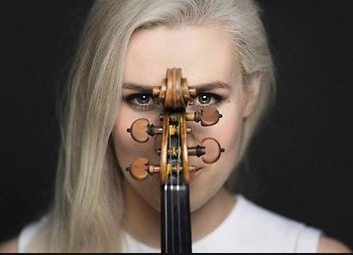
One may not often see links between the cultures of Norway and Azerbaijan (okay, you’ve got me – none ever crossed my mind!), but the excellent pairing of Norwegian violinist Eldbjørg Hemsing and Azerbaijani pianist Nargiz Aliyarova made a compelling case for just such connections this week at Bruno Walter Auditorium. Playing works of Ali-Zadeh, Garayev, and Melikov from Azerbaijan, and Brustad and Grieg from Norway – along with a Prokofiev opening – they gave a uniquely stimulating recital entitled “From East to West.” The program was subtitled, “Prokofiev Violin Sonata No. 2 and Works from Azerbaijan and Norway,” but the Russian role in the evening’s theme seemed to be that of a musical bridge (alluded to in Dr. Aliyarova’s comments about the influence of Russian teachers on both performers and their chosen composers). The focal roles of Norway and Azerbaijan were underscored in Dr. Aliyarova’s introductory remarks, including references to the Norwegian explorer and ethnographer Thor Heyerdahl, whose Azerbaijan-Viking theories have invited discussion years after his death (the reader may find more about these fascinating but highly debated hypotheses here Thor Heyerdahl Azerbaijan-Viking theories.


The evening was almost too tantalizing in too many directions to assimilate, so there is definitely ore to be mined for numerous future lecture-recitals; the overarching theme, however, was one of global unity. In that spirit, Dr. Aliyarova, the director and founder of the National Music and Global Cultural Society, presented this recital as part of the stated mission “to bring people of different ethnic groups together through their national music to global culture.”


Matching the intensity of the stated mission was an intensity in the duo’s opening performance of the Prokofiev Sonata No. 2 in D major, Op. 94. The work is often heard in its original version for flute and piano, but Prokofiev transcribed it later for the legendary violinist David Oistrakh, and numerous violinists have since adopted it into their violin repertoires. Ms. Hemsing and Dr. Aliyarova gave it an exciting account, exhibiting the technical and musical versatility to accommodate myriad changes of spirit, mood, and tempo without loosening the grip of its neoclassical restraint. Ms. Hemsing proved to be a violinist of consistently pure and refined sound, conveying well Prokofiev’s placid lyricism at the opening, from which its ever wider expressive range grew. The boisterous accents in the vigorous Scherzo were just right from both players, and the sinuous chromaticism of the Andante had an intoxicating sway to it. A memorable moment was the brief F-major section in the final movement – played with a special ethereal quality. Dr. Aliyarova was the assured collaborator throughout, projecting the music’s brilliance and humor – the latter especially in the “piano exercise” moments of the last movement.


Ms. Hemsing took the program to Norway next with a work listed as Fairy Tale for solo violin by Bjarne Brustad (1895-1978). It combined a pesante fiddler’s style with silky improvisatory flights, and its tonal language brought to mind how Bartok might have sounded had he been Norwegian. Ms. Hemsing spoke of it evoking the trolls of Norwegian folklore, and she played it with captivating whimsy. The piece seemed to fall into sections and perhaps was actually the Fairy Tale Suite one has seen listed elsewhere, but, while it would have been better to have more specifics on the printed program, the spoken introduction – and playing – did spur the listener’s imagination. Ms. Hemsing is an exceptional violinist who has also championed on disc the largely forgotten Norwegian composer Hjalmar Borgström (whose work sadly we did not get to hear). Her other repertoire has ranged from Bach, Beethoven, and Bartók to Tan Dun (for whom she recently premiered a violin concerto with the Oslo Philharmonic). To read more one can visit eldbjorghemsing.info.


Dr. Aliyarova closed the first half with an arresting solo, Music for Piano by Azerbaijani composer Franghiz Ali-Zadeh (b. 1947 and currently living in Germany). Ms. Ali-Zadeh composed the work in 1989 (publishing it nearly a decade later), and in it she used a prepared piano technique to evoke the plaintive sound of traditional Azerbaijani music (presumably the tar, a lute-like string instrument). The “preparation” was Dr. Aliyarova’s placement of a chain on the piano strings to create a buzzing metallic timbre on a selected set of notes (including a very prominent, hypnotically repeated middle F-sharp), allowing traditional piano tones to ring out above it in quasi-improvisatory outpourings. Ferocious toccata-like passages in the bass alternated with the more songful sections, both of which the pianist imbued with great emotion. Dr. Aliyarova was a compelling interpreter for this work and is clearly a dynamo who combines excellent pianistic skills and artistry with her role as presenter and educator. More can be learned at her website: www.nargizaliyarova.com


Having heard a piece by Franghiz Ali-Zadeh, we were treated after intermission to music of Ms. Ali-Zadeh’s teacher of piano and composition, Gara Garayev (1918-1982), one of the leaders in the Azerbaijani music world. Garayev’s Adagio for violin and piano from his ballet Seven Beauties brought a lush, tonal style not far from the language of Borodin and some Khatchaturian (as in the Adagio from Spartacus), and the duo reveled in its unabashed Romanticism. Garayev was himself a pupil of Shostakovich and thus could act as a connection to the Russian master for his own students, including for Arif Melikov (b. 1933), whose work we heard next. Melikov’s Monologue from the ballet, Legend of Love reflected some of Garayev’s expansive lyricism but with even more exotic flavor to its lines. Dr. Aliyarova and Ms. Hemsing melded well to convey the spirit in both pieces.
The concert was capped off by a Norwegian composer who needs no introduction, Edvard Grieg, whose Sonata No. 3 for Violin and Piano in C minor, Op. 45 is enjoying a busy spring (including a performance this reviewer was assigned to write up just a few weeks ago). It was given an impassioned performance here by both musicians, but Ms. Hemsing emerged as a particularly powerful interpreter for her countryman, delivering in each note and phrase the vividness and nuance that one hears more often from opera singers. Dr. Aliyarova was excellent in her handling of the work’s myriad challenges, only occasionally allowing accompanying parts in the piano to overpower the violin. Some of the nasty octaves and passagework in the last movement slipped a bit from her grasp, matters which might have been resolved by reining in the tempo a bit, but the duo had a “go for it” spirit which deserved admiration. After all, a few imperfections only remind an audience that these are human beings.


On the subject of being human comes one reservation for the evening: in live performance the performer (who is human!) should not be subject to the distractions of cameras moving around, especially on stage. One assumes that the wandering of one photographer onto the stage (in a bright red shirt, no less) may have been condoned at least initially by the performers, probably for purposes related to the ever-encroaching forces of social media, but it was a distraction for audience and performer alike and an affront to the music itself. It also implies, even if obliquely, that some virtual audience in the future matters more than those who traveled and made a point of being present.


Another reservation was the lack of program notes about the music itself, because, if the mission is to draw connections, notes can help to educate beyond the scope of some rather offhand comments from the stage. Though one could argue that most works can be researched online these days, the same could be said of performers’ biographical notes, which in this case were fairly extensive. Web links to the biographies might have sufficed, allowing room in the program for a bit more content about the composers and works themselves. That said, one looks forward to this organization’s further musical explorations.

Share

The Center for Musical Excellence (CME) presents Brannon Cho in Review

The Center for Musical Excellence (CME) presents Brannon Cho in Review

Brannon Cho, cello
Victor Santiago Asuncion, piano
Weill Recital Hall at Carnegie Hall, New York, NY
April 22, 2019


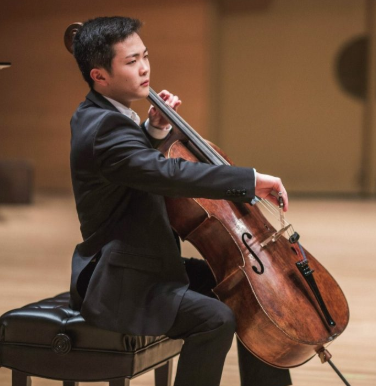
On April 22, 2019, The Center for Musical Excellence(CME) presented 2015 CME Artist Winner Brannon Cho in his Carnegie Hall (Weill Hall stage) recital debut. CME Founder and Director Min Kwon spoke briefly before the recital about CME, and to explain the four-year gap between Mr. Cho’s award and his debut by explaining that CME did not want to rush, but to allow Mr. Cho to continue exploring opportunities. It appears that Mr. Cho has been quite busy since then, and, given the quality of his performance on this evening, he should continue to be for the foreseeable future.

Mr. Cho and pianist Victor Santiago Asuncion took the stage and opened with Boccherini’s Sonata in A major, G.4 (the first two movements only). A sunny work, it was an ideal opener. Mr. Cho’s beautiful singing tone, combined with razor-sharp articulation, made one eager for what was to come.

Following the Boccherini came Matthias Pintscher’s Figura V/Assonanza (part of a larger work Figura I-V for String Quartet). With fluttering ultra-soft harmonics and sounds of atmend (breathing), it has an eerie, atmospheric quality. Mr. Cho’s playing was mesmerizing, even if one was left wondering whether this was meant to be chiefly an exercise in special effects. In any case, it showed Mr. Cho’s versatility as an artist.

More mainstream fare came next with Brahms’s Cello Sonata in E minor, Op. 38. Brahms entitled it Sonate für Klavier und Violoncello with the intent that the pianist is not merely a background accompanist, but a full and equal partner. Completed in 1865, the sonata is Brahms’s homage to J. S. Bach and uses material from Contrapuncti 4 and 13 of The Art of Fugue, as Mr. Cho reminds us in his program notes. This work always brings to mind the famous story associated with it, about Brahms and the cellist Robert Hausmann, its dedicatee. Hausmann was playing this work with Brahms at the piano, and Brahms was playing so loudly that Hausmann remarked that he could not hear his cello. “Lucky for you!” was Brahms’s reply! This listener thinks that the gruff Brahms would have been delighted with this performance. The rapport between Mr. Cho and Mr. Asuncion was striking, each attuned to the other as if they shared a single mind. The opening movement was filled with the feeling of sorrow, but also the glimmers of hope, as the duo robustly conveyed. The second movement Menuetto was played with charm. The finale was thrilling in its mutuality of conception. The large, and very enthusiastic audience gave the players a standing ovation. It was one of the finer performances of this masterpiece this listener has heard.

After intermission, Mr. Cho opened the second half with Benjamin Britten’s Cello Suite No. 1, Op. 72. The first of three suites written for and dedicated to Mstislav Rostropovich, it is inspired by Bach’s cello suites and Rostropovich’s cello playing. It is a haunting nine-movement solo cello work, with a beautiful opening canto that repeats several times in later movements, each time with an increasingly disturbing tone. The movements that surround the canto suggest memories, some playful and childlike, and others of a nightmarish quality. The ending is manic, with a final angry outburst in its final notes. The challenges are immense. The cellist must not only deal with the technical demands (which are considerable), but also convey the almost manic mood changes while trying to maintain the sense of structure and continuity for the work’s twenty-plus minutes.

There was none of the coughing or fidgeting from the audience that one often hears/sees in a work of this type – indeed, their attention was locked to the stage with utter silence. This listener was completely transfixed, experiencing the joy, the innocence, and the nightmares, as if privy to a particularly emotional therapy session. To convey this musically was something extraordinary. It was my favorite performance of the evening, and it is still resonating in my mind as I write these lines.

After the emotionally demanding Britten, it was time for Mr. Cho to have some fun, and this took the form of Sarasate’s Zigeunerweisen, Op. 20, a staple of the violin repertoire. Why should violinists have all the fun? In an arrangement by Hans Jørgen Jensen (Mr. Cho’s teacher at Northwestern), Mr. Cho let loose with a performance that many a violinist would be hard pressed to equal. With all of the Roma soulfulness coupled with the scintillating virtuosic fire, Mr. Cho’s playing exceeded all expectations (and for full disclosure, this reviewer heard Mr. Cho in a 2015 performance on YouTube as pre-concert preparation, so there was already some idea of what to expect). The audience leapt to their feet in a loud ovation, which almost seemed an insufficient response to such a dynamic performance!

Mr. Cho offered two encores. The first, Chopin’s Etude, Op. 25, No. 7, as arranged by Alexander Glazunov, was announced from the stage by Mr. Cho. The heartfelt melody was played with melting beauty by both players. The second, with the grandiose title “Concert Paraphrase on ‘Largo al factotum’ from Barber of Seville” (sometimes simply called “Figaro”), arranged by Mario Castelnuovo-Tedesco, was not announced, but it is highly likely that most made the Rossini connection. It is a sure-fire crowd pleaser. Mr. Cho played it to the hilt, with wit, whimsy, and brilliance.

After such a showstopper as the Zigeunerweisen, this reviewer had reservations about doing another such piece as an encore, lest it diminish the effect of the “serious” works (especially the Britten) – and yet it was a savvy move on his part to whip the audience into a frenzy. It worked – the audience loved every second and once again reacted with an extended standing ovation.

Mr. Cho is an artist to watch – mature beyond his years as a musician. Yes, he has technique to burn (and he is not at all shy about using it), but he pairs this with a fine sense of line and phrase shaping. He knows when to “breathe,” and does not hurry, letting the sound linger organically, without “chopping” phrase endings. Mr. Asuncion deserves high praise as well for both his attentive collaboration as well as his assured technique. I hope to hear this duo again in the future.


Share

Romanian Cultural Institute presents “Four Strings Around the World” : Irina Muresanu in Review

Romanian Cultural Institute presents “Four Strings Around the World” : Irina Muresanu in Review

Irina Muresanu, violin
Romanian Cultural Institute, New York, NY
April 12, 2019


This event was the first in a new concert series presented by the Romanian Cultural Institute called “The Enescu Soirees of New York.” To paraphrase the printed program, these concerts will be designed to showcase cultivate and promote Romanian music through chamber music concerts featuring Romanian, American and international performers. The namesake of the series honors Romania’s most prolific and revered composer, George Enescu. Tonight’s soloist, violinist Irina Muresanu, is the series musical advisor.


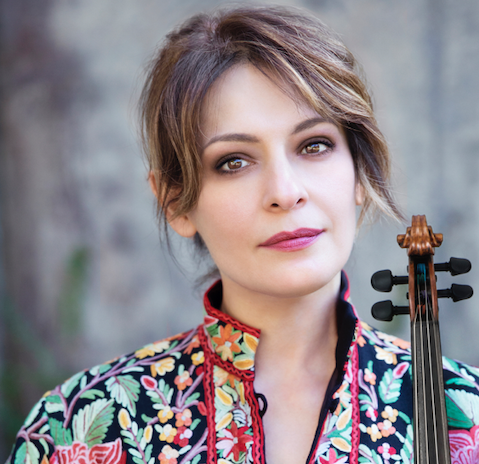
And what a beautifully constructed program she chose for this inaugural concert. Called “Four Strings Around, the World,” a showcase of works for solo violin by composers from four continents with pieces inspired by the folk music of Europe, the Middle East, Asia and the Americas. (It is available on a just issued Sono Luminus CD.) Fittingly, the first work was Enescu’s Romania – Airs in Romanian Folk Style. Although composed in 1926, this evocative composition remained in manuscript form until it was published in 2006. This was its American premiere. I say evocative because its combination of rhythms, bent notes (notes that to us sound slightly “out of tune”) and rubato phrases immediately told us that this work was from Eastern Europe. (In fact, “evocative” could be applied to all of the folk-song-derived works on this concert.) Ms. Muresanu produces a voluptuous rich sound and I was most impressed by her impeccable control while playing violin harmonics. It took but a few minutes to realize that we were hearing a master violinist.


We then moved on to Ireland with David Flynn’s Tar Éis an Caoineadh (After the Keening). Written in one continuous movement, this work consists of four dances which might have taken place at a traditional Irish wake after the ritualized keening (mournful display of sorrow and wailing). Traditional Irish wakes were a celebration of the life of the deceased and often had professional keeners, lots of alcohol, and lots of music. Each dance illustrated techniques employed by famous Irish fiddlers including droning double-stops, playing near the violin’s fingerboard (sul tasto) and near the bridge (sul ponticello). I again marveled at Ms. Muresanu’s fabulous technique. Needless to say, the work ended with a joyous Irish jig.


Departing from the folk music theme of this recital, Ms. Muresanu then performed J. S. Bach’s monumental Chaconne in D minor from his Partita BWV 1004. After hearing her performance of the first two works, I wasn’t surprised that she was up to the many technical hurdles of this most demanding masterpiece. The string crossings, and the double and triple stops were perfectly executed with seeming ease, but I found the performance, with its use of lots of vibrato and big crescendos, too romantic in style. However, as she kept the audience mesmerized for almost fifteen minutes and then received one the evening’s longest and enthusiast round of applause, I’ll stop my Baroque nitpicking.


After a brief intermission we began a musical and visual tour which took us to Iran, India, China, Argentina, and the United States of America. The visuals which preceded each piece were projected on a screen behind the performing space. They included pictures from each country, audio of the type of music on which the works we were to hear were based, and printed text about this music. While this was happening, Ms. Muresanu would be off stage changing into clothes suggesting the country whose music she would be playing. This was a wonderful touch.


Iran (Persia) was first on this tour. As with most of the folk-influenced works on tonight’s program, Reza Vali’s Calligraphy No.5 utilizes a musical scale which differs from that used in compositions such as Bach’s Chaconne in D minor. As a scale is determined by how the octave is divided (how many pitches are used, and what are the relative frequencies of these pitches), the more a culture’s scale differs from that we are used to, the more exotic it sounds. I marveled as to how Ms. Muresanu, a “classically” trained musician who has spent a lifetime playing the notes of “our scale” in tune, performed Mr. Vali’s carefully notated “out of tune notes” with such confidence and skill. She had already shown this skill playing the “bent notes” during the two folk-like works on the concert’s first half.


Next on to India for Shirish Korde’s Vák (for solo violin and electronic drone.) As much of Indian music utilizes a drone (one or two notes continuously sounded throughout a piece), Ms. Muresanu’s performance was supported by a two-note drone prerecorded on her mobile phone. Then on to the music of China, which utilizes a pentatonic (five-note) scale. But, to me, Bright Sheng’s The Stream Flows didn’t sound very Chinese. I thought I heard many half-steps (intervals like B to C) which are not found in the pentatonic scale. And Astor Piazzolla’s Tango Étude No.3 didn’t evoke the dance that I know, but the flower on Ms. Muresanu’s dress did.


Although I found the last three works less interesting than those of the rest of the program, I was still kept engaged by the magnetism of Ms. Muresanu’s playing, always exhibiting a rich sound, impeccable technique and beautiful phrasing.


This wonderful concert concluded with two contrasting works from the USA. The first, Oshta (Four) by Jerod Impichchaachaaha’ Tate. Born in Norman, Oklahoma, Mr. Tate is a citizen of the Chickashaw Nation who has infused his music with aspects of his American Indian heritage. Quoting Mr. Tate: “Oshta is the Chickashaw word for the number Four and became the title of this work in the spirit of [Irina Muresanu’s] Four Strings Around the World project.” Oshta, based upon a 19th century Choctaw church hymn, was for this reviewer the evening’s most beautiful work.


The concert’s finale was a foot stompin’, rip roarin’ rendition of Mark O’Connor’s rousing The Cricket Dance. This was Bluegrass fiddling at its best, as Ms. Muresanu, country music hat on her head, pulled out all the stops.


What an auspicious beginning to this new concert series whose next concert will be a June 7th recital by the Romanian-Nigerian pianist Rebeca Omordia.

Share

Wa Concert Series presents Wind Power in Review

Wa Concert Series presents Wind Power in Review

New York Woodwind Quintet
Carol Wincenc, flute; Stephen Taylor, oboe; Charles Neidich, clarinet; William Purvis, French horn; Marc Goldberg, bassoon; Bryan Wagorn, piano (guest)
Tenri Cultural Institute, New York, NY
April 12, 2019


The beneficent ghost of Samuel Baron (1925–1997) was undoubtedly smiling in attendance at the New York Woodwind Quintet’s April 12th concert at the Tenri Cultural Institute. Mr. Baron, founder of the Quintet in 1949 and, for a half-century, a beloved conservatory mentor to flutists (and their collaborative pianists), was also a conductor, a champion of new composers, a musical entrepreneur, an arranger, a member of the Bach Aria Group, New York City Symphony and City Opera, and a captivating lecturer on subjects psychological and practical. In this April installment of the Wa Concert Series, titled “Wind Power,” quintets by John Harbison and György Kurtág preceded a rendition of Mr. Baron’s sextet transcription of the Brahms G minor Piano Quartet, Op. 25, comprising throughout a glorious tribute both to Baron’s own legacy and to the Quintet’s seventieth anniversary.

Mr. Baron viewed the principal winds, the core of the symphony orchestra or the “leaders from within,” as bearers of a crucial responsibility in the realm of chamber music; in place of their standard role as simple executants of an orchestral conductor’s wishes, the players in a small ensemble could—and must—be interpreters and magical conjurors, channeling the composer’s ineffable spirit. To this aim, the most spectacular of the Quintet’s achievements on April 12 was Kurtág’s Woodwind Quintet, Op. 2 (1959), with Harbison and Brahms trailing close by.

György Kurtág, who is 93, has often been compared to Anton Webern, albeit in Central European Jewish guise. Kurtág was lucky enough to sidestep the horrors of World War II by studying in 1940 in the inconspicuous locale of Temesvar (Timişoara), Romania, later emigrating to Hungary in 1946. A pithy writer heavily influenced by Kafka, he underwent a brutal course of psychoanalysis during his years of study in the late 1950s in Paris, where he recounted the reverse metamorphosis of a “cockroach striving to change into a human being, seeking light and purity.” Perhaps stemming from art therapy sessions in which Kurtág was asked to create confessional sculptures from matchsticks, his penchant for divining expressive significance from the most ascetic of materials led to his rough-hewn, aphoristic early style.

Kurtág’s Quintet for Winds traverses eight movements in as many minutes, implanting microcosmic layers of intent within every terse utterance. For the breath-stopping duration of these miniatures, the bright and sterile concert room of the Tenri became a murky, post-war therapist’s lair, in which out-of-doors motifs of Bartók were exhumed and the birdcalls of Messiaen (with whom Kurtág studied) twisted themselves around a skein of intimate associations. Whirs and jabs floated, pierced, fell by microtones, and leapt questioningly from flute to oboe to clarinet and bassoon, all over a sustained horn (Mr. Purvis appeared to have a mountaineer’s lung capacity). This sort of identification with black dots takes place only under the obsessive tutelage of a composer, and although the twelve-page program booklet neglected to offer notes on the music (or even the correct key of the Brahms), we were treated to helpful verbal explanations of Kurtág’s coaching and the nurturing process behind what we were hearing.

The stage-setter for this catharsis came from the opposite end of the Schoenberg-Stravinsky spectrum. John Harbison, 80, is one of our national treasures and has been especially fêted in the current season. At the height of his career, the renowned composer is unveiling new recordings, world premieres, a book, and numerous performances to add to an enormous catalogue of symphonies, concerti, choral works, and operas including “The Great Gatsby,” commissioned by the Met. Mr. Harbison, winner of countless accolades in addition to a MacArthur Fellowship and a Pulitzer Prize, hails from the Northeast (Harvard, Princeton, MIT) and is active throughout the United States, with many of his compositions receiving performances worldwide.

His five-movement Quintet for Winds, a Naumburg commission from 1978—both Mr. Neidich and Ms. Wincenc are former Naumburg Competition winners—is an aural feast as well as a cerebral one; traditional dissonances and tensions between mismatched notes speak the language we know from Bach and Stravinsky, merely updated and laced with Americana, lyricism, and humor to bring us home. Harbison is all about communication, from before the music starts until the performers walk offstage, and this group’s burnished blend could react to the gesture of a shifting eyeball on the part of Mr. Goldberg. The clever choice to open the concert with Harbison’s animated declamation (Intrada), filled with sevenths, expressive doublings, and stratospheric explorations of every instrument’s range, was outdone only by the players’ attention to highlighted balances and well-honed intonation, leaving no harmony to chance. A moment for Mr. Taylor to shine in the plaintive Romanza opened forth into a series of escalating, quirky punctuations, perfectly calibrated, followed by the most seamless and ridiculous barrage of perpetual natterings in clarinet, flute, and bassoon (Scherzo: Prestissimo), paving the way for a somber Adagio and a hilarious, multi-tongued, gimpy march to close.

Considerations of balance were evidently central to Mr. Baron’s arrangement of Brahms for piano and five winds (the original calls for piano and three strings). Pre-concert publicity and print had conspired to secrecy about the name or even the existence of a pianist in this piece, leaving the introduction of a mystery guest to Mr. Neidich. When he arrived, however, Bryan Wagorn was a game contributor to the festivities. Already an established figure in the vocal world, Mr. Wagorn has performed with legendary singers and worked as assistant conductor at the Met. His presence at the Tenri’s seven-foot Steinway, a Wittgenstein family bequest, was dazzling and evocative, and certainly Mr. Baron’s arrangement of the G minor Quartet is a thrill to hear. The piece presents new challenges in wind territory, as double-reeds and brass tend to drive the tone much more than bowed nylon and titanium, and the horn’s dominating lines kept bringing to mind stretches of unwritten Mahler symphonies. The molto piano, con sordino pulsating triplets in the Intermezzo were recast as vibrantly tongued attacks, a timbral stimulant to the piano’s whimsical folk melodies. If one was looking for completion from the earnest, soul-searching Brahms, his reassuring voice warmed the air in transitional moments such as the piano’s Bachian cadenza in the Zingarese finale and a heavenly flute entrance joining its afterglow.

The Wa Series is also highly recommended for its culinary post-concert delights, courtesy of Ayako Oshima.


Share

The Paulus Hook Music Foundation presents Cong Bi in Review

The Paulus Hook Music Foundation presents Cong Bi in Review

Cong Bi, pianist
Zankel Hall at Carnegie Hall, New York, NY
April 12, 2019


In a well-attended debut at Zankel Hall at Carnegie Hall this week, Chinese pianist Cong Bi took on three of the most demanding works in the piano literature. Beethoven’s Sonata in F minor, Op. 57 (the “Appassionata”) and Schumann’s Davidsbündlertänze shared the first half, and Mussorgsky’s Pictures at an Exhibition stood alone as the second half. The concert was billed as a “celebration of the 40th anniversary of the establishment of Sino-US diplomatic relations.” Though there was no music from China to mark the occasion (even when an audience member called out “Chinese song!” at encore time), a large Chinese contingent seemed proud and excited.


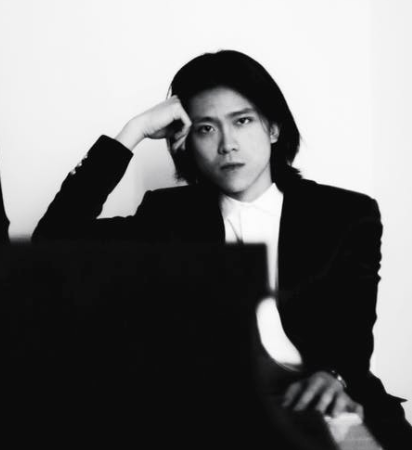
This reviewer gives generally few (if any) words about an artist’s appearance, but one would be remiss here not to mention that Cong Bi drew a gasp of admiration before he played a note. Blessed with a movie star’s good looks, he cuts a swath simply by striding onstage and gazing dreamily out at the hall from beneath a Lisztian mane. Why mention such a thing, when it is the music that matters? Well, at the risk of lumping classical music together with the pop world (e.g., the teen models who become overnight “musicians” with the magic of Auto-Tune), a distinctive stage persona does help command some attention even from classical music audiences (despite what many say). What happens after that initial impression is up to the performer’s actual musical gift and the discernment of the audience, though a magnetic image doesn’t hurt then either.


A quick web search finds that Cong Bi recently completed a graduation recital for the Bachelor of Music degree at the Mannes School of Music (The New School), but many of his credentials are from performances with orchestras and at international festivals from as early as 2011. Though no mention of the pianist’s age is made, one would guess that 2011 would have found him in his young teens. His biography cites a Rachmaninoff Concerto No. 2 performance at age fifteen (Forbidden City Hall in Beijing) for “fulfilling his stature as a musical prodigy.”


The transition period from the sketchy label “prodigy” to that of “mature artist” is challenging, because a prodigy by nature is a standout among his peers with all the attention focused on himself or herself; the gradual shift of attention towards music’s deepest offerings, though, is what allows the genuine “slow burn” career. There were many glimmers of that pure musical devotion throughout the evening (not to mention the discipline involved in tacking the program itself), but at the moment the romance and excess of youth are centerstage.


The good news from this reviewer’s perspective is that, given the order of repertoire chosen, one could enjoy each piece more than the last, with the Beethoven showing promise, the Schumann featuring a wonderfully manic ride, and the Mussorgsky going for broke completely in an unbridled tour de force. On the downside, the range from wild to wilder to wildest seemed to place Beethoven’s great Op. 57 in the position of being the steed that one uses to ride onstage rather than the substantial work of art that it is. The technical grasp was certainly there, except for a few rough patches and occasional balance issues (e.g., where left-hand repeated note rumbles overwhelmed higher lines); on the other hand, various important junctures were glossed over at high speed, and weighty moments seemed rather glib. This piece requires a bit of living, as well as thorough scholarship, and though it was clear that Mr. Bi has been well taught to be mindful of most of its details, one missed feeling the hard-won wholeness of conception that one wants. That quality tends to come with time.


Things simply got better after the Beethoven. Some of the qualities that one tends to link with youth – fierce energy, breakneck speeds, the glorying in massive sonorities, and almost schizoid shifts to intimate poetry – these all enhanced numerous passionate moments of the Mussorgsky and Schumann.


In the Schumann Davidsbündlertänze, we heard just the right impulsiveness in the eighteen wildly diverse episodes. Impetuosity was especially pronounced in the fourth (Ungeduldig), the sixth (Sehr rasch), the thirteenth (Wild und lustig), and the fifteenth (Frisch). The three episodes marked Mit Humor were also just so. We heard a hale and hearty romp through the third, with delightful ease in the leaps (as heard later in the ninth as well), and there was a Horowitzian devilry in the twelfth. The sixteenth had a jaggedness that verged on madness (in the best way possible), and in and out of the entire set we heard some astonishing lightness and delicacy as well. Present were the heroic flourishes of Florestan and introspective spells of Eusebius (contrasting characters who were quite alive in Schumann’s musical imagination), and the Davidsbünd (“The Band of David” against the Philistines) was well conveyed with excellent range. Having heard the Davidsbündlertänze easily a hundred times in capable hands, one has a rather high bar set for it, but this performance held its own quite well. The final episode (Nicht schnell) spoke stirringly, even if its last pianissimo breaths were a shade too loud (probably thanks to the hall piano’s highly resonant bass).


As for the Mussorgsky Pictures, it was a thrill to hear it played with such total immersion. The overall “exhibition” (each musical movement representing a painting at an exhibit) was interpreted thoughtfully, as were the individual sections. The Gnomus movement was appropriately craggy (almost brutal, but it worked), followed by a hypnotic Old Castle and an effortlessly fleet and clear Tuileries. The Bydlo (oxen) movement, was certainly leaden as it should be, though the giant hand gestures with each chord seemed needless at best and a bit risky.


What followed Bydlo was special in that the recurring Promenade theme (suggesting the composer’s own stroll between artworks) was treated with more special sensitivity to tonal color than it usually receives. This reviewer has found many performances of Mussorgsky’s Pictures quite tiresome, and it may be because the proverbial chain (in music especially) is only as strong as its weakest link. In other words, when the Promenade theme is treated as mere connecting material as often happens, interest lags. Why should we not be as involved in the walk of the art lover (within this musical artwork), as well as in his changing gait and spirit? Cong Bi did well in this regard, holding his audience firmly as he moved through the encyclopedic array of moods, characters, and images – not to mention pianistic challenges. From the sobbing character of the repeated notes of Samuel Goldenberg and Schmuÿle to the frantic double notes of The Market at Limoges, he drew on tremendous pianism resources. The Hut on Hen’s Legs (Baba Yaga) was absolutely nightmarish, topped only by “no holds barred” rendition of The Great Gates of Kiev. A few minor glitches hardly affected the sweep from such sheer abandon, and listeners were on the edges of their seats. It was the kind of excitement that could help draw the next generation into the world of classical piano music. A standing ovation followed.


Despite the audience plea for a Chinese song, the evening retained its Russo-German slant with an encore of Bach, the Andante from the Italian Concerto. It was sensitively played, although I couldn’t agree with all of the pianist’s ornamentations. A second encore was Bach’s Prelude in C major (Well-Tempered Clavier, Bk. I). It exuded a certain lovely reverence until the tacking on of a jazz ending after the close, a strange (some would say heretical) add-on for a piece that still inspires debate over even a single measure (the “Schwenke” measure, no. 23, which Mr. Bi rightly omitted).


It was an auspicious debut – and this will be an interesting career to follow!

Share