Distinguished Concerts International New York (DCINY) presents Windsongs in Review

Distinguished Concerts International New York (DCINY) presents Windsongs in Review

Ed W. Clark High School Concert Band (NV)
Jeffrey A. Lacoff, director; David Seifert, assistant director; Julio Vargas, guest director
Ed. W. Clark High School Symphonic Strings
Charles Cushinery, Eric Maine, directors
Susan E. Wagner High School Wind Ensemble (NY)
Paul Corn, director; Brian Worsdale, guest director
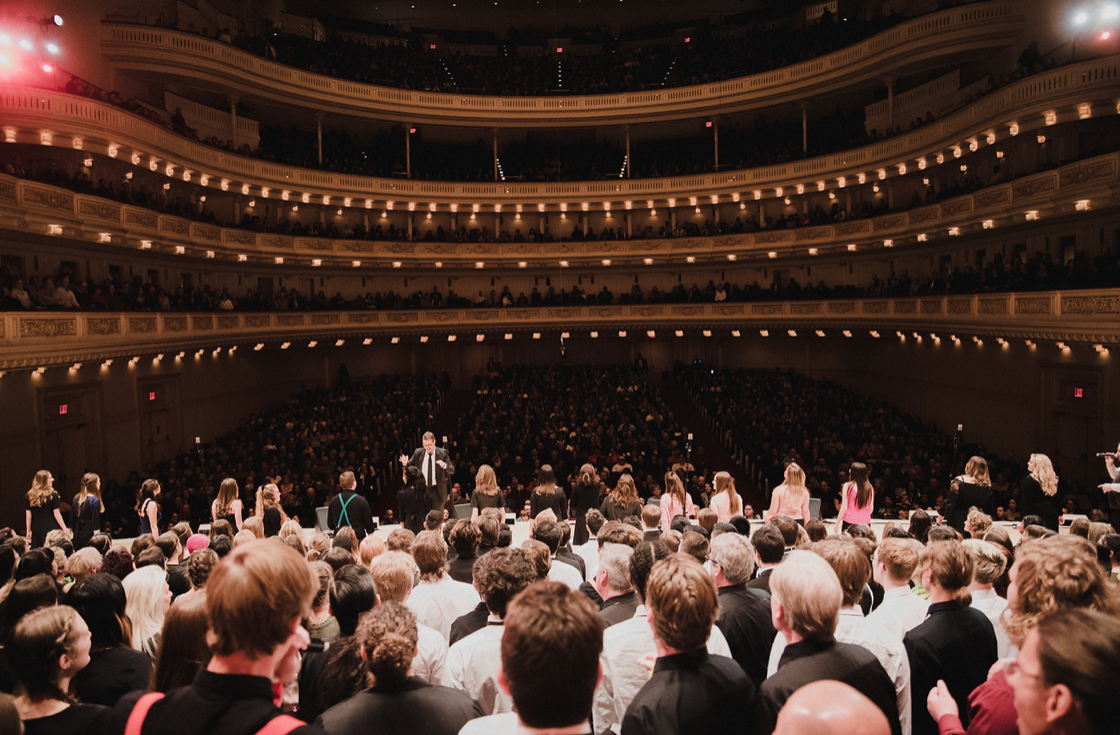
Stern Auditorium at Carnegie Hall, New York, NY
April 12, 2019


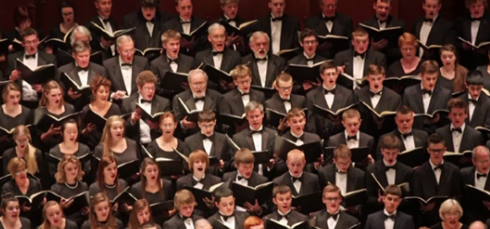
We often hear about the lamentable state of affairs regarding music education in our country. Lack of funds and a focus on the latest fads in education are often cited as causes. Thankfully, there are still many programs not only surviving, but thriving, with the next generation of talent being nurtured and filled with a lifelong love of music. Distinguished Concerts International New York (DCINY) hosted two such programs last Friday, the Ed. W. Clark High School (wind and string ensembles) from Las Vegas, Nevada, and the Susan E. Wagner High School (winds) from Staten Island, New York. They called their concert Windsongs.

To any regular reader of New York Concert Review it is no secret that I am a fan of both “band” music and young ensembles. At heart, I am still as much of a “band geek” as I was in the long-ago days when I was one of those youngsters having the time of my life. It’s truly a delight to see all the excited faces as the young musicians walk onto the stage of Carnegie Hall, ready to give their all. Lest people think that my feelings of nostalgia mean that a rave review is “in the bag,” they would be missing the fact that my experiences mean I am not easily fooled or dazzled by the tricks of the trade.

A few housekeeping items before I get to the performances. There were twenty-one works played this evening, so I am not going to mention each work, as that would turn this review into a book report. In the past, I would provide a link to the program so the reader could investigate further, but regrettably, DCINY has appeared to have ceased posting the concert programs on their website. Also, though the Susan E. Wagner High School Wind Ensemble played between the two Ed W. Clark groups, I am going to begin with them.

Led by Paul Corn, with guest director Brian Worsdale sharing the podium, the Susan E. Wagner High School Wind Ensemble hit the ground running. They did their tuning before taking the stage, something I wish more ensembles would do (especially the younger ones), and they lit right into the music. The instrumentation was well-balanced overall (something not always the case in High School ensembles), and no one section was dominant (also something not common in High School ensembles). The intonation and the ensemble were excellent overall.

Glenn Miller in Concert (arrangement by Paul Murtha), with quotes from In the Mood, Tuxedo Junction, A String of Pearls, Little Brown Jug, and Pennsylvania 6-5000, was smartly played with the old-time big band feel. Saturn Returns by Michael Markowski is a showstopper that these young players tore into with gusto. John Mackey’s This Cruel Moon, a poignantly beautiful work (adapted from the “Immortal thread, so weak” movement of his Wine-Dark Sea: Symphony for Band), was the highlight of their selections for this listener. It was an “A” that could have been an “A+” if there had been a bit more feeling of the heartache that abounds in this piece (as heard in an excellent recording done by the University of Texas Wind Ensemble led by Jerry Junkin). Yes, it is persnickety, but as the saying goes, “If you can do it this well, then you can do it even better!” Two Leonard Bernstein works (Slava! and a concert suite from On the Town) bookended their selections. Their supporters gave them a standing ovation at the end, and it was richly deserved.

The Ed W. Clark High School Concert Band took the stage to open the concert (and as a side note, I was intrigued by the tuning to Concert F). The conducting duties were shared by Jeffrey A. Lacoff, David Seifert, and Ed W. Clark alumnus Julio Vargas (Mr. Lacoff was also to been seen in the percussion section when not on the podium). Running though my standard checklist again: Well-balanced instrumentation – check (actually check-plus, as that is a dream come true for most High School ensembles), and good intonation and ensemble – check. There was again no single overly dominant section. Ten pieces were played, each from two to five minutes in duration.

This presents an interesting challenge for the reviewer, as the short duration of the pieces lends itself much more to “adjudication” then it does to a review. Reading of the band’s many superior ratings in adjudicated festivals does not surprise me, as their program seemed almost built to succeed in such format. I’ll try to do a bit of both adjudication and reviewing here. First, the review portion: Gershwin’s Second Prelude (arranged by John Krance) won me over, despite initial incredulity over the arrangement itself (from the piano version). It was a stylish and persuasive performance. Caesar Giovannini’s Overture in B-Flat (scored by Wayne Robinson) was brimming with energy and played with polish. Ginastera’s Danza Final from Estancia enjoyed a restrained tempo that allowed a cleanly articulated performance. It can so easily spiral into a helter-skelter, indistinct mess if too fast, but the group neatly avoided that fate. Derek Bourgeois’s Serenade with its irregular meter has a quirky charm which the ensemble captured well and with an appropriate sense of whimsy – good work! Finally, John Philip Sousa’s immortal march, The Stars and Stripes Forever (composed in 1896, not 1928 as stated in the notes), brought the audience to a standing ovation. Adjudication verdict: Superior, with one suggestion. The notes are all there, but there is an opportunity to heighten performance further with more careful attention to ensemble timbre. Poignant phrases (especially in Eric Whitacre’s The Seal Lullaby) need to be “softer” (in tone, not dynamics) to maximize the effect.

After intermission, the Symphonic Strings (also from Clark High School) took the stage. They were an impressive assemblage with fifty violins, twenty-one(!) violas, twenty-two cellos, and six string basses. Charles Cushinery and Eric Maine shared the podium. The sheer number of players had this listener thinking that perhaps this group was one of those in which “everyone gets in” regardless of ability. I was quickly disabused of this notion after a few measures of the opening movement of Tchaikovsky’s Serenade for Strings. Such true intonation for such a large group was striking, and the ensemble balance was every bit as impressive as well. The high level continued in the Intermezzo from Mascagni’s opera Cavalleria Rusticana.

Three selections from Béla Bartók’s Romanian Folk Dances had a young girl (probably four or five-years-old) two rows in front of me happily dancing along to the music, which says more than any fusty “critic” words, and it was followed by the World Premiere of High Resolution by Jennifer Bellor, commissioned by the Ed W. Clark High School Symphonic Strings. This work has an atmospheric, dream-like quality, and Ms. Bellor writes in her notes that she took inspiration from two states of realities, being awake and being asleep. It is an effective work that is a worthy addition to the repertoire. The composer was present and rose to acknowledge the audience’s applause and to salute the orchestra.

The delightfully named Kwoktet, three brothers and a cousin sharing the last name Kwok (two violinists, a violist, and a bassist), were featured front and center in Por Una Cabez. What talents they proved to be, with the added bonus of all being personality-plus – they may be stars of the future, so keep your eyes and ears open! The fourth movement Fugue finale from Ernest Bloch’s Concerto Grosso No. 1 was scintillating. It was this listener’s favorite on a program that had much that was excellent. The audience gave them an extended standing ovation. This was one of the finest high school string orchestras that this reviewer can recall hearing in sometime.

An encore of the Temptations’ classic song My Girl had the audience clapping along in rhythm and was a joyful end to this well-presented evening of music. Congratulations to all!

Share

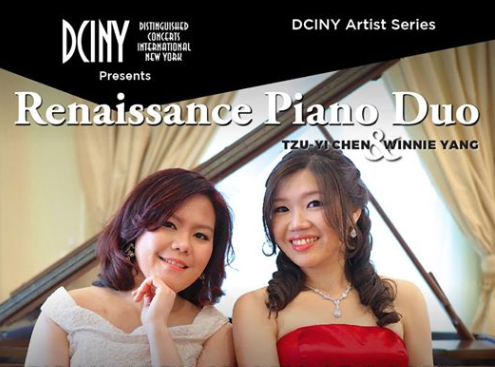
Distinguished Concerts International New York (DCINY) Artist Series presents Renaissance Duo: Tzu-Yi Zoe Chen and Lan-In Winnie Yang in Review

Distinguished Concerts International New York (DCINY) Artist Series presents Renaissance Duo: Tzu-Yi Zoe Chen and Lan-In Winnie Yang in Review

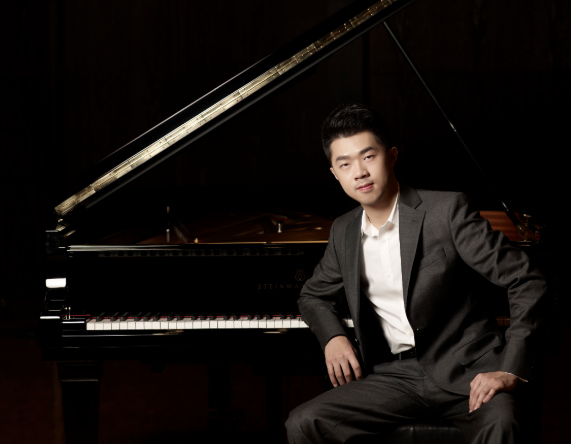
Tzu-Yi Zoe Chen and Lan-In Winnie Yang, piano
Weill Recital Hall at Carnegie Hall, New York, NY
April 12, 2019


Though April showers came our way, they brought a piano duo, and boy could they play! The Renaissance Duo, consisting of duo-pianists Tzu-Yi Zoe Chen and Lan-In Winnie Yang (who is also a composer), presented as a part of the Distinguished Concerts International New York (DCINY) Artist series, brought a powerhouse program to Weill Hall on April 12, 2019. I recall fondly Tzu-Yi’s Weill Hall solo debut recital from October 11, 2014, reviewed in these pages (Tzu-Yi Chen in Review). At that recital, she played a suite by Lan-In, so to hear the two of them working together was almost foretold, but I had no idea it would be as delightful as it was.


Their unanimity of ensemble, scrupulous attention to phrasing, generous flexibility (so hard for two to achieve together), and their budgeting of dynamics all contributed to the fine impression they made. The two alternated which one played the Primo and Secondo parts throughout the evening, yet I was never thinking about the mechanics of ensemble playing with these two. The overarching theme of this generous program was transcription, the way composers repurpose existing material, whether by them or by someone else.


The concert opened with Busoni’s Duettino concertante nach Mozart, based on the perky Finale of Mozart’s Piano Concerto in F, K. 459. One usually does not think “-ino” when Busoni’s music is the topic, but here the dimensions of the piece (only six minutes) justifies it, even though the conception and working-out are grand. The duo managed to preserve the lightness of the original composer, yet when Busoni begins to go off in his complex contrapuntal direction, they responded without gross thickening of the texture. It sounded as if Mozart had lived another 100 years, this is the piece he would have written.


The other work on the first half was the Brahms Sonata in F minor, Op. 34b, the third reworking of a piece that eventually became the Piano Quintet in F minor, Op. 34. Brahms was a relentless self-criticizer and reviser. The duo’s seriousness of approach, and ability to handle masses of sound was greatly appreciated by me, as was their attention to soft lyrical playing. It is indeed thrilling to see two Steinway concert grands on stage, to know what they are capable of, and yet to hear them whisper together. This was a majestic, passionate, and warm performance, and they managed a minor miracle: I didn’t miss the string parts (!).


After intermission, the tone became decidedly lighter, beginning with a new version of the Finale from Ms. Lan-In’s recently commissioned Piano Concerto, “Sketches of Taiwan” (2014), an affectionate programmatic portrayal of the bustle of life in the island, specifically Taipei, I would imagine. The piece alternates fast material, with influences of Prokofiev, and lyrical material that hearkens to Rachmaninoff, even Khatachurian a bit. That I mention other composers is not a slam, I’m sure Ma. Lan-In’s music will show even more individuality as she matures. Her craft is wonderful, however, and the duo really opened up through the showier portions.


This was followed by William Bolcom’s humorous take on the Garden of Eden and the expulsion of Adam and Eve in a suite (originally for solo piano) of four modern ragtime dances. After Joplin, Bolcom really is the preeminent composer of rags. I found myself marveling at how stylish the women rendered each and every corner of the “cool” music, with such enjoyment and wit. The audience reacted with delight, especially in The Serpent’s Kiss, which is full of foot stomping, wood tapping, clucking, and whistling, none of which is easy to do in the context of also having to play the piano!


The recital concluded with a stunning performance of the fierce Lutoslawski Variations on a Theme by Paganini, the theme from the violin Caprice in A minor that so fascinated Liszt, Brahms, and Rachmaninoff, among others. It is an encyclopedia of technical difficulties, yet time and again the duo gave me the leisure to enjoy just how much “music” there is in the piece, which was only possible because of their sovereign command of their parts.


The audience would not let them go, so they reformulated to one piano, four-hands for two unannounced encores. The first was a zany thing in polka rhythm that I did not know, and the second was a hair-raising, hysterically good version of the Sabre Dance from Khatchaturian’s ballet Gayaneh. The loudest sounds of the entire evening took place (completely appropriate) in this work, and Ms.Tzu-Yi got up and switched places with her partner to play the last zinger bass note (she had been on the upper part).


Share

Legato Arts Presents Ivan Ženatý in Review

Legato Arts Presents Ivan Ženatý in Review

Ivan Ženatý, violin, Dmitri Vorobiev, piano
Weill Recital Hall at Carnegie Hall, New York, NY
April 9, 2019


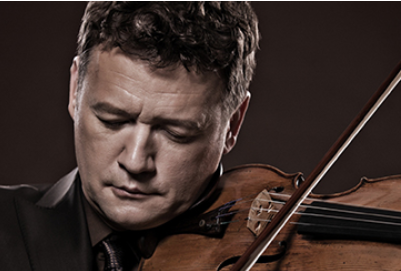
It is one of the joys of long-term reviewing (nearly thirteen years now) to re-hear an artist one praised years before and find one’s earlier impressions not only confirmed but intensified. In 2012, I first heard the violinist Ivan Ženatý in music of Dvořák, Janáček, and Smetana, and wrote glowingly. This week, in music of Robert Schumann, Edvard Grieg, Oskar Nedbal (1874-1930), and Juraj Filas (b. 1955), he was possibly even greater. His pianist was Dmitri Vorobiev, who was also superb.


For those who are not familiar with the Czech violinist, Ivan Ženatý, he has a discography of over forty recordings including the complete works of Telemann, Bach, Mendelssohn, Schumann, Schulhoff, Dvořák and Grieg, and his repertoire includes over fifty violin concertos from Bach through Britten. He has taught at the Cleveland Institute for Music and is currently Professor of Music at the Royal Academy of Music in Copenhagen. Being a prizewinner in the prestigious Tchaikovsky International Violin Competition some decades ago has become almost parenthetical among his credentials – and that says a lot. For more information one can visit www.ivanzenaty.com.


His program offered many enticements, not the least of which was the first work, Schumann’s Märchenbilder, Op. 113, from 1851. Though one generally falls in love with this set as a viola work, it works as a violin piece as well, with some parts simply raised by an octave, and others with reworked arpeggio inversions and the like. It was, in fact, dedicated to the violinist Joseph Wasielewski, a good friend of Robert and Clara Schumann. Though this listener still prefers the work on the viola, especially the inspired depths of the fourth and final piece, the music speaks in almost any incarnation as long as there are sensitive interpreters, and there certainly were on this occasion. Mr. Ženatý played with the refinement and thorough musicianship one has come to expect from him, and Mr. Vorobiev was right with him. There was the flexible artistry that is possible only with complete trust in the collaborators’ responsiveness. It didn’t hurt either that Mr. Ženatý plays a rare Giuseppe Guarneri del Gesu violin made in 1740 (thanks to the Harmony Foundation).


Oskar Nedbal (1874-1930), pupil of Dvořák, was the composer of the next work, the Sonata in B minor, Op. 9, for Violin and Piano. For full disclosure, I can’t recall hearing this Sonata in live concert ever, and though an internet search will yield some scattered recorded files of it, most are by – you guessed it – Ivan Ženatý. Nedbal may be best known for his shorter Valse Triste, which is in the repertoire of Czech orchestras. Mr. Ženatý has performed a valuable service for music and musicology by investing his energy and interpretive artistry into this work, and though the composer may not rival Brahms or Beethoven in a musician’s pantheon, it was fascinating to hear, both for its Dvořák connections and its idiomatic and brilliant writing. Both pianist and violinist conveyed its Romantic spirit and drama well, making short work of the spates of stormy virtuoso passages. They lent it the persuasiveness that comes from truly believing in a piece’s worth. I for one will aim to give it several more hearings.


Both players, despite the tremendous technical demands of the program, never flagged or played up the showman aspect with physical demonstrativeness. That integrity was familiar from Mr. Ženatý’s last recital, and he clearly has a gift for finding pianists with similar virtues. It was an evening of pure music-making at the highest level.


After intermission we heard Les adieux for Violin and piano by Slovakian composer Juraj Filas (b. 1955), who was present for the performance. As Mr. Ženatý wrote in the program notes, “During a very happy period in my life, I asked Juraj for a ‘Romance’ for Violin and Piano. Instead, he wrote, ‘Les Adieux’ for me in 2003, a romantic story about lost love; terribly sad but magically beautiful…” Indeed, the piece lived up to this description, with extremely poignant harmonies underscoring its lyrical lines. Mr. Filas came to the stage for a much-earned bow afterwards.


The final work, Grieg’s Sonata in C minor, Op. 45 (1886), was feast of music-making in all respects. From the first movement’s driving intensity – and the purity of its gentler E-flat theme – right up to the final movement’s triumphant major ending, there was no moment without commitment and character. Mr. Ženatý is far from self-indulgent, and because of such restraint, the listener is even more captivated by the occasional Romantic flourish, lingering, or slide. One heard the seasoned veteran’s ability to be expressive within boundaries and with respect for proportion.


Technically no hurdle was too great for this duo, and incidentally the piano lid was all the way up, with no problems of balance resulting. Mr. Vorobiev was able to keep the torrents of notes within his controlled grasp and unafraid to take the lead where called for, though never intrusively.


The audience gave a much-deserved standing ovation but rushed to sit down again at the prospect of an encore. When De Falla’s Spanish Dance was announced one could hear a gratified “mmm” from the hall, and no one was disappointed. Mr. Ženatý tossed off the Kreisler arrangement with dazzling skill and panache. As grounding as it was to hear such a thorough musician for an entire program, it was a delight to see him having fun just reveling in some fireworks. Mr. Vorobiev collaborated expertly.


Incidentally, not that one assesses an artist by his following, one simply could not help appreciating the audience itself – not for sheer size (though it was large) but for apparent musical awareness. The duo clearly attracted experienced listeners, and they responded to performers’ mastery. In many spellbinding moments, one could hear the proverbial pin drop (not the shuffling and unwrapping of candies, as often occurs). Upon entering one even overheard a ticketholder mentioning that he “came to hear the Nedbal” (and one wondered whether Nedbal himself had encountered that as often as he should have).


It was an evening to reaffirm one’s faith in unwavering high standards. Bravo!


Share

Key Pianists presents Terry Eder in Review

Key Pianists presents Terry Eder in Review

Terry Eder, piano
Weill Recital at Carnegie Hall, New York, NY
April 8, 2019


Key Pianists, a valuable New York series that features under-recognized pianists in repertoire they are passionate about, presented its founder and patron, Terry Eder on April 8th at Weill Recital Hall. Ms. Eder modestly programs herself only once every couple of years or so, leaving the roster open to other deserving players. I reviewed her last performance in 2017 (Terry Eder in Review 2017), and wrote a profile about her in these pages as well (A conversation with Terry Eder).


On this occasion, she brought most of her vivid strengths, and though I take issue with some of the interpretive choices she made, the evening was a resounding success. Ms. Eder exemplifies the golden-age pianism of the so-called “Leschetizky method”: deep, relaxed, unforced piano sound at all dynamic levels. It is rare in our age to hear music-making of such purity and honesty, without artifice.


This quality was evident in the program opener, Dohnányi’s rarely heard Intermezzo in F minor from Opus 2, a work written under the influence of Brahms, so to speak. Its grim little theme returns for increasingly ornate variation treatment, pianistically thick, though every bit of it was warm and clear in Ms. Eder’s playing. I’m sure she feels quite committed to the work, but it did strike me as somewhat dated, “Brahms” without the self-discipline or austerity.


Ms. Eder followed this with the first impromptu from Schubert’s second set of four, in F minor, D. 935. This was presented with simple songfulness, though I did wish for greater dynamic contrast, especially in the softest sounds. Ms. Eder managed one magical nuance: she made the lyrical second theme, originally heard in A-flat major, sound much more angelic when it returned in F major.


Next came the first of Beethoven’s late sonatas, No. 28 in A major, Op. 101. The work is structurally innovative, and the famous lyrical opening starts “in the middle,” as though the music has already been flowing along before the part we hear begins. To achieve this effect, however, takes a much softer beginning volume than we heard, although Beethoven himself left it out, and an editor suggests p. I found Ms. Eder’s approach much more corporeal than spiritual. Again, throughout I wished for more pianissimi, as I know Ms. Eder is capable of them. Her rendition of the second movement’s march was appropriately angular. The third section, barely a “movement,” more like an introduction to the finale, again lacked the mysterious delicacy that can make the sadness palpable. That finale, marked mit Entschlossenheit (resolve or determination) was indeed resolute, a bit too stiff for my taste, needing more final abandon as the positivity of it breaks the spell of what went before, as well as a wider dynamic range—there are many pianissimi indicated.


After intermission, Ms. Eder returned with one of her amazing specialties: Hungarian piano music, the fruit of her training and also of years spent there. This time we received gratefully four rarely heard works by Zoltán Kodály, a noted ethnomusicologist who, with Bartók, catalogued and ennobled so much of eastern Europe’s heritage of folk music before it was lost. He was, however, also a prolific composer of his own music, often influenced by the folk studies and materials. The Transylvanian Lament, from Op. 11, was gorgeously played, haunting in all the right ways. This set off the contrast made by the sassy little Allegro giocoso (Op. 3 No. 7) even more. Interestingly, I recently heard someone else play the Méditation sur un motif de Claude Debussy recently in the same hall, and I was struck by how much individuality Ms. Eder gave it. The piece uses as its principal theme the motive from the Scherzo of Debussy’s String Quartet. Kodály was profoundly influenced by his studies in France, and here he produces dark, mysterious sections “inspired by” but not imitative of, Debussyian impressionism. The Épitaphe, also from the Op. 11 set of pieces, was Kodály’s response to the news of Debussy’s death in 1918, again another stunning revelation provided to us by Ms. Eder.


There followed the first book of Images by Debussy himself, and his own celebration of orgiastic love inspired by a Watteau painting and his own personal life, L’Isle joyeuse. With this music, my variance with Ms. Eder’s approach was greatest. I’m beginning to sound like a broken record (who remembers records?!), but I only intermittently heard the sophisticated mixtures of very soft tone that this repertoire needs. Conversely, I don’t know why she downplayed the climax in Reflets dans l’eau. For me, the most successful movement was, no pun intended, Mouvement, which means tempo or speed, a grim take on the mechanization of life (the Dies irae makes a couple of appearances). The “happy island” nearly came to grief due to memory lapses (which were more or less present all evening). Now those who know my writing know that I always say it’s not so important when something adverse happens, it’s how one continues that matters, and continue Ms. Eder did, always saving the situation. However, the beginning trill of L’Isle is marked piano then crescendo, it doesn’t start with a loud accent (however fiendishly difficult this is to accomplish!). Debussy knew he was creating a very difficult work, and he entrusted the premiere to the great Catalan virtuoso Ricardo Viñes. I must mention one more detail, the final ascending ecstatic “rocket” arpeggio must be immediately connected to the descending one which follows, plummeting all the way to the lowest note on most pianos, a gesture that has brought many pianists to grief (missing the note and thwacking the wood with their finger!), but that did not happen on this occasion.


After an enthusiastic ovation, Ms. Eder played Chopin’s Waltz in G-flat major, Op. 70 No. 1 (posthumous) ever so sweetly and with that beautiful tone mentioned earlier.


Share

Distinguished Concerts International New York (DCINY) Presents Mass in Blue: The Music of Will Todd in Review

Distinguished Concerts International New York (DCINY) Presents Mass in Blue: The Music of Will Todd in Review

Will Todd, DCINY Composer-in-Residence and Pianist
Alicia Walker and James M. Meaders, Guest Conductors; Distinguished Concerts Singers International
Kristin M. Claiborne, Soprano; Craig Butterfield, Double Bass;
Cliff Leaman Saxophone; Chris Lee, Percussion
David Geffen Hall, Lincoln Center, New York, NY
Apr 7, 2019


An entire program at David Geffen Hall was devoted this weekend to the music of Will Todd (b. 1970), Composer-in-Residence for Distinguished Concerts International New York (DCINY). Featured were two large-scale works, Mass in Blue (constituting the first half, conducted by Alicia Walker) and Songs of Peace on the second half (conducted by James M. Meaders), followed by a shorter piece, No More Sorrow. Choruses came from all over (Connecticut, Florida, Kansas, Maine, Mississippi, Missouri, Rhode Island, South Carolina, Texas, and Virginia, as well as Canada and the UK), and Geffen Hall was abuzz with the excitement that DCINY always manages to create.

In case our readers are unfamiliar with Mr. Todd (as this reviewer was), he is a British composer and jazz pianist, best known for combining jazz and blues with traditional choral music. His jazz trio performs regularly and plays a large role in his Mass in Blue (2003), originally entitled Jazz Mass. The mass, commissioned by the Hertfordshire Chorus in the United Kingdom and premiered there in 2003, has since been performed over 200 times at venues including the Barbican, London, and Lincoln Center, NYC, as well as live on BBC Radio. Mr. Todd’s arrangements and compositions overall have been performed before dignitaries worldwide and in prominent venues across the globe. For more information, visit https://willtodd.co.uk

Some may call it bold – or even cheeky – to take the Latin text of the Mass, so reverently treated to noble settings by Bach, Mozart, Beethoven, Schubert, Fauré, Verdi, and others, and to set it chorally against the often insistent rhythms of a jazz trio of piano, percussion and double bass, with saxophone as well; anyone objecting to it, though, is around sixteen years late, as it appears that Mass in Blue has done quite well in terms of repeat performances and overall popularity.

Of course, the use of jazz in religious works is not new, and many artists (Duke Ellington, Mary Lou Williams, and others) have used the soulfulness or earthiness of some jazz styles to express personal faith quite naturally; the Todd Mass, though, sent a different message, and a mixed one, largely due to the juxtaposition of old Latin with his particular style of jazz. There were moments when the sacredness of the venerated texts seemed simply lost in the high gloss of the piano lounge, with all its commercial associations, and one felt a twinge of sadness, as if seeing a dear elder friend abandoned on a noisy, crowded street corner. This feeling would have not arisen had the familiar Latin texts been replaced by original personal ones in the composer’s native tongue, building bridges to a new sacred music through new words. Then again, this reviewer is sixteen years too late in commenting.

In terms of the performance itself, the DCINY rendition of Mass in Blue was a triumph. Conductor Alicia Walker, who works regularly with multiple choruses in South Carolina as well as through international programs, is a dynamo. She led the combined choruses through a performance of tremendous polish and spirit. It had to be a challenge to juggle chorus and jazz trio in terms of both tempo and balance, but she was more than up to it. The soprano soloist Kristin M. Claiborne was also superb, singing improvisatory jazz lines that reached the stratosphere. One reads in Ms. Claiborne’s biography that she, like Dr. Walker, has also led choral groups here and abroad and in fact worked with groups of the singers performing on this occasion. This was quite a team from Columbia, South Carolina, and with the rest of the DCINY singers, they made a formidable group.

Mr. Todd’s Mass in Blue consists of the six usual movements of a mass, the traditional Latin Kyrie, Gloria, Credo, Sanctus, Benedictus, and Agnus Dei – though, again, there was nothing usual about the settings. The work opens with jazz piano, and here it was Will Todd himself at the keyboard, his opening blues improvisation punctuated with soft swishes of the cymbal by percussionist, Chris Lee. Mr. Todd is a highly skilled jazz pianist, for whom piano seems to be the center of inspiration, though he is known for numerous choral works and arrangements.

Soprano, Kristin Claiborne wove her solos beautifully into the first movement Kyrie, but it was probably the third movement, Credo, which showed her in full glory. For anyone unaccustomed to the idea of a mass with 12-bar-blues sequences and “funky riffs” (as described in the excellent notes by Ralph Woodward), the spirit of the performers certainly helped sell it. Thankfully the settings of “crucifixus” and “et sepultus est” reflected more sobriety than much of the rest of the piece, although they still felt somewhat facile. They normally would provide the depths against which the “et resurrexit” line rises, though the latter was still fittingly jubilant. Dr. Walker was masterful, not only corralling these massive forces to keep up with the trio’s highly energized flights, but also reining them in to give leeway to the occasionally freer solo and trio passages.

Percussionist Chris Lee was rock-steady throughout a marathon afternoon of playing with little break, but he also enjoyed the occasional featured moment, such as his somewhat freer “last hurrah” in the third movement Credo. Saxophonist Cliff Leaman shone as well, particularly in the fourth movement, Sanctus.

An opening pizzicato solo from excellent double bassist Craig Butterfield introduced the next movement Benedictus with an unforgettably smooth style. One half expected something along the lines of Van Morrison’s Moondance to break out, but then again, much of the afternoon involved filtering out similar associations of popular music (and classical text) from one’s preconceptions. With that approach there was much to enjoy, including more stunning high notes from Ms. Claiborne in the Agnus Dei. The audience was unable to obey the printed instructions not to applaud until the end of the piece and burst into ovations at the end of the Credo and subsequent movements. There was certainly much appeal here for the audience, and it grew with each added voice, meter change, crescendo, and upward modulation.

The second half by comparison was more subdued. The program notes by Will Todd on his Songs of Peace tell of his mother, who passed away in 2012, and of her importance in instilling “a lifelong interest in choral music and worship.” James M. Meaders was the conductor for this half and was excellent as ever.

The Songs of Peace included six movements: Requiem, Precious Moment (text by Todd), Just as I am (from the traditional hymn of that name), Ave verum, A Song of Peace (text by Todd), and the lovely, lyrical finale, Into the Stars, in which the treble piano parts seemed to twinkle like celestial imaginings. Along with Into the Stars, one of the highlights was Just as I am. As Mr. Todd writes, his mother loved the hymn, which “she always said she would like at her funeral, and indeed this arrangement in a solo piano version was what I played on that occasion. The voices feel like a natural addition.” Though the hymn version was not specified in the program, it was the Saffron Walden melody that Mr. Todd used (this reviewer’s preference too, among a confusing array of versions). It was sensitively arranged by Mr. Todd, with an a cappella opening, a florid jazz center, and touching return to the melody in the end. There was something so direct and immediate at work here that, even though it was a pre-existing hymn, it seemed as if one might be hearing the composer’s truest voice.


The concert ended with a performance of No More Sorrow, another touchingly beautiful song, which offered a much-needed respite from the ubiquitous percussion. (Let there be no mistake – the afternoon’s percussionist was absolutely terrific – but just as with any pervasive flavor or stimulus, one could not after a while fully absorb anything else.) No More Sorrow provided a perfect end to another successful DCINY concert, and the words served as a final good wish for all.

Share

Armenian General Benevolent Union 75th Anniversary Concert presents Şahan Arzruni in Review

Armenian General Benevolent Union 75th Anniversary Concert presents Şahan Arzruni in Review

Şahan Arzruni, piano
French Institute Alliance Française-Florence Gould Hall, New York, NY
April 5, 2019


Turkish-born Armenian pianist Şahan Arzruni gave an important and deeply felt recital April 5 in the intimate Florence Gould Hall of the French Institute/Alliance Française, and it was in works by Armenian composers that he was most colorful and convincing. Marquee names Hovhaness and Khachaturian were present, but so was the relatively unknown Edward Mirzoyan. Come to think of it, one doesn’t often hear music by the “marquee” names either, so this recital served an important musical as well as patriotic function. A nearly full house of enthusiastic supporters seemed to thrive on the life assertion of a culture that was nearly eliminated in 1915 by a deliberate genocide planned by the Turks.

The recital began with a generous helping of works by Chopin, however. Here, Mr. Arzruni exhibited great dexterity and a very personal rubato and flow, as well as heartfelt commitment, in two impromptus (Op.29 and Op. 66) and three nocturnes (Op 9, No.1 &2, Op.32, No.1).

He then turned to music by Alan Hovhaness, with verbal remarks that clarified what was about to be played, stating that Hovhaness could be regarded as the “first minimalist,” so much of his piano music consists of single-line (or very lightly supported) melody. Don’t let the phrase “single line” fool you; the music abounds in subtlety and rhythmic surprise, and Mr. Arzruni created vivid, eloquent atmospheres, even with these “limited’ means. In Vanadour: Armenian God of Hospitality, Op. 55, No. 1, the pianist is actually imitating the oud (similar to the Western lute). Farewell to the Mountains, Op. 55, No.2, displayed again the maximal result of such slender writing. Achtamar (sometimes spelled Akdamar), Op. 64, was inspired by an island in Lake Van, the largest lake in Turkey, with the Cathedral of the Holy Cross and a tenth century monastery that were spared from demolition (three others were destroyed). Hovhaness joked (or was he joking?) that it was “composed by the cat,” Hovhaness’ cat Raja Hoyden.

After intermission, the old chestnut Toccata (first movement of a largely forgotten three-movement suite) by Aram Khatchaturian was given a propulsive reading full of abandon when appropriate, making the most of the lyrical moments that are also in the work. Armenian folk melodies and rhythms form the raw materials of this dazzler. After this master rendition, one never wants to hear it played by a student pianist again!

Thereon followed a small suite by Edward Mirzoyan (1921-2012), a Georgian-born Armenian composer who was previously unknown to me, although in his day he was regarded, right along with Khatchaturian and four others, as a leading light. The suite, inspired by and dedicated to his granddaughter Mariam, could easily take its place next to Debussy’s Children’s Corner and Schumann’s Kinderszenen as an adult’s “view” of childhood. Mr. Arzruni was absolutely authoritative—he knew Mirzoyan—and particularly haunting in two movements titled Meditation and Sad Waltz.

The recital closed with a performance of the most famous sonata of all time, Beethoven’s so-called “Moonlight.” Once the audience hears the all too familiar first measure of triplets at the beginning, it really ceases critical listening, and far be it from me to be too hard on this performance. The sempre pianissimo delicacy and pedaling required by Beethoven were not present, and the triplets were consistently distorted to “fit in” the sixteenth note, something we tell all our students not to do, yet I found myself pulled in to the interpretation because Mr. Arzruni was so convincing in his concept. The Allegretto “flower between two abysses” was nicely delineated, and the tempestuous finale thundered appropriately, with some extremes of rubato that even scholars are beginning to admit “may” have been more commonplace in Beethoven’s time than we are willing to admit. I just felt that the time could have been better used to present even more rarely heard Armenian music (perhaps some Komitas).

Mr. Arzruni received a standing ovation, well deserved, and he played two unannounced encores, neither of which I knew, though the first sounded like Hovhaness to me, and the second a bit like Mirzoyan, or was it a touch of Arzruni?

Share

Hsin-I Huang, “Mighty Shadow” CD in Review

Hsin-I Huang, “Mighty Shadow” CD in Review

Hsin-I Huang, Piano
Recorded August 2016 at Legacy Hall, GA
Matthew McCabe, Engineer


A CD entitled Mighty Shadow (no connection to the recently deceased calypsonian Winston Bailey known by that name) arrived on my desk this week and turned out to be all Russian piano music, Rachmaninoff and Mussorgsky, played by Taiwanese pianist Hsin-I-Huang.

Mr. Huang is a pianist with whom I was not familiar, but one learns from his biography that his credentials are numerous, including prizes (first prize of the Bradshaw & Buono International Piano Competition in New York and the International Music Competition Paris Grand Prize Virtuoso 2015, among others) as well as concerts throughout Asia, Europe, and the United States, including in Taipei’s National Concert Hall, and Weill Recital Hall at Carnegie Hall. Mr. Huang is currently a doctoral candidate on scholarship and assistantship at Stony Brook University, while also serving as staff pianist at several colleges – clearly a busy and versatile musician. For more information one can visit his website, www.hsinihuang.com

The two works on Mr. Huang’s CD, Rachmaninoff’s Variations on a Theme by Corelli Op. 42 and Mussorgsky’s Pictures at an Exhibition, are far from neglected. The Mussorgsky falls almost in the category of “warhorse” – and though the Rachmaninoff Op. 42 is performed perhaps less often than some of the composer’s other piano works, it has hardly been ignored. One always wonders, as the seemingly saturated market for recordings of such masterpieces is saturated still further, how a new CD will distinguish itself. In this case the title “Mighty Shadow” suggests that the two works are being connected in something resembling a “concept album” (though the concept could be applied so widely as to seem a bit arbitrary). In the introduction to the liner, Mr. Huang explains that, “These two words for me conjure tensions between vigor and vulnerability, inspiration and intimidation, sacredness and secularism. And these emotions and ideas weave throughout this album’s masterworks in Mussorgsky’s Pictures at an Exhibition and Rachmaninoff’s Variations on a Theme by Corelli.”

Whether or not one finds the title to be enlightening or a tenuous attempt at a theme, the playing is always what counts, and it is very good here. Does this new CD merit a spot on the record collecting music lover’s shelf? The short answer, especially for the Rachmaninoff, is yes. Not only does Mr. Huang’s Rachmaninoff hold up under scrutiny and withstand comparison with some of the best performances available, but at some moments it surpasses them. Huang plays with a sincere devotion to this music, and his interpretations are thoughtful. His technique is up to it all as well, without question.

Points to admire included the organic flow from variation to variation after the hallowed theme and the sense of flexibility without excessive license. Skillful voicing was also evident, especially apparent in Variation II. Variation VII, heard in some hands as a harrowing blur, was coherent here, though clearly Mr. Huang was observing the “laissez vibrer” pedal instructions – perhaps with a lighter foot than others use. The subsequent variation had just the right misterioso feeling, and Mr. Huang managed the ritardandi without chopping up the whole.

In each case where this listener felt a reservation, the musical logic was nonetheless apparent. One was struck by the stiffness in Variation IV and wanted more lightness and speed in Variation X, but these made sense in context of the surrounding variations. In Variation XII the loudness felt exaggerated, but one admired the way it helped set up the lightness of Variation XIII. Variation XVIII towards the end was in a markedly more deliberate tempo than one is used to, but then it helped suggest a heroic gait. One could hardly argue with the conception, and thankfully it also avoided the hectic feeling that besets other interpretations.

An effective rhapsodic feeling was created in the Intermezzo, which prepared the ears for the “creamy center” of the piece in Variations XIV and XV. Pianists approach Variation XIV with varied emphases, some favoring inflection of the almost bluesy individual harmonies and others prioritizing a taut melodic line – and though it should not be an either-or proposition, prioritizing is inevitable. Mr. Huang tended to favor the unbroken melodic line, and, though this reviewer likes a bit more lingering over the shifting colors, it is probably a wise choice not to dillydally too much before the subsequent Variation XV. The fifteenth, marked dolcissimo, is a special slice of musical heaven, and it needs to be framed with care. Mr. Huang did just that with a childlike purity and transparency of sound. It could possibly have been even gentler, but that consideration may relate to the engineering (and more on that aspect later).

The issue of parts versus the whole arises whenever one reviews such lengthy works in recording. Perhaps the division into tracks reminds one to check how Ashkenazy or Trifonov did this or that segment, and inevitably one has one’s favorite moments. When one listens for the whole, though, as one should, Mr. Huang’s conception is hard to fault.


In the Mussorgsky, the sound struck this listener quite differently from that of the Rachmaninoff. Naturally one expects a difference of sound between pieces and composers, but the issue was more than, say, the warmer harmonies of Rachmaninoff versus the starker chords, single lines, and octaves in the Mussorgsky. The Mussorgsky sounded (despite all printed information to the contrary) like a different instrument in a different hall. It had at times a twangy brightness resembling even that of a MIDI synthesizer. If such a sound had been present at all in the recording or engineering of the Rachmaninoff, it was somehow camouflaged.


The Mussorgsky movements which struck one as excessively bright were rather predictable – especially Gnomus, Bydlo, and the Limoges Marketplace – and some could argue that these are meant to be quite bright, and they are, though it is always a matter of quality. It is with some reluctance that one mentions such things, as they do not necessarily reflect on Mr. Huang as a pianist, but if one is reviewing the CD – and especially considering the abundance of recordings – one must comment on the recorded sound itself. It is assumed that Mr. Huang was the producer, though none was listed. Possibly a pianist performing such demanding works may be too preoccupied with pianistic issues to have clear oversight of audio production concerns.


That said, there was much to admire in the playing itself. Highlights were the nuance and lightness and control in the playful Tuileries and the Ballet of the Unhatched Chicks and the treble tranquillo part before it. There was good contrast in the argument of Samuel Goldberg and Schmuyle and the Catacombs ending was especially haunting. Baba Yaga seemed tempo-wise much more deliberate at first than what one is used to, but it built well to The Great Gate finale.


The finale was also on the slow side, but it could be regarded as stately at such a pace. As a drawback to the tempo, though, it resulted in extraordinarily long final tremolos, unnaturally prolonged for this listener. If one can sustain their energy, the approach may work; it is hard to pull it off, though, in a recording, as much of their excited energy comes through live concert acoustics – and the live experience itself.


On that note, one hopes for a chance to hear this young pianist play this very program in live recital one day. It would promise to be a rewarding musical experience for artist and audience alike.

Share

Wa Concert Series presents The Golden Triangle: Prague, Budapest and Vienna in Review

Wa Concert Series presents The Golden Triangle: Prague, Budapest and Vienna in Review

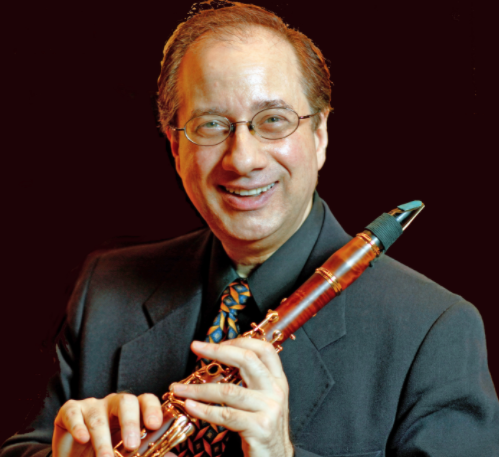
Charles Neidich, artistic director, C and A clarinets; Ayako Oshima, C clarinet;
Parker Quartet: Daniel Chong, Ken Hamao, violin; Jessica Bodner, viola; Kee-Hyun Kim, cello
Tenri Cultural Institute, New York, NY
March 30, 2019


The beginning of the baseball season seems an apt time for this metaphor: The Wa Concert Series hit another home run in its already estimable string of them last night. The Parker Quartet (Daniel Chong, Ken Hamao, violin; Jessica Bodner, viola; Kee-Hyun Kim, cello ) joined clarinetists Charles Neidich and Ayako Oshima in concert. The general theme of Central Europe was the pretext for a wide variety of expression through music.


The curtain-raiser, so to speak (Tenri does not have a curtain), was Bohuslav Martinů’s Serenade for two clarinets and string trio, a 1951 work from his American period that Mr. Neidich stated was also influenced by sojourns in Paris and New York. This was not always apparent. One thing that is always reliable is the high level of craftsmanship of Martinů’s work. For me, his expressivity lies in his slow movements, while the quicker ones can sometimes feel a bit like they are on autopilot, despite the interesting rhythmic difficulties. The piece was played masterfully by Mr. Neidich, Ms. Oshima, and three members of the Parker Quartet.


The complete Parker Quartet followed the Martinů with a beautiful performance of György Kurtág’s Officium breve, in memoriam Andreae Szervanszky, a double-requiem (without words of course) for his colleague, Hungarian composer/clarinetist Endre Szervanszky, and their Austrian serialist predecessor, Anton Webern. It also memorializes cellist Tibor Turcsányi, recorder player Zsolt Baranyai, close friend Gabriella Garzó, and pianist György Szoltsányi. The fifteen minuscule movements have maximal expressive power, and the Parker Quartet’s perfection of style and intonation allowed even the uninitiated listener to share in the sense of sorrow; Kurtág, still active at 93, was a mentor to the group. Kurtág is here fascinated with the procedure known as canon (so important to Webern as well), and he utilizes references to Webern’s final work, the Kantate No. 2, Op. 31, a setting of six poems by Hildegard Jone that are mystical in content, and which Webern himself saw as a Missa brevis (Officium breve). Kurtág also self-quotes from his piano cycle Játékok, “Hommage à Szervánszky,” and song cycle The sayings of Péter Bornemisza, “Flowers we are,” and he quotes Szervanszky’s Serenade for String Orchestra. The audience held its applause for quite some time after the ending, always a good sign that the intensity of attention being paid was great.


After intermission, Mr. Neidich took the stage, again with the Parker Quartet, for a shattering, expressive performance of a repertoire staple, the Brahms Quintet for clarinet and string quartet in B minor, Op. 115, a work written from the heart and addressed to the heart. Thank goodness Brahms didn’t retire from composition, as he had announced after his Op. 111; he drew new inspiration from hearing the great clarinetist Richard Mühlfeld (Brahms gave him the nickname Fräulein Klarinette), and he created a beloved series of chamber works including the instrument (as well as piano pieces and Lieder), in which he further cemented his “late style”—every note is related organically to every other note, every motif recurs and interpenetrates, and there is in the quintet cyclic reference also (music from an earlier movement recurs).


That five musicians functioned as one would be the greatest understatement of my writing career. Sometimes in this work one hears a “diva” clarinet way out in front and four “others” supporting. Not so on this occasion! Every breath, every color, every phrase taper, was absolutely unanimous, yet always managed to sound completely “lived,” never over-planned. I could go on and on about Mr. Neidich, one of the greatest clarinetists in the world, but the Parker Quartet here matched him for inspiration: they made the hearty, warm Romantic sound so essential to this composer. I was particularly drawn to the cello work of Kee-Hyun Kim, so expressive, and his interplay with the other members. Also wonderful was the violist, Jessica Bodner. I don’t mean to neglect the violins either, but everyone knows the inner voices are more interesting!


The sense of leave-taking was palpable in the Brahms, and I can’t imagine there was a dry eye in the house (another long pause before clapping); they were brought back for four bows, but of course there is no “encore” possible after such a journey. I was ruminating on a line from the Hildegarde Jone poem: “By holy love’s great power.” As Mr. Neidich explained, there are references to the “Clara” theme (Clara Schumann, perhaps Brahms’ greatest unconsummated love), and even J.S. Bach. Thank goodness there was no Prozac in the nineteenth century!


By the way, the excellent dinner, included with one’s ticket and handmade by the multitalented Ayako Oshima , included two of Brahms’ favorites: sardines and chicken paprikash. Anyone who hasn’t attended a Wa concert, what are you waiting for? Two remain in this season.


Share

Distinguished Concerts International (DCINY) presents Total Vocal with Deke Sharon in Review

Distinguished Concerts International (DCINY) presents Total Vocal with Deke Sharon in Review

Deke Sharon, Conductor, Arranger, and Creative Director
DCappella, Special Guests
Vintage Mix, Special Guests
Distinguished Concerts Singers International
Stern Auditorium at Carnegie Hall, New York, NY
March 24, 2019


Distinguished Concerts International New York (DCINY) held yet another large-scale concert on Sunday at Carnegie Hall with its production of Total Vocal with Deke Sharon, 5th Anniversary. For those unfamiliar with the name Deke Sharon, he is a leading force (arguably the leading force) behind the enormous resurgence of a cappella singing here in the US and around the world for the past few decades. As arranger and conductor, Deke Sharon was a producer of The Sing-Off, an a cappella singing competition that was on television from 2009-2014, and it spawned numerous similar enterprises. Perhaps the best-known a cappella film, Pitch Perfect (2012) was followed with sequels Pitch Perfect II in 2015 and Pitch Perfect III in 2017. There seems no sign of the craze letting up, and this 5th anniversary concert helped affirm that fact.

Featured on this concert were smashing a cappella arrangements nearly all made by Deke Sharon (and one original composition). Mr. Sharon has made over 2000 arrangements, and they are eminently appealing and singable. For full disclosure, much of the music popular with these largely teenaged performers is not generally my cup of tea – it generally leaves me craving a Bach Fugue or a Brahms Sextet; that said, very few people with a pulse could resist the sheer joy in music-making that these groups share. Guests joining the Distinguished Concert Singers International included the Disney ensemble DCappella, guests from The Sing-Off and Pitch Perfect films, and the singing quadruplet ensemble, Vintage Mix.

Once a few hundred mostly young singers had filed onto risers on the Stern Auditorium stage, their charismatic leader Deke Sharon launched the music with fun.Medley (no typo – that is the name) from the show The Sing-Off (credited to Jeff Bhasker, Andrew Dost, Jack Antonoff, and Nate Ruess). The three songs of the medley were Some Nights, Carry On, and We are Young. It was full of energy and fun, with eighteen soloists cranking up the excitement, but thanks to some overdone amplifying it was almost unbearably loud. Covering one’s ears tightly barely helped. One started worrying about how one would endure the next few hours, but the electrifying presence of Deke Sharon managed to sustain one’s hope.

Not to sound like a fangirl (happily married old gal here), but the tall, athletic Deke Sharon has one of the most magnetic stage personalities one has ever encountered. To say he exudes energy, rhythm, and joy is wholly inadequate – he is a phenomenon. He appears virtually airborne as he covers the entire stage in a few strides and conducts with a uniquely agile and exuberant dance, drawing ecstatic energy from his musicians. In his role as emcee he excels as well, and, as he greeted the audience after the first number, he took on the role of cruise director (complete with humorous references to old television shows Gilligan’s Island and The Love Boat). His travel-themed banter helped string together a program of some fairly disparate music.

Forget About the Boy (from the 2002 Thoroughly Modern Millie, music by Jeanine Tesori) took us back to flapper days with a jazz-age beat (and thankfully more listenable volume -perhaps because there were no guest artist microphone requirements?). The segue to a love song was a natural, and Beneath Your Beautiful (by Mike Posner from Pitch Slapped) fit the bill. With the chorus in the role of “string orchestra” the featured soloists Martel Jones, Aryanna Rent, John Yokoyama, and Chelsea Rifkin sang beautifully.

I’ll Make a Man Out of You (from Mulan – Matthew Wilder) featured guest artists Chamber Bravura (consisting of 35 vocalists) in a passionate and tightly knit performance. I Wanna Be Like You (by Robert Sherman and Richard Sherman) followed with special guest group DCappella (four men and three women) giving their all. Amps were all still overpoweringly loud, but one still enjoyed the spirit through cupped ears.

Bellas Opening (a medley by various artists from Pitch Perfect 2) included the catchy tune Timber and a quote from America the Beautiful. Soloists were Madeline Glave and Lilly Gaven, with Madeleine Lasker as the excellent vocal percussionist (often called beatbox). One of the fun aspects of a cappella singing, of course, is the range of vocal techniques used to substitute for traditional instruments – and these effects throughout the concert were amazing.

It’s A Man’s World (James Brown) featured the group Unstremental (around fifteen singers), reveling in melisma like the inimitable Brown himself. Travelin’ Band (John Fogerty) followed without any miked soloists, but with full choral forces in a spirited delivery of its rock and roll beat, it had the perfect sound. The audience joined in the infectious fun with clapping. A more pensive song, I Lived (Ryan Tedder), followed as a welcome breather in a lovely arrangement.

The afternoon’s only arrangement not by Deke Sharon was Connecticut (Hugh Martin and Ralph Blane, arr. Adam Bock) with special guests Vintage Mix, a group of quadruplets (yes, quadruplets!) who sang with a not-surprising familial blend and synchronization. The song itself, new to this listener, occupies a rather obscure niche, but it was a good vehicle for these sensational siblings (three sisters and a brother) who took the audience back to the days of close harmony singing (reminiscent of the barbershop quartets of the 1890’s, revived in the 1940’s). Deke Sharon (ever the teacher and leader) used the performance as a springboard to get the audience to try some part singing (with surprisingly decent results), before the first portion of the program concluded with the chorus singing the Earth, Wind & Fire hit, September (Maurice White) with Reed Rosenberg, vocal percussionist. At the risk of sounding curmudgeonly, I don’t share Mr. Sharon’s enthusiasm for this song, but it certainly did make for a high-voltage close.

To continue for just another moment in curmudgeonly mode, Carnegie Hall is a beautifully resonant hall that does not require the heavy amplification that was used, and in fact one of the beauties of a cappella singing is its focus on the music one can make with just the human body, though admittedly a soloist may need some amplification to be heard over a large chorus (and certainly the vocal percussionists do); that said, the decibel levels here were so painful that an older woman in my row actually (demonstratively) removed her hearing aids, while others repeatedly jolted and cringed. I was prodded to relay to some assistants milling about the stage at intermission that some in the audience were actually in pain. For the second half the issue was much improved – though whether that was because of modified settings or one’s newly encroaching deafness remains uncertain.

Grievances receded, in any case, as one watched the force of nature that is Deke Sharon bounding back to the stage, seemingly made out of music. He led the chorus in the relatively unknown Elton John song Club at the End of the Street (Bernie Taupin) and followed with the ever-popular Blue Skies (Irving Berlin) with Bekal Peterson and Madeline Ross, jazz soloists, scatting to beat the band. A mellower feel was setting in, and Blue Skies made a nice segue to the popular Soak Up the Sun (Sheryl Crow and Jeff Trott) with eighteen soloists and Filip Rusin as vocal percussionist, all excellent.

One of the big standouts of the evening was the ensemble Revv52 (around fifty singers from Canada), featured next in Moondance (Van Morrison). With beautiful intonation, smooth blending, and seductive rhythm, they revived this sometimes forgotten hit from the seventies.

Just when one thought the concert had reached a peak, we heard Quiet Moon, composed and sung by Deke Sharon himself – he has (not surprisingly) a beautiful voice! He was joined by Antonio Fernandez from DCappella, and both did impressive vocal percussion as well. Many in the audience gasped in admiration as Mr. Sharon alternated his gently crooning vocals with some of the best “mouth trumpet” one has ever heard. For those unfamiliar with this skill, it is the simulation, using one’s own mouth, of the sounds of trumpets – and Mr. Sharon did two kinds, in rapid alternation with vocal phrases. Nothing could quite top the latter, but Defying Gravity (Stephen Schwartz) from Wicked was excellent – lovelier than I had remembered it, undoubtedly due in part to the arrangement.

The superb Croatian ensemble, A.K.A. Crescendo, was welcomed next (a dozen or so musicians) to sing a medley of Jailhouse Rock/Levisice (Mike Stoller, Daniel Popovic, and Alka Vuica). They ought perhaps to be renamed “A.K.A. Accelerando” for the beautifully synchronized way they handed some ramping up of the tempo, but let it suffice to say that they were great, another polished and tightly knit group. The full chorus followed with As (by Stevie Wonder, 1976) as arranged for the Sing-Off winners, Committed.

Approaching the end of the program, the group DCappella returned to give a fittingly sentimental rendition of Remember Me from the 2017 movie Coco (music by Robert Lopez and Kristen Anderson-Lopez). It was even more heartrending than the original in this Deke Sharon arrangement. Finally, riding the wave of the 2018 movie Bohemian Rhapsody, the combined forces of DCappella, Vintage Mix, and Distinguished Concert Singers International gave a passionate rendition of Don’t Stop Me Now (Freddie Mercury). Singers streamed down the aisles stirring up audience members to join in the singing and clapping. An encore of The Lion Sleeps Tonight, complete with rhythmic “Wimbawet” sections, capped the concert off well.

Several audience members who appeared cranky, uncomfortable, and impatient at the concert’s start could be seen bobbing, swaying, and tapping hands and feet by the end. Many looked high on music. If the spirit of this concert resembled an evangelical event, in a way it was. Deke Sharon believes in the power of music to transform the world, and he shows how it is done, drawing people together through the love of it (even sharing his email for anyone in the audience who may not be able to find a chorus to join). When he says that music can transform people, it may sound like a platitude, but I wouldn’t doubt his sincerity for an instant. This concert itself gave ample evidence.

Share

Vocal Artists Management Presents Jinho Hwang in Review

Vocal Artists Management Presents Jinho Hwang in Review

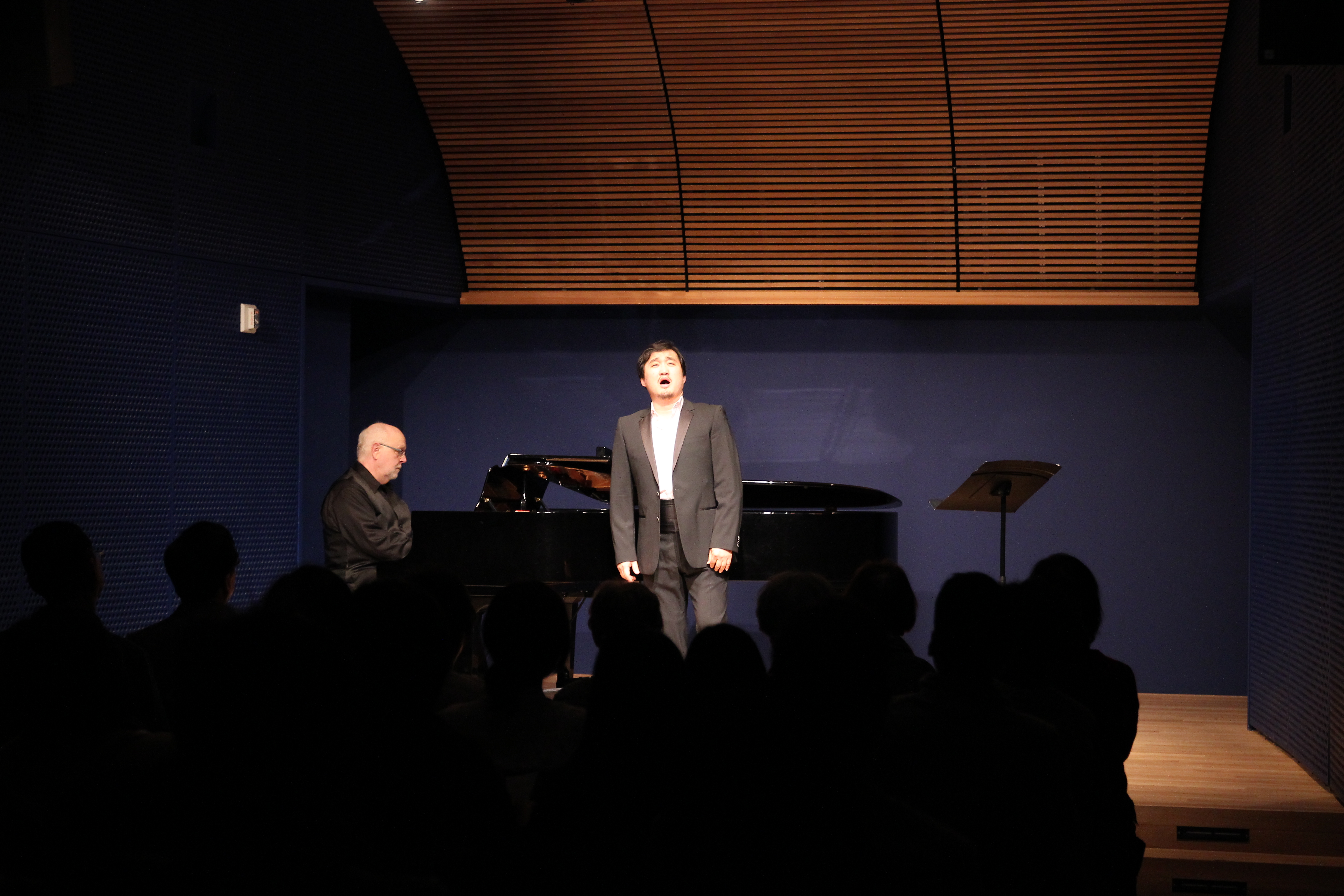
Jinho Hwang, tenor; Steven Crawford, pianist
Marc A. Scorca Hall, The National Opera Center, New York, NY
March 22, 2019


Sogno di Primavera, or Dream of Spring, was the title of tenor Jinho Hwang’s recent recital at the National Opera Center, and it was an evening that reflected Romantic dreams as well as optimistic beginnings. Though Mr. Hwang is not at the beginning of his career, with various prizes and noteworthy operatic appearances behind him, he seems to be enjoying a comeback of sorts after some unspecified medical challenge he alluded to from the stage at the end of the concert – and he appears to have fully recovered. The audience, many of whom undoubtedly have been with him through it all, were fervently supporting him.

Mr. Hwang’s program was full of impassioned and sensuous music about love and nature, predominantly Italian art songs (Bellini and Tosti) with a few Italian opera arias (Donizetti, Verdi, and Cilea), a French aria (Massenet), and two Korean songs (by Panghil Park and Geung Soo Lim). The texts were wide-ranging, suggesting longing, nostalgia, euphoria, and despondency, and brimming with Romantic imagery of roses, rivers, kisses and tears. The works lived up to the title, Dream of Spring – with Tosti’s Aprile feeling especially fitting as we speed toward the end of March.

As for Mr. Hwang himself, he seems to possess all of the vocal ingredients that one should need for a fine career; the main question, though, is how he will use those ingredients, in what balance, to what degree when, and in what repertoire. He has an extremely powerful voice, for example, and yet it did not always work to his advantage in a hall with such extremely live acoustics as the Marc A. Scorca Hall at the National Opera Center. One is faced generally with several choices in such cases: switch halls, switch repertoire, or scale down one’s dynamics. One would hesitate to suggest switching halls, as this one is a fine, intimate space and boasts a nice seven-foot Yamaha piano. The repertoire switch is probably not the answer either, as, even in the more delicate pieces such as Tosti’s A vucchella, the sound still came across as overly bright. The remaining option is to make big vocal adjustments, something any artist needs to learn to do throughout a career – and yet all remained overpowering. One was left guessing whether the hall acoustics were misleading from the performer’s standpoint or the dominance of such a consistently big sound was actually an artistic preference. There also seemed to be a preponderance of high drama from which some quieter miniatures would have offered relief, the sort of gentle miniature that is perhaps not typical on an audition demo recording but exists as art. Programming is an art in itself, and ideally it balances dramatic tension and urgency with release.

Music of the bel canto master Vincenzo Bellini opened the concert. Rather than opt for Bellini’s operatic arias, Mr. Hwang chose five songs from the more intimate Ariette da Camera (omitting only the fourth, Almen se non poss’io). The first two selections, Ma rendi pur contento and Malinconia ninfa gentile had glimmers of the beautiful timbres of which this singer is capable, but it seemed that Mr. Hwang was already working for large-scale operatic projection, as if directing his sound to the back row at La Scala. This approach did not reel in the listener as one hopes from an opener, but rather tended to draw the listener’s ears toward whatever imperfections of intonation there may have been as the singer was still finding his stride. Mr. Hwang does not appear to make things easy on himself.

In Vanne, o rosa fortunata, the superb collaborative pianist Steven Crawford provided a gently playful introduction, and it set the tone for a more relaxed, less stentorian approach. Mr Hwang here reflected more of the character of the text and also sang with delight in the diction (one dazzlingly rolled “R” comes to mind).

The following Bellini selections, Bella Nice, che d’amore and Per pietà, bell’idol mio again showed tremendous power. The latter enjoyed some glorious high notes, and Mr. Hwang was especially compelling in the unaccompanied sections, as if his gifts had been waiting for the cue to soar with increased freedom. More of that freedom elsewhere, paired with a search for more dynamic low points, will help deepen these pieces even further.

Two twentieth-century Korean pieces followed the Bellini group, Twilight over the mountain by Pan Ghil Park and As if spring comes across the river by Geung Soo Lim. Both were evocative in the manner of film scores, and both showed the singer at his most expressive so far. He then turned to opera arias to close the program’s first half, maximizing the drama in Donizetti’s Una furtive lagrima (from L’elisir d’amore) and lending a swagger to Verdi’s La mia Letizia infondere (from I Lombardi). He was quite visibly expressive in both of these, and – it should be mentioned as well – had a regal bearing throughout, which should serve him well in his operatic roles.

A beautiful array of six art songs by Francesco Tosti opened the second half. La serenata brought a gently rolling feeling to the program, and Mr. Hwang sang it with a natural ease, as it demands. It was followed by L’ultima canzone, A vucchella, Ideale, Aprile, and finally L’alba separa dalla luce l’ombra, all with moments that reminded one in purely vocal qualities of some of the great tenors of the past. What will ripen these pieces further will be more of a focus on the musical uniqueness of each one, irrespective of any issues of technique, passaggio or vocal fixations of any kind. It is always interesting to note how even many of the so-called technical challenges fall more easily into place as one gets away from audition-style demonstrations of skill and goes more deeply into the music. Of course, the opera world is filled with buzz about this or that singer’s “high C” and other strenuous achievements, but many listeners simply want music, with all its nuance, color, and variety.

The last two works were dramatic tours de force which elicited Mr. Hwang’s all, Massenet’s Pourquoi me réveiller (from Werther), with some magnificent vocal peaks, and Cilea’s E la solita storia del pastore (from L’Arlesiana). They closed the program with brilliance from both performers, drawing hearty ovations from the audience. There is no question that this singer has remarkable gifts, and – as one noticed a video camera filming it all from the back – one imagines some of the concert will result in some excellent demos and roles to come. There is much promise for Jinho Hwang – now may he enjoy the ride!

After some humble thanks to his friends, family, and God, Mr. Hwang announced that he would sing one more song, Grace of God. He sang it in Korean, with considerable emotion, and it was quite moving.


Share