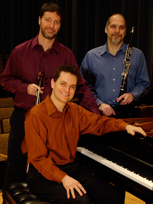
The Chihara Trio

The Chihara Trio
Weill Recital Hall at Carnegie Hall, New York, NY
March 25, 2010

The Chihara Trio, formed in 2009 and comprised of Penn State School of Music faculty members Anthony J. Costa on clarinet, violist Timothy Deighton and pianist Enrico Elisi, performed a diverse array of works that were sometimes interrelated in subtle, yet special ways. The clarinet/viola/piano trio repertoire isn’t often heard, so the forming of this ensemble was a great idea. The trio’s inaugural season has included performances throughout Pennsylvania and Maryland, and they made their New York debut with this concert.

The highlight of this program—as I expected—was Mozart’s inspired Trio in E-flat from 1786. Not only is it one of Mozart’s most beautiful works, it was given a splendid performance by the Chihara Trio. Deighton’s technical aplomb and precision during the notoriously tricky Menuetto movement were very impressive.

The group takes its name from Paul Chihara, whose new work Images was also featured on the program. This work is light-hearted and fun—pure and simple. The joy comes from anxiously awaiting musical quotes, which runs the gamut from Brahms to Schoenberg to Ellington. The work should be performed often. The trio made it clear why they dedicated their name to this composer, as they played every note with affection and devotion.

Schumann’s Fairy Tales, Op. 132, composed just three years prior to the composer’s untimely death in an insane asylum, is an uneven work, and the trio’s phrasing and dynamics needed more forward movement and exaggeration to pull off some of the awkward transitions. The last movement, for example, felt a bit sluggish.

The ensemble also performed Ad infinitum, composed by Kye Ryung Park. The notes C, D and E, which are used often and in a myriad of ways, are derived from the first letters of the trio members’ last names. So this was evidently an evening sponsored by the mutual admiration society; Park’s aforementioned subtle dedication to members of the trio, the trio dedicating their name to Chihara, and Chihara himself paying homage to a long list of influential composers.

Share

Carlos Perez, guitar

Carlos Perez, guitar
Weill Recital Hall at Carnegie Hall, New York, NY
March 18, 2010

Guitarist Carlos Perez, a native of Chile, presented a potpourri of composers from Bach to Rodrigo on his recital. He performed entirely from memory. Rodrigo’s Elogio de la Guitarra is wonderfully inventive, and Perez played it with much flavor and zest¸ and with spontaneity of tempo and spirit. Another highlight of the program was the inventive, captivating and technically demanding Tarentella by David Pavlovits. Pavlovitz is a young Hungarian composer and guitarist (one can tell he plays guitar because his work is so idiomatic for the instrument) whose work is inspired by the folklore of South-Eastern Europe. Perez played the piece with both depth of character and technical accomplishment.

In Carulli’s Deux Andantes (No. 1 and 3), Op. 320, Perez showed a wide variety of color, and the pieces were exquisitely rendered. Bach’s Cello Suite No. 4 in E-flat is not really suited to guitar, as one misses the sustained sound of the cello and its dynamic range. Antonio Lauro’s Three Pieces could have used more contrast as well, although the Romanza was perfect in its detail. Four Chilean Folk Songs could not have been played with a more natural affinity for the style. Earlier in the program, I occasionally wished for more definition in the phrasing, but here, Perez brought a lovely shape to all of them, especially to Parabienes—Ya se casaron los novios, where a captivating, gradual decrescendo had me searching for the fading sonorities at the edge of my seat.

Perez has issued ten CDs, two DVDs, and recorded at several European radios, and he has given recitals in over thirty countries in North, Central, and South America as well as Europe. He has played at the Berlin Philarmonie, the Auditorio Nacional in Spain, and England’s Royal Festival Hall among others. We look forward to his next recital here in New York. No doubt, he has much to offer the guitar community.

Share

University of Louisville Grawemeyer Players

University of Louisville Grawemeyer Players
Weill Recital Hall at Carnegie Hall, New York, NY
March 9, 2010

After a fascinating and thorough pre-concert lecture by composer Augusta Read Thomas,
in which she discussed the relevance and mission of classical contemporary concert music and how the University of Louisville School of Music’s Grawemeyer Award— celebrating an important 25th Anniversary—has helped and could help foster this mission, several faculty members from the school assembled to perform music by current and past Grawemeyer Award winners.

Lutoslawski won in 1985 and wrote Grave (Metamorphoses) for cello and piano in 1981. The performers here, cellist Paul York and pianist Krista Wallace-Boaz, performed this first-rate work admirably, with pacing and a good eye for the overall structure. The Little Predicament “A kis csava” (1978) by Gyorgy Kurtag, who won in 2006, is comprised of four short pieces which are outrageously humorous— all the more comical due to its clever scoring of piccolo¸ trombone and guitar. The performers, Kathleen Karr on piccolo, guitarist Stephen Mattingly, and trombonist Brett Shuster played with unity of ensemble—although Shuster, who has a great sound, had some trouble producing the work’s difficult high notes.

Sebastian Currier, 2007 Grawemeyer winner, composed Verge in1997, and there is no shortage of humor and ingenuity in this clever array of nine (almost ten) movements, which have titles like Almost Too Fast, Almost Too Slow, Almost Too Little (only about 10 seconds long), Almost Too Much, etc. The latter is the climactic piece, with a consistently exciting, pulsating drive. The last, Almost Too Calm, is a fitting close despite its slow tempo, because it reaches a sublime, stratospheric peak that is exquisitely beautiful. Pianist Wallace-Boaz, violinist J. Patrick Rafferty, and clarinetist Dallas Tidwell played the work very well, although Rafferty—while very talented—played with a tentative sound this evening.

Peter Lieberson, who won in 2008, had 3 Songs from his Rilke Songs performed by outstanding soprano Edith Davis Tidwell and her fine pianist Naomi Oliphant. There is some Mahlerian influence in the melodic writing and it sometimes uniquely combines with a piano left-hand that is almost jazz-like. Three Caprichos after Goya, written by 2009 winner Brett Dean, are three delightful and well-crafted pieces for solo guitar. It was performed by Stephen Mattingly, who played this work without much imagination or depth of dynamics (his instrument didn’t resonate enough.)

Klangzeichen (2003), the wind quintet with piano composed by this year’s winner, York Holler (born 1944), was given an absolutely polished, dynamic and riveting performance by Karr on flute, oboist Jennifer Potochnic, Tidwell on clarinet, Bruce Heim on horn, and bassoonist Matthew Karr. The work is skillfully written for sustained or chiming piano against fast, double-tonguing wind-playing; the parts often switch roles, with much interchange. The tension and even clashing among the various parts symbolize the Israeli-Palestinian conflict, and an old Hebrew melody, which was previously complicated and fragmented, becomes touchingly simple and innocent towards the end, with a tribute to the children of the two lands. Unfortunately, the composers were unavailable to hear their music on this occasion; it was an important evening for live contemporary concert music.

Share

Benefit Concert for Haiti

Benefit Concert for Haiti
Xu Hui, piano;
Frank Lévy, piano;
Andy McCullough, tenor
Weill Recital Hall at Carnegie Hall, New York, NY
February 22, 2010

In the wake of Haiti’s disastrous earthquake, it is heartening to see numerous concerts by musicians joining forces to raise funds, and a recital by Xu Hui and Frank Lévy was among them. Though the audience was small, the spirit of giving was palpable.

Opening with the four-hand work, En Bateau from Debussy’s Petite Suite, the duo gave a gently lilting—if off-the-cuff—reading. Xu Hui continued in a meditative vein with Liszt’s Transcendental Etude No. 9, Ricordanza. It was refreshing to hear this work alone, as a special homage or remembrance, rather than as part of a barrage of blockbuster etudes. Xu Hui gave the work the sensitivity and patient lyricism it needs.

The programming of Gaspard de la Nuit by Ravel raised expectations that the evening would officially “set sail,” but tonal beauty and polish took precedence over drama here. Ondine’s vexation was subdued, and even the nightmarish visage of Scarbo took on a silky veneer. Xu Hui has tremendous potential if she widens her range a bit. To close the first half, Andy McCullough sang An American Hymn, an appropriately nostalgic song by Lee Holdridge (b. 1944, Port-Au-Prince), with Xu Hui at the piano. Though a lovely gesture, it effectively underscored the absence of other composers born in—or with connections to—Haiti; there are several other composers that could have been included to enhance the evening’s theme.

Frank Lévy’s portion of the program opened with Scarlatti’s Sonata, L. 457 in C Major, thoughtfully wrought, even if pedaling became tricky with such a resonant piano. Schubert’s Four Impromptus, Op. 90 enjoyed the command of a mature master with a marvelous ability to bend a phrase at just the right time. Liszt’s Vallée d’Obermann, commendably performed, elicited an encore of Chopin’s Nocturne in D-flat, Op. 27, No. 1, which was played with breathtaking delicacy. The evening was capped off with a four-hand encore: Dvorak’s Slavonic Dance in E minor from his Opus 72.

Share

SoNoRo Festival Bucharest

Ensemble Raro:Diana Ketler, piano;
Alexander Sitkovetsky, violin;
Razvan Popovici, viola;
Bernhard Naoki Heidenborg, cello;
Roxana Constantinescu, guest mezzo-soprano
Zankel Hall at Carnegie Hall
New York, NY
February 16, 2010

Formed in 2004, Ensemble Raro (named after Master Raro, the wise old arbiter of Schumann’s imaginary Davidsbündler) must be one of the best, most versatile young groups before the public. Resident Ensemble of the SoNoRo Festival, founded in 2006 by violist Popovici, the group appears in concert halls world-wide; this was its New York debut. SoNoRo has released two recordings, and fosters living composers through performances, and young musicians through scholarships.

The players of Ensemble Raro, who also pursue individual, solo, chamber music and teaching careers, are splendid technically, musically and communicatively, making this a true collaboration of equals. Although they were born and trained in different countries, their rapport is so close that they seem to share and anticipate one another’s whims and wishes; the strings’ tone, which is warm and expressive, blends together without losing its variety or individual timbre, and their intonation is impeccable, as they take over lines imperceptibly on the same note. Totally immersed in the music, they never call attention to themselves by sound or gesture. The only flaw, endemic to this combination, is the balance, which favors the (wide-open) piano, despite pianist Ketler’s obvious sensitivity.

Their program featured two novelties by Enescu and Peteris Vasks. Enescu’s Sept chansons de Clément Marot combines Romanian folk melodies with medieval modes and elegant French sophistication. Mezzo-soprano Constantinescu and pianist Ketler brought out the songs’ different character and moods beautifully. Born in 1946, Peteris Vasks gained recognition in the 1990s and has received several European honors and prizes. His Piano Quartet (2000-2001) is extremely difficult and almost unremittingly intense. The strings often alternate with the piano in textures featuring solos, duets, chordal unisons, long glissandi, double stops, and drones. Some of its six movements flow together, some are obsessively repetitive, and all have powerful climaxes (Vasks calls one “a black hole”). The Raro Ensemble introduced it in Germany and England; in this New York premiere, their performance was committed and authoritative.

The players’ youthful romanticism showed to fine advantage in a wonderfully spontaneous, exuberant, expressive but unsentimental performance of Schumann’s Piano Quartet. But the playing of the slow movement of Brahms’ C Minor Piano Quartet as an encore was even more impressive for its deeply felt inwardness.

Share

Distinguished Concerts International New York – Love, Lust, and Light: A Valentine’s Day Concert

Distinguished Concerts International New York – Love, Lust, and Light: A Valentine’s Day Concert
Love, Lust, and Light: A Valentine’s Day Concert
Carnegie Hall: Stern Auditorium, New York, NY
February 14, 2010

After hearing this concert, I am happy to report that high quality choral singing in the United States is flourishing. In my review of DCINY’s January 18th concert at Avery Fisher Hall, I lauded them for bringing fine amateur choruses to New York. The sentiments expressed in that review are equally applicable to this afternoon’s concert.

This Valentine’s Day concert began with Morten Lauridsen’s gentle “Lux Aeterna” (“Eternal Light”) – definitely a non-Valentine’s Day piece, but connected to “Love and Lust” by alliteration. Nancy Menk, a prominent Indiana choral conductor, led five choirs and the Distinguished Concerts Orchestra International, a group of fine New York free-lance musicians who perform at DCINY choral concerts. The singers were drawn from three high school choirs, leavened by more mature voices from two of Ms. Menk’s own performing organizations. What a glorious sound! But there were some problems with diction – vowels were fine, but most consonants were indistinct. And many choral entrances were tentative. As to Ms. Menk’s conducting technique: it was hard to discern a clear pattern to the beat, and there was little connection between what was going on in the music and the beat’s size and intensity. Most gestures were just too large. Good amateur choral singers don’t need the music to be constantly “drawn out from them.”

After intermission, the “Love and Lust” theme was expressed in a work beloved of many choruses and audiences, Carl Orff’s “Carmina Burana.” We heard six choirs, a much larger orchestra and three soloists, all under the masterful direction of Vance George (DCINY Conductor Laureate). We also saw a quite different conducting technique – clear, economic, elegant. While setting fine tempi and skillfully shaping the overall performance, he just let the performers make the music they had so carefully rehearsed. No need to “draw it out from them.”

Dillon McCartney sang the stratospheric tenor part of the “Roasted Swan” with ease. Soprano Penelope Shumate, in a sexy red gown which conjured up the word “lust”, possessed a beautiful, flexible, dramatic voice. My favorite soloist was baritone Stephen Swanson, whose expressive sound was especially thrilling in the upper registers.

Share

Denitsa Laffchieva, clarinet; Ofer Canetti, cello; Maria Prinz, piano

Denitsa Laffchieva, clarinet;
Ofer Canetti, cello;
Maria Prinz, piano
Weill Recital Hall at Carnegie Hall, New York, NY
February 11, 2010

Three musicians from different corners of the world, Maria Prinz from Bulgaria; Denitsa Laffchieva from Bulgaria—but residing in London; and Ofer Canetti from Israel, converged recently to perform a program of Debussy, Strauss and Zemlinsky. The concert was presented by MidAmerica Productions. Each musician impressed in different ways, not always complementary to one another, but ultimately providing a stimulating evening to their large audience.

Opening with Debussy’s Première Rhapsodie for clarinet and piano, Prinz provided a gently colored backdrop for Laffchieva’s silky, elegant clarinet sound. Both players managed the challenges of the work with grace and ease overall, though this listener somewhat missed the sensuous abandon heard in favorite performances. Perhaps simply living with the work a bit more would help. It’s also possible that placing the piano lid on the half-stick (it was on full) might have rendered pianistic details less constraining to the clarinetist.

Ofer Canetti joined forces with the versatile Ms. Prinz in Strauss’s Sonata, Op. 6. This was a full-bodied and impassioned performance. Canetti is a powerfully communicative young musician of strong temperament and technique. Some slipping of the endpin at the beginning seemed ready to derail things, but he drove it into the floor with force (from a height and with a loud thud) and continued. One was at first surprised by this harpooning exhibition, but with a player as naturally expressive and unselfconscious as Mr. Canetti, such matters may unfortunately escape consideration. Unfazed, he dove deeply into the work, projecting each nuance with sensitivity, while keeping a firm grip on the larger structure. Prinz ably held her own with her demanding part (made more so by some unruly page-turns). A piano on half-stick and more regular collaboration will bring them to an even higher level.

The second half consisted of the Zemlinsky Trio, Op. 3, a challenging, Brahmsian work that requires a special advocacy to pull it off. It seemed under-rehearsed here; despite some beautiful solos passed between clarinet and cello, there was some groping in the dark for the music’s shape and direction. The third movement of the Brahms Op. 114 Trio was played as an encore, and the performance made one wish that that trio had been played instead of the Zemlinsky.

Share

Musica de Camara String Ensemble

Musica de Camara String Ensemble
Christian Colberg, conductor
The Cathedral of St. Patrick’s
February 11, 2010

The soloists who participated in this concert “Celebrating 30 Years of Excellence in Classical Music” were fine ambassadors of Musica de Camara’s mission to present “Puerto Rican and Hispanic classical musicians in concert.” And the Musica de Camara String Ensemble, made up of Hispanic and non-Hispanic players, presented a beautiful picture of the diversity of this great city of ours.

After a special introductory proclamation from the City Council of New York, presented by its Speaker of the House, Christine Quinn, we heard a reduced group of the ensemble perform J.S. Bach’s Double Violin Concerto in D minor, BWV 1043. My worries about how this piece would fare in the over-reverberant acoustics of the cathedral were unfounded. The polyphonic textures were clear, and the expert soloists, Jose Miguel Cueto and Evelyn Estava, were well balanced. They handled the work’s technical demands with ease and performed the slow movement with lilting grace. I did miss the use of a harpsichord continuo to fill in the chords during the solo passages accompanied by just cello and bass. And we needed more celli and basses during the tutti sections.

The rest of the players then joined their colleagues for a luscious performance of Ralph Vaughan Williams’ “Fantasy on a Theme of Thomas Tallis”. Here, the ensemble’s beautiful, rich sound was further enhanced by the cathedral’s live acoustics. This is a perfect piece for this space, but a very important spatial aspect of the work was disregarded. It is scored for a string quartet and two different sized string orchestras. If, as in tonight’s performance, these orchestras aren’t physically separated from each other, the composer’s antiphonal effects are weakened or lost. Although we heard a fine performance, skillfully paced and shaped by conductor Christian Colberg, it was one which didn’t express a crucial part of the composer’s intent.

A performance of Dvorak’s Serenade for Strings in E major, Opus 22 exhibited the same fine intonation and tight ensemble we heard all evening. But here the echoey acoustics got in the way and created muddy textures. The concert ended with a spirited performance of Jose Ignacio Quinton’s Puerto Rican dance, “El Coqui.”

Share

The Park Avenue Chamber Symphony

The Park Avenue Chamber Symphony
David Bernard, conductor


Sirena Huang, violin


All Saints Church, New York, NY


February 7, 2010


The Park Avenue Chamber Symphony


Sirena Huang was the featured soloist, and despite her fifteen years of age, she played Saint-Saens’ Third Violin Concerto like a seasoned pro. Not only did Sirena confidently “nail” the difficult notes in the stratosphere of her instrument and play with a beautifully resonant sound, she winningly captured the essence of this brilliant French score. The Park Avenue Chamber Symphony’s talented Music Director, David Bernard, held things together very well, but he needs more rehearsal time to work on the pitch of the winds, as chords in the second movement were significantly out of tune. This was also true of the chords in the first movement of Beethoven’s Fifth Symphony—before the recapitulation. Still, there were many things to admire in this performance of the Fifth. For one, there was excellent precision of ensemble in the notoriously tricky first movement, with all its off-beat entrances. One also felt and heard the players’ emotional commitment throughout the symphony. I also really liked Bernard’s emphasis of the first movement’s famous four-note motive when it appears in the horns two or four times slower than normal (as augmentation). 

I did find it very unusual that on the third fermata of the first movement opening, in which the first violins sustain a high G, some violinists—on two different occasions—also held the B-natural, which, traditionally, is only a part of the chord’s roll. Tempo-wise, the last movement Allegro was faster than usual—it was refreshing to hear, although the strings sometimes struggled with the pace. The third movement Scherzo, on the other hand, sounded slower than usual; Beethoven’s Allegro indication (not to mention his metronome marking), was ignored in this performance—but many agree that Beethoven hastily added some of his metronome markings in order to accommodate his publisher. Wagner’s Prelude to Act III of “Lohengrin”, which was placed on the second half before the Beethoven, was played with unabashed exuberance—as it should be. Food for thought: as it is so extremely short, I wonder how it would have fit on the first half, immediately prior to the Overture to “Die Fledermaus”, which opened the program. The Strauss—like the Wagner—was performed with an immensely appealing flair. 

Share

Distinguished Concerts International New York – “Music on Canvas, 57×7”

Distinguished Concerts International New York
“Music on Canvas, 57×7”
Weill Recital Hall at Carnegie Hall, New York, NY
January 23, 2010

An enjoyable presentation of music and art—and even fashion—entitled: “Music on Canvas, 57×7” took place on January 23rd at… (Actually, the numbers in the title cleverly indicate the concert’s location, so take a guess.) (Yet…you’ve probably already seen the location listed in the above heading, so never mind.) Anyway, while we listened to music sung by the delightful Amy Buckley and Kirsten Allegri, we were afforded the luxury of seeing portraits by talented artist Stef-Albert Bothma. Bothma has a unique style to his paintings—several of them portraits of composers on the program—and they are brilliant in their use of color and chiaroscuro (light-dark contrasts). I recommend that you take a look at his website to peruse his work: www.stefalbertstudios.com. Slides of his paintings lingered tastefully on screen and appropriately back-dropped the music—never flashing at a quick pace to distract us from the performances. After the concert, the audience was treated to a viewing of his originals.

Allegri and Buckley frequently perform individually but also as the duo “Canzone”, and one could instantly recognize the chemistry between them. Mozart’s “Via Resti..” from “Figaro” had more than the requisite comedy and charm, and technically they have the goods as well: “Pur ti miro” from “Poppea” was sung with excellent intonation, a matching vibrato, and a unified eye for peaks of phrase. Kirsten Allegri went solo with both sincerity and elegance in Korngold’s lush and inspired “Lieder des Abschieds”. Her rendering of Bernstein’s “I Am Easily Assimilated” from “Candide” was carefree and sexy, with exceptionally funny accents. Buckley’s solo turn in Rachmaninoff songs displayed her stunningly accurate and beautiful high range.

Bothma’s improvisations on “Carmen” and on Gershwin melodies show promise, but editing might be welcome: they ramble on a bit, and some harmonies and key shifts were awkward. He tends to over-pedal at the piano–obscuring some melodic lines–but his solo octave-playing was impressively virtuoso-like. Bothma’s beautiful artwork wasn’t the only stunning visual aspect to this unique program; the ladies were splendidly and varyingly gowned in several different Alecia Zameska designs that seemed tailor-made for the music at hand. (I never comment on wardrobe, so trust me that this made an impression.) One example was Buckley’s eye-catching dress accompanied by a diamond necklace in a sparkling performance of “Glitter and Be Gay” from “Candide”. Her great comic timing didn’t hurt either.

Share