Ian Hobson: Robert Schumann Cycle: “Carnaval Jests” in Review

Ian Hobson: Robert Schumann Cycle: “Carnaval Jests” in Review

Ian Hobson, piano

The Chapel at Saint Bartholomew’s Church, New York, NY

April 22, 2022

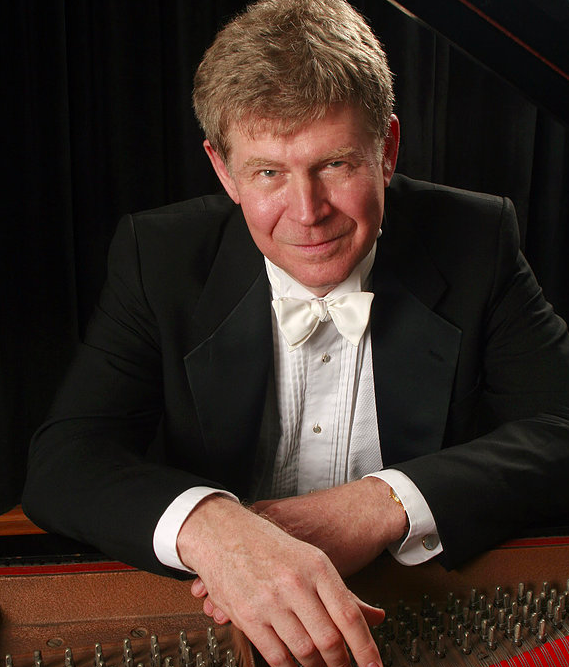
It has been more than two long years since virtuoso pianist Ian Hobson has graced New York. His Schumann series was cruelly interrupted—even the venue where he began presenting it (SubCulture) became a casualty of the pandemic. The original idea was to present the complete solo piano music and the piano-based chamber music in fifteen concerts over three seasons, and I sincerely hope he continues.

Undaunted by all this, Mr. Hobson changed the location to the inspiring Chapel at Saint Bartholomew’s Church on Park Avenue. Among Schumann’s many obsessions was the Kölner Dom (Cologne Cathedral) on the Rhine, so I imagine he might have approved of the liturgical setting, which provided an extra layer of irony to the “Carnival Jests” theme of Mr. Hobson’s program.

The carnival/papillons subjects were largely inspired by Schumann’s feverish discovery and reading of the works of Johann Paul Friedrich Richter, known as Jean-Paul. Contemporary Thomas Carlyle said that his writing groaned “with indescribable metaphors… flowing onward, not like a river, but an inundation, circling in complex eddies, chafing and gurgling now this way, now that, the proper current sinks out of view amid the boundless uproar.” This is similar to what many listeners thought upon hearing Schumann’s piano music.

Let us recall that even Schumann’s wife, Clara, one of the great piano virtuosi of the nineteenth century and one of her husband’s staunchest advocates, was constantly begging him to produce something more comprehensible and easier on the listener. The larger cycles of his music were almost never presented in their entirety, but as a group of a few extracts. Our modern concert culture frowns on such abbreviations.

Mr. Hobson, one of the great virtuosi of our century, gave us not one, but four of these “butterfly” or “masked ball” sequences on Tuesday night. The atmosphere of the masked balls, commonly held during Carnaval, the multi-month period of indulgence prior to Lent, invites disguise, intrigue, and romance. Jean-Paul (and by inference Schumann) saw people as potential butterflies who first had to emerge from their larval state, an apt analogy for a composer just starting out. Schumann’s works abound in ciphers, coded musical references to places (ASCH), himself (SCHA), and Clara (a descending scale motto found in many works). Asch was the birthplace of Schumann’s pre-Clara fiancée, Ernestine von Fricken. Even the word Faschingsschwank contains both the ASCH and the SCHA.

Mr. Hobson began with the rarely played Intermezzi, Op. 4, a set designed to be played without interruption, which Schumann referred to as “longer papillons,” and pièces phantastiques. He played with great impetuosity and brought an appropriately feverish anxiety to these works that “begin in the middle,” so to speak. Their discourse is often fragmentary, jumping from one thought to another. The second Intermezzo has words printed above its central section’s theme: Meine Ruh ist hin (My peace is gone), the famous song sung by the betrayed Gretchen in Goethe’s Faust. Mr. Hobson brought a lovely yearning to this section. The final Intermezzo contains an exact quote of the “ABEGG” theme (Schumann’s Op. 1), the name of a countess Schumann may have fancied.

Hobson then preceded to the Faschingsschwank aus Wien (Carnival Jest from Vienna), Op. 26, which Schumann regarded as a five-movement sonata, though only its Finale is in sonata form. The first movement is the one filled with jest: fleeting musical portraits of Schubert, Beethoven, and perhaps Strauss the elder; but its greatest laugh is the appearance of the Marseillaise, which was forbidden to be played in Vienna, so devastated were the Austrians by Napoleon’s ravages of thirty years prior. The three succeeding movements are a tender Romanze, a light-hearted Scherzino, and the turbulent Intermezzo in the exotic key of E-flat minor. At times, Mr. Hobson’s orchestral treatment of the piano would allow smaller note values to swamp the melodic lines, but his sense of the big picture was admirable. I began to be worried that either the acoustic of the chapel was too live, or the piano had been voiced too glassy. But suddenly he  would pull the dynamic back and the result was gorgeous.

Following the post-pandemic fashion of intermissionless concerts, Mr. Hobson proceeded directly to Schumann’s Papillons, Op. 2, another masked ball, this one based directly (though not programmatically) on Richter’s novel Flegeljahre (Adolescence), with its disguised twin brothers, Walt and Vult, both after the same girl, Wina. After the Grossvatertanz (Grandfather’s Dance) which signaled the end of every ball, the clock strikes six (a.m.) through misty memories of what went before, and it all vanishes. Here, Mr. Hobson played divinely, with the intended pedaling. Also of note, this ending features another one of Schumann’s stranger ideas: a chord is played through the release of each note, rather than it being played. At some places during the whole, I wished for greater delicacy and lingering or stretching of phrases. For me, the essence of Romanticism lies in the Faustian bargain, one says to the moment “Stay, for Thou art so fair,” of course, once one does, everything goes to the devil. However, I could also see how Mr. Hobson was de-cluttering the music of decades of sentimentality by amateur players.

The rousing conclusion was provided by the ultimate masked ball, Carnaval, Op. 9 (Cute scenes based on four notes, the ASCH and SCHA). This is no “roman à clef” since everyone is identified in the titles of the dizzying succession of movements: Pierrot, Arlequin, Eusebius (Schumann’s dreamy side), Florestan (Schumann’s fiery side), Charina (Clara), Chopin, Estrella, Pantalon et Colombine, Paganini to name only some. Here Mr. Hobson seems to have lived with the music longer, it somehow went deeper into his pianism and his poetry. Of particular delight were: Pierrot, Chiarina, Chopin (breathtaking pianissimo repeat), Reconnaisance, Valse allemande, Aveu, and Promenade. Here Mr.  Hobson enjoyed the softer colors and brought out the sense of longing. The work closes with the “carnival jest” of a march that is in three-four time, of the “League of David” (sensitive comprehending artists like Schumann and his friends) versus the Philistines (sounds kind of relevant doesn’t it?). The most admirable thing about Mr. Hobson’s overall take on these works is the headlong plunge he takes, seems very Schumann-esque to me, though Schumann was also a hyper-refined poetic sensibility.

Dear Mr. Hobson, please return soon and often, and show us these treasures in whatever venue is available.

Share

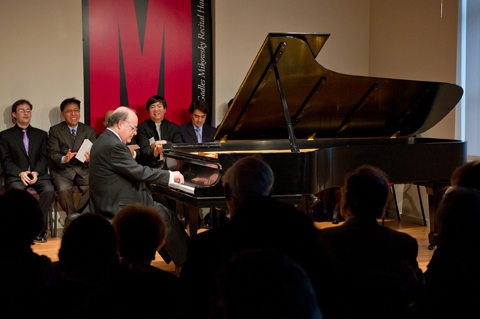
A Birthday Celebration: Solomon Mikowsky at 85! From Rameau to Rzewski! Video in Review

A Birthday Celebration: Solomon Mikowsky at 85! From Rameau to Rzewski! Video in Review

A compilation of audio and video recordings by Solomon Mikowsky and 75 of his piano students and alumni

Joseph Patrych, Artistic and Technical Director

March 2021

For the past fifty years, Manhattan School of Music faculty member Solomon Mikowsky has been a nurturing presence behind pianists who have garnered prizes, accolades, and teaching posts throughout the world. As Mr. Mikowsky reached his 85th birthday last March, the idea arose, credited to master recording engineer Joseph Patrych, to compile performance videos by 75 of these students, past and present in a birthday tribute. Mr. Patrych served as Artistic and Technical Director for the project, and the resulting video is amazing.

There is no way to match in words the cumulative effect of hearing these 75 pianists (many in live concert) – let alone a way to imagine the joy and pride a teacher must feel in having taught and guided them all – but suffice it to say that the reader needs to see it to believe it. The video is linked here: Solomon Mikowsky Birthday Celebration

Being assigned to hear all 75 seemed a daunting assignment for this reviewer, but despite playing time of over three hours of music, there winds up being hardly a dull moment. Thanks no doubt to Mr. Patrych, the styles skillfully alternate (“from Rameau to Rzewski” as the subtitle states), with judicious excerpting and fadeouts to move things along.  A nitpicker might object to the truncating of classics and some strange juxtapositions (such as the middle of a Bach Partita movement to the finale of Tchaikovsky’s Piano Concerto No. 1), but such criticism would be missing the point. In its entirety the video resembles a potluck feast, with each musician bringing a favorite dish, each unique (with sometimes just a taste), and the result is a dreamlike retrospective greater than the sum of its parts. Rare is the teacher who can cultivate such a range of musicianship with so many personalities, but Mr. Mikowsky has done so and deserves great admiration for it.

Repertoire includes – though not presented in chronological order – Baroque, Classical, Romantic, and Impressionistic styles, as well as more “modern” music, for lack of a better term. As one might expect with a teacher strongly committed to music of Cuba, there are some Cuban offerings as well as a fair helping of music from Spain. In addition there are excerpts from concerti, segments from orchestral and chamber ensembles, and transcriptions of all kinds (even electronic). It is a richly kaleidoscopic collection.  For simplicity’s sake, we’ll not describe the zigzagging program “blow by blow” (lest the reader get whiplash) but just group pieces in the most organized way possible.

To open there is J. S. Bach. Fittingly the video begins with Solomon Mikowsky at age 13 playing Bach’s Fantasy & Fugue in A Minor, BWV 944, taken from a 1949 recording on a Chickering piano, (with several photos of him from his youth onward supplying video content), and the transfer to digital from reel-to-reel is surprisingly good. The playing is intelligent and assured, with excellent contrasts and energy. One can already hear in it the same virtues that grace the Bach of Mr. Mikowsky’s students, including Simone Dinnerstein in her Two-Part Inventions – a personal, romanticized rendition of the A Minor followed by a fleet-fingered F Major – and Daniel Hart, whose crisply voiced excerpt of the Toccata in D Major leaves us wanting more. Equally individual are other Bach contributions including the Capriccio from the Partita No. 2 brightly articulated by Kyu Yeon Kim, the Prelude and Fugue No. 1 in C Major (WTC I), shaded sensitively by Yuan Sheng, and the  Chromatic Fantasy & Fugue, BWV 903 contoured caringly by Weiwei Zhai. Less frequently played works add a welcome freshness, including Bach’s Capriccio on the Departure of a Beloved Brother, played pensively by José Luís Castillo, as well as music of Bach’s most famous son, C.P. E. Bach, whose Württemberg Sonata No.1, Op.49, is interpreted dramatically by Maxim Anikushin.

Adding to the Baroque repertoire is Scarlatti’s Sonata in F Major, L.494 played by Robert Buxton who savors its characteristic leaps and piquant dissonances. Interestingly its bite emerges as a bit tame due to its placement after a piece by Sebastian Currier (b. 1959) entitled Scarlatti Cadences & Brainstorm, exploiting the leaps and repeated notes of its eponymous keyboard master (so much so that it might have been preferable to hear the actual Scarlatti first). At any rate, the latter is played quite effectively as well by Saúl Ibarra Ramos.


On the topic of 20th and 21st-century music, there is a healthy representation here, including Annie Gosfield’s Piano & Baseballs performed – with a baseball and mitt striking the keyboard – by Jenny Qionyang Chai. It is hard to watch and hear for a devotee of the piano’s lyrical qualities, but it certainly does add an unforgettable element of spectacle. Percussiveness and lyricism combine in the Cuban contributions, Yalil Guerra’s Toccata (composed 2013), played persuasively by Willany Darias, and Brouwer’s Boceto No. 7 Cabrera Moreno played compellingly by Jiayin Li (and which your reviewer favorably covered earlier this season). Ahmed Alom sounds simply brilliant in Elliott Carter’s Catenaires, and the closeups of his hands in live concert add to the electricity.

Also in a modern vein, Sophiko Simsive is dauntless in Rzewski’s challenging work, The Days Fly By (from The Road) in memory of its composer who died in 2021. Elina Christova projects the haunting beauty of Autumn Elegy, Op.15 (1922) by Bulgarian composer Pancho Vladigerov, and from the same decade we have Busoni’s thorny Toccata played with ferocity by Yeontaek Oh and filmed at the Concours Musical International de Montreal, as well as Szymanowski’s Mazurka, Op.50, No.14 played by Zoe Pian-Chowdhury  (only in Pre-College, but with an intelligent grasp of the style and language). Two Debussy pieces from the Children’s Corner suite (1908) bring us over to the Impressionists, and then we hear The Snow is Dancing played enchantingly by Chi-Ying Hung and an excellent performance of Dr. Gradus ad Parnassum by Eleni Moon (Pre-College).

Also from the earlier 20th century and turn of the century (and with the understanding that many works categorized here fall in several categories) come a large number of works from the great pianistic world of Prokofiev, Rachmaninov, Scriabin, and Blumenfeld. We hear Inesa Sinkevych diving into Prokofiev’s Piano Sonata No. 6 with rhythmic energy, Albert Kim in a bracing excerpt from the Sonata No. 8, and Rexa Han in a highly athletic rendition of his Toccata, Op.11.

From Rachmaninoff, we enjoy Ren Zhang’s recording (with still photo) of the final part of a live performance of Rachmaninoff’s Polka de V. R. – played freely and brilliantly in a style reminiscent of the “Golden Age” of pianism. Among Rachmaninoff’s Preludes we hear Wael Farouk (whom I’ve reviewed several times in amazing stretches of repertoire) in a passionate performance of the C Minor, Op.23, No.7, as well as Hayk Arsenyan in a beautifully dreamy G Major, Op.32, No.5, and Jovianney Emmanuel Cruz in a lyrical excerpt from the D Major, Op.23, No.4. Moving to the Etudes-Tableaux, we hear Edward Neeman in an excellent performance of the A Minor, Op.39, No.6.

Kirill Gerstein is exceptional in Blumenfeld’s Etude for the Left Hand, Op.36 – and though sadly it is only an excerpt, we are left wanting more throughout this video, and it is a good excuse to continue following these pianists! Klara Min is exquisite in Scriabin’s Prelude, Op.11, No.21, and Ruoting Li offers still more Scriabin with her sensitively played Album Leaf, Op.45, No.1.

Among Russian selections, the first taste comes very early in video from Alexandre Moutouzkine in the finale of Tchaikovsky’s Piano Concerto No. 1 with the Israel Philharmonic. Mr. Moutouzkine plays from the climax to the final blazing octaves and roar of the crowd, and it reminds us that among the exciting moments for Mr. Mikowsky’s students are many involving orchestral and chamber collaborations.

Other exciting performances with orchestra include Saint-Saens Concerto No. 2 played by Rowena Arrieta at the Tchaikovsky Competition in 1982 and the same composer’s Concerto No. 5 played with passionate commitment by Sofya Melikyan in Spain. Peter Fancovic and the MSM Chamber Symphony are in fine form with an excerpt of the Mendelssohn Concerto No. 1 in G minor (reminding one never to underestimate a student orchestra when it is from a top conservatory), and the cadenza from Schumann’s Piano Concerto is admirably handled by Chia-Hui Lu.  A segment of Gershwin’s Concerto in F is played with sensitivity by Aliaksandra Beliakovich, and a section of Ravel’s Piano Concerto in G is delivered with aplomb by Chun Wang (at the 59th Concurso Internacional de Piano Premio Jaén). These youthful performances have an electricity that reaches us more than most of what we hear from studio recordings.  

Among less frequently heard works for piano and orchestra, we have a small impressive slice of Beethoven’s demanding Choral Fantasy from Youngho Kim as well as one from the Schnittke Concerto for Piano & Strings played admirably by Adam Kosmieja with the Capella Bydgostiensisess.

There is a clip of one small chamber collaboration, a superb performance by Pei-Shan Li with the Bowdoin Chamber Players in Schumann’s magnificent Piano Quintet, Op.44, and also a lovely duo with Aaron Shorr and another unnamed pianist in Rachmaninoff’s Romance from the 2nd Suite for 2 Pianos, Op.17.

This is perhaps a good point for transitioning to the music inspired by ensembles but played solo, in other words piano transcriptions, of which there are several here. This video compilation reflects just how important piano transcriptions have become, and there are some gems included.

Perhaps the most unusual transcription offering is the one of the Saint-Saens Rondo Capriccioso, Op.28 originally for violin, but arranged and performed as a solo piano piece by Kenneth Jiang on his YouTube channel called Piano Turtle X. An aerial view of his hands on keyboard combines with floating light patterns above – a clear embrace of 21st century technology!

Among the better-known transcriptions, we hear the Gershwin-Wild I Got Rhythm played with elan by Olga Vinokur, the sparkling Mendelssohn-Rachmaninoff Scherzo from A Midsummer Night’s Dream given a brisk ride by Beilin Han, and the well-loved Glück-Sgambati Melodie From Orfeo, played devoutly by Angelika Fuchs.

La Valse of Ravel, famously demanding, is taken on with zest by Sophie Zhang, and the underperformed Godowsky transcription of Rameau’s Tambourin enjoys the skillful treatment of Mijung Lee. Rimsky-Korsakoff’s Flight of the Bumblebee as embellished by Rachmaninoff and then Cziffra, is among the more over-the-top transcriptions, and it is given an over-the-top intensity to match by Jie Yuan.

From Liszt we hear the Paraphrase on Verdi’s Rigoletto played with self-assurance and composure by Wenqiao Jiang (Precollege), the Rossini-Liszt: William Tell Overture played excitingly by Khowoon Kim (at the International Franz Liszt Piano Competition Weimar Bayreuth), and the Wagner-Liszt Liebestod from Tristan and Isolde, played with tragic heft by Charis Demaris.

Once one enters the realm of Franz Liszt, the boundaries between transcription and composition blur, as the composer transcribed his own works; in any case, it would be a shock if such a compilation as this did not contain plenty of original works of Liszt. Sure enough, we hear his Totentanz, played with fire by Minhae Lee, and the central “love scene” section of the Mephisto Waltz No. 1 played very expressively by Tatiana Tessman (to be commended for not merely playing the brilliant “warhorse” passages). Among Etudes, we hear part of Waldesrauschen given a breezy reading by Yoni Levyatov, the fiercely difficult Mazeppa tackled by Chen-Shen Fan, the Paganini Etude No. 6 given fine fingerwork by Emily White, and a praiseworthy home recording of La Campanella by Jingjing Wang. 

Of Chopin as well, there is a fair amount. Of Etudes we hear Ian Yungwook Yoo delighting in the “Black Key” Etude Op.10, No.5 (which actually benefited from a rather steely sounding Kawai piano), and Kookhee Hong in a strong performance of the C-sharp Minor, Op.10, No.4. Of Nocturnes we hear Jonathan Floril in the Eb major (Op.55, No.2) starting in medias res but leaving us wanting to hear its entirety, and Martin Soderberg embracing the singing opening (and a bit of the stormier middle section) of the F major, Op.15, No.1. Daniela Bracchi gives a a driving performance of the Scherzo No. 3 in C-Sharp minor, Op.39.

For Schumann (along with the Concerto cadenza and quintet previously mentioned) we hear Guangshou Tian in a small slice of the Symphonic Etudes, Op.13 (Variations IX & X). He projects his musical segment well, as does Yoon Lee in the Fantasy in C Major, Op.17 which she imbues with expressiveness.

The only Franck of the evening is a section of the Chorale from the Prelude, Chorale and Fugue, but it is lavished with care by Robin Freund-Epstein.

Among Classical period works, Beethoven’s Bagatelle in E-Flat major, Op.33, No.1 is given a delicious interpretation by Adam Kent who conveys its spirit in an especially witty, gently playful way. Of Mozart, we hear his C Major Sonata, K. 330 given a thorough reading by Bai Yang and his Rondo K. 494 from Audrey Axinn on fortepiano, with more of the embellishing we heard in the Mozart compilation reviewed here a few weeks ago (The Twinkle Project).

Among lesser-known classical composers, we hear a relatively rare sampling of music by Matéo Albéniz (1755-1831) – not to be confused with the more famous (but unrelated) Isaac Albeniz (1860-1909). Sining Liu takes on his Sonata in D Major quite effectively, and we are grateful.

Returning now to Spanish and Latin American influences (which one guesses are rarely absent among Mr. Mikowsky’s teaching), there are just a few works left so far unmentioned. Three are by Isaac Albeniz, including Triana from the Suite Iberia played by Gustavo Díaz-Jerez – with playing as compelling as recalled from when I reviewed his DVD of the entire Suite a few years ago. We also enjoy a beautiful performance of El Puerto in the able hands of Zeze Xue (also reviewed earlier this winter) and from Ruiqi Fang, who lets the percussive qualities of Navarra come to the fore.

From South America we have only La niñas by Carlos Guastavino of Argentina (1912-2000), but Allison Brewster-Franzetti plays it with gusto and a strong projection of the lush harmonies.

Coming full circle to Cuba, along with the Brouwer and Guerra pieces mentioned earlier, we hear 2 Danzas by Cuba’s beloved Ignacio Cervantes (1847-1905) played engagingly by Misha Namirovsky, and a piece by Ernesto Lecuona (1895-1963) entitled A la antigua from pianist Ana Karina Alamo who plays it with intense involvement.

Last of all, we hear not another Cuban work but the work of a great Cuban, Solomon Mikowsky himself, whose Scarlatti Sonata in E major, L.23 is a perfect close to this voluminous project. It was recorded in 1948, when the pianist was just twelve years old (from reel-to-reel recording with a Chickering piano), but it already reveals masterful phrasing and a sensitive harmonic awareness. Though it is easy to say such things in hindsight, one can already hear in it his great journey ahead, his understanding of human moods and differences, his explorations, and his triumphs. The reluctance to let the music stop is felt in his most special ritardando at the close – and we trust the music never will.

Bravi tutti – and feliz cumpleaños, Maestro Mikowsky!

Share

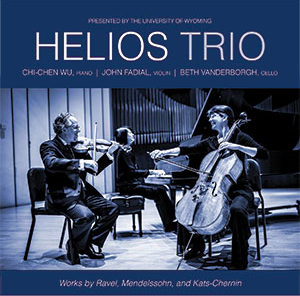
University of Wyoming presents Helios Trio in Review

University of Wyoming presents Helios Trio in Review

Helios Trio: Chi-Chen Wu, piano; John Fadial, violin; Beth Vanderborgh, cello

Weill Recital Hall at Carnegie Hall, New York, NY

March 1, 2022

I can’t speak with authority about the State of the Union, but I can assert that the State of Chamber Music in Wyoming is very fine, as manifested by the Helios Trio (Not to be confused with the French-based Trio Helios!): Chi-Chen Wu, piano; John Fadial, violin; Beth Vanderborgh, cello; on Tuesday, March 1, 2022. They gave the audience a rich Mardi Gras indulgence, but I hope they’re not giving chamber music up for Lent.

The program of two pillars of the piano trio repertoire and one novelty was played with great togetherness, sensitivity, solo ability, unanimity of phrasing, and dynamic planning.

The program began with The Spirit and the Maiden (2004, rev. 2013) by Elena Kats-Chernin (b. 1957), born in Uzbekistan but a resident of Australia from an early age. This is a programmatic trio, based on a mystical tale, a sort of “reverse” Ondine, if you will: the seductive water creature is male and the mortal victim is female. One often hears that with program music, the important thing isn’t the program at all, but the quality of the music without the program. If I had heard this work without reading the story, I would have enjoyed it; however, I can’t really detect an “illustration” of the story in its three movements, as lovely as they are.

The three movements are what I like to call “maximal” minimalism—there are some of the usual hallmarks (motoric energy, repeated patterns), but Kats-Chernin also uses modal melodies that are very accessible and sounding almost folkloric. The performance was beautiful and engaging; the enigmatic ending almost prohibited the audience from applauding.

Helios followed this with the first of Mendelssohn’s two piano trios, the oft-played D minor, Op. 49. Once again, everything was scrupulously prepared, with fine attention to phrasing. One small caveat: I found pianist Chi-Chen Wu to be extremely virtuosic but overly deferent in terms of balance. This made the work sound “small-scale” when, in important places, it should have sounded more heroic. She played so softly that in too many places there were notes that didn’t sound; this was particularly detrimental in the final chord of the Andante movement, where one only heard B-flats from strings and piano, instead of a full B-flat chord in the piano. The writing is indeed thick at times (Mendelssohn’s piano was lighter), but all notes must be played and then a dynamic determination made. Never mind, the blistering speed Ms.Wu adopted in the Scherzo showed her credentials as a pianist to be admired.

I also particularly enjoyed the fine playing of cellist Beth Vanderborgh, especially in the Andante, but throughout. So often in piano trios the cellist tends to be the “ignored” one. Her musicality would allow none of that, and she brought attention to lines that one often doesn’t pay attention to. Perhaps besides the discretion of the pianist, she was aided in this by violinist John Fadial, who never played like a diva, but  I felt he even scaled some of his big moments down. The ensemble took many of the “standard” places where one expands the tempo, but they also contributed some of their own individuality to what amounted to an exciting rendition.

After intermission, they tackled Maurice Ravel’s only piano trio. Ravel viewed each one of his relatively few compositions as the unique and perfect solution to a musical problem he posed to himself. Thus, the piano trio, with its perennial balance issues became his thesis. Ravel the master orchestrator brings his skill to the three instruments perfectly, while not neglecting to create heartbreakingly simple modal themes to express emotion.

In this work, Helios really opened up. Ms. Wu came out of her shell and really rose to the immense climaxes that are required. The first movement’s main theme, in a Basque rhythm called zortziko, is “of Basque color,” as Ravel said. He composed it just adjacent to his birthplace of Ciboure in Basque country, in July 1914 “despite the rain and freezing temperatures” (unusual on the Côte Basque in July), a sort of harbinger.

The first three movements were finished prior to the outbreak of World War I. Ravel loathed any association of his music with current events (the violence of La Valse, for example), but it is hard not to hear in the fanfares of the Final, the desperate hopes for victory in the coming conflict.

The Pantoum, second movement scherzo, is based on an esoteric Malaysian verse form with interlocking lines within the stanzas. Here, Ravel does find some musical equivalency with the two main themes interweaving. Ever the master constructor, the first (silvery rapid) theme of the Pantoum, greatly slowed down, becomes the melody of the Passacaille.

Equally hard not to hear is the De Profundis despair of this Passacaille, which in the Baroque was a composition based on a repeating bass line. Of course Ravel the fastidious perfectionist knew he wasn’t writing a strict passacaglia at all, only the melody repeats, climbing out of the depths, building to a shattering climax, and then retreating, mirror-fashion, to its tomb-like conclusion. This journey was gorgeously rendered by the three members of Helios.

By this time, everyone in the audience knew, as well as I, that the Final would be an exciting ride, and indeed it was. Ravel himself, despite repeated rejections by the French army, managed to enlist and serve as a truck driver in 1916 and early 1917, near the Verdun front. During this time, he became ill, and his beloved mother died—he was discharged to attend her funeral. The premiere of the Trio was in January 1915, and during those anguished early months of heavy losses, it went virtually unnoticed. Thank goodness for wonderful advocates of the trio repertoire like Helios, who bring it to us in our own anguished time. Dear Helios, please return often!

Share

Creative Classical Concert Management presents Seong-Joo Kang in Review

Creative Classical Concert Management presents Seong-Joo Kang in Review

Seong-Joo Kang, piano

Weill Recital Hall at Carnegie Hall, New York, NY

February 23,  2022

One of those rare events happened on Wednesday evening: a recital that made the reviewer set aside his analytical self and simply surrender to the beauty of what was unfolding. Seong-Joo Kang, a 27-year-old Korean-born pianist, was the creator of this magic.

Seong-Joo Kang began piano studies in his native Seoul at age five, but has done his collegiate-level music study in various locales in Germany, playing for the leading lights of that culture, and obviously absorbing everything he can about the Austro-Hungarian and German traditions.

However, there are some things that can not be taught. Ah, therein lies the mystery of talent! With the first clear notes of the Haydn F minor Variations, Hob. XVII:6, a pianist of taste, style, poetic feeling, intellect, and discipline was revealed. This work, written in a key Haydn rarely used, is almost painfully private; a double variation set. In keeping with the most authentic style practice, Mr. Kang had the good sense to play the F major sections just a tad faster (nothing radical), but when he returned to the minor key, the deliberate pace he resumed each time became ever bleaker. Just prior to the conclusion, the piece breaks into what I call a “mad scene” from some imagined Baroque opera, or a reference to Bach’s Chromatic Fantasy, before resolving into a very uncertain F major. Not a note was out of place, the sonority was beautiful, and there was no idle “passagework” – every note sang.

Next came Schubert’s Fantasy in C Major, commonly known as the “Wanderer,” after the song quoted in the second part (of four continuous “movements”). The archetype of Romantic period longing, “Da wo Du nicht bists/Da ist dein Haus” (Wherever you are not/There is your home). The continuous dactyls of the poem (long-short-short; commonly used in ancient Greek epics) are represented musically in this monothematic masterpiece. For Schubert, even the epic triumphs of this Fantasy may be more desperate than joyful; this rhythm also became an oft-used signifier for death.

The sheer bravado of the three quick sections should really make us reevaluate what Schubert may have been like as a piano performer. In the Fantasy, Mr. Kang was able to thunder (without ever banging!), then turn immediately to a whisper. He savored every color change from minor to major, and knew exactly how to make the required subito pianos, as well as pacing the repeated climaxes. This is the work that does not want to “say goodbye,” its C major coda restates itself again and again. Yet Mr. Kang’s grasp of structure is so strong, the work never wandered. One hint: After playing such a titanic work, dear Seong-Joo, please take a much bigger bow- you’ve earned it!

After intermission, the entire second half was devoted to delicious Rachmaninoff, one transcription and one original set. One could hardly imagine a composer more diametrically opposed to Viennese classicism than Sergei R. the “6-foot scowl.” Yet, in his own abundant recordings Rachmaninoff reveals himself to be quite “classical” in his expression, unlike the sometimes highly exaggerated versions we hear today. Mr. Kang followed in this straightforward path, to great effect.

The first work was Fritz Kreisler’s delectable Liebesleid (Pains of Love, originally for violin and piano), a Viennese waltz of such charm that one scarcely notices how difficult Rachmaninoff’s arrangement is (!), especially in the hands of a pianist like Mr. Kang. His economy of motion is a joy to behold. Everything goes into the music, no gratuitous display.

He followed with Rachmaninoff’s Six Moments Musicaux, Op. 16, an obvious reference to Schubert’s set of the same name. But what a difference. Four of these pieces are awash in decorative filigrees of either lacy delicacy or thundering power (or both). Mr. Kang clarified every single texture without ever sounding taxed or busy. Frankly, I could have used a little more exaggeration in these works, as well as that hallmark of the Russian school: attention paid to bringing out inner voices. The two lyrical movements were also beautiful, with No. 5 in D-flat bringing a spontaneous tear or two to this crabby old reviewer’s eyes. Have I gone soft due to the pandemic? I think not.

Mr. Kang favored his small but fiercely devoted audience with the Schumann/Liszt song transcription Widmung, which was perfectly sensitive.

Share

The Twinkle Project in Review

The Twinkle Project in Review


Mozart “Ah, vous dirai-je, Maman” Variations, KV 265: Six Sets of Video Performances by Solomon Mikowsky and Piano Students (including Alumni and MSM Faculty)

Original idea by Ahmed Alom (BM student), Administrative Director and Coordinator

Joseph Patrych, Technical Supervisor; Asaf Blasberg, Videographer

March 2021

Pianophiles everywhere, take heed! If you’ve ever thought there is “one way” to play Mozart, or if you’d like to explore multiple styles and approaches but without combing the Internet, you have a treat in store! All on one webpage (The Twinkle Project) at the Manhattan School of Music website, there are six video compilations dedicated to what is called The Twinkle Project, including performances by 50 pianists (though the website states the count is 47), each playing a variation (or two or three of the twelve) from Mozart’s famous Variations for Piano, K. 265, on “Ah, vous dirai-je, Maman” (the French folk song from which the “Twinkle, Twinkle” tune was taken a half a century later). It is a mammoth project, a feat of organization and collaboration, and a moving and awe-inspiring celebration to see and hear fifty pianists of diverse ages, nations, and styles, uniting in tribute to Mozart, with the common ground being their association with the Manhattan School of Music –  in particular with master teacher Solomon Mikowsky, who himself performs the theme for each set.

As Mr. Mikowsky states on the website: “When my gifted piano student, Ahmed Alom (BM ’21), alerted me to his idea of a video-recording of Mozart’s “Twinkle” variations performed in collaboration with 11 of his classmates, I immediately realized that this project would be an ideal vehicle for an expression of gratitude to the school to which we all owe so much: MANHATTAN SCHOOL OF MUSIC! Shortly afterwards, I decided to expand it to also encompass many alumni, including the seven current members of MSM’s piano faculty.  This has allowed me to renew contacts with students who studied with me from as far back as 51 years ago: more than 5 decades!” He continues to say, “The most rewarding aspect of this MSM multi-pianist collaboration is the inspiration provided by the great composer, making the participants realize anew Mozart’s genius and the artistic challenge that performing 16 measures of his music entails.”

Indeed, anyone who has ever said “it’s as easy as Twinkle, Twinkle, Little Star” (referring to the nursery song) probably does not know Mozart’s twelve scintillating piano variations on this theme (published in 1785), and the wide range of techniques and expression that this work encompasses. A perfect pandemic project for an assemblage of conservatory pianists performing virtually from locations all over the world, it was completed March 2021, under the guidance of recording veteran Joseph Patrych, with videographer Asaf Blasberg. It remains available at the link above, a testament to resiliency of musicians during the pandemic and of loyalty to their teacher, colleague, and alma mater. As cheerful as much of the Mozart composition is, one may need a box of tissues while watching these pianists, some in slippers, playing on instruments ranging from at-home electronic keyboards to uprights and grands, some clearly borrowed, some by necessity untuned, and all coping valiantly despite the blows of pandemic lockdowns and quarantines.

Having been assigned to review this project, I faced several challenges. Clearly there is no way to address thoroughly all fifty pianists on six separate videos (with some overlap among them), so there will be just brief mentions of some highights; all fifty pianists, however, are listed at the end of this review.

Also challenging was the issue of the very premise, which Mr. Mikowsky himself addressed, asking, “Can both unity and variety be established with this number of performers …?” Well, to riff on the famously simplistic definition of musical “variations” as a work in which “something is constantly the same throughout (the theme) and something is constantly different (the treatment of it),”  this collaboration was naturally destined to feature more of the “different” aspect than the unity – and that is just fine. The recognizability of “Twinkle, Twinkle” guarantees that no listener can lose the thread (so a good choice of theme!). Furthermore, as we hear pianists from Australia, Bulgaria, China, Cuba, Cyprus, Georgia, Greece, Israel, Korea, Russia, Slovakia, Spain, Taiwan, Ukraine, and the USA, playing a single piece, the spirit of this entire project emerges as one of “e pluribus unum” – a very moving experience.

Opening with the “Twinkle” theme, octagenarian Solomon Mikowsky demonstrates that his ability to perform is clearly undiminished, and with his meticulous portato articulation he sets a stately tone. Alumni Jie Yuan and Kookhee Hong follow expertly, maximizing the expressiveness of highpoints while retaining the flow.  Alumna Yoon Lee takes the most liberties with time so far, with what might be called a more Romantic approach, and it is welcome. Inesa Sinkevych, projects the next variation with more driving metric precision and energy, still with considerable variety for such a short segment, and Chi-Ying Hung,brings polish and nuance in all regards, letting Mozart’s wit shine through.

Simone Dinnerstein dazzles in Variation 6, with light and fleet fingerwork (as many know from her Bach Goldberg Variations recording), and Kyu Yeon Kim is also brilliant, with attention to the character of each  detail bringing spirit and personality to Variation 7. Bai Yang‘s 8th Variation has a delightful mischievous quality to it, interesting especially in comparison with José Ramón Mendez who takes a more solemn approach – both convincing! Ren Zhang delivers the 9th variation with easy mastery and a beautiful ritardando at the end – as several do – which raises the recurring question as to whether that’s  a drawback of having multiple performers share a piece (one player’s turn is coming to a close, hence a ritard is natural, but then the piece continues, so it perhaps oughtn’t to wind down thirteen times). In any case, this project must be experienced differently. So, onward to Variation 10, we see Adam Kent, sporting a Mozartean white wig (and listed in one caption as Adam “Adameus” Kent!) just in time to remind us that, despite his highly professional music-making, this is all in the spirit of fun!

To follow, the absolutely meltingly beautiful Variation 11 is made more so in the hands of Yuan Sheng, who creates such a spell that one might forget to look at the score and realize that one reason that his ornaments sound so utterly graceful is that they are largely his own. Mastery follows mastery with Alexandre Moutouzkine‘s final variation, made more interesting  with some featuring of alternating registers in an almost stereophonic effect – a fittingly rousing close!

Three encores are included in the first video, starting with Aaron Shorr playing his own “Alla Diabelli e Leporello” (inspired by Beethoven’s Diabelli Variations). It is an inventive classical tribute and is played here with flair. The second encore, for piano and orchestra (here the Havana Lyceum Orchestra), is entitled “Mozart Dreaming of Havana.” It starts with Simone Dinnerstein playing Mozart’s Sonata in G, K. 279, then fading and developing with the orchestra into a dreamlike fusion of Mozart and Cuban popular song, with various orchestral section leaders taking turns at solos. It is a wonderfully spirited and fitting tribute to Mozart, Cuba, and to Mr. Mikowsky’s Cuban roots, which have a great influence on his students. Under that same Latin influence, the third encore is a song called “Mojito” sung in Chinese by Mr. Mikowsky’s doctoral student Jiayin Li, whom I had the pleasure of reviewing in her piano recital in late January. Not only is it extraordinary to hear her versatility of instrument and style, but her singing has an infectiously playful spirit that could “win the Internet” as they say. I’d recommend grabbing a mojito and hearing it. Smiles are guaranteed.

Time limitations will keep the following video summaries shorter, but suffice it to say that in the second video (which is called “set 1” in the upper left corner, all the videos being labeled differently on the site from the captions), we hear more nicely refined phrases from Aaron Shorr, humorous Beethovenian bursts of sound from Yoni Levyatov, some well-projected offbeat melodies from Edward Neeman, and a lovingly rendered Variation 11 from Charis Dimaras. Mr. Dimaras seems so well suited to its pensive quality (like Yuan Sheng), just as Peter Fancovic seems ideal for the grand final variation, that one starts to wonder how the musical “casting” was done. If there is not a musical version of Casting Central, there ought to be one, and a good teacher can fill that role, which may be what has happened here.

By the time one hears the third video (called “Set 2” in the captions), one can be overwhelmed with emotion by some of the out-of-tune instruments and trials that one knows are facing these fine players. We hear impressive playing from all, but notable are the attention to detail from Gloria Lin, the authoritative precision from Olga Vinokur, the nicely sustained lines from Chun Wang, and the almost operatic phrasing from Kyriakos Sourollas. Emily White‘s Variation 6 is brilliant, but she resists excesses of speed, with a moderation of tempo that allows one to experience the details fully. Clarity of imitative entrances marks the playing of Willany Darias, very musical and unselfconscious. Tapered edges and elegance characterize the performance of Elina Christova who follows. Just as one is marveling at the kaleidoscopic range of qualities among all of these pianists, we hear Audrey Axinn who has not only freely ornamented Variation 11 but has practically rewritten it. One might feel a yen to hear a more straightforward reading if this were a single-pianist performance of the entire piece, but as it follows multiple readings of the same music, it comes as a fascinating refreshment. Yungwook Yoo displays tremendous finger technique in the final variation. Capping off the video is a fantastic encore played by (and one assumes composed by)  Jennifer Chu. Entitled “Mozart in Havana” (and dedicated to Mr M’s hometown) it is essentially the “Twinkle” melody cleverly set over a Cuban beat. It is wonderful to see such spirit and such “thinking outside the box” especially in a time of being relegated to living in boxes!

The fourth video (called “Set 3” in the captions) brings some more current students, and all were excellent. Some standouts include Daniel Hart with nice offbeat phrasing as the music invites, Zoe Pian-Chowdhury who finds room to be personal and expressive where it is not easy to do so, plus the fiery Jiayin Li and very sensitive Sophiko Simsive. Ahmed Alom, whose brainchild this all was, finishes the set in fine style, followed by that fabulous “Mojito” encore again!

The fifth video (called “Set 4” in the captions) features MSM faculty and alumni, and one can only think how inspiring it must be for their current students of these pianists to see and hear. After another theme by Mr. Mikowsky, we hear the commanding playing of Elena Belli followed by more wizardry from Alexander Moutouzkine (including some devilishly tricky ornaments). Daniela Bracchi, Inesa Sinkevych, and Robin Freund-Epstein all uphold a high standard, and the energies of Jiayin Li and Adam Kent enliven it all.

In the sixth and final video (“Set 5” in the captions) we hear several pianists we’ve heard already, including Jie Yuan, Simone Dinnerstein, who now adds Variations 7 and 8, showing her more lyrical gifts (along with the previously heard Variation 6), Yuan Sheng, who shows a heartier side in Variation 4 (as well as the previously heard Variation 11), and Ren Zheng, with his crisp and taut Variation 9. In and amongst these performances also we hear some enchanting trills from Po-Wei Ger in Variation 3, and a very young Pre-college student, Eleni Moon, playing Variation 5. It is especially heartening to see the youngest generation taking up the tradition, as it bodes very well for the future of music.

In addition (we knew someone was missing!) we hear Wael Farouk, whom I’ve had the pleasure of reviewing on several occasions and who continues to be a joy to hear. He brings life to Variations 2, 10 (including some special ornamentation), and a grand No. 12 to cap off the entire project.

Congratulations are in order to everyone involved! Congratulations to Solomon Mikowsky on this astonishing array of very individual talents, congratulations to those organizing and recording it all, and congratulations to MSM!

The complete listing of performers alphabetically is (not including Solomon Mikowsky, who played the theme): Ahmed Alom, Audrey Axinn, Elena Belli, Daniela Bracchi, Elina Christova, Jennifer Chu, Willany Darias, Charis Dimaras, Simone Dinnerstein, Peter Fancovic, Ruiqi Fang, Wael Farouk, Robin Freund-Epstein, Po-Wei Ger, Erica Guo, Daniel Hart, Kookhee Hong, Chi-Ying Hung, Tzu-Wei Kang, Adam Kent, Kyu Yeon Kim, Tatuka Kutsnashvili, Mijung Lee, Yoon Lee, Yoni Levyatov, Jiayin Li, Gloria Lin, Sining Liu, José Ramón Mendez, Eleni Moon, Alexandre Moutouzkine, Edward Neeman, Zoe Pian-Chowdhury, Yuan Sheng, Aaron Shorr, Sophiko Simsive, Inesa Sinkevych, Kyriakos Sourollas, Olga Vinokur, Chun Wang, Emily White, Hangli Wu, Jojo Yan, Bai Yang, Yungwook Yoo, Julian Yu, Jie Yuan, WeiWei Zhai, and Ren Zhang.

Share

Jiayin Li, Pianist in Review

Jiayin Li, Pianist in Review

Jiayin Li, piano

Samuel Torres, Percussion

Mikowsky Recital Hall, Manhattan School of Music, New York, NY

January 25, 2022

Call it making lemonade when life deals out lemons, but the Manhattan School of Music has made the best of the pandemic situation with an array of live-streamed performances that would make a diehard concertgoer want to stay home and listen. https://www.msmnyc.edu/livestreams/

Among performances this week was a recital by excellent young pianist Jiayin Li, a pupil of Solomon Mikowsky, esteemed professor for whom the evening’s venue was named. Ms. Li is a candidate for the Doctor of Musical Arts Degree at MSM, and though this recital was listed as a “non-required” one, her program of Cuban piano music goes hand in hand with a dissertation she is writing on the subject, including an annotated collection of the music performed. Under the guidance of Solomon Mikowsky, Cuban-born and a longtime proponent of his country’s music, Ms. Li clearly chose her dissertation topic well, and this listener could hardly wait to hear the eighteen listed Cuban composers from the nineteenth, twentieth, and twenty-first centuries.

The program enjoyed a festive start with Niña con violín (Girl with a Violin) by Ernán López-Nussa (b. 1958).  Supported with excellent percussion by Samuel Torres on bongos, Ms. Li dove headlong into the music’s spirit,  with none of what might expect to be opening nerves.  The music enjoyed dreamy moments, but with support from Mr. Torres there was an undercurrent of dance rhythms throughout.

Going back to the 1800’s Ms. Li gave appealing renditions of Two Contradanzas by Manuel Saumell (1817–1870), first Los ojos de Pepa (Pepa’s eyes) and then El pañuelo de Pepa (Pepa’s Handkerchief). Direct and unassuming folk-like music with rather reined-in use of syncopation, these are close in style (and vintage) to the music of Louis Moreau Gottschalk (who enjoyed several trips to Cuba). Each has a rather self-effacing ending which Ms. Li tossed off with appropriate understatement. Well done!

Next, moving on to Ignacio Cervantes (1847–1905) came two contrasting Danzas, the soulful Adiós a Cuba (Farewell to Cuba) and to follow it No llores más (Don’t Cry Anymore). Adiós a Cuba was given a sensitive, involved performance, nostalgic and impassioned without being excessive or maudlin. To follow it with the consoling No llores más was a beautiful programming touch, and the playing was captivating.

As a side note, it is hard to write even a review of these pieces without expounding on the details of these interesting composers and how their lives intertwined; it is therefore nearly impossible to see how a doctoral candidate could resist writing program notes for this concert. They would surely have been helpful and enjoyable to many.

A festive spirit resumed with La conga de medianoche (The Midnight Conga) from Six Afrocuban Danzas by Ernesto Lecuona (1895–1963). For those who immediately associate Lecuona with his Malagueña or other popular pieces, La conga de medianoche is rather different in its jazzy evocations of a tropical midnight procession, with spicy dissonances adding a good bit of humor.

In a drastic mood change (great programming leaving not a dull moment), we heard Canción de cuna del niño negro (Lullaby for the Black Child) by Amadeo Roldán (1900–1939). A haunting lullaby with plaintive melody over a hypnotic tritone bass pattern, this lullaby is not one for carefree dreaming (its spirit, though not its harmonic language, bringing to mind the Delius Lullaby for a Modern Baby and other ponderous “modern” berceuses). Ms. Li established its haunting atmosphere from the start and held the audience spellbound.

The tempo and mood lightened up for Con un viejo tres from Sones by Carlo Borbolla (1902–1990). Though one might have expected something more sedate with the word “viejo” (old), a “tres” is a kind of small Cuban guitar – and one can still make a spirited sound on an old instrument! Ms. Li’s interpretation verged on the brisk as did some other pieces – and she could certainly afford more taking of time – but there may have been reasons to move the evening along.

This Sones selection was in any case well played, delivered like a wry story, with surprising twists and turns and the occasional “arched brow” musically. It led perfectly to Danza cubana No. 10, “Machacando” (Cuban Danza No. 10, “Pounding”) by Félix Guerrero (1916–2001). Despite the suggestion of “pounding” Ms. Li played with what was emerging in her performances as a characteristic elegance. Perhaps the translation set up an expectation of something more unleashed, but in any event, it was a joy.

What one expected next (as it was printed in the program) was Berceuse campesina (Peasant Lullaby) by Alejandro García Caturla (1906–1940). It is a piece close to my heart, so fortunately I knew something was amiss with the program order when it did NOT come next. (If the very brief opening remarks from the stage manager had perhaps been to clarify a program change, they were nearly inaudible, and so one was relying on the printed program.) Not to be curmudgeonly, but it is not pleasant to be floundering around to disentangle program order while listening (especially as an assigned reviewer), so the downloadable program ought to have been changed. Suffice it to say that one hopes, particularly in the case of a doctoral candidate, that leaving the audience in a haze of confusion is the opposite of what one wants to do in sharing music.

What actually came next was Zapateo Cubano (Cuban Stomping) by Héctor Angulo (1932–2018). It was alternately jaunty and lilting,  all in all, a winning performance – and it was after the Angulo that we heard the beloved Caturla Berceuse, and it was played with soulful involvement, a pleasure.

Somehow one missed the Guajira (Peasant Song) Harold Gramatges (1918-2008) – was it omitted? Just another communication glitch for the lost audience? In any case, the program moved on like quicksilver to what this reviewer knew to be Cabrera Moreno, No. 7  from Ten Bocetos (Sketches) by Leo Brouwer(b. 1939). Ms. Li dove into it with ferocity, seeming to relish its motoric patterns. In a similar vein was Tumbao by Tania León (b. 1943), also displaying a powerful finger technique and rhythmic precision.

Just when one couldn’t imagine Ms. Li continuing without a “breather” she proceeded to the tour de force that is Caleidotropic (Kaleidotropic) by Guido López-Gavilán (b. 1944). Complete with extended techniques, strumming inside the piano, tapping, and dramatic vocal chanting (with some remarkable singing as well), Ms. Li fearlessly “knocked it out of the park” as they say, leaving her audience dumbfounded before intermission.

The second half of the concert, by comparison to the first, was a relative breeze. A piece by Jorge Lopez Marín (b. 1949) entitled Marileny started somewhat strictly in two voices, then opening up into a freer, jazzier quasi-improvisatory exploration. Following Marileny was a piece called ¡Que Confusión De Tonos! (What A Tonal Confusion!) by Andrés Alén (b. 1950) – actually much less confusing than figuring out what piece was what on the program –  but with tonal shifts well within the range of what one has come to expect from 20th-century music (and 21st). All in all, it was an interesting romp through tonal surprises and “good clean fun” as they say. Habanera Del Ángel (Angel Habanera) by José María Vitier (b. 1954) was just as its title suggests, a soothing and gentle habanera with an intense middle section.

Nearing the program’s end we heard the third piece from El Libro De Música De La Ciudad Celeste (The Music Book Of The Celestial City) by Juan Piñera (b. 1949).  Once again it appears that there was a slight mix-up, as the title of No. 3 was listed as Hacia Una Región De La Luz (Towards A Region Of Light), which seems to be a different movement from what we heard. It seems that what we heard was Como un sol que se derrumba (still No. 3). At any rate, Ms. Li showed in it more of her impressive motoric energy and passion.

Rounding out the program as it began, we enjoyed more percussion collaboration with Samuel Torres on congas joining Ms. Li in, Pan Con “Timba” (Bread With Timba) by Aldo López Gavilán (b. 1979). After a bravura percussion introduction from Mr. Torres – truly virtuosic! – the two musicians took us on one final and fantastic Cuban romp. It was a wonderfully festive finish to the evening, and only the iciest soul would not want to dance to it in celebration.

Ms. Li concluded the concert by graciously thanking her professor in a clearly well-deserved tribute.  Bravi tutti!

Rorianne Schrade for New York Concert Review; New York, NY

Share

Pro Musicis presents Solange Merdinian in Review

Pro Musicis presents Solange Merdinian in Review

Solange Merdinian, mezzo-soprano

Joel  A. Martin, piano

Weill Recital Hall at Carnegie Hall, New York, NY

December 15, 2021

Weill Recital Hall was the venue for yet another fine presentation from Pro Musicis this week, featuring 2019 prize-winning artist Solange Merdinian. Ms. Merdinian offered a program celebrating her Armenian-Argentinean heritage, with some Cole Porter and Kurt Weill added to the mix.  Ms. Merdinian said she chose composers who are well known in their native lands, but less well known elsewhere.  One can make the case that Komitas and Guastavino, while not “household” names, are known to many, but it is certain that Ashot Satian, Parsegh Ganachian, and Carlos López Buchardo are names new to most listeners (including this one). It is almost always a pleasure to be introduced to music one would not hear otherwise, and Ms. Merdinian’s performances were both educational and artistically fulfilling.

Ms. Merdinian of course possesses all the attributes one expects of a contest winner – a stage presence that is confident and polished, a voice that projects well without strain, and exceptional intonation and diction.  What sets Ms. Merdinian apart from most is her remarkable versatility. While most singers can (and do) venture away from their “comfort zones” it is usually apparent that they are doing so, i.e. Opera singers doing cabaret but sounding like opera singers doing cabaret – not so in the case of Ms. Merdinian. Whatever style she is singing in is completely compelling as if it is her “main” style, which might seem unremarkable, but it is something that few are capable of pulling off so convincingly.  I also had the unmistakable impression that Ms. Merdinian was “in the zone” and that only the complete shutdown of concerts had prevented her from unleashing her obvious passion for these songs on the concert stage. When finally given the opportunity to do so the energy she radiated filled the hall and fired up an already enthusiastic audience.

The recital opened with five Armenian Songs as arranged by Ms. Merdinian’s pianist Joel A. Martin. A candle was placed at the front of the stage and lit (or one should say turned-on, as it was battery-powered ). Surprisingly Mr. Martin entered alone, bowed and sat at the piano. The hall was darkened and he began to play as one heard a voice in the distance, gradually sounding closer as Ms. Merdinian entered. It was a stirring effect, and her voice was hauntingly beautiful. The ideas of longing, heartache, loss, and recovery were the overarching themes of this set, delivered with an intensity that was devastating in its effect. It was a powerful start to the evening, which Ms. Merdinian explained was not her usual way of opening, but she felt the need to acknowledge the tragedy of loss due to the pandemic.  Of the five songs, Mardigi Yerk (Soldier’s Song -“I flew in my mind”), by Ashot Satian, was this listener’s favorite. My one quibble was that there was very little break between songs, making it hard for one who does not speak Armenian to distinguish one from the next. I understand that they functioned as a set that Ms. Merdinian did not want to be interrupted by applause, but a note in the program would have lessened the confusion.

The remainder of the first half took on a lighter and often joyful tone. Five of the Seis Canciones from Eduardo Toldrà followed the Armenian songs.  They are filled with sunny optimism and the feeling of young love, and it was impressive how Ms. Merdinian so effortlessly moved from the emotional weightiness of the Armenian songs to the ethereal Cantarcillo and the heart-racing excitement of first love in Después que te conocí.

Two art songs, Rocío and Meciando, by Carlos Guastavino followed.  Guastavino had an undeniable gift for melody and these songs showcase that gift. As Gustavino is known to have said, “I love melody, I love to sing. I refuse to compose music only intended to be discovered and understood by future generations.”  Ms. Merdinian’s voice was made for these songs, and it is good to see a composer who is overshadowed in this country by his countrymen Piazzolla and Ginastera being heard and appreciated.

The first half ended with Jujeña by Carlos López Buchardo. Filled with sunny cheer and the innocent joy of a young girl who doesn’t have a cloud in her sky,  Ms. Merdinian became that young girl, swaying and dancing happily, while her heart pours out unbridled excitement and wonder about the world.  The duo projected it with élan, and it was a dynamic ending to the half. 

After intermission. Ms. Merdinian offered what she calls her “Musical Salon.” Shifting to cabaret, she transformed into a world-weary chanteuse for three songs (I’m a Stranger Here Myself, Complainte de la Seine, and Je ne t’aime pas) by Kurt Weill.  While I am not always simpatico with Weill’s often ultra-cynical style, these selections were, much to my surprise, highlights of the night for me.  Of the three, the last, Je ne t’aime pas was my favorite.  Ms. Merdinian conveyed the efforts of one who is desperately trying to convince herself that she no longer loves someone when it is plainly clear that she does, and that the harder she tries, the more apparent the love is. The final line,  Je ne t’aime pas! was delivered with such a burst of passion that one could feel their own heart breaking. One wasn’t sure if they should applaud her, or console her!

The Cole Porter standards Let’s Do It and It’s De-Lovely were fun romps, with Ms. Merdinian delighting (or is that De-Lighting?) the audience with some playful changes to the lyrics that drew laughter.

Let’s take a moment to recognize pianist Joel A. Martin, a star in his own right. From his smart and stylish arrangements to his superb pianism, infused with panache,  he is an ideal collaborator. His musical rapport with Ms. Merdinian was outstanding.

Three songs, Chiquilíde Bachín, Nalada para un loco, and Siempre se Vuelve a Buenos Aries, by the master of the tango, Astor Piazzolla, ended the evening.  Ms. Merdinian transported the audience to the cafés of Argentina in a perfect end to a wonderful concert. With a final flair of vocal gymnastics, the audience roared approval with a raucous standing ovation. Ms. Merdinian is an artist to watch, and I wish her continued success in her future endeavors.

Share

Christopher Jessup  The First Movements in Review

Christopher Jessup The First Movements in Review

Christopher Jessup, piano

Provided to YouTube by CDBaby

Released on: 2021-06-12

The young and talented pianist Christopher Jessup has produced an album that is based on a novel premise.  What if one was to play only the very first movements of some of the cornerstones of the piano repertoire?  This is a provocative way to structure a recording, and I admit to having mixed feelings about this project.  As Mr. Jessup surely knows, a sonata is a musical narrative, and the omission of the later movements leaves a story untold, a story with no resolution.  This sense of incompleteness in the musical works extends to our knowledge of the artist as well.  Can we know him fully from these partial sketches?  I suspect that the pianist is offering us a tasting menu as an introduction both to him, and to the works he is playing.  As a marketing ploy, it may be ingenious, especially as a way to attract new audiences to classical music. For those discovering these works for the first time however, it would be helpful to credit the composer next to the title. 

Mr. Jessup is a very fine musician with a high standard of technique that is always in service to the composer.  He has a brisk, clean approach to the instrument,  coupled with a sense of the overall musical architecture in mind.  This serves him most well in repertoire from the Classical era, represented here by the Haydn B minor Sonata, Hob. XVI: 32 and the Mozart D major, K.311.  Both works were marked by beautiful, sensitive phrasing, with well-calibrated dynamics and careful attention to voicing.  The Haydn was particularly well played, at a slightly faster tempo, but with its drama intact.

I found it refreshing that the pianist did not adhere to the convention of presenting the works in chronological order.  The juxtaposition of the Ravel Sonatine and the Mozart, for example, is illuminating.   Mr. Jessup shows an affinity for Ravel in the same way that he does for the Classicists.  There is much to admire in this light, gossamer, pristine interpretation and again, the phrasing is impeccable.  Similarly, his Beethoven is a model of clarity and balance, and belies a composer’s understanding of harmony and modality.

As is the case with most artists, their strengths may also prove to be their weaknesses on occasion.  For this reason, I felt that both the Grieg Sonata and the Bach Italian Concerto were not convincing, due to a restraint that robbed them of their most important qualities.  The Grieg lacked passion and the Bach was too polite, without the driving rhythm that makes it so purely joyous.  The ” stylistic approaches”  which the pianist refers to in his notes are too muted here to be effective.

Mr. Jessup very generously includes a “bonus track” to conclude this album, and it is indeed a bonus.  His own composition, Le Revenant (The Ghost), develops from its opening tritone theme into a mysterious, skittering moto perpetuo that is impressive for the quality of the playing, and its coherence as a composition.  I would love to hear more of his output as a composer.  This will also feed him as an interpretive musician, and expand his already considerable gifts as a pianist of note.

Share

Opus Two Celebrates Sondheim and Bernstein in Review

Opus Two Celebrates Sondheim and Bernstein in Review

Opus Two: William Terwilliger, violin; Andrew Cooperstock, piano

With Eric Stern, host, arranger; Elena Shaddow, vocals

Feinstein’s/54 Below, New York, NY

November 23, 2021

First off, let me say what a pleasure it is to attend a violin/piano duo recital that does NOT contain the Franck Sonata (not that there’s anything intrinsically wrong with that work). Opus Two has well established its unconventional approach, with special attention to genres other than the standard ‘classical’ repertoire. In the “swellegant” atmosphere of Feinstein’s/54 Below they provided an evening of good listening. The few caveats I cite below are quibbles, but important ones. This concert was planned for the ninetieth birthday observances for Stephen Sondheim (2020), but a certain virus derailed all of our plans.

To begin, although the well-heeled audience was eating ($36 dollar hangar steaks and the like) and drinking, necessarily maskless, William Terwilliger and Andrew Cooperstock performed with masks on, robbing them of important visual emotive cues, rendering them somewhat remote. The host, and their arranger of ten years, Eric Stern, narrated his somewhat superfluous chat without a mask; and the singer they brought to assist in three numbers, Elena Shaddow, sang maskless as well.

The dry acoustics of Feinstein’s, while not injurious to most cabaret-style performances, were somewhat unforgiving, especially to Mr. Terwilliger’s violin, and they made the beautiful Steinway, ably played by Mr. Cooperstock, sound glassy and brittle. One longed for some reverberance. The Duo’s recordings are much more refined than this.

Transcribing and arranging are noble and ancient arts. Many composers have enjoyed doing so. I’m thinking especially of Franz Liszt, who brought entire operas to life with his ten fingers to small towns across Europe

where the residents may not have been able to access an actual opera in a large cultural center. He also transformed dozens of songs by Schubert, Schumann, Mendelssohn, and others for piano solo.

The best transcribers of vocal music manage to make us “hear” the words despite their absence. I feel Opus Two’s program would best be appreciated by people who already know the words. Bernstein’s reputation as a classical composer is canonic at this point, I feel Sondheim should equally be in this category—he himself cited Britten, Ravel, and Stravinsky as his main influences, and of course, Rodgers and Hammerstein.

Many years ago, the common wisdom stated that Brahms’ Lieder were so instrumentally conceived that they could easily be played on violin, viola, or cello without losing any of their value. I would never argue with one of my professors, but for me a poem, and its evoked emotions, inspired the work to begin with. Thus the fun arrangements this evening, some extravagantly virtuosic, by Mr. Stern, ought to have done more than just ornament the notes.

They began with the Four Moments from Bernstein’s Candide, which suffered from a technical mishap in the slide projections which wrongly labeled each selection. Sadly, I don’t think anyone but me and the reviewer seated next to me knew the difference. The tempos seemed stiff and conservative especially in Glitter and Be Gay. Here is a prime example of my point: When a coloratura soprano sings a high E-flat amid a welter of rapid bouncing back and forth, it’s quite an achievement—when a violin does it, it’s normal, not so extraordinary. I often felt that the sense of giddiness didn’t make it into the arrangement, though Mr. Stern kept Mr.Terwilliger quite busy with difficult figurations, most of which were met with aplomb, despite intonation issues and the acoustic mentioned previously.

For two songs about ‘houses’ the Opus Two brought onstage Broadway’s soprano Elena Shaddow, who had an appropriately Wendy-like innocence for My House from Peter Pan, though she lacked the gravitas for Abigail Adams singing Take Care of this House (1600 Pennsylvania Avenue) amid the ruins of the White House in 1814, sounding merely petulant. She should have held her final notes longer, to end together with the violin/ensemble; it left a curious, unfinished feeling.

I am stridently against the transformation of Somewhere from West Side Story into a sort of feel-good Muzak number. Of course, at its initial appearance, the song heralds the love of Tony and Maria against all odds—but for me it is the reprise with Maria holding the dead Tony in her arms that is the true psychological underpinning of this music, and it should end with the discordant tritone found at the end of the musical, not a bland “C major,” even at the risk of making the listener uncomfortable. After all…

Shaddow returned for the beautiful I Remember (Sondheim) from Evening Primrose, a television drama from 1966. Ella, who was trapped in a department store at age six, but is now nineteen, falls in love with The Poet, who has taken refuge in the store present-day. The evil master of all the souls who come to life after closing hours turns them into mannequins in the window, where Ella can finally, tragically, see her sky again. Ms. Shaddow lacked the poignance and complexity of this song of memory—when the line comes “I would gladly die, for a day of sky,” one should not feel good about it.

Finally, the Duo performed Mr. Stern’s Suite from A Little Night Music, whose music is all in ¾ waltz time. Here again, the violin/piano failed to suggest the words. The longing of a certain syllable, the stresses and releases, the wistful floating off, especially in Send in the Clowns, didn’t find their way into Mr. Terwillger’s playing, busy as he was with figurations provided by Mr. Stern, which here I felt oddly could have been even more extravagant.

At any rate, as I said before, these are the quibbles of a cranky reviewer approaching this from the classical side. The audience didn’t mind, and was extremely appreciative.

Share

Zeze Xue, Pianist in Review

Zeze Xue, Pianist in Review

Zeze Xue, pianist

Bruno Walter Auditorium at Lincoln Center, New York, NY

November 19, 2021

A large crowd came to hear young pianist Zeze Xue this week in a program that included Chopin’s B minor Sonata, Debussy’s Ballade, selections from Goyescas of Granados, Tan Dun’s Eight Memories in Watercolor, and the Liszt Concert Fantasy on Bellini’s La Sonnambula. There was much to admire and enjoy, from the brilliance of the Liszt to the multicolored evocations of the Tan Dun, and the warm and receptive audience appeared to appreciate it all, rewarding the pianist with loud ovations.

Opening with Debussy’s much neglected Ballade, Mr. Xue captured well its mood of reverie. I was struck by his dramatic projection of the opening phrases which pulled the audience, after the noisy lines to show vaccination cards and all, into his quiet conception. His shading was sensitive and nuanced, and his immersion was compelling as he let the spell of the piece take hold. His expressive physical gestures, which some might call extraneous, did serve to punctuate phrases visually, probably intensifying the experience for some.

We heard more of this atmospheric playing on the second half in Quejas, o La Maja y el ruiseñor (“The Maiden and the Nightingale”) and Los requiebros (“Compliments”) of Granados, both very well suited to this performer. His expressiveness bloomed in the direct lyrical lines of the lamenting Maja, projecting well its plaintive spirit. In Los requiebros, a deceptively thorny piece to play, the thematic lines are easily outweighed by secondary pianistic material, like a too heavily laden strand of jewelry, so there were moments here where one wanted more prioritizing of the line over the decoration; all in all, though, it was effectively played.

A performance highlight for this listener was the set of Tan Dun’s Eight Memories in Watercolor. From the somber opening, Missing Moon, through the meticulously articulated Staccato Beans, attention to detail was excellent. That same level of devotion continued, from the rustic melancholy of Herdboy’s Song to the magical Floating Clouds and the vivid splashes of the finale, Sunrain. It is just such personal commitment that can set a young artist apart from his peers, so though one has tended to associate these pieces with Lang Lang who premiered them, they could become signature pieces for this pianist.

Though the Chopin Sonata in the first half had had some distinctly individual qualities as well, it somehow did not fully win over this listener as a whole. There was a slightly labored quality in the first movement (sometimes described by musicians as “notey-ness”), as if it had not been lived with quite long enough to gain natural freedom and flexibility (and this quality was underscored by the dryness in pedaling). There were also some quirks of tempo and tone that broke the flow, hindering the cohesion of this already sprawling movement, and though one still saw the physical hand gestures demarcating phrases, the aural experience did not always match the visual (with perhaps the hall piano being to blame at times).  

Surprisingly in the Chopin, the extreme slowness of the Largo – and even the Trio section of the Scherzo – gained points for bravery from me, though they “pushed the envelope” as the saying goes. Performances of the Scherzo movement usually maintain some momentum throughout, but here it felt like the Trio section within was its own separate slow piece. In the Largo, that slowness suspended time nearly to a halt. The pandemic perhaps has the world adjusting everyone’s sense of time, but in any case it was refreshing to hear a performer unafraid to try a slower than usual tempo in a slow movement. Some adjustments to pedaling and tone in sustaining the line will help make this interpretation more convincing. The Finale brought the work to a rousing close just as it should, bringing the music to the “five-minute” break that substitutes for full intermissions lately.

The entire evening was capped off in bravura fashion with the Liszt’s Fantasy on Bellini’s La Sonnambula, and here it seemed that one could best hear the benefits of Mr. Xue’s illustrious roster of teachers, including Craig Sheppard at the University of Washington and Solomon Mikowsky and William Wolfram at the Manhattan School of Music, from which he graduated with an MM degree in 2019. It was an impressive performance, with passion and grandeur.

Zeze Xue clearly has much going for him – not the least of which is a winsome stage presence – so it will be interesting to follow him. Still more winsome was his encore of Debussy’s La fille aux cheveux de lin, a touching close to an auspicious recital.

Share